Species · Birds
Red Avadavat Amandava amandava
The scientific name of the Red Avadavat is Amandava amandava. It is a species of bird in the family Estrildidae (munias), order Passeriformes. The name dates from 1758.
- Scientific name
- Amandava amandava (Linnaeus, 1758)
- Common name
- Red Avadavat
- Genus
- Amandava
- Family
- Estrildidae (Munias)
- Order
- Passeriformes
- Class
- Aves
- Red List category
- LC Least Concern
- Recorded in
- 44 countries
- Name status
- accepted in the Catalogue of Life

Overview
Amandava amandava inhabits open fields, grasslands, gardens, meadows and areas near water across southern and southeastern Asia. Breeding males have predominantly red plumage with white spots, a black eye-stripe and a rounded black tail.
Written 26 November 2026 from the sources listed below. Each statement was checked against the passage it cites; statements that could not be supported were removed.
Uses
Red avadavats are popular cage birds because of the colourful breeding plumage of males.[1]
Appearance
Breeding males have predominantly red upperparts, a black eye-stripe, black lower belly and wings, and white spots on the body and wing feathers. They have a rounded black tail and a bill that changes colour seasonally.[2][3]
Non-breeding males have duller plumage than breeding males but retain their red rump. Females have less white spotting on their feathers than breeding males.[4][5]
Adults measure approximately 10.16 centimetres in length.[6]
Habitat
Red avadavats inhabit open fields and grasslands in tropical Asia. They commonly occupy flat plains with tall grasses or crops, often near water.[7][8]
Their habitats also include jungle clearings, gardens, meadows and sugarcane fields. They inhabit areas near marshes and other bodies of water.[9][10]
Diet
Grass seeds constitute the main food source of red avadavats. They also consume insects, including termites, and are primarily ground feeders.[11][12][13]
In captivity, red avadavats prefer seeds from sprouting millet. When feeding their young, they prefer ant larvae and pupae, centipedes and caterpillars.[14][15]
Behaviour
Red avadavats usually gather in small flocks. These flocks fly with rapid wingbeats and descend into grass clumps.[16][17]
During the non-breeding season, they form social flocks containing up to 100 individuals. They also engage in social preening, which may help establish and maintain social bonds.[18][19]
Breeding pairs remain together during the breeding season, and red avadavats are monogamous within a breeding season. Males use a mating dance and their bright red plumage to attract females.[20][21][22]
During courtship, males bow deeply while holding a grass stem or feather in their mouths and erecting their feathers.[23]
Red avadavats are non-migratory. When alarmed, they move their tails from side to side at a downward angle.[24][25]
They produce a distinctive low, single-note call that is often given during flight. They use shrill calls when displaying aggression or perceiving danger.[26][27]
Reproduction and life cycle
Red avadavats breed during the monsoon season in the Indian subcontinent. Breeding pairs typically lay between four and six eggs per clutch.[28][29]
Both parents incubate the eggs during the day, while females generally incubate them at night. The eggs take approximately 11 days to hatch.[30][31]
Both parents feed the nestlings. Young red avadavats take approximately 20 days to fledge after hatching.[32][33]
Red avadavats construct globular nests from grass blades. The nest lining includes soft feathers, tree cotton and grass.[34][35]
Conservation
The Red Avadavat is classified as Least Concern. However, red avadavats have become increasingly uncommon in at least some parts of Southeast Asia.[36][37]
The species occurs across southern and southeastern Asia, extending from India to the Malay Peninsula and surrounding islands. The nominate subspecies A. a. amandava occurs in Pakistan, India, Nepal and Bangladesh.[38][39]
Introduced populations have become established in the Philippines, Japan, Puerto Rico and Hawaii.[40]
Classification of the Red Avadavat
| Kingdom | Animalia |
|---|---|
| Phylum | Chordata |
| Subphylum | Vertebrata |
| Infraphylum | Gnathostomata |
| Parvphylum | Osteichthyes |
| Megaclass | Tetrapoda |
| Class | Aves (Bird) |
| Order | Passeriformes (Passerine) |
| Family | Estrildidae (Munias) |
| Genus | Amandava (Avadavats) |
| Species | Amandava amandava (Linnaeus, 1758) |
Where the Red Avadavat is found
Checklists and occurrence records place Amandava amandava in 44 countries across North America and Oceania. GBIF holds 99,822 georeferenced records of it.
Countries
- Australia 4
- Bahrain 12
- Bangladesh 446
- Belgium 40
- Cambodia 1,196
- Canada 9
- China 108
- Denmark 6
- Egypt 413
- Fiji 1,683
- France 15
- Greece 5
- Guadeloupe 502
- Hong Kong 18
- India 65,786
- Indonesia 682
- Iran 10
- Israel 21
- Italy 215
- Japan 21
- Kuwait 4
- Laos 332
- Malaysia 94
- Martinique 26
- Myanmar 274
- Nepal 1,566
- Oman 14
- Pakistan 195
- Philippines 7
- Portugal 583
- Puerto Rico 52
- Qatar 22
- Saudi Arabia 113
- Singapore 167
- Spain 14,256
- Switzerland 3
- Taiwan 82
- Thailand 5,335
- The Netherlands 3
- Timor Leste 134
- United Arab Emirates 121
- United Kingdom 5
- United States 5,172
- Vietnam 70
Regions and cities with the most records
- Maharashtra, India 17,497
- Karnataka, India 11,283
- Extremadura, Spain 8,016
- Hawaii, United States 5,071
- Gujarat, India 4,498
- Chhattisgarh, India 3,988
- Madrid, Spain 3,908
- Kharghar, India 3,684
- Ciempozuelos, Spain 3,604
- koppana Agrahara, India 3,587
- Roshanpura, India 3,559
- Seseña, Spain 3,557
- Najafgarh, India 3,548
- Electronic City Phase I, India 3,547
- Hebbagodi, India 3,531
- Haryana, India 3,526
- Bommasandra Industrial Area, India 3,525
- Telangana, India 3,507
- Gurugram, India 3,478
- Uttar Pradesh, India 3,404
- San Martín de la Vega, Spain 3,329
- West Bengal, India 3,262
- Valdemoro, Spain 3,255
- Jigani, India 3,218
- Rijokri, India 3,189
- Bādshāhpur, India 3,109
- Pinto, Spain 3,094
- Parla, Spain 3,058
- Arganda, Spain 2,973
- Rivas-Vaciamadrid, Spain 2,962
- Mānesar, India 2,942
- Airoli, India 2,855
- Bengaluru, India 2,651
- Malakpur Kohi Rangpur, India 2,598
- Dombivali, India 2,594
- Madhya Pradesh, India 2,579
2 more countries have a few records outside this range
These countries hold a few records of Amandava amandava but lie outside the range the checklists give for it. Such records are often zoo or garden specimens, museum material or vagrants, so the species is not counted as occurring there.
Range as the checklists state it
Caribbean
Oceania
A number beside a place is its count of GBIF occurrence records. A place without a number comes from a checklist alone. Records show where a species has been observed or collected, which can include escapes and vagrants.
Common names
English
- Red Avadavat
- Red Munia
- Strawberry Finch
Names in 50 other languages
- Arabic
- شمعي المنقار الأحمر, عصفور الفراولة, عصفور هندي أحمر, مونيا حمراء
- Asturian
- bengalín bermeyu
- Bengali
- লাল মুনিয়া
- Bulgarian
- Тигрова астрилда
- Catalan
- bengalí roig, múnia roig
- Chinese
- 紅梅花雀, 红梅花雀
- Croatian
- crvena estrilda
- Czech
- tygříček tečkovaný
- Danish
- Tigerfinke
- Dutch
- Tijgervink, Tijgervinkje
- Esperanto
- ruĝa estrildo
- Estonian
- maasik-amadiin
- Finnish
- punatiikeripeippo
- French
- Bengali amandava, Bengali rouge
- Galician
- Bengalí vermello
- German
- Tigerfink, Tüpfelastrild
- Greek
- Αβαντάβατ
- Hebrew
- פרושית אדומה
- Hungarian
- tigrispinty
- Icelandic
- Tígurstrildi
- Indonesian
- Pipit benggala
- Irish
- Céirghob súchraoibhe
- Italian
- Bengalino comune
- Japanese
- ベニスズメ
- Kannada
- ಕೆಂಪು ರಾಟವಾಳ
- Latvian
- zemeņu žubīte
- Lithuanian
- tigrinė astrilda
- Malayalam
- കുങ്കുമക്കുരുവി
- Marathi
- लाल मनोली, लाल मुनिया
- Northern Sami
- Ruksestigerbeibboš
- Norwegian
- tigerastrild
- Persian
- سهره توتفرنگی, سهره نوک لاکی
- Polish
- bengalik czerwony
- Portuguese
- Bengali, bengali-mosqueado, bengali-vermelho
- Punjabi
- ਲਾਲ ਮੁਨੀਆ
- Russian
- Красная муния, Тигровый астрильд
- Serbian
- Tigrasta zeba
- Slovak
- amandava bodkovaná
- Slovenian
- rdeči bengalček
- Spanish
- Amandava Roja, Bengalí rojo, Chamorro fresa
- Swedish
- röd tigerfink
- Tamil
- சிவப்புச் சில்லை
- Thai
- นกกระติ๊ดแดง
- Turkish
- Kırmızı Avadava
- Ukrainian
- бенгалик червоний
- Vietnamese
- Mai hoa
- Welsh
- cwyrbig coch
- asm
- ৰঙা টুনি
- pnb
- لال مُنیا
- rcf
- Ti Coq
Synonyms
3 other scientific names have been used for this species and are now treated as synonyms of Amandava amandava.
- Amandava punctata Blyth, E, 1836
- Estrilda amandava Linnaeus, C, 1758
- Fringilla amandava Linnaeus, C, 1758
Subspecies and varieties
- Amandava amandava amandava subspecies
- Amandava amandava flavidiventris subspecies
- Amandava amandava punicea subspecies
Related species
-
 Green AvadavatAmandava formosa
-
 Orange-breasted WaxbillAmandava subflava
-
 Scaly-breasted MuniaLonchura punctulata
-
 Common WaxbillEstrilda astrild
-
 Indian SilverbillEuodice malabarica
-
 Red-browed FinchNeochmia temporalis
-
 White-rumped MuniaLonchura striata
-
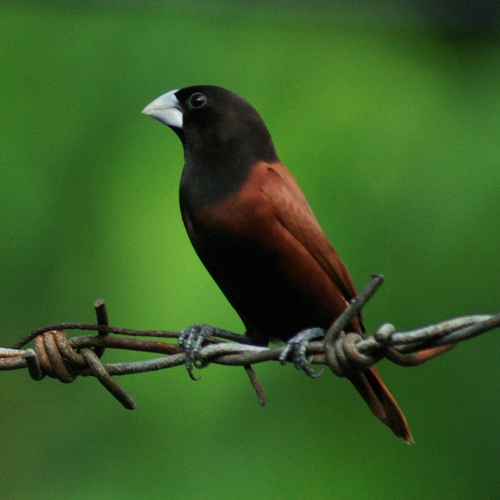 Chestnut MuniaLonchura atricapilla
Compare
Questions and answers
What is the scientific name of the Red Avadavat?
The scientific name of the Red Avadavat is Amandava amandava. Written with its author, the full name is Amandava amandava (Linnaeus, 1758).
Which family does the Red Avadavat belong to?
Amandava amandava belongs to the family Estrildidae, in the order Passeriformes and the class Aves.
Where is the Red Avadavat found?
Checklists and occurrence records place Amandava amandava in 44 countries, including India, Spain, Thailand, United States, Fiji and Nepal.
What is the conservation status of the Red Avadavat?
The IUCN Red List category recorded for Amandava amandava is Least Concern (LC).
What other names does the Red Avadavat have?
Amandava amandava is also known in English as Red Munia and Strawberry Finch.
What does "avadavat" mean?
The common name avadavat derives from Ahmedabad, Gujarat, India.[41]
Where was the red avadavat introduced?
Introduced populations have become established in the Philippines, Japan, Puerto Rico and Hawaii.[40]
How big is a red avadavat?
Adults measure approximately 10.16 centimetres in length.[6]
What do red avadavats eat?
Grass seeds constitute their main food source, and they also consume insects, including termites. When feeding their young, they prefer ant larvae and pupae, centipedes and caterpillars.[11][12][15]
What are some interesting facts about the strawberry finch?
Breeding males have predominantly red plumage with white spots, while non-breeding males retain their red rump. Red avadavats form social flocks containing up to 100 individuals during the non-breeding season. They are monogamous within a breeding season and construct globular nests from grass blades.[2][4][18][22][34]
Sources
Passages the profile rests on
- Red avadavats are popular cage birds because of the colourful breeding plumage of males. Source passage: “is popular as a cage bird due to the colourful plumage of the males in their breeding season.” — English Wikipedia
- Breeding males have predominantly red upperparts, with a black eye-stripe, lower belly and wings, and white spots on the body and wing feathers. Source passage: “the breeding male is red on most of the upper parts except for a black eye-stripe, lower belly and wings. There are white spots on the red body and wing feathers.” — English Wikipedia
- The species has a rounded black tail and a bill that changes color seasonally. Source passage: “This small finch is easily identified by the rounded black tail and the bill that is seasonally red.” — English Wikipedia
- Non-breeding males have duller plumage than breeding males but retain their red rump. Source passage: “The non-breeding male is duller but has the red-rump” — English Wikipedia
- Females have less white spotting on their feathers than breeding males. Source passage: “the female is duller with less of the white spotting on the feathers.” — English Wikipedia
- Adults measure approximately 10.16 centimetres in length. Source passage: “Red avadavats are about 10.16 centimeters in length (3 to 4 inches).” — animaldiversity.org
- The species inhabits open fields and grasslands in tropical Asia. Source passage: “It is found in the open fields and grasslands of tropical Asia” — English Wikipedia
- Red avadavats commonly occupy flat plains with tall grasses or crops, often near water. Source passage: “Red avadavats are found mainly on flat plains, in places with tall grasses or crops, often near water.” — English Wikipedia
- The species occurs in jungle clearings, gardens, meadows and sugarcane fields. Source passage: “Red avadavats are found in grassy areas, such as jungle clearings, gardens, and meadows. They also frequent sugarcane fields” — animaldiversity.org
- Red avadavats also inhabit areas near marshes and other bodies of water. Source passage: “areas near bodies of water, such as marshes.” — animaldiversity.org
- Grass seeds constitute the main food source of red avadavats. Source passage: “They feed mainly on grass seeds” — English Wikipedia
- Red avadavats also consume insects, including termites. Source passage: “but will also take insects such as termites when they are available.” — English Wikipedia
- Red avadavats are primarily ground feeders. Source passage: “They are known mainly as ground feeders.” — animaldiversity.org
- In captivity, red avadavats prefer seeds from sprouting millet. Source passage: “In captivity red avadavats prefer seeds from sprouting millet.” — animaldiversity.org
- When feeding their young, red avadavats prefer ant larvae and pupae, centipedes and caterpillars. Source passage: “When feeding young, they prefer ant larvae and pupae, centipedes and caterpillars.” — animaldiversity.org
- Red avadavats usually gather in small flocks. Source passage: “This finch is usually seen in small flocks” — English Wikipedia
- Flocks fly with rapid wingbeats and descend into grass clumps. Source passage: “flying with rapid wingbeats and descending into grass clumps where they are hard to observe.” — English Wikipedia
- During the non-breeding season, red avadavats form social flocks containing up to 100 individuals. Source passage: “When not in the breeding season, red avadavats stay in large social flocks of up to 100 birds.” — animaldiversity.org
- Red avadavats engage in social preening, which may help establish and maintain social bonds. Source passage: “During this time they engage in social preening (grooming) which may serve to create and maintain bonds.” — animaldiversity.org
- Breeding pairs remain together during the breeding season. Source passage: “Pairs stay together during the breeding season.” — English Wikipedia
- Male red avadavats use a mating dance and their bright red plumage to attract females. Source passage: “Male red avadavats use their bright red plumage in addition to a mating dance to attract females.” — animaldiversity.org
- Red avadavats are monogamous within a breeding season. Source passage: “Red avadavats are monogamous within a breeding season” — animaldiversity.org
- During courtship, males bow deeply while holding a grass stem or feather in their mouths and erecting their feathers. Source passage: “The dance begins with males, a grass stem or feather in their mouth, deeply bowing with feathers erect.” — animaldiversity.org
- Red avadavats are non-migratory. Source passage: “They are not a migratory bird.” — animaldiversity.org
- When alarmed, red avadavats move their tails from side to side at a downward angle. Source passage: “when they are alarmed, they move their tails from side to side and at a down angle.” — animaldiversity.org
- Red avadavats produce a distinctive low, single-note call that is often given during flight. Source passage: “These birds produce a distinctive low single note pseep call that is often given in flight.” — English Wikipedia
- Red avadavats use shrill calls when displaying aggression or perceiving danger. Source passage: “When red avadavats are displaying aggressive behaviors they will use a shrill call.” — animaldiversity.org
- Red avadavats breed during the monsoon season in the Indian subcontinent. Source passage: “It breeds in the Indian subcontinent in the monsoon season.” — English Wikipedia
- Breeding pairs typically lay between four and six eggs per clutch. Source passage: “Breeding pairs have between 4 to 6 eggs in a clutch.” — animaldiversity.org
- The eggs take approximately 11 days to hatch. Source passage: “The eggs take around 11 days to hatch;” — animaldiversity.org
- Both parents incubate the eggs during the day, while females generally incubate them at night. Source passage: “The eggs of Amandava amandava are incubated by both parents during the day. Females usually take over at night.” — animaldiversity.org
- Young red avadavats take approximately 20 days to fledge after hatching. Source passage: “hatchlings take around 20 days to fledge.” — animaldiversity.org
- Both parents feed the nestlings. Source passage: “Both parents feed nestlings.” — animaldiversity.org
- Red avadavats construct globular nests from grass blades. Source passage: “They build a globular nest made of grass blades.” — English Wikipedia
- The nest lining includes soft feathers, tree cotton and grass. Source passage: “The nest is lined with soft feathers, tree cotton (found inside seed pods of trees of genus Bombax ) and grass.” — animaldiversity.org
- The red avadavat is classified as Least Concern. Source passage: “the current conservation status of Red avadavat is Least Concern (LC)” — English Wikipedia
- Red avadavats have become increasingly uncommon in at least some parts of Southeast Asia. Source passage: “it has become increasingly uncommon in at least part of Southeast Asia.” — English Wikipedia
- The species occurs across southern and southeastern Asia, extending from India to the Malay Peninsula and surrounding islands. Source passage: “Red avadavats can be found throughout southern and southeastern Asia, from India to the Malay Peninsula and surrounding islands.” — animaldiversity.org
- The nominate subspecies A. a. amandava occurs in Pakistan, India, Nepal and Bangladesh. Source passage: “A. a. amandava (Linnaeus, 1758) – Pakistan, India, Nepal and Bangladesh” — English Wikipedia
- Introduced populations have become established in the Philippines, Japan, Puerto Rico and Hawaii. Source passage: “These birds have been successfully introduced to the Philippines, Japan, Puerto Rico, and Hawaii.” — animaldiversity.org
- The scientific species name and the common name avadavat derive from Ahmedabad, Gujarat, India. Source passage: “The species name of amandava and the common name of avadavat are derived from the city of Ahmedabad in Gujarat, India” — English Wikipedia
Data
- Catalogue of Life, 2026-10-16 XR cc by
- Global Biodiversity Information Facility CC BY 4.0
- Wikidata CC0
- GeoNames CC BY 4.0
- Wikimedia Commons per image; credit shown with each image
- Within the Catalogue of Life, this name comes from The Integrated Taxonomic Information System cc0
References
- Banks, R. C., R. W. McDiarmid, and A. L. Gardner. (1987). Checklist of Vertebrates of the United States, the U.S. Territories, and Canada. Resource Publication, No. 166.
- Banks, R. C., R. W. McDiarmid, A. L. Gardner, and W. C. Starnes. (2003). Checklist of Vertebrates of the United States, the U.S. Territories, and Canada.
- Gill, Frank, & and Minturn Wright. (2006). Birds of the World: Recommended English Names.
This species in other databases
Page built on 28 November 2026. See how the catalog is made and all sources and licences.
Cite this page
ScientificNames.org. (2026). Amandava amandava (Red Avadavat). Retrieved November 28, 2026, from https://scientificnames.org/species/amandava-amandava
“Amandava amandava (Red Avadavat).” ScientificNames.org, 2026, scientificnames.org/species/amandava-amandava. Accessed 28 Nov. 2026.
ScientificNames.org. “Amandava amandava (Red Avadavat).” Accessed November 28, 2026. https://scientificnames.org/species/amandava-amandava.
@misc{scientificnames_amandava_amandava_red_avadavat,
  author = {{ScientificNames.org}},
  title = {Amandava amandava (Red Avadavat)},
  year = {2026},
  url = {https://scientificnames.org/species/amandava-amandava},
  note = {Accessed 2026-11-28}
}