Species · Amphibians
Sardinian Brook Salamander Euproctus platycephalus
The scientific name of the Sardinian Brook Salamander is Euproctus platycephalus. It is a species of amphibian in the family Salamandridae (newts), order Caudata. The name dates from 1829.
- Scientific name
- Euproctus platycephalus (Gravenhorst, 1829)
- Common name
- Sardinian Brook Salamander
- Genus
- Euproctus
- Family
- Salamandridae (Newts)
- Order
- Caudata
- Class
- Amphibia
- Red List category
- EN Endangered
- Recorded in
- 2 countries
- Name status
- accepted in the Catalogue of Life

Overview
Euproctus platycephalus is endemic to the mountainous areas on the eastern side of Sardinia, Italy. It has a slender body, a flat head and a rounded snout, and males have a spur on each hind limb.
Written 26 November 2026 from the sources listed below. Each statement was checked against the passage it cites; statements that could not be supported were removed.
Appearance
The species has a slender body, a flat head and a rounded snout. Its lower jaw is shorter than its upper jaw, and its skin is smooth except for a few irregularly distributed tubercles.[1][2][3]
Its coloration ranges from olive and grey to reddish-brown, often with red, brown or black spots and longitudinal streaks. A thin yellow or brown stripe often runs along its spine.[4][5]
Its underside is paler and often has a red or yellow central region with black spots. Males have a spur on each hind limb.[6][7]
The species can reach approximately 15 cm in length. Females are slightly larger than males.[8][9]
Habitat
The species inhabits slow-moving streams and rivers, small lakes and ponds. It occurs at elevations between 50 and 1,800 metres above sea level.[10][11]
It inhabits streams, springs and pools in Sardinia's main mountain systems. In aquatic habitats, it hides beneath stones.[12][13]
On land, it is generally found in undergrowth or beneath stones and remains close to water.[14]
Behaviour
The species is predominantly aquatic but also hibernates and sometimes aestivates on land near the water's edge.[15]
Reproduction and life cycle
Mating takes place in water. Before mating, the male carries the passive female in his jaws to a suitable location.[16][17]
During mating, the male clasps the female with his jaws and wraps his tail around hers. He transfers spermatophores from his cloaca to the female's cloaca, sometimes using his spurs.[18][19]
Females lay up to 220 eggs individually over a period of several weeks. Eggs are deposited in crevices, beneath stones and possibly buried in sand.[20][21]
When depositing eggs, females form their mobile cloaca into a tube and turn onto their backs.[22]
Larvae take between six and 15 months to undergo metamorphosis, depending on water temperature. Sexually mature individuals with remnants of gills were reported in 1999, suggesting possible paedomorphosis.[23][24]
Conservation
The species is classified as vulnerable by the IUCN Red List. Its occupied area totals less than 500 square kilometres and is fragmented into separate populations.[25][26]
A survey conducted between 1999 and 2001 identified 14 localities with apparently stable populations, some of which were abundant. The survey recorded the species at 30 sites after 1991.[27][28]
Eleven historical sites were identified where the species was no longer present. The species appears to have disappeared from some locations where it was previously recorded.[29][30]
Habitat loss, watercourse pollution, dry conditions resulting from excessive water extraction and tourism-related disturbance threaten the species. Its numbers appear to be declining.[31][32]
Most specimens recorded were male.[33]
Classification of the Sardinian Brook Salamander
| Kingdom | Animalia |
|---|---|
| Phylum | Chordata |
| Subphylum | Vertebrata |
| Infraphylum | Gnathostomata |
| Parvphylum | Osteichthyes |
| Megaclass | Tetrapoda |
| Class | Amphibia (Amphibians) |
| Order | Caudata (Salamanders) |
| Family | Salamandridae (Newts) |
| Subfamily | Pleurodelinae |
| Genus | Euproctus (European Mountain Salamanders) |
| Species | Euproctus platycephalus (Gravenhorst, 1829) |
Where the Sardinian Brook Salamander is found
Checklists and occurrence records place Euproctus platycephalus in 2 countries. GBIF holds 215 georeferenced records of it.
Countries
Regions and cities with the most records
A number beside a place is its count of GBIF occurrence records. A place without a number comes from a checklist alone. Records show where a species has been observed or collected, which can include escapes and vagrants.
Common names
English
- Sardinian Brook Salamander
- Sardinian Mountain Newt
- Sardinian Brook Newt
- Sardinsk Bjergsalamander
Names in 12 other languages
- Arabic
- نيوط الجبلي السرديني
- Chinese
- 撒丁山螈
- Czech
- čolek sardinský
- Dutch
- Sardijnse Beeksalamander
- Finnish
- sardinianpuromanteri
- French
- Euprocte de Sardaigne
- German
- Hechtkopf-Gebirgsmolch, Sardischer Gebirgsmolch
- Italian
- Euprotto sardo, Tritone Sardo
- Korean
- 세르데냐개울영원
- Polish
- Traszka sardyńska
- Russian
- Сардинский горный тритон, Сардинский тритон, Щукоголовый тритон
- Spanish
- Tritón sardo
Synonyms
11 other scientific names have been used for this species and are now treated as synonyms of Euproctus platycephalus.
- Bulga rusconii (Gené, 1839)
- Diemictylus rusconii (Gené, 1839)
- Euproctus rusconii Gené, 1839
- Molge platycephala Gravenhorst, 1829
- Molge rusconii (Gené, 1839)
- Pelonectes platycephalus (Gravenhorst, 1829)
- Phatnomatorhina platycephalus (Gravenhorst, 1829)
- Triton platycephalus (Gravenhorst, 1829)
- Triton rusconii (Gené, 1839)
- Triturus platicephalus (Gravenhorst, 1829)
- Triturus rusconii (Gené, 1839)
Related species
-
 Corsican Brook SalamanderEuproctus montanus
-
 Fire SalamanderSalamandra salamandra
-
 Eastern NewtNotophthalmus viridescens
-
 Rough-skinned NewtTaricha granulosa
-
 Northern Crested NewtTriturus cristatus
-
 Smooth NewtLissotriton vulgaris
-
 Iberian Ribbed NewtPleurodeles waltl
-
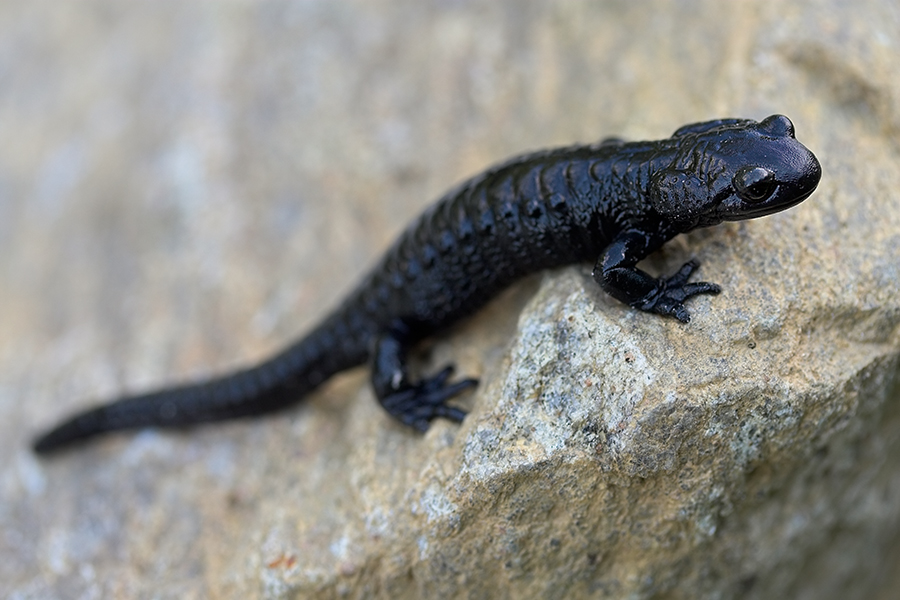 Alpine SalamanderSalamandra atra
Compare
Questions and answers
What is the scientific name of the Sardinian Brook Salamander?
The scientific name of the Sardinian Brook Salamander is Euproctus platycephalus. Written with its author, the full name is Euproctus platycephalus (Gravenhorst, 1829).
Which family does the Sardinian Brook Salamander belong to?
Euproctus platycephalus belongs to the family Salamandridae, in the order Caudata and the class Amphibia.
Where is the Sardinian Brook Salamander found?
Checklists and occurrence records place Euproctus platycephalus in 2 countries: Italy and France.
What is the conservation status of the Sardinian Brook Salamander?
The IUCN Red List category recorded for Euproctus platycephalus is Endangered (EN).
What other names does the Sardinian Brook Salamander have?
Euproctus platycephalus is also known in English as Sardinian Mountain Newt, Sardinian Brook Newt and Sardinsk Bjergsalamander.
Sources
Passages the profile rests on
- The species has a slender body, a flat head and a rounded snout. Source passage: “This is a slender salamander with a flat head and a rounded snout.” — amphibiaweb.org
- Its skin is smooth except for a few irregularly distributed tubercles. Source passage: “The skin is smooth apart from a few irregularly placed tubercles.” — English Wikipedia
- Its lower jaw is shorter than its upper jaw. Source passage: “The lower jaw is shorter than the upper jaw.” — English Wikipedia
- Its coloration ranges from olive and grey to reddish-brown, often with red, brown or black spots and longitudinal streaks. Source passage: “The colour is olive, grey, or reddish-brown, often with red, brown, or black spots and longitudinal streaks” — English Wikipedia
- A thin yellow or brown stripe often runs along its spine. Source passage: “often a thin yellow or brown stripe occurs along the spine.” — English Wikipedia
- Its underside is paler and often has a red or yellow central region with black spots. Source passage: “The underside is paler, often having a red or yellow central region and black spots.” — English Wikipedia
- Males have a spur on each hind limb. Source passage: “The male has a spur on each hind limb.” — English Wikipedia
- The species can reach approximately 15 cm in length. Source passage: “The Sardinian brook salamander can grow to about 15 cm (6 in) in length” — English Wikipedia
- Females are slightly larger than males. Source passage: “with females being a bit larger than males.” — English Wikipedia
- The species inhabits slow-moving streams and rivers, small lakes and ponds. Source passage: “It is found in slow-moving streams and rivers, small lakes, and ponds” — English Wikipedia
- It occurs at elevations between 50 and 1,800 metres above sea level. Source passage: “It is found at altitudes between 50 and 1,800 metres (160 and 5,910 ft)” — English Wikipedia
- The species hides beneath stones in aquatic habitats. Source passage: “where it hides under stones.” — English Wikipedia
- The species inhabits streams, springs and pools in Sardinia's main mountain systems. Source passage: “found in streams, springs and pools in the main mountain systems of Sardinia” — centaur.reading.ac.uk
- On land, it is generally found in undergrowth or beneath stones and remains close to water. Source passage: “When on land, it is usually found in undergrowth or under stones, and usually stays close to water.” — English Wikipedia
- The species is predominantly aquatic but also hibernates and sometimes aestivates on land near the water's edge. Source passage: “The Sardinian brook salamander is largely aquatic, though it does hibernate and sometimes aestivate on land near the water's edge.” — English Wikipedia
- Mating takes place in water. Source passage: “Mating takes place in the water” — English Wikipedia
- Before mating, the male carries the passive female in his jaws to a suitable location. Source passage: “the male having first carried the passive female in his jaws to a suitable location.” — English Wikipedia
- During mating, the male clasps the female with his jaws and wraps his tail around hers. Source passage: “He clasps her body with his jaws and bends his body around, wrapping his tail around hers.” — English Wikipedia
- The male transfers spermatophores from his cloaca to the female's cloaca, sometimes using his spurs. Source passage: “He transfers spermatophores to her cloaca from his cloaca, sometimes with the aid of his spurs.” — English Wikipedia
- Females lay up to 220 eggs individually over a period of several weeks. Source passage: “The female lays up to 220 eggs singly over a period of weeks” — English Wikipedia
- Eggs are deposited in crevices, beneath stones and possibly buried in sand. Source passage: “in crevices and under stones and possibly buried in sand.” — English Wikipedia
- Females form their mobile cloaca into a tube and turn onto their backs when depositing eggs. Source passage: “She forms her mobile cloaca into a tube and turns on her back to deposit them in suitable locations.” — English Wikipedia
- Larvae take between six and 15 months to undergo metamorphosis, depending on water temperature. Source passage: “The larvae take six to 15 months before metamorphosis depending on the water temperature.” — English Wikipedia
- Sexually mature individuals with remnants of gills were reported in 1999, suggesting possible paedomorphosis. Source passage: “In 1999, sexually mature adults were reported to have been found with the vestiges of gills, suggesting the species may exhibit paedomorphosis.” — English Wikipedia
- The species is classified as vulnerable by the IUCN Red List. Source passage: “The Sardinian brook salamander is classified by the IUCN Red List of Threatened Species as vulnerable” — English Wikipedia
- Its occupied area totals less than 500 square kilometres and is fragmented into separate populations. Source passage: “the area it occupies is less than 500 km2 (190 sq mi) in total and fragmented into a number of separate populations.” — English Wikipedia
- A survey conducted between 1999 and 2001 identified 14 localities with apparently stable populations, some of which were abundant. Source passage: “A total of 14 localities where Sardinian salamanders are represented by apparently stable and in some cases abundant populations have been identified” — centaur.reading.ac.uk
- The survey recorded the species at 30 sites after 1991. Source passage: “as well as 30 sites where species presence has been recorded after 1991.” — centaur.reading.ac.uk
- Eleven historical sites were identified where the species was no longer present. Source passage: “Some 11 historical sites were identified which are no longer inhabited by the species.” — centaur.reading.ac.uk
- The species appears to have disappeared from some locations where it was previously recorded. Source passage: “the species seems to be no longer present in some locations where it was previously found.” — English Wikipedia
- Habitat loss, watercourse pollution, dry conditions resulting from excessive water extraction and tourism-related disturbance threaten the species. Source passage: “It is threatened by loss of habitat, pollution of watercourses, dry conditions caused by the excessive extraction of water, and disturbance due to tourism.” — English Wikipedia
- The species' numbers appear to be declining. Source passage: “Its numbers appear to be dwindling.” — English Wikipedia
- Most specimens recorded were male. Source passage: “Most of the specimens found were male” — English Wikipedia
Data
- Catalogue of Life, 2026-10-16 XR cc by
- Global Biodiversity Information Facility CC BY 4.0
- Wikidata CC0
- GeoNames CC BY 4.0
- Wikimedia Commons per image; credit shown with each image
- Within the Catalogue of Life, this name comes from The Integrated Taxonomic Information System cc0
This species in other databases
Page built on 29 November 2026. See how the catalog is made and all sources and licences.
Cite this page
ScientificNames.org. (2026). Euproctus platycephalus (Sardinian Brook Salamander). Retrieved November 29, 2026, from https://scientificnames.org/species/euproctus-platycephalus
“Euproctus platycephalus (Sardinian Brook Salamander).” ScientificNames.org, 2026, scientificnames.org/species/euproctus-platycephalus. Accessed 29 Nov. 2026.
ScientificNames.org. “Euproctus platycephalus (Sardinian Brook Salamander).” Accessed November 29, 2026. https://scientificnames.org/species/euproctus-platycephalus.
@misc{scientificnames_euproctus_platycephalus_sardinian_brook_salamander,
  author = {{ScientificNames.org}},
  title = {Euproctus platycephalus (Sardinian Brook Salamander)},
  year = {2026},
  url = {https://scientificnames.org/species/euproctus-platycephalus},
  note = {Accessed 2026-11-29}
}