Species · Birds
Brown-throated Parakeet Eupsittula pertinax
The scientific name of the Brown-throated Parakeet is Eupsittula pertinax. It is a species of bird in the family Psittacidae (macaws), order Psittaciformes. The name dates from 1758.
- Scientific name
- Eupsittula pertinax (Linnaeus, 1758)
- Common name
- Brown-throated Parakeet
- Genus
- Eupsittula
- Family
- Psittacidae (Macaws)
- Order
- Psittaciformes
- Class
- Aves
- Red List category
- LC Least Concern
- Recorded in
- 17 countries
- Name status
- accepted in the Catalogue of Life

Overview
The species occurs in Costa Rica, Panama, northern mainland South America, and islands off the South American coast. Adults of the nominate subspecies have yellow foreheads, faces, and chins, green upperparts, dull olive breasts, and grass-green bellies with central orange patches.
Written 26 November 2026 from the sources listed below. Each statement was checked against the passage it cites; statements that could not be supported were removed.
Appearance
Adult nominate Brown-throated Parakeets have yellow foreheads, faces, and chins, green crowns, napes, and upperparts, dull olive breasts, and grass-green bellies with central orange patches. Their wings are predominantly green, with dullish blue edges and tips on the flight feathers.[1][2]
The tail feathers are green with dullish blue edges and tips. Immature birds have very little yellow coloration.[3][4]
Brown-throated Parakeets measure 23–28 cm in length and weigh 76–102 g.[5][6]
Habitat
Brown-throated Parakeets inhabit savannas, arid scrublands, mangroves, tropical deciduous forests, gallery forests, and evergreen forests. They also occupy cultivated areas and pastures containing some remaining trees.[7][8]
In Colombia, the species has been recorded at elevations reaching 2,600 m. Outside Colombia, it occurs mostly below 1,200 m elevation.[9][10]
In Venezuela, the species prefers open vegetation, particularly the Llanos savannas and northwestern arid scrublands.[11]
Diet
Brown-throated Parakeets consume seeds, fruits, nuts, flowers, and leaves, as well as occasional insects. They have also been observed feeding on cactus.[12][13]
In a Venezuelan study area, human-planted food sources accounted for as much as 70% of the species' diet.[14]
The species damages maize and other field crops in Colombia and Venezuela, as well as fruit plantations in the Leeward Antilles.[15]
Behaviour
Some mainland populations undertake seasonal movements, while others move nomadically in response to food availability. Brown-throated Parakeets generally forage in pairs or small flocks.[16][17]
Brown-throated Parakeets are highly vocal birds. Flying flocks vocalize, and other flocks may join when responding to their calls.[18][19]
Reproduction and life cycle
The breeding season varies geographically. Nesting is possible throughout the year in Suriname and the Antilles and typically occurs from February through April in Colombia and Venezuela.[20]
Brown-throated Parakeets commonly excavate nesting cavities in arboreal termite nests, particularly those belonging to the genus Nasutitermes. They also nest in natural cavities in trees, cliff faces, and earthen banks.[21][22]
Multiple pairs sometimes nest in the same decaying tree. Clutches contain between two and seven eggs.[23][24]
The incubation period in captivity is 23 days. Wild young fledge approximately 36–37 days after hatching.[25][26]
Conservation
The IUCN classifies the Brown-throated Parakeet as Least Concern. Its estimated population is at least five million mature individuals, and its population is considered stable.[27][28]
No immediate threats to the species have been identified. The subspecies E. p. tortugensis appears to be declining.[29][30]
Nest poaching affects island populations. Young and adult Brown-throated Parakeets are locally traded as cage birds in Venezuela.[31][32]
Classification of the Brown-throated Parakeet
| Kingdom | Animalia |
|---|---|
| Phylum | Chordata |
| Subphylum | Vertebrata |
| Infraphylum | Gnathostomata |
| Parvphylum | Osteichthyes |
| Megaclass | Tetrapoda |
| Class | Aves (Bird) |
| Order | Psittaciformes (Parrot) |
| Family | Psittacidae (Macaws) |
| Genus | Eupsittula (Eupsittula Parakeets) |
| Species | Eupsittula pertinax (Linnaeus, 1758) |
Where the Brown-throated Parakeet is found
Checklists and occurrence records place Eupsittula pertinax in 17 countries across North America and South America. GBIF holds 139,703 georeferenced records of it.
Countries
- Aruba 2,972
- Bonaire, Saint Eustatius and Saba 9,267
- Brazil 1,213
- British Virgin Islands 37
- Colombia 56,766
- Costa Rica 1,966
- Curacao 11,323
- French Guiana 1,760
- Guadeloupe 3
- Guyana 3,030
- Panama 10,923
- Puerto Rico 35
- Suriname 1,155
- Trinidad and Tobago 58
- U.S. Virgin Islands 568
- United States 9
- Venezuela 38,618
Regions and cities with the most records
- Los Dos Caminos, Venezuela 14,678
- Chacao, Venezuela 14,636
- Caracas, Venezuela 14,621
- Petare, Venezuela 14,620
- Baruta, Venezuela 14,599
- El Hatillo, Venezuela 14,559
- Caucagüito, Venezuela 14,280
- San Antonio de Los Altos, Venezuela 13,690
- Caraballeda, Venezuela 12,046
- La Guaira, Venezuela 11,895
- Meta Department, Colombia 11,642
- Maiquetía, Venezuela 11,529
- Miranda, Venezuela 10,391
- Bonaire, Bonaire, Saint Eustatius and Saba 8,510
- Kralendijk, Bonaire, Saint Eustatius and Saba 8,024
- Willemstad, Curacao 7,956
- Bandariba, Curacao 7,711
- Bolívar, Colombia 6,488
- Carrizal, Venezuela 6,381
- Cartagena, Colombia 5,803
- Falcón, Venezuela 5,672
- Chiriquí Province, Panama 5,515
- Turbaco, Colombia 5,375
- La Guajira Department, Colombia 5,158
- Santa Rosa, Colombia 4,837
- Magdalena Department, Colombia 4,323
- La Vela de Coro, Venezuela 4,124
- Barranquilla, Colombia 4,085
- Soledad, Colombia 4,011
- Zulia, Venezuela 3,978
- Casanare Department, Colombia 3,839
- Galapa, Colombia 3,482
- Atlántico, Colombia 3,388
- Coro, Venezuela 3,374
- Villavicencio, Colombia 3,169
- Malambo, Colombia 3,158
1 more country has a few records outside this range
These countries hold a few records of Eupsittula pertinax but lie outside the range the checklists give for it. Such records are often zoo or garden specimens, museum material or vagrants, so the species is not counted as occurring there.
Range as the checklists state it
Middle America
South America
Caribbean
A number beside a place is its count of GBIF occurrence records. A place without a number comes from a checklist alone. Records show where a species has been observed or collected, which can include escapes and vagrants.
Common names
English
- Brown-throated Parakeet
- Caribbean Parakeet
- Caribbean Parroquet
Names in 28 other languages
- Arabic
- ببغاء بني الحنجرة
- Catalan
- Aratinga pertinax, aratinga de coroneta blava
- Chinese
- 褐喉鸚哥, 褐喉鹦哥
- Croatian
- smeđogrla jandaja
- Czech
- aratinga hnědohrdlý
- Danish
- Brunstrubet Aratinga
- Dutch
- Maïsparkiet, West-Indische parkiet
- Esperanto
- brungorĝa papago
- Estonian
- ljaano-aratinga
- Finnish
- savanniaratti
- French
- Conure cuivrée
- German
- Braunwangensittich, St.-Thomas-Sittich
- Hungarian
- barnaarcú aratinga, barnatorkú aratinga
- Italian
- Parrocchetto golabruna
- Japanese
- チャノドインコ
- Lithuanian
- rudagurklė aratinga
- Norwegian
- brunstrupeparakitt
- Papiamento
- Prikichi
- Polish
- konura brązowogardła
- Portuguese
- periquito-de-bochecha-parda, periquito-de-garganta-castanha
- Russian
- Бурощёкая аратинга, Коричневощёкая аратинга
- Serbian
- Pertinaks aratinga
- Slovak
- klinochvost plavolíci
- Spanish
- Aratinga pertinaz, Perico Cara Sucia, Perico Gorgicafé, Perico carisucio, Periquito cara sucia, Periquito de Curazao
- Swedish
- brunstrupig parakit
- Turkish
- Kahverengi Gerdanlı Papağan
- Ukrainian
- аратинга рудоволий
- Welsh
- conwra gyddf-frown
Synonyms
2 other scientific names have been used for this species and are now treated as synonyms of Eupsittula pertinax.
- Aratinga pertinax (Linnaeus, 1758)
- Psittacus pertinax Linnaeus, 1758
Subspecies and varieties
- Eupsittula pertinax aeruginosa subspecies
- Eupsittula pertinax arubensis subspecies
- Eupsittula pertinax chrysogenys (Brazilian Brown-throated Parakeet) subspecies
- Eupsittula pertinax chrysophrys (Orange-cheeked Parakeet) subspecies
- Eupsittula pertinax griseipecta (Sinú Brown-throated Parakeet) subspecies
- Eupsittula pertinax lehmanni (Colombian Brown-throated Parakeet) subspecies
- Eupsittula pertinax margaritensis (Margarita Parakeet) subspecies
- Eupsittula pertinax ocularis (Brown-eared Parakeet) subspecies
- Eupsittula pertinax paraensis (Tapajos Brown-throated Parakeet) subspecies
- Eupsittula pertinax pertinax (Curaçao Brown-throated Parakeet) subspecies
- Eupsittula pertinax surinama (Surinam Brown-throated Parakeet) subspecies
- Eupsittula pertinax tortugensis (Tortuga Brown-throated Parakeet) subspecies
- Eupsittula pertinax venezuelae (Venezuelan Brown-throated Parakeet) subspecies
- Eupsittula pertinax xanthogenia (Bonaire Brown-throated Parakeet) subspecies
Related species
-
 Orange-fronted ParakeetEupsittula canicularis
-
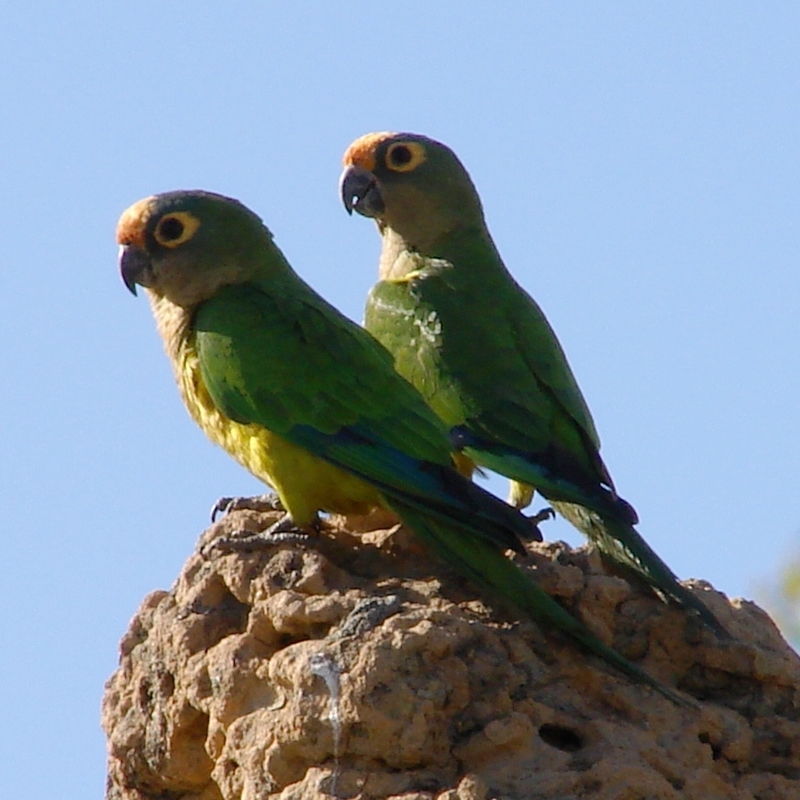 Peach-fronted ParakeetEupsittula aurea
-
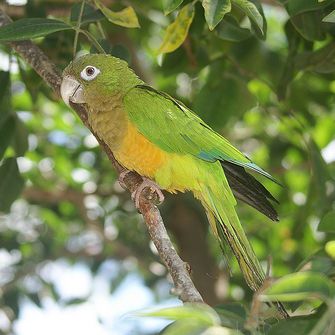 Caatinga ParakeetEupsittula cactorum
-
 Jamaican ParakeetEupsittula nana
-
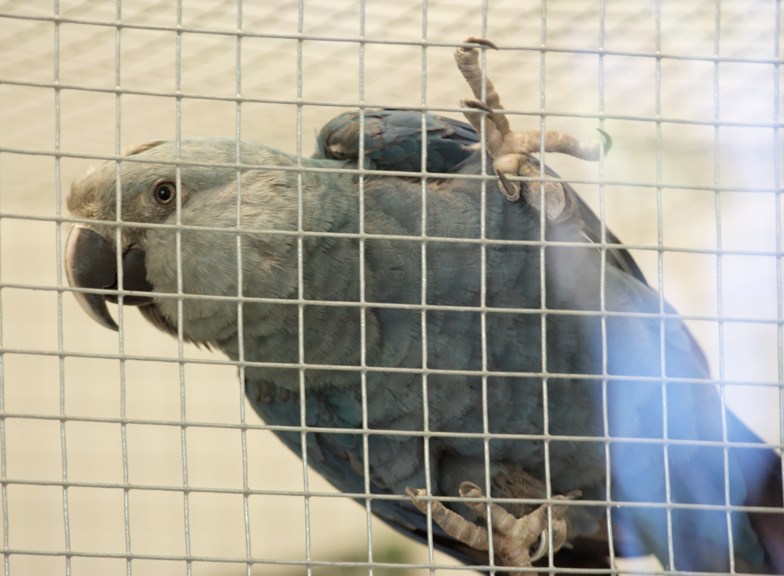 Spix's MacawCyanopsitta spixii
-
 Grey ParrotPsittacus erithacus
-
 Scarlet MacawAra macao
-
 Hyacinth MacawAnodorhynchus hyacinthinus
Compare
Questions and answers
What is the scientific name of the Brown-throated Parakeet?
The scientific name of the Brown-throated Parakeet is Eupsittula pertinax. Written with its author, the full name is Eupsittula pertinax (Linnaeus, 1758).
Which family does the Brown-throated Parakeet belong to?
Eupsittula pertinax belongs to the family Psittacidae, in the order Psittaciformes and the class Aves.
Where is the Brown-throated Parakeet found?
Checklists and occurrence records place Eupsittula pertinax in 17 countries, including Colombia, Venezuela, Curacao, Panama, Bonaire, Saint Eustatius and Saba and Guyana.
What is the conservation status of the Brown-throated Parakeet?
The IUCN Red List category recorded for Eupsittula pertinax is Least Concern (LC).
What other names does the Brown-throated Parakeet have?
Eupsittula pertinax is also known in English as Caribbean Parakeet and Caribbean Parroquet.
What is the name of a brown bird?
Brown-throated Parakeet is the recorded English name of Eupsittula pertinax.[33]
What are the different types of parakeets?
Fourteen subspecies of the Brown-throated Parakeet are recognized.[34]
What is the best diet for a parakeet?
Brown-throated Parakeets consume seeds, fruits, nuts, flowers, and leaves, as well as occasional insects.[12]
Sources
Passages the profile rests on
- Adult nominate brown-throated parakeets have yellow foreheads, faces, and chins, green crowns, napes, and upperparts, dull olive breasts, and grass-green bellies with central orange patches. Source passage: “Adults of the nominate subspecies E. p. pertinax have a yellow forehead, face, and chin. Their crown, nape, and upperparts are green. Their breast is dull olive and their belly grass green with an orange patch in its center.” — English Wikipedia
- The wings of the nominate subspecies are predominantly green, with dullish blue edges and tips on the flight feathers. Source passage: “Their wings are mostly green with dullish blue edges and tips on the flight feathers” — English Wikipedia
- The nominate subspecies has green tail feathers with dullish blue edges and tips. Source passage: “their tail feathers are also green with dullish blue edges and tips.” — English Wikipedia
- Immature brown-throated parakeets have very little yellow coloration. Source passage: “Immature birds have very little yellow.” — English Wikipedia
- Brown-throated parakeets measure 23–28 cm in length. Source passage: “The brown-throated parakeet is 23 to 28 cm (9.1 to 11 in) long” — English Wikipedia
- Brown-throated parakeets weigh 76–102 g. Source passage: “weighs 76 to 102 g (2.7 to 3.6 oz).” — English Wikipedia
- Brown-throated parakeets inhabit savannas, arid scrublands, mangroves, tropical deciduous forests, gallery forests, and evergreen forests. Source passage: “including savannas, arid scrublands, mangroves, tropical deciduous forests, gallery forests, evergreen forests” — English Wikipedia
- The species also occupies cultivated areas and pastures containing some remaining trees. Source passage: “cultivated areas and pastures with some remaining trees.” — English Wikipedia
- In Colombia, the species has been recorded at elevations reaching 2,600 m. Source passage: “In Colombia, it reaches an elevation of 2,600 m (8,500 ft)” — English Wikipedia
- Outside Colombia, brown-throated parakeets are found mostly below 1,200 m elevation. Source passage: “but is found mostly below 1,200 m (3,900 ft) elsewhere.” — English Wikipedia
- In Venezuela, the species shows a preference for open vegetation, particularly the Llanos savannas and northwestern arid scrublands. Source passage: “shows preference for areas with open vegetation with higher probabilities of occurrence in the savannas of the Llanos bioregion and the arid scrublands of northwestern Venezuela.” — English Wikipedia
- Brown-throated parakeets consume seeds, fruits, nuts, flowers, and leaves, as well as occasional insects. Source passage: “The brown-throated parakeet's diet includes seeds, fruits, nuts, flowers, leaves, and sometimes insects.” — English Wikipedia
- Brown-throated parakeets have been observed feeding on cactus. Source passage: “It has been observed feeding on cactus.” — English Wikipedia
- In a Venezuelan study area, human-planted food sources accounted for as much as 70% of the species' diet. Source passage: “A study in Venezuela found that up to 70% of its food in the study area came from human-planted, rather than wild, sources.” — English Wikipedia
- The species damages maize and other field crops in Colombia and Venezuela, as well as fruit plantations in the Leeward Antilles. Source passage: “The species is a significant crop pest, especially on maize and other field crops in Colombia and Venezuela, and in fruit plantations in the Leeward Antilles.” — English Wikipedia
- Some mainland populations undertake seasonal movements, while others move nomadically in response to food availability. Source passage: “Some populations on the mainland make seasonal movements and others are somewhat nomadic to follow the availability of food.” — English Wikipedia
- Brown-throated parakeets generally forage in pairs or small flocks. Source passage: “The species typically forages in pairs or small flocks.” — English Wikipedia
- Flying flocks vocalize, and other flocks may join when responding to their calls. Source passage: “Flocks will call in flight, and if an actively foraging flock responds, the others may join it.” — English Wikipedia
- Brown-throated parakeets are highly vocal birds. Source passage: “The brown-throated parakeet is very vocal.” — English Wikipedia
- The breeding season varies geographically, with nesting possible throughout the year in Suriname and the Antilles and typically occurring from February through April in Colombia and Venezuela. Source passage: “It may nest at almost any time of year in Suriname and the Antilles, and from February to April in Colombia and Venezuela.” — English Wikipedia
- Brown-throated parakeets commonly excavate nesting cavities in arboreal termite nests, particularly those belonging to the genus Nasutitermes. Source passage: “It usually excavates a cavity in a nest of an arboreal termite, often one from the genus Nasutitermes.” — English Wikipedia
- The species also nests in natural cavities in trees, cliff faces, and earthen banks. Source passage: “it also nests in natural cavities in a tree, on a cliff face, or in an earthen bank.” — English Wikipedia
- Multiple pairs sometimes nest in the same decaying tree. Source passage: “Often several pairs will nest in a single rotten tree.” — English Wikipedia
- Clutches contain between two and seven eggs. Source passage: “The clutch size is two to seven eggs.” — English Wikipedia
- The incubation period in captivity is 23 days. Source passage: “In captivity, the incubation period is 23 days.” — English Wikipedia
- Wild young brown-throated parakeets fledge approximately 36–37 days after hatching. Source passage: “In the wild, the time to fledge is 36 to 37 days.” — English Wikipedia
- The IUCN classifies the brown-throated parakeet as Least Concern. Source passage: “The IUCN has assessed the brown-throated parakeet as being of Least Concern.” — English Wikipedia
- The species has an estimated population of at least five million mature individuals, and its population is considered stable. Source passage: “its estimated population of at least five million mature individuals is believed to be stable.” — English Wikipedia
- No immediate threats to the species have been identified. Source passage: “No immediate threats have been identified.” — English Wikipedia
- The subspecies E. p. tortugensis appears to be declining. Source passage: “Subspecies E. p. tortugensis, however, appears to be in decline” — English Wikipedia
- Nest poaching affects island populations of brown-throated parakeets. Source passage: “Nest poaching is a concern in island populations” — English Wikipedia
- Young and adult brown-throated parakeets are locally traded as cage birds in Venezuela. Source passage: “in Venezuela both young and adult individuals are locally traded as cage birds for the pet market.” — English Wikipedia
- Carl Linnaeus formally described the brown-throated parakeet in 1758 under the name Psittacus pertinax. Source passage: “He placed it with all the other parrots in the genus Psittacus and coined the binomial name Psittacus pertinax.” — English Wikipedia
- Fourteen subspecies of the brown-throated parakeet are recognized. Source passage: “These 14 subspecies are recognized; some of them are island endemics:” — English Wikipedia
Data
- Catalogue of Life, 2026-10-16 XR cc by
- Global Biodiversity Information Facility CC BY 4.0
- Wikidata CC0
- GeoNames CC BY 4.0
- Wikimedia Commons per image; credit shown with each image
- Within the Catalogue of Life, this name comes from The Integrated Taxonomic Information System cc0
References
- Dickinson, E. C., and L. Christidis, eds. (2014). The Howard and Moore Complete Checklist of the Birds of the World, 4th Edition, Vol. 2 Passerines.
This species in other databases
Page built on 26 November 2026. See how the catalog is made and all sources and licences.
Cite this page
ScientificNames.org. (2026). Eupsittula pertinax (Brown-throated Parakeet). Retrieved November 26, 2026, from https://scientificnames.org/species/eupsittula-pertinax
“Eupsittula pertinax (Brown-throated Parakeet).” ScientificNames.org, 2026, scientificnames.org/species/eupsittula-pertinax. Accessed 26 Nov. 2026.
ScientificNames.org. “Eupsittula pertinax (Brown-throated Parakeet).” Accessed November 26, 2026. https://scientificnames.org/species/eupsittula-pertinax.
@misc{scientificnames_eupsittula_pertinax_brown_throated_parakeet,
  author = {{ScientificNames.org}},
  title = {Eupsittula pertinax (Brown-throated Parakeet)},
  year = {2026},
  url = {https://scientificnames.org/species/eupsittula-pertinax},
  note = {Accessed 2026-11-26}
}