Species · Amphibians
Texas Salamander Eurycea neotenes
The scientific name of the Texas Salamander is Eurycea neotenes. It is a species of amphibian in the family Plethodontidae (lungless salamanders), order Caudata. The name dates from 1937.
- Scientific name
- Eurycea neotenes Bishop & Wright, 1937
- Common name
- Texas Salamander
- Genus
- Eurycea
- Family
- Plethodontidae (Lungless Salamanders)
- Order
- Caudata
- Class
- Amphibia
- Red List category
- EN Endangered
- Recorded in
- 1 country
- Name status
- accepted in the Catalogue of Life
Overview
Eurycea neotenes inhabits caves and is endemic to central Texas, near Helotes in Bexar County. It has bright-red external gills, reduced vision, and a slender body with short limbs.
Written 26 November 2026 from the sources listed below. Each statement was checked against the passage it cites; statements that could not be supported were removed.
Appearance
The Texas Salamander has a brown body that often displays yellow or brown mottling and light-yellow spots along its back. It has a slender body, short limbs, and bright-red external gills.[1][2]
Its vision is reduced as a result of prolonged exposure to darkness in caves. It measures approximately 5.1–10.2 cm in length.[3][4]
Habitat
The Texas Salamander inhabits caves. The species was originally described from a spring at Helotes in Bexar County, Texas.[5][6]
Diet
The Texas Salamander feeds on amphipods, blind shrimp, daphnia, small snails, and other invertebrates.[7]
Behaviour
The Texas Salamander detects prey by moving its head from side to side to generate water pressure waves and sensing disturbances in still water. It is entirely aquatic and lacks lungs.[8][9]
Similar species
The Texas Salamander is described as similar to the Texas blind salamander (Eurycea rathbuni).[10]
Classification of the Texas Salamander
| Kingdom | Animalia |
|---|---|
| Phylum | Chordata |
| Subphylum | Vertebrata |
| Infraphylum | Gnathostomata |
| Parvphylum | Osteichthyes |
| Megaclass | Tetrapoda |
| Class | Amphibia (Amphibians) |
| Order | Caudata (Salamanders) |
| Family | Plethodontidae (Lungless Salamanders) |
| Subfamily | Hemidactyliinae |
| Genus | Eurycea (Brook Salamander) |
| Species | Eurycea neotenes Bishop & Wright, 1937 |
Where the Texas Salamander is found
Checklists and occurrence records place Eurycea neotenes in 1 country across North America. GBIF holds 4,010 georeferenced records of it.
Countries
Regions and cities with the most records
- Texas, United States 3,146
- Kerrville, United States 647
- San Marcos, United States 181
- Canyon Lake, United States 110
- Live Oak, United States 103
- Schertz, United States 103
- Universal City, United States 103
- Cibolo, United States 101
- Converse, United States 101
- Kyle, United States 89
- Austin, United States 15
- Ciudad Acuña, Mexico 10
- Del Rio, United States 10
- Brushy Creek, United States 9
- Cedar Park, United States 9
- Leander, United States 9
- Round Rock, United States 9
- New Braunfels, United States 5
Range as the checklists state it
North America
A number beside a place is its count of GBIF occurrence records. A place without a number comes from a checklist alone. Records show where a species has been observed or collected, which can include escapes and vagrants.
Common names
English
- Texas Salamander
Names in 4 other languages
- Czech
- mločík neotenický
- French
- Eurycée du Texas
- Russian
- Неотеническая саламандра
- Spanish
- Salamandra de Texas
Synonyms
One other scientific name has been used for this species and is now treated as a synonym of Eurycea neotenes.
- Eurycea neotenes neotenes Bishop & Wright, 1937
Related species
-
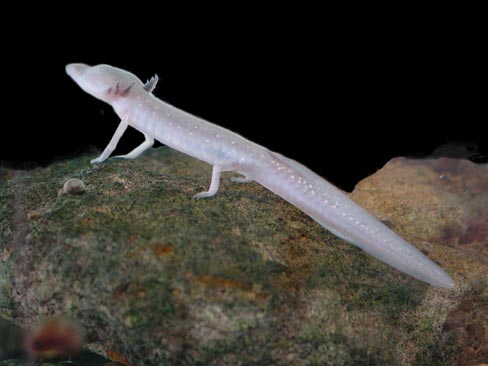 Texas Blind SalamanderEurycea rathbuni
- Blanco Blind SalamanderEurycea robusta
-
 Northern Two-lined SalamanderEurycea bislineata
-
 Barton Springs SalamanderEurycea sosorum
-
 Long-tailed SalamanderEurycea longicauda
-
 Cave SalamanderEurycea lucifuga
-
 Southern Two-lined SalamanderEurycea cirrigera
-
 Blue Ridge Two-lined SalamanderEurycea wilderae
Compare
Questions and answers
What is the scientific name of the Texas Salamander?
The scientific name of the Texas Salamander is Eurycea neotenes. Written with its author, the full name is Eurycea neotenes Bishop & Wright, 1937.
Which family does the Texas Salamander belong to?
Eurycea neotenes belongs to the family Plethodontidae, in the order Caudata and the class Amphibia.
Where is the Texas Salamander found?
Checklists and occurrence records place Eurycea neotenes in 1 country: United States.
What is the conservation status of the Texas Salamander?
The IUCN Red List category recorded for Eurycea neotenes is Endangered (EN).
What is the diet of a salamander?
The Texas Salamander feeds on amphipods, blind shrimp, daphnia, small snails, and other invertebrates.[7]
Sources
Passages the profile rests on
- The Texas salamander has a brown body that often displays yellow or brown mottling and light-yellow spots along its back. Source passage: “It is brown in color, often with yellow or brown mottling, with light-yellow spotting down its back.” — English Wikipedia
- The Texas salamander has a slender body, short limbs, and bright-red external gills. Source passage: “It is neotenic, with a slender body, short limbs, and bright-red external gills.” — English Wikipedia
- The Texas salamander has reduced vision as a result of prolonged exposure to darkness in caves. Source passage: “The Texas salamander lives in caves, which resulted in reduced vision in its eyes, due to the long period of time in darkness.” — English Wikipedia
- The Texas salamander measures approximately 5.1–10.2 cm in length. Source passage: “The Texas salamander grows from 2 to 4 in (5.1 to 10.2 cm) in length.” — English Wikipedia
- The Texas salamander inhabits caves. Source passage: “The Texas salamander lives in caves” — English Wikipedia
- The species was originally described from a spring at Helotes in Bexar County, Texas. Source passage: “were described by Bishop and Wright (1937) from a spring at Helotes, Bexar County” — amphibiaweb.org
- The Texas salamander feeds on amphipods, blind shrimp, daphnia, small snails, and other invertebrates. Source passage: “The Texas salamander typically preys on amphipods, blind shrimp (Palaemonetes antrorum), daphnia, small snails and other invertebrates.” — English Wikipedia
- The Texas salamander detects prey by moving its head from side to side to generate water pressure waves and sensing disturbances in still water. Source passage: “It hunts by swishing its head side to side to create water pressure waves and sensing their prey break the still water.” — English Wikipedia
- The Texas salamander is entirely aquatic and lacks lungs. Source passage: “is a species of entirely aquatic, lungless salamander” — English Wikipedia
- The Texas salamander is described as similar to the Texas blind salamander (Eurycea rathbuni). Source passage: “It is akin to the Texas blind salamander Eurycea rathbuni.” — English Wikipedia
Data
- Catalogue of Life, 2026-10-16 XR cc by
- Global Biodiversity Information Facility CC BY 4.0
- Wikidata CC0
- GeoNames CC BY 4.0
- Within the Catalogue of Life, this name comes from The Integrated Taxonomic Information System cc0
References
- Crother, Brian I., Jeff Boundy, Jonathan A. Campbell, et al. / Moriarty, John J., ed. (2000). Scientific and Standard English Names of Amphibians and Reptiles of North America North of Mexico, with Comments Regarding Confidence in Our Understanding. Herpetological Circular, No. 29.
- Crother, Brian I., Jeff Boundy, Frank T. Burbrink, et al. / Moriarty, John J., ed. (2008). Scientific and Standard English Names of Amphibians and Reptiles of North America North of Mexico, With Comments Regarding Confidence in Our Understanding, Sixth Ed. Herpetological Circular No. 37.
This species in other databases
Page built on 27 November 2026. See how the catalog is made and all sources and licences.
Cite this page
ScientificNames.org. (2026). Eurycea neotenes (Texas Salamander). Retrieved November 27, 2026, from https://scientificnames.org/species/eurycea-neotenes
“Eurycea neotenes (Texas Salamander).” ScientificNames.org, 2026, scientificnames.org/species/eurycea-neotenes. Accessed 27 Nov. 2026.
ScientificNames.org. “Eurycea neotenes (Texas Salamander).” Accessed November 27, 2026. https://scientificnames.org/species/eurycea-neotenes.
@misc{scientificnames_eurycea_neotenes_texas_salamander,
  author = {{ScientificNames.org}},
  title = {Eurycea neotenes (Texas Salamander)},
  year = {2026},
  url = {https://scientificnames.org/species/eurycea-neotenes},
  note = {Accessed 2026-11-27}
}