Species · Amphibians
Jollyville Plateau Salamander Eurycea tonkawae
The scientific name of the Jollyville Plateau Salamander is Eurycea tonkawae. It is a species of amphibian in the family Plethodontidae (lungless salamanders), order Caudata. The name dates from 2000.
- Scientific name
- Eurycea tonkawae Chippindale, Price, Wiens & Hillis, 2000
- Common name
- Jollyville Plateau Salamander
- Genus
- Eurycea
- Family
- Plethodontidae (Lungless Salamanders)
- Order
- Caudata
- Class
- Amphibia
- Red List category
- EN Endangered
- Recorded in
- 1 country
- Name status
- accepted in the Catalogue of Life

Overview
Eurycea tonkawae is endemic to Travis and Williamson counties in Texas, United States, and occurs in the Jollyville Plateau and Brushy Creek areas of Texas. It retains its gills throughout its life.
Written 27 November 2026 from the sources listed below. Each statement was checked against the passage it cites; statements that could not be supported were removed.
Appearance
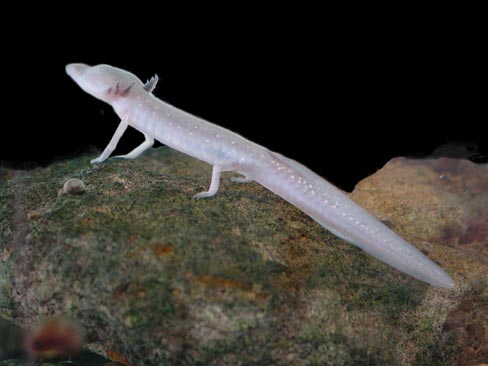
The Jollyville Plateau Salamander retains its gills throughout its life.[1]
Habitat
The Jollyville Plateau Salamander inhabits freshwater springs, spring runs, and wet caves in the Buttercup karst system. It occupies aquatic areas beneath rocks, aquatic plants, and algae.[2][3]
The species is concentrated in areas with abundant water, including wet caves, springs, and spring-dominated surface flows.[4]
Behaviour
The Jollyville Plateau Salamander occurs in localized clusters rather than being evenly distributed. Its highest reported abundance occurs during the spring and summer rainfall seasons.[5][6]
Similar species
The Jollyville Plateau Salamander is closely related to Eurycea naufragia and Eurycea chisholmensis. Cave-dwelling populations may represent a distinct species, but their taxonomic status requires further investigation.[7][8]
Conservation
The species was listed as threatened under the Endangered Species Act in August 2013.[9]
Classification of the Jollyville Plateau Salamander
| Kingdom | Animalia |
|---|---|
| Phylum | Chordata |
| Subphylum | Vertebrata |
| Infraphylum | Gnathostomata |
| Parvphylum | Osteichthyes |
| Megaclass | Tetrapoda |
| Class | Amphibia (Amphibians) |
| Order | Caudata (Salamanders) |
| Family | Plethodontidae (Lungless Salamanders) |
| Subfamily | Hemidactyliinae |
| Genus | Eurycea (Brook Salamander) |
| Species | Eurycea tonkawae Chippindale, Price, Wiens & Hillis, 2000 |
Where the Jollyville Plateau Salamander is found
Checklists and occurrence records place Eurycea tonkawae in 1 country across North America. GBIF holds 317 georeferenced records of it.
Countries
Regions and cities with the most records
- Texas, United States 235
- Cedar Park, United States 207
- Brushy Creek, United States 203
- Round Rock, United States 200
- Pflugerville, United States 169
- Leander, United States 154
- Austin, United States 114
- Hutto, United States 82
- Georgetown, United States 80
Range as the checklists state it
North America
A number beside a place is its count of GBIF occurrence records. A place without a number comes from a checklist alone. Records show where a species has been observed or collected, which can include escapes and vagrants.
Common names
English
- Jollyville Plateau Salamander
- Tonkawa Springs Salamander
Names in 2 other languages
- French
- Eurycée de Jollyville
- Spanish
- Salamandra de la Meseta Jollyville
Related species
-
 Texas Blind SalamanderEurycea rathbuni
- Blanco Blind SalamanderEurycea robusta
-
 Northern Two-lined SalamanderEurycea bislineata
-
 Barton Springs SalamanderEurycea sosorum
-
 Long-tailed SalamanderEurycea longicauda
-
 Cave SalamanderEurycea lucifuga
-
 Southern Two-lined SalamanderEurycea cirrigera
-
 Blue Ridge Two-lined SalamanderEurycea wilderae
Compare
Questions and answers
What is the scientific name of the Jollyville Plateau Salamander?
The scientific name of the Jollyville Plateau Salamander is Eurycea tonkawae. Written with its author, the full name is Eurycea tonkawae Chippindale, Price, Wiens & Hillis, 2000.
Which family does the Jollyville Plateau Salamander belong to?
Eurycea tonkawae belongs to the family Plethodontidae, in the order Caudata and the class Amphibia.
Where is the Jollyville Plateau Salamander found?
Checklists and occurrence records place Eurycea tonkawae in 1 country: United States.
What is the conservation status of the Jollyville Plateau Salamander?
The IUCN Red List category recorded for Eurycea tonkawae is Endangered (EN).
What other names does the Jollyville Plateau Salamander have?
Eurycea tonkawae is also known in English as Tonkawa Springs Salamander.
Sources
Passages the profile rests on
- The species retains its gills throughout its life. Source passage: “This species is perrenibranchiate, retaining its gills throughout life.” — English Wikipedia
- The species inhabits freshwater springs, spring runs, and wet caves in the Buttercup karst system. Source passage: “Its natural habitats are freshwater springs, spring runs, and wet caves of the Buttercup karst system.” — English Wikipedia
- Individuals occupy aquatic areas beneath rocks, aquatic plants, and algae. Source passage: “They are known to inhabit aquatic habitats occupying areas under rocks, aquatic plants, and algae.” — English Wikipedia
- The species is concentrated in areas with abundant water, including wet caves, springs, and spring-dominated surface flows. Source passage: “Eurycea tonkawae have a restricted in abundance in areas with an abundance of water such as the vicinity of wet caves, springs, and spring dominated surface flows.” — English Wikipedia
- The species occurs in localized clusters rather than being evenly distributed. Source passage: “Eurycea tonkawae occur in a clumped-like distribution” — English Wikipedia
- The species has its highest reported abundance during the spring and summer rainfall seasons. Source passage: “Previous studies have shown highest abundance rates during rainfall seasons such as spring and summer.” — English Wikipedia
- The species is closely related to Eurycea naufragia and Eurycea chisholmensis. Source passage: “Eurycea tonkawae is the sister taxon to E. naufragia and E. chisholmensis” — English Wikipedia
- Cave-dwelling populations may represent a distinct species, but their taxonomic status requires further investigation. Source passage: “Cave dwelling E. tonkawae may represent a distinct species, however further work is needed to clarify their taxonomic status.” — English Wikipedia
- The species was listed as threatened under the Endangered Species Act in August 2013. Source passage: “In August, 2013, this species was listed as threatened under the Endangered Species Act of 1973.” — English Wikipedia
Data
- Catalogue of Life, 2026-10-16 XR cc by
- Global Biodiversity Information Facility CC BY 4.0
- Wikidata CC0
- GeoNames CC BY 4.0
- Wikimedia Commons per image; credit shown with each image
- Within the Catalogue of Life, this name comes from The Integrated Taxonomic Information System cc0
References
- Phylogenetic relationships and systematic revision of central Texas hemidactyliine plethodontid salamanders. (2000). Herpetological Monographs, 14, 1–80. https://doi.org/10.2307/1467045 Link where the name was published
- Crother, Brian I., Jeff Boundy, Jonathan A. Campbell, et al. / Moriarty, John J., ed. (2000). Scientific and Standard English Names of Amphibians and Reptiles of North America North of Mexico, with Comments Regarding Confidence in Our Understanding. Herpetological Circular, No. 29.
- Crother, Brian I., Jeff Boundy, Jonathan A. Campbell, K. de Queiroz, et al. / Moriarty, John J., ed. (2000). Scientific and Standard English Names of Amphibians and Reptiles of North America North of Mexico, with Comments Regarding Confidence in Our Understanding. Herpetological Circular, No. 29.
- Crother, Brian I., Jeff Boundy, Frank T. Burbrink, et al. / Moriarty, John J., ed. (2008). Scientific and Standard English Names of Amphibians and Reptiles of North America North of Mexico, With Comments Regarding Confidence in Our Understanding, Sixth Ed. Herpetological Circular No. 37.
This species in other databases
Page built on 27 November 2026. See how the catalog is made and all sources and licences.
Cite this page
ScientificNames.org. (2026). Eurycea tonkawae (Jollyville Plateau Salamander). Retrieved November 27, 2026, from https://scientificnames.org/species/eurycea-tonkawae
“Eurycea tonkawae (Jollyville Plateau Salamander).” ScientificNames.org, 2026, scientificnames.org/species/eurycea-tonkawae. Accessed 27 Nov. 2026.
ScientificNames.org. “Eurycea tonkawae (Jollyville Plateau Salamander).” Accessed November 27, 2026. https://scientificnames.org/species/eurycea-tonkawae.
@misc{scientificnames_eurycea_tonkawae_jollyville_plateau_salamander,
  author = {{ScientificNames.org}},
  title = {Eurycea tonkawae (Jollyville Plateau Salamander)},
  year = {2026},
  url = {https://scientificnames.org/species/eurycea-tonkawae},
  note = {Accessed 2026-11-27}
}