Species · Birds
Red-necked Falcon Falco chicquera
The scientific name of the Red-necked Falcon is Falco chicquera. It is a species of bird in the family Falconidae (falcons), order Falconiformes. The name dates from 1800.
- Scientific name
- Falco chicquera Daudin, 1800
- Common name
- Red-necked Falcon
- Genus
- Falco
- Family
- Falconidae (Falcons)
- Order
- Falconiformes
- Class
- Aves
- Red List category
- NT Near Threatened
- Recorded in
- 38 countries
- Name status
- accepted in the Catalogue of Life

Overview
Adults have bluish-grey wings and upperparts, a chestnut-red cap and a black-banded tail with a white tip.
Written 26 November 2026 from the sources listed below. Each statement was checked against the passage it cites; statements that could not be supported were removed.
Appearance
Adults have bluish-grey wings and upperparts with a chestnut-red cap. The tail has a broad black subterminal band and a white tip.[1][2]
The legs, cere and eyering are yellow. The bill has a black tip and a greenish-yellow base.[3][4]
Juveniles have buff underparts, less extensive barring and duller upper plumage than adults.[5]
The species measures approximately 30–36 cm in length and has an average wingspan of approximately 85 cm. Females are larger than males.[6][7][8]
Habitat
In Africa, the species inhabits semi-deserts, savannahs and other dry open country with scattered trees. African populations also occur in riverine forests.[9][10]
The Indian population inhabits open habitats and avoids dense forests and high hills. The species also occurs in cultivated land and villages where open habitats are interspersed with trees.[11][12]
The species avoids dense forests and coastlines.[13]
Diet
The Red-necked Falcon feeds on small birds, bats and squirrels. Its diet also includes mice, lizards and large insects.[14][15]
In a Bangladesh study, adult falcons obtained 72% of their recorded prey from small sparrow-sized birds and 28% from Pipistrellus bats. The species preferentially hunts birds found in open areas.[16][17]
Falcons in Bangladesh hunted smaller prey during months with higher temperatures and precipitation. They were more likely to consume bats during warmer and wetter months.[18][19]
Urban pairs in Bangladesh tended to consume bats, whereas rural pairs tended to consume birds.[20]
Behaviour
The species usually hunts in pairs, particularly around dawn and dusk. Pairs sometimes cooperate by flushing small birds from cover and capturing them in flight.[21][22]
The species has a fast and dashing flight. It sometimes steals prey caught by other medium-sized raptors and sometimes caches prey for later consumption.[23][24][25]
The species drinks water during afternoons when water is available.[26]
The species produces a shrill vocalization described as ki-ki-ki-ki.[27]
Reproduction and life cycle
The Indian population breeds between January and March. The breeding season in Zambia begins in August.[28][29]
The species lays eggs in tree forks, palm crowns or previously constructed tree nests. Indian nests are often situated in large mango trees and concealed within foliage.[30][31]
The clutch generally consists of two to four eggs. Only the female incubates the eggs, beginning after the final egg is laid.[32][33]
The eggs hatch approximately 32–34 days after incubation begins. Young typically fledge after approximately 35–37 days in Africa and up to 48 days in India.[34][35]
Conservation
The species is classified globally as Near Threatened. It is experiencing moderately rapid population declines, primarily associated with habitat degradation.[36][37]
The number of mature individuals in the global population remains unknown.[38]
Classification of the Red-necked Falcon
| Kingdom | Animalia |
|---|---|
| Phylum | Chordata |
| Subphylum | Vertebrata |
| Infraphylum | Gnathostomata |
| Parvphylum | Osteichthyes |
| Megaclass | Tetrapoda |
| Class | Aves (Bird) |
| Order | Falconiformes (Falcons) |
| Family | Falconidae (Falcons) |
| Subfamily | Falconinae |
| Genus | Falco (Falcons) |
| Species | Falco chicquera Daudin, 1800 |
Where the Red-necked Falcon is found
Checklists and occurrence records place Falco chicquera in 38 countries across Africa and Asia. GBIF holds 18,242 georeferenced records of it.
Countries
- Angola 6
- Bangladesh 250
- Benin 280
- Bhutan 7
- Botswana 638
- Burkina Faso 107
- Burundi 9
- Cameroon 67
- Central African Republic 12
- Chad 40
- Democratic Republic of the Congo 32
- Ethiopia 37
- Gambia 1,509
- Ghana 180
- Guinea 10
- Guinea-Bissau 30
- India 7,858
- Indonesia 3
- Kenya 302
- Malawi 156
- Mali 52
- Mauritania 8
- Mozambique 119
- Namibia 1,405
- Nepal 260
- Niger 46
- Nigeria 655
- Pakistan 51
- Rwanda 55
- Senegal 901
- South Africa 1,059
- South Sudan 12
- Sudan 17
- Tanzania 349
- Togo 14
- Uganda 961
- Zambia 579
- Zimbabwe 166
Regions and cities with the most records
- Tamil Nadu, India 1,493
- Gujarat, India 1,406
- Rajasthan, India 1,058
- Maharashtra, India 941
- Karnataka, India 918
- Northern Cape, South Africa 834
- Oshikoto Region, Namibia 761
- Busumbala, Gambia 758
- Sinchu Alagi, Gambia 724
- Abuko, Gambia 698
- Kunkujang, Gambia 693
- Welingara, Gambia 684
- Faji Kunda, Gambia 679
- Western, Gambia 673
- Latri Sabiji, Gambia 669
- Talinding, Gambia 667
- Sukuta, Gambia 660
- Serekunda, Gambia 658
- Bakoti, Gambia 648
- Sanchaba, Gambia 647
- Dippa Kunda, Gambia 643
- Manjai Kunda, Gambia 632
- Brufut, Gambia 630
- New Jeshwang, Gambia 625
- Kanifing, Gambia 622
- Tanji, Gambia 617
- Kotu, Gambia 612
- Bakau, Gambia 585
- Brikama, Gambia 513
- Sanyang, Gambia 512
- Banjul, Gambia 478
- Chhāpar, India 457
- Sūjāngarh, India 456
- Lādnūn, India 454
- Bīdāsar, India 448
- Gunjur, Gambia 422
Range as the checklists state it
Europe & Northern Asia (excluding China)
Southern Asia
Africa
A number beside a place is its count of GBIF occurrence records. A place without a number comes from a checklist alone. Records show where a species has been observed or collected, which can include escapes and vagrants.
Common names
English
- Red-necked Falcon
- RNFA
- Red-headed Falcon
Names in 36 other languages
- Afrikaans
- Rooinekvalk
- Arabic
- صقر أحمر العنق
- Bengali
- তুরমতি বাজ
- Breton
- Falc'hun penn ruz
- Catalan
- falcó cap-roig
- Chinese
- 紅頸隼, 红头隼
- Croatian
- riđoglavi sokol
- Czech
- dřemlík rudohlavý
- Danish
- Rødhovedet Dværgfalk
- Dutch
- Roodkopsmelleken
- Esperanto
- ruĝkapa falko
- Estonian
- palmipistrik
- Finnish
- palmuhaukka
- French
- Faucon chicquera
- German
- Rothalsfalke, Rotkopffalke
- Hebrew
- בז אדום-עורף
- Hungarian
- vörösnyakú sólyom
- Irish
- Fabhcún ceanndearg
- Italian
- Falco collorosso, Falco testarossa, Turumti
- Japanese
- アカガシラチョウゲンボウ
- Latvian
- rudkakla piekūns
- Lithuanian
- rudagalvis sakalas
- Malayalam
- ചെന്തലയൻ പുള്ള്
- Norwegian
- rødhodefalk
- Persian
- شاهین سرحنایی
- Polish
- sokół rudogłowy
- Portuguese
- falcão-de-nuca-vermelha
- Russian
- Турумти
- Serbian
- Crvenovrati soko
- Slovak
- sokol červenohlavý
- Spanish
- Alcotán cuellirrojo, Alcotán turumti
- Swedish
- rödhuvad falk
- Tswana
- Phakwe
- Turkish
- Kızıl boyunlu doğan, Turumtay Doğanı
- Ukrainian
- турумті
- Welsh
- hebog gwargoch
Synonyms
One other scientific name has been used for this species and is now treated as a synonym of Falco chicquera.
- Falco chiquera Smith, A, 1838
Subspecies and varieties
- Falco chicquera chicquera (Asian Red-necked Falcon) subspecies
- Falco chicquera horsbrughi subspecies
- Falco chicquera ruficollis (Red-necked Falcon) subspecies
Related species
-
 Peregrine FalconFalco peregrinus
-
 Common KestrelFalco tinnunculus
-
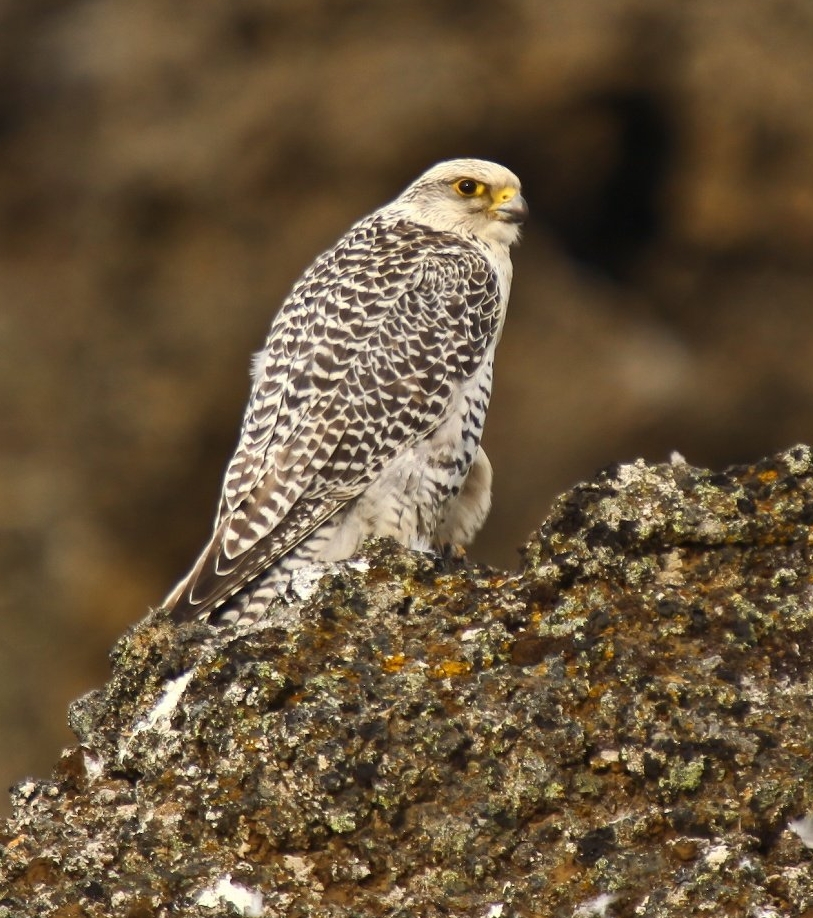 GyrfalconFalco rusticolus
-
 MerlinFalco columbarius
-
 American KestrelFalco sparverius
-
 Saker FalconFalco cherrug
-
 Eurasian HobbyFalco subbuteo
-
 Amur FalconFalco amurensis
Compare
Questions and answers
What is the scientific name of the Red-necked Falcon?
The scientific name of the Red-necked Falcon is Falco chicquera. Written with its author, the full name is Falco chicquera Daudin, 1800.
Which family does the Red-necked Falcon belong to?
Falco chicquera belongs to the family Falconidae, in the order Falconiformes and the class Aves.
Where is the Red-necked Falcon found?
Checklists and occurrence records place Falco chicquera in 38 countries, including India, Gambia, Namibia, South Africa, Uganda and Senegal.
What is the conservation status of the Red-necked Falcon?
The IUCN Red List category recorded for Falco chicquera is Near Threatened (NT).
What other names does the Red-necked Falcon have?
Falco chicquera is also known in English as RNFA and Red-headed Falcon.
Sources
Passages the profile rests on
- The adult has bluish-grey wings and upperparts with a chestnut-red cap. Source passage: “This medium-sized falcon has bluish grey wings and upper body, a chestnut red cap with short chin straps passing through the eye.” — English Wikipedia
- The tail has a broad black subterminal band with a white tip. Source passage: “The wings and upper parts are bluish grey and the tail has narrow bars, a broad subterminal black band tipped with white.” — English Wikipedia
- The legs, cere and eyering are yellow. Source passage: “The legs, ceres and eyering are yellow.” — English Wikipedia
- The bill has a black tip and a greenish-yellow base. Source passage: “The tip of the bill is black while the basal portion is greenish yellow.” — English Wikipedia
- Juveniles have buff underparts, less extensive barring and duller upper plumage than adults. Source passage: “Young birds are buff below with less extensive barring and duller upper plumage.” — English Wikipedia
- The species measures approximately 30–36 cm in length. Source passage: “It is on average 30–36 cm (12–14 in) in length with a wingspan of 85 cm (33 in).” — English Wikipedia
- The species has an average wingspan of approximately 85 cm. Source passage: “It is on average 30–36 cm (12–14 in) in length with a wingspan of 85 cm (33 in).” — English Wikipedia
- Females are larger than males. Source passage: “The sexes are similar except in size, males are smaller than females as is usual in falcons.” — English Wikipedia
- In Africa, the species inhabits semi-deserts, savannahs and other dry open country with scattered trees. Source passage: “In Africa, the red-necked falcon is found in semi-desert, savannah and other dry open country with some trees” — English Wikipedia
- African populations also occur in riverine forests. Source passage: “but also riverine forest.” — English Wikipedia
- The Indian population inhabits open habitats and avoids dense forests and high hills. Source passage: “In India, they are found in open habitats and is not found in dense forests or high hills.” — English Wikipedia
- The species inhabits open habitats interspersed with trees, including cultivated land and villages. Source passage: “The species inhabits open habitats interspersed with trees, including cultivated land and villages” — pmc.ncbi.nlm.nih.gov
- The species avoids dense forests and coastlines. Source passage: “but avoids dense forest and coastlines” — pmc.ncbi.nlm.nih.gov
- The species feeds on small birds, bats and squirrels. Source passage: “They hunt in pairs mostly at dawn and dusk, capturing small birds, bats and squirrels.” — English Wikipedia
- Its diet also includes mice, lizards and large insects. Source passage: “In addition mice, lizards, large insects are also taken.” — English Wikipedia
- In a Bangladesh study, adult falcons obtained 72% of their recorded prey from small sparrow-sized birds and 28% from Pipistrellus bats. Source passage: “In one study in Bangladesh, adults fed mainly on small sparrow sized birds (72%) and Pipistrellus bats (28%).” — English Wikipedia
- The species preferentially hunts birds found in open areas. Source passage: “It prefers to prey on birds found in open areas” — English Wikipedia
- Falcons in Bangladesh hunted smaller prey during months with higher temperatures and precipitation. Source passage: “Falcons hunted smaller prey items during months with increased temperatures and precipitation” — pmc.ncbi.nlm.nih.gov
- Falcons in Bangladesh were more likely to consume bats during warmer and wetter months. Source passage: “Falcons were more likely to prey on bats during warmer and wetter months.” — pmc.ncbi.nlm.nih.gov
- Urban pairs in Bangladesh tended to consume bats, whereas rural pairs tended to consume birds. Source passage: “urban pairs tended to prey on bats, whereas more rural pairs tended to prey on birds.” — pmc.ncbi.nlm.nih.gov
- The species usually hunts in pairs, particularly around dawn and dusk. Source passage: “The red-necked falcon usually hunts in pairs, often at dawn and dusk” — English Wikipedia
- Pairs sometimes cooperate by flushing small birds from cover and capturing them in flight. Source passage: “one of the pair flies low and flushes up small birds while the other follows higher up and seizes the prey as it flushes from cover.” — English Wikipedia
- The species has a fast and dashing flight. Source passage: “They fly with a fast and dashing flight.” — English Wikipedia
- The species sometimes steals prey caught by other medium-sized raptors. Source passage: “They may sometimes pirate prey obtained by other medium-sized raptors.” — English Wikipedia
- The species sometimes caches prey for later consumption. Source passage: “Prey may sometimes be cached and eaten subsequently.” — English Wikipedia
- The species drinks water during afternoons when water is available. Source passage: “The red-necked falcon drinks water where available during the afternoons.” — English Wikipedia
- The species produces a shrill vocalization described as ki-ki-ki-ki. Source passage: “The voice of this species is a shrill ki-ki-ki-ki.” — English Wikipedia
- The Indian population breeds between January and March. Source passage: “The breeding season in India is January to March.” — English Wikipedia
- The breeding season in Zambia begins in August. Source passage: “In Zambia, the breeding season begins in August.” — English Wikipedia
- The species lays eggs in tree forks, palm crowns or previously constructed tree nests. Source passage: “This falcon usually reuses the old tree nest platforms, particularly of corvids, or lays its 3-5 eggs in a nest that it builds on the fork of a tall tree or in the crown of a palm tree.” — English Wikipedia
- Indian nests are often situated in large mango trees and concealed within foliage. Source passage: “In India, the nest is often placed in a large mango tree (Mangifera indica) and concealed inside foliage.” — English Wikipedia
- The clutch generally consists of two to four eggs. Source passage: “The clutch consists of two to four eggs” — English Wikipedia
- Only the female incubates the eggs, beginning after the final egg is laid. Source passage: “which are incubated only by the female which begins after the last egg of the clutch is laid.” — English Wikipedia
- The eggs hatch approximately 32–34 days after incubation begins. Source passage: “The eggs hatch after about 32 to 34 days” — English Wikipedia
- Young typically fledge after approximately 35–37 days in Africa and up to 48 days in India. Source passage: “The young fledge in about 35 to 37 days in Africa and up to 48 days in India.” — English Wikipedia
- The species is classified globally as Near Threatened. Source passage: “Globally, the species is classified as near threatened by the International Union for the Conservation of Nature's Red List of Threatened Species (IUCN Red List)” — pmc.ncbi.nlm.nih.gov
- The species is experiencing moderately rapid population declines, primarily associated with habitat degradation. Source passage: “Red‐necked Falcons are experiencing moderately rapid population declines predominantly driven by habitat degradation” — pmc.ncbi.nlm.nih.gov
- The number of mature individuals in the global population remains unknown. Source passage: “with the number of mature individuals remaining unknown” — pmc.ncbi.nlm.nih.gov
Data
- Catalogue of Life, 2026-10-16 XR cc by
- Global Biodiversity Information Facility CC BY 4.0
- Wikidata CC0
- GeoNames CC BY 4.0
- Wikimedia Commons per image; credit shown with each image
- Within the Catalogue of Life, this name comes from The Integrated Taxonomic Information System cc0
References
- Daudin, François M. 1800. Traité élémentaire et complet d’ornithologie, ou, Histoire naturelle des oiseaux. Duprat, Paris. Vol. 2: 1-473; pls. ix-xxix. where the name was published
- Mayr, Ernst, and G. William Cottrell, eds. (1979). Check-List of Birds of the World, Vol. 1, Second Edition.
- Dickinson, Edward C., ed. (2003). The Howard and Moore Complete Checklist of the Birds of the World, 3rd Edition.
- Gill, Frank, & and Minturn Wright. (2006). Birds of the World: Recommended English Names.
- Dickinson, E. C., and J. V. Remsen Jr., eds. (2013). The Howard and Moore Complete Checklist of the Birds of the World, 4th Edition, Vol. 1 Non-Passerines.
This species in other databases
Page built on 28 November 2026. See how the catalog is made and all sources and licences.
Cite this page
ScientificNames.org. (2026). Falco chicquera (Red-necked Falcon). Retrieved November 28, 2026, from https://scientificnames.org/species/falco-chicquera
“Falco chicquera (Red-necked Falcon).” ScientificNames.org, 2026, scientificnames.org/species/falco-chicquera. Accessed 28 Nov. 2026.
ScientificNames.org. “Falco chicquera (Red-necked Falcon).” Accessed November 28, 2026. https://scientificnames.org/species/falco-chicquera.
@misc{scientificnames_falco_chicquera_red_necked_falcon,
  author = {{ScientificNames.org}},
  title = {Falco chicquera (Red-necked Falcon)},
  year = {2026},
  url = {https://scientificnames.org/species/falco-chicquera},
  note = {Accessed 2026-11-28}
}