Species · Birds
Sooty Falcon Falco concolor
The scientific name of the Sooty Falcon is Falco concolor. It is a species of bird in the family Falconidae (falcons), order Falconiformes. The name dates from 1825.
- Scientific name
- Falco concolor Temminck, 1825
- Common name
- Sooty Falcon
- Genus
- Falco
- Family
- Falconidae (Falcons)
- Order
- Falconiformes
- Class
- Aves
- Red List category
- VU Vulnerable
- Environment
- terrestrial
- Recorded in
- 27 countries
- Name status
- accepted in the Catalogue of Life

Overview
Falco concolor breeds from northeastern Africa to the southern Persian Gulf region and winters in eastern Africa and Madagascar. It has blue-grey adult plumage, long pointed wings and a wingspan of 78–90 cm.
Written 26 November 2026 from the sources listed below. Each statement was checked against the passage it cites; statements that could not be supported were removed.
Appearance
Adult Sooty Falcons have blue-grey plumage. The species has long pointed wings, a long tail and a slim body.[1][2]
Juvenile Sooty Falcons have a dark trailing edge to their wings and tail. Their underparts are pale and spotted.[3][4]
The Sooty Falcon has a wingspan of 78–90 cm.[5]
Habitat
Sooty Falcons breed on islands and coastal or desert cliffs. Their breeding habitats include small islands in the Red Sea, mountainous deserts and deserts with rocky outcrops.[6][7][8][9]
Sooty Falcons nest on ledges or rocks, sometimes between rocks or on the ground. They occasionally nest in colonies.[10][11][12]
The Sooty Falcon breeds from northeastern Africa to the southern Persian Gulf region, with a breeding distribution extending from Libya to Pakistan. Its breeding range is discontinuous and highly localized from Libya eastwards through Egypt, and includes Red Sea islands off Sudan, Eritrea and Djibouti.[13][14][15][16]
The species is distributed across Southwest Asia and North Africa. It winters in eastern Africa, including Mozambique and eastern South Africa, and in Madagascar.[17][18]
Diet
During the breeding season, Sooty Falcons feed almost exclusively on migrating birds. Passerines constitute the majority of their migrating bird prey, and they also eat swifts and hoopoes.[19][20][21]
Sooty Falcons also prey on bats and consume large insects such as dragonflies. Lizards and crabs have also been recorded in their diet.[22][23][24]
Large insects form a much greater proportion of the Sooty Falcon's diet in winter.[25]
Behaviour
Sooty Falcons transfer prey from their talons to their beaks and eat it in flight. They use four hunting techniques.[26][27]
Male Sooty Falcons perform most of the hunting during the breeding season. During winter, they hunt individually, in groups or in flocks of up to 15 individuals.[28][29]
Winter hunting flocks tend to perch in trees and feed on swarming insects.[30]
Sooty Falcons migrate between their breeding grounds and African wintering areas over approximately 13 days. The migration journey covers approximately 5,500 kilometres.[31][32]
Sooty Falcons begin migration at night but generally travel during daylight. They stop at resting places in eastern Africa where potential water sources occur.[33][34]
Reproduction and life cycle
Sooty Falcons begin displaying and mating during April and May. They lay eggs during mid-summer, with egg laying occurring in July and August.[35][36][37]
Sooty Falcon clutches contain up to four eggs. On islands in the Sea of Oman, the mean clutch size is 2.83 eggs and the mean brood size is 2.11.[38][39][40]
Sooty Falcon eggs have an incubation period of approximately 27–29 days. Females perform most of the incubation.[41][42]
Young Sooty Falcons remain in the nest for 32–38 days. After leaving the nest, they remain nearby for another two to three weeks.[43][44]
Conservation
The Sooty Falcon was uplisted to Vulnerable status in 2017. Its estimated global population is between 2,800 and 4,000 individuals, and the population is declining.[45][46][47]
The breeding population on islands in northern Oman is declining. Human disturbance on accessible islands is identified as a likely cause of declining breeding populations in northern Oman.[48][49]
Sooty Falcons breeding close to beaches have lower nesting success than those breeding farther away.[50]
Similar species
Eleonora's Falcon is considered a possible close relative of the Sooty Falcon. The Sooty Falcon may be more closely related to the Eurasian Hobby and African Hobby than to Eleonora's Falcon.[51][52]
Classification of the Sooty Falcon
| Kingdom | Animalia |
|---|---|
| Phylum | Chordata |
| Subphylum | Vertebrata |
| Infraphylum | Gnathostomata |
| Parvphylum | Osteichthyes |
| Megaclass | Tetrapoda |
| Class | Aves (Bird) |
| Order | Falconiformes (Falcons) |
| Family | Falconidae (Falcons) |
| Subfamily | Falconinae |
| Genus | Falco (Falcons) |
| Species | Falco concolor Temminck, 1825 |
Where the Sooty Falcon is found
Checklists and occurrence records place Falco concolor in 27 countries across Africa and Asia. GBIF holds 3,053 georeferenced records of it.
Countries
- Algeria 11
- Bahrain 13
- Djibouti 6
- Egypt 403
- Eritrea 7
- Eswatini 8
- Ethiopia 21
- Iran 4
- Israel 230
- Jordan 44
- Kenya 168
- Kuwait 18
- Madagascar 793
- Mayotte 18
- Mozambique 104
- Oman 282
- Qatar 3
- Reunion 77
- Rwanda 3
- Saudi Arabia 146
- Somalia 4
- South Africa 395
- Sudan 3
- Tanzania 118
- Uganda 94
- United Arab Emirates 70
- Zimbabwe 10
Regions and cities with the most records
- Southern District, Israel 222
- Ambohidratrimo, Madagascar 214
- Antananarivo, Madagascar 213
- Ivato, Madagascar 212
- KwaZulu-Natal, South Africa 181
- Plettenberg Bay, South Africa 115
- Western Cape, South Africa 115
- Al Batinah South, Oman 110
- Muscat, Oman 100
- Bawshar, Oman 99
- Inhambane Province, Mozambique 67
- Sharm el-Sheikh, Egypt 58
- Tabuk Region, Saudi Arabia 58
- Hurghada, Egypt 56
- Abu Dhabi, United Arab Emirates 47
- Mpumalanga, South Africa 46
- Ambato Boeny, Madagascar 42
- Arusha, Tanzania 42
- Morondava, Madagascar 41
- Cairo, Egypt 40
- Taita Taveta, Kenya 39
- Al Ḩawāmidīyah, Egypt 38
- New Cairo, Egypt 38
- Al Badrashayn, Egypt 37
- Ḩalwān, Egypt 37
- Abū an Numrus, Egypt 36
- Cairo, Egypt 36
- Giza, Egypt 35
- Eilat, Israel 32
- Le Tampon, Reunion 29
- Saint-Louis, Reunion 28
- Amboasary, Madagascar 27
- Aqaba, Jordan 27
- Le Port, Reunion 25
- Saint-Paul, Reunion 25
- Aqaba, Jordan 24
1 more country has a few records outside this range
These countries hold a few records of Falco concolor but lie outside the range the checklists give for it. Such records are often zoo or garden specimens, museum material or vagrants, so the species is not counted as occurring there.
Range as the checklists state it
Southern Asia
Africa
A number beside a place is its count of GBIF occurrence records. A place without a number comes from a checklist alone. Records show where a species has been observed or collected, which can include escapes and vagrants.
Common names
English
- Sooty Falcon
Names in 37 other languages
- Afrikaans
- Roetvalk
- Arabic
- صقر الغروب, صقر فاحم
- Bulgarian
- Тъмен сокол
- Catalan
- falcó fumat
- Chinese
- 烟色隼, 煙色隼, 煙隼
- Croatian
- mrki sokol
- Czech
- ostříž arabský
- Danish
- Sodfalk
- Dutch
- woestijnvalk
- Esperanto
- fulga falko
- Estonian
- nõgipistrik
- Finnish
- nokihaukka
- French
- Faucon concolore
- German
- Schieferfalke
- Greek
- Σταχτογέρακο
- Hebrew
- בז שחור
- Hungarian
- hamvas sólyom, kormos sólyom
- Icelandic
- Skuggafálki
- Irish
- Fabhcún súicheach
- Italian
- Falco fuligginoso, Falco unicolore
- Japanese
- ウスズミハヤブサ
- Latvian
- tumšais piekūns
- Lithuanian
- pilkasis sakalas, pilkšvasis sakalas
- Malagasy
- Fandrasambary
- Northern Sami
- Gožufálli
- Persian
- شاهین دودی
- Polish
- sokół śniady
- Portuguese
- Falcão-cinzento, falcão-sombrio, falcão-uniforme
- Russian
- серебристый чеглок
- Serbian
- Čađavi soko
- Slovak
- sokol bridlicový
- Slovenian
- sajasti sokol
- Spanish
- Halcón pizarroso, halcón opaco
- Swedish
- sotfalk
- Turkish
- gri dogan, gri doğan, İsli doğan
- Ukrainian
- Підсоколик задимлений, підсоколик сірий
- Welsh
- hebog tywyll
Related species
-
 Peregrine FalconFalco peregrinus
-
 Common KestrelFalco tinnunculus
-
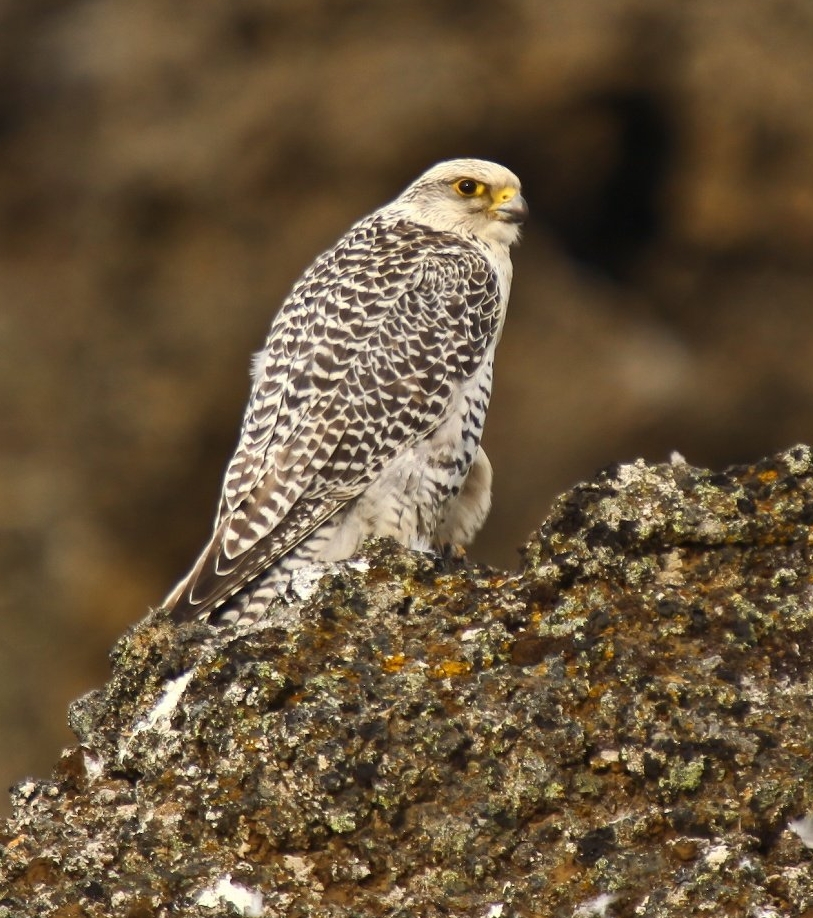 GyrfalconFalco rusticolus
-
 MerlinFalco columbarius
-
 American KestrelFalco sparverius
-
 Saker FalconFalco cherrug
-
 Eurasian HobbyFalco subbuteo
-
 Amur FalconFalco amurensis
Compare
Questions and answers
What is the scientific name of the Sooty Falcon?
The scientific name of the Sooty Falcon is Falco concolor. Written with its author, the full name is Falco concolor Temminck, 1825.
Which family does the Sooty Falcon belong to?
Falco concolor belongs to the family Falconidae, in the order Falconiformes and the class Aves.
Where is the Sooty Falcon found?
Checklists and occurrence records place Falco concolor in 27 countries, including Madagascar, Egypt, South Africa, Oman, Israel and Kenya.
What is the conservation status of the Sooty Falcon?
The IUCN Red List category recorded for Falco concolor is Vulnerable (VU).
Sources
Passages the profile rests on
- Adult Sooty Falcons have blue-grey plumage. Source passage: “The adults are blue-grey” — English Wikipedia
- The species has long pointed wings, a long tail and a slim body. Source passage: “with its long pointed wings, long tail and slim body.” — English Wikipedia
- Juvenile Sooty Falcons have a dark trailing edge to their wings and tail. Source passage: “Its dark trailing edge to the wings and tail distinguish it from the former species” — English Wikipedia
- Juvenile Sooty Falcons have pale, spotted underparts. Source passage: “juveniles have pale, spotted underparts.” — ebird.org
- The Sooty Falcon has a wingspan of 78–90 cm. Source passage: “with a 78–90 cm wingspan.” — English Wikipedia
- The species breeds on islands and coastal or desert cliffs. Source passage: “It breeds on islands and coastal or desert cliffs” — English Wikipedia
- The species breeds in small islands in the Red Sea. Source passage: “(1) small islands in the Red Sea” — English Wikipedia
- The species also breeds in mountainous deserts. Source passage: “(2) mountainous deserts” — English Wikipedia
- The species breeds in deserts with rocky outcrops. Source passage: “(3) in deserts with rocky outcrops.” — English Wikipedia
- Sooty Falcons nest on ledges or rocks. Source passage: “It nests on a ledge or on rocks” — English Wikipedia
- Sooty Falcons sometimes nest between rocks or on the ground. Source passage: “they have also been found nesting between rocks or on the ground.” — English Wikipedia
- Sooty Falcons occasionally nest in colonies. Source passage: “and occasionally nest in colonies.” — English Wikipedia
- The Sooty Falcon breeds from northeastern Africa to the southern Persian Gulf region. Source passage: “breeding from northeastern Africa to the southern Persian Gulf region” — English Wikipedia
- The breeding distribution extends from Libya to Pakistan. Source passage: “from Libya to Pakistan).” — English Wikipedia
- The breeding distribution is discontinuous and highly localized from Libya eastwards through Egypt. Source passage: “Falco concolor breeds discontinuously and highly locally from Libya, eastwards through Egypt” — datazone.birdlife.org
- The breeding range includes Red Sea islands off Sudan, Eritrea and Djibouti. Source passage: “to the Red Sea islands off Sudan, Eritrea and Djibouti, ...” — datazone.birdlife.org
- The species winters in eastern Africa, including Mozambique and eastern South Africa, and in Madagascar. Source passage: “wintering in East Africa (Mozambique, eastern South Africa) and Madagascar.” — English Wikipedia
- The species is distributed across Southwest Asia and North Africa. Source passage: “This species is distributed across Southwest Asia and North Africa.” — English Wikipedia
- During the breeding season, Sooty Falcons feed almost exclusively on migrating birds. Source passage: “In the breeding season, sooty falcons almost exclusively eat migrating birds” — English Wikipedia
- Passerines constitute the majority of migrating birds eaten during the breeding season. Source passage: “(mostly passerines but also swifts, hoopoes, and others)” — English Wikipedia
- Sooty Falcons also eat swifts and hoopoes during the breeding season. Source passage: “but also swifts, hoopoes, and others” — English Wikipedia
- Sooty Falcons also prey on bats. Source passage: “It will also take bats” — English Wikipedia
- Sooty Falcons consume large insects such as dragonflies. Source passage: “and large insects, such as dragonflies” — English Wikipedia
- Sooty Falcons have also been recorded eating lizards and crabs. Source passage: “They have also been known to eat lizards and crabs.” — English Wikipedia
- In winter, large insects form a much greater proportion of the Sooty Falcon's diet. Source passage: “In winter, large insects form a far higher proportion of the diet.” — English Wikipedia
- Sooty Falcons transfer prey from their talons to their beaks and eat it in flight. Source passage: “which are transferred from talons to beak and eaten in flight.” — English Wikipedia
- Sooty Falcons use four hunting techniques. Source passage: “Four hunting techniques are employed:” — English Wikipedia
- During winter, Sooty Falcons hunt individually, in groups or in flocks of up to 15 individuals. Source passage: “During winter the falcons hunt alone, in groups or even as flocks of up to 15 individuals.” — English Wikipedia
- Male Sooty Falcons perform most of the hunting during the breeding season. Source passage: “During the breeding, summer, season males do the majority of the hunting.” — English Wikipedia
- Winter hunting flocks tend to perch in trees and feed on swarming insects. Source passage: “These hunting flocks tend to perch on trees and feed on swarming insects.” — English Wikipedia
- Sooty Falcons migrate between their breeding grounds and African wintering areas over approximately 13 days. Source passage: “The journey takes approximately 13 days” — English Wikipedia
- The migration journey covers approximately 5,500 kilometres. Source passage: “and covers a distance of 5500 kilometres.” — English Wikipedia
- Sooty Falcons begin migration at night but generally travel during daylight. Source passage: “The falcons start their migration during the night but tend to travel only during the day.” — English Wikipedia
- Migrating Sooty Falcons stop at resting places in eastern Africa where potential water sources occur. Source passage: “They stop-over at rest spots along Eastern Africa, spots where there are potential water sources.” — English Wikipedia
- Sooty Falcons lay eggs during mid-summer. Source passage: “Sooty Falcons lay eggs during mid-summer” — English Wikipedia
- Sooty Falcons begin displaying and mating during April and May. Source passage: “Birds begin to display and mate during April and May” — English Wikipedia
- Eggs are laid during July and August. Source passage: “with eggs being laid by July-August.” — English Wikipedia
- Sooty Falcon clutches contain up to four eggs. Source passage: “laying up to four eggs.” — English Wikipedia
- On islands in the Sea of Oman, the mean clutch size is 2.83 eggs. Source passage: “have a mean clutch size of 2.83” — English Wikipedia
- On islands in the Sea of Oman, the mean brood size is 2.11. Source passage: “and brood size of 2.11” — English Wikipedia
- Sooty Falcon eggs have an incubation period of approximately 27–29 days. Source passage: “Egg incubation lasts approximately 27-29 days.” — English Wikipedia
- Female Sooty Falcons perform most of the incubation. Source passage: “Incubation is predominantly performed by the female” — English Wikipedia
- Young Sooty Falcons remain in the nest for 32–38 days. Source passage: “The young falcons remain in the nest for 32-38 days” — English Wikipedia
- After leaving the nest, young Sooty Falcons remain nearby for another two to three weeks. Source passage: “after which they still remain near the nest for a further 2-3 weeks.” — English Wikipedia
- The Sooty Falcon was uplisted to Vulnerable status in 2017. Source passage: “Consequently, it was uplisted to Vulnerable status in 2017.” — English Wikipedia
- The estimated global population of Sooty Falcons is between 2,800 and 4,000 individuals. Source passage: “It is estimated that their population ranges between 2800 and 4000 individuals” — English Wikipedia
- The Sooty Falcon population is declining. Source passage: “and that these numbers are declining.” — English Wikipedia
- The breeding population on islands in northern Oman is declining. Source passage: “The breeding population of Sooty falcons on the islands of northern Oman is in decline” — English Wikipedia
- Human disturbance on accessible islands is identified as a likely cause of declining breeding populations in northern Oman. Source passage: “with human disturbance on accessible islands a likely cause” — English Wikipedia
- Sooty Falcons breeding close to beaches have lower nesting success than those breeding farther away. Source passage: “falcons breeding close to beaches have lower nesting success than those breeding further away.” — English Wikipedia
- Eleonora's Falcon is considered a possible close relative of the Sooty Falcon. Source passage: “Eleonora's falcon F. eleonorae is sometimes considered its closest relative” — English Wikipedia
- The Sooty Falcon may be more closely related to the Eurasian Hobby and African Hobby than to Eleonora's Falcon. Source passage: “with F. concolor possibly closer to Eurasian hobby F. subbuteo and African hobby F. cuvieri than it is to Eleonora's falcon.” — English Wikipedia
Data
- Catalogue of Life, 2026-10-16 XR cc by
- Global Biodiversity Information Facility CC BY 4.0
- Wikidata CC0
- GeoNames CC BY 4.0
- Wikimedia Commons per image; credit shown with each image
- Within the Catalogue of Life, this name comes from The Integrated Taxonomic Information System cc0
References
- Mayr, Ernst, and G. William Cottrell, eds. (1979). Check-List of Birds of the World, Vol. 1, Second Edition.
- Dickinson, Edward C., ed. (2003). The Howard and Moore Complete Checklist of the Birds of the World, 3rd Edition.
- Gill, Frank, & and Minturn Wright. (2006). Birds of the World: Recommended English Names.
- Dickinson, E. C., and J. V. Remsen Jr., eds. (2013). The Howard and Moore Complete Checklist of the Birds of the World, 4th Edition, Vol. 1 Non-Passerines.
This species in other databases
- Catalogue of Life 3DTFX
- Wikidata Q747785
- iNaturalist 4683
- WoRMS urn:lsid:marinespecies.org:taxname:212679
- Avibase soofal1
Page built on 27 November 2026. See how the catalog is made and all sources and licences.
Cite this page
ScientificNames.org. (2026). Falco concolor (Sooty Falcon). Retrieved November 27, 2026, from https://scientificnames.org/species/falco-concolor
“Falco concolor (Sooty Falcon).” ScientificNames.org, 2026, scientificnames.org/species/falco-concolor. Accessed 27 Nov. 2026.
ScientificNames.org. “Falco concolor (Sooty Falcon).” Accessed November 27, 2026. https://scientificnames.org/species/falco-concolor.
@misc{scientificnames_falco_concolor_sooty_falcon,
  author = {{ScientificNames.org}},
  title = {Falco concolor (Sooty Falcon)},
  year = {2026},
  url = {https://scientificnames.org/species/falco-concolor},
  note = {Accessed 2026-11-27}
}