Species · Birds
Orange-breasted Falcon Falco deiroleucus
The scientific name of the Orange-breasted Falcon is Falco deiroleucus. It is a species of bird in the family Falconidae (falcons), order Falconiformes. The name dates from 1825.
- Scientific name
- Falco deiroleucus Temminck, 1825
- Common name
- Orange-breasted Falcon
- Genus
- Falco
- Family
- Falconidae (Falcons)
- Order
- Falconiformes
- Class
- Aves
- Red List category
- NT Near Threatened
- Environment
- terrestrial
- Recorded in
- 17 countries
- Name status
- accepted in the Catalogue of Life

Overview
Adults have a buffy rufous-orange upper breast above a black lower breast with coarse reddish-brown bars.
Written 26 November 2026 from the sources listed below. Each statement was checked against the passage it cites; statements that could not be supported were removed.
Appearance
Adult Orange-breasted Falcons have black heads and bluish-black upperparts with paler blue-gray feather edges. Their throats and neck sides are white, and their upper breasts are buffy rufous-orange.[1][2]
The lower breast is black with coarse reddish-brown bars. The belly, thighs, and undertail coverts are buffy rufous-orange.[3][4]
The cere, eye-area skin, legs, and feet are usually bright yellow, and the adult iris is dark brown. Immature individuals have paler, less sharply defined markings than adults, while juveniles have mostly pale buffy underparts with dark brown breast barring.[5][6][7][8]
Adult males measure 35–36 cm in length and weigh 325–425 g. Adult females measure 38–40 cm and weigh 550–700 g.[9][10][11][12]
This species has the greatest size difference between the sexes among falcons.[13]
Habitat
The Orange-breasted Falcon depends on tropical rainforest and semi-deciduous forest containing cliffs suitable for nesting. It favors uninterrupted mature forest but also occupies landscapes combining forest and more open areas.[14][15]
The species was formerly distributed from southern Mexico to northern Argentina. There are no records of the species in El Salvador in the document's account.[16][17]
Diet
The Orange-breasted Falcon preys on a wide variety of birds and bats. At least 45 bird species belonging to 22 families have been documented as prey in Belize and Guatemala.[18][19]
Behaviour
The species usually hunts above the forest canopy. It captures prey by diving from cliffs or dead treetops and by stooping from great heights.[20][21]
At dawn and dusk, it uses stealth hunting to capture migrating songbirds, shorebirds, and bats. Individuals have also been observed deliberately crashing into water-covered tree leaves, apparently to bathe.[22][23]
Pairs maintain their territories throughout the year, and young individuals disperse after becoming independent.[24][25]
Both sexes become highly vocal during the breeding period. Pairs produce soft chirps or piping sounds during courtship.[26][27]
Reproduction and life cycle
The species usually nests in scrapes or depressions on cliff ledges or in potholes. Some nests have been recorded in detritus accumulated in the fork of a large emergent tree, and a pair has been recorded nesting on a temple in Guatemala's Tikal National Park.[28][29][30][31]
The usual clutch contains three eggs, although clutches of two or four occur. Incubation lasts approximately 30–34 days, and young birds fledge approximately 40–45 days after hatching.[32][33][34]
Females perform most of the incubation and provisioning of nestlings.[35]
Conservation
The IUCN classifies the Orange-breasted Falcon as Near Threatened. Its population is believed to be declining.[36][37]
Forest clearance for timber production, agriculture, and ranching is the principal threat to the species. Black vultures and Africanized bees are known or suspected to affect its nesting success.[38][39]
Similar species
The Orange-breasted Falcon resembles a larger version of the Bat Falcon. The two species share plumage and vocal characteristics and are sister species.[40][41]
Adult Orange-breasted Falcons can be distinguished from adult Bat Falcons by their orange upper-breast band above the black chest.[42]
Classification of the Orange-breasted Falcon
| Kingdom | Animalia |
|---|---|
| Phylum | Chordata |
| Subphylum | Vertebrata |
| Infraphylum | Gnathostomata |
| Parvphylum | Osteichthyes |
| Megaclass | Tetrapoda |
| Class | Aves (Bird) |
| Order | Falconiformes (Falcons) |
| Family | Falconidae (Falcons) |
| Subfamily | Falconinae |
| Genus | Falco (Falcons) |
| Species | Falco deiroleucus Temminck, 1825 |
Where the Orange-breasted Falcon is found
Checklists and occurrence records place Falco deiroleucus in 17 countries across North America and South America. GBIF holds 599 georeferenced records of it.
Countries
- Argentina 16
- Belize 32
- Bolivia 12
- Brazil 83
- Colombia 61
- Costa Rica 4
- Ecuador 25
- French Guiana 33
- Guatemala 125
- Guyana 20
- Mexico 11
- Panama 6
- Peru 17
- Suriname 16
- Trinidad and Tobago 4
- United States 13
- Venezuela 121
Regions and cities with the most records
- Petén, Guatemala 123
- Espírito Santo, Brazil 30
- Cayo District, Belize 28
- Domingos Martins, Brazil 18
- Amazonas, Brazil 17
- Marechal Floriano, Brazil 17
- San Ignacio, Belize 17
- Napo, Ecuador 14
- Madre de Dios, Peru 9
- Chiapas, Mexico 8
- Chocó, Colombia 8
- Bogota D.C., Colombia 7
- Bogotá, Colombia 7
- Cauca Department, Colombia 7
- Jujuy, Argentina 7
- Pará, Brazil 7
- Villa Rica, Colombia 7
- Belmopan, Belize 6
- Potaro-Siparuni, Guyana 6
- Santa Cruz Department, Bolivia 6
- Funza, Colombia 5
- Georgetown, Guyana 5
- Guaviare Department, Colombia 5
- Libertador General San Martín, Argentina 5
- Manaus, Brazil 5
- Meta Department, Colombia 5
- Mosquera, Colombia 5
- Nickerie District, Suriname 5
- Soacha, Colombia 5
- Careiro da Várzea, Brazil 4
- Huánuco Department, Peru 4
- Puerto Asís, Colombia 4
- Putumayo Department, Colombia 4
- Roraima, Brazil 4
- Santa Teresa, Brazil 4
- Upper Takutu-Upper Essequibo, Guyana 4
Range as the checklists state it
Middle America
South America
A number beside a place is its count of GBIF occurrence records. A place without a number comes from a checklist alone. Records show where a species has been observed or collected, which can include escapes and vagrants.
Common names
English
- Orange-breasted Falcon
Names in 27 other languages
- Arabic
- صقر برتقالي الصدر
- Catalan
- falcó de pit carbassa
- Chinese
- 橙胸隼
- Croatian
- narančastoprsi sokol
- Czech
- ostříž rezavoprsý, ostříž rudoprsý
- Danish
- Rødbrystet Falk
- Dutch
- Bonte Slechtvalk
- Esperanto
- oranĝbrusta falko
- Estonian
- ruugepugu-pistrik
- Finnish
- punajalohaukka
- French
- Faucon orangé
- German
- Rotbrustfalke
- Hungarian
- rozsdásmellű sólyom
- Italian
- Falco pettoarancio
- Japanese
- アカハラハヤブサ
- Lithuanian
- rusvakrūtis sakalas
- Norwegian
- langtåfalk
- Polish
- sokół rudogardły
- Portuguese
- falcão-de-peito-laranja
- Russian
- Красногрудый сокол, Рыжегрудый чеглок
- Serbian
- Soko narandžastih grudi
- Slovak
- sokol bielohrdlý
- Spanish
- Halcón Pechianaranjado, Halcón Pechirrufo, Halcón Pecho Canela, Halcón Plomizo, Halcón de pecho naranja, Halcón negro grande, Halcón pechinaranja, Halcón pechirrojo
- Swedish
- orangebröstad falk
- Turkish
- Turuncu Göğüslü Doğan
- Ukrainian
- підсоколик рудогрудий
- Welsh
- hebog bronoren
Synonyms
One other scientific name has been used for this species and is now treated as a synonym of Falco deiroleucus.
- Hypotriorchis melanogyne Bertoni, AW, 1901
Related species
-
 Peregrine FalconFalco peregrinus
-
 Common KestrelFalco tinnunculus
-
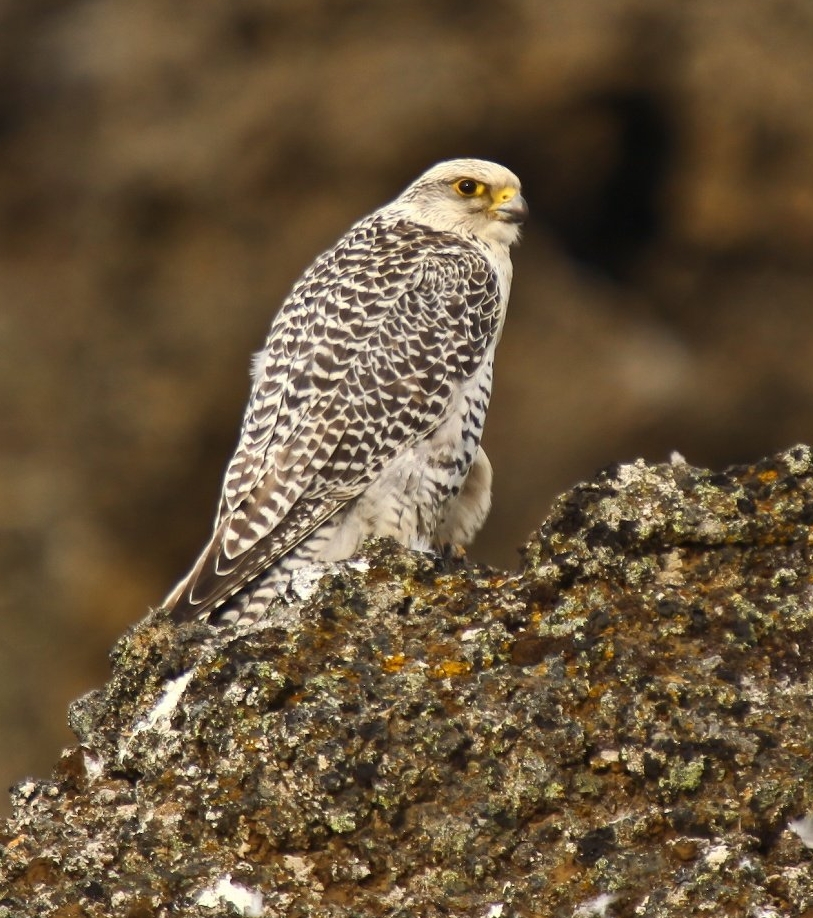 GyrfalconFalco rusticolus
-
 MerlinFalco columbarius
-
 American KestrelFalco sparverius
-
 Saker FalconFalco cherrug
-
 Eurasian HobbyFalco subbuteo
-
 Amur FalconFalco amurensis
Compare
Questions and answers
What is the scientific name of the Orange-breasted Falcon?
The scientific name of the Orange-breasted Falcon is Falco deiroleucus. Written with its author, the full name is Falco deiroleucus Temminck, 1825.
Which family does the Orange-breasted Falcon belong to?
Falco deiroleucus belongs to the family Falconidae, in the order Falconiformes and the class Aves.
Where is the Orange-breasted Falcon found?
Checklists and occurrence records place Falco deiroleucus in 17 countries, including Guatemala, Venezuela, Brazil, Colombia, French Guiana and Belize.
What is the conservation status of the Orange-breasted Falcon?
The IUCN Red List category recorded for Falco deiroleucus is Near Threatened (NT).
Sources
Passages the profile rests on
- Adult Orange-breasted Falcons have black heads and bluish-black upperparts with paler blue-gray feather edges. Source passage: “Adults have a black head and bluish black upperparts with paler blue-gray edge on the feathers.” — English Wikipedia
- Adult Orange-breasted Falcons have white throats and neck sides, with a buffy rufous-orange upper breast. Source passage: “Their throat and sides of the neck are white and their upper breast is buffy rufous orange” — English Wikipedia
- The lower breast is black with coarse reddish-brown bars. Source passage: “Their lower breast is black with coarse reddish brown bars, somewhat lighter on the flanks.” — English Wikipedia
- The belly, thighs, and undertail coverts are buffy rufous-orange. Source passage: “Their belly, thighs, and undertail coverts are the same buffy rufous orange as the upper breast.” — English Wikipedia
- The cere, eye-area skin, legs, and feet are usually bright yellow. Source passage: “Their cere, the bare skin around the eye, and their legs and feet are usually bright yellow” — English Wikipedia
- The iris of the adult is dark brown. Source passage: “Their iris is dark brown.” — English Wikipedia
- Immature individuals have paler and less sharply defined markings than adults. Source passage: “Immatures are paler and less sharply marked than adults.” — English Wikipedia
- Juveniles have mostly pale buffy underparts with dark brown barring on the breast. Source passage: “their underparts mostly pale buffy with dark brown barring on the breast.” — English Wikipedia
- Adult males measure 35–36 cm in length. Source passage: “Male orange-breasted falcons are 35 to 36 cm (14 to 14 in) long” — English Wikipedia
- Adult males weigh 325–425 g. Source passage: “weigh 325 to 425 g (11 to 15 oz).” — English Wikipedia
- Adult females measure 38–40 cm in length. Source passage: “Females are 38 to 40 cm (15 to 16 in) long” — English Wikipedia
- Adult females weigh 550–700 g. Source passage: “weigh 550 to 700 g (19 to 25 oz).” — English Wikipedia
- This species has the greatest size difference between the sexes among falcons. Source passage: “Of all the falcons, this species has the greatest difference in size between the sexes.” — English Wikipedia
- The species depends on tropical rainforest and semi-deciduous forest containing cliffs suitable for nesting. Source passage: “The orange-breasted falcon is dependent of tropical rain- and semi-deciduous forest with cliffs for nesting.” — English Wikipedia
- The species favors uninterrupted mature forest but also occupies landscapes combining forest and more open areas. Source passage: “It favors uninterrupted mature forest but also occurs in a mosaic landscape of forest and more open areas.” — English Wikipedia
- There are no records of the species in El Salvador in the document's account. Source passage: “There are no records in El Salvador.” — English Wikipedia
- The species was formerly distributed from southern Mexico to northern Argentina. Source passage: “The orange-breasted falcon was formerly found from southern Mexico all the way to northern Argentina.” — English Wikipedia
- The species preys on a wide variety of birds and bats. Source passage: “The orange-breasted falcon preys on a very wide variety of birds and also bats.” — English Wikipedia
- At least 45 bird species belonging to 22 families have been documented as prey in Belize and Guatemala. Source passage: “At least 45 species of birds, of 22 families, have been documented as prey in Belize and Guatemala” — English Wikipedia
- The species usually hunts above the forest canopy. Source passage: “It usually hunts above the forest canopy” — English Wikipedia
- It captures prey by diving from cliffs or dead treetops and by stooping from great heights. Source passage: “either by diving from a cliff or dead treetop or by stooping from great height.” — English Wikipedia
- It uses stealth hunting at dawn and dusk to capture migrating songbirds, shorebirds, and bats. Source passage: “It also uses a stealth strategy for capturing migrating songbirds, shorebirds, and bats, by silhouetting them against the sky at dusk and dawn” — English Wikipedia
- Individuals have been observed deliberately crashing into water-covered tree leaves, apparently to bathe. Source passage: “An orange-breasted falcon purposely crashed into leaves of trees with water gathered on them, apparently as a form of bathing.” — English Wikipedia
- Pairs maintain their territories throughout the year. Source passage: “Orange-breasted falcon pairs occupy their territories year-round.” — English Wikipedia
- Young individuals disperse after becoming independent. Source passage: “Young disperse when independent” — English Wikipedia
- Both sexes become highly vocal during the breeding period. Source passage: “Both sexes of the orange-breasted falcon are highly vocal when breeding.” — English Wikipedia
- Pairs produce soft chirps or piping sounds during courtship. Source passage: “Pairs utter soft chirps or piping sounds as part of courtship.” — English Wikipedia
- Nesting sites include cliff ledges and potholes. Source passage: “usually on a cliff ledge or pothole” — English Wikipedia
- The species usually nests in scrapes or depressions on cliff ledges or in potholes. Source passage: “The orange-breasted falcon's nest is a scrape or depression, usually on a cliff ledge or pothole” — English Wikipedia
- A pair has been recorded nesting on a temple in Guatemala's Tikal National Park. Source passage: “though a pair has nested on a temple in Guatemala's Tikal National Park.” — English Wikipedia
- Some nests have been recorded in detritus accumulated in the fork of a large emergent tree. Source passage: “There are also a few records of nesting in detritus caught in the crotch of a large emergent tree.” — English Wikipedia
- The usual clutch contains three eggs, although clutches of two or four occur. Source passage: “The clutch size is usually three eggs but can be two or four.” — English Wikipedia
- Incubation lasts approximately 30–34 days. Source passage: “The incubation period is about 30 to 34 days” — English Wikipedia
- Young birds fledge approximately 40–45 days after hatching. Source passage: “fledging occurs about 40 to 45 days after hatch.” — English Wikipedia
- Females perform most of the incubation and provisioning of nestlings. Source passage: “The female does most of the incubating and provisioning of nestlings.” — English Wikipedia
- The IUCN classifies the Orange-breasted Falcon as Near Threatened. Source passage: “The IUCN has assessed the orange-breasted falcon as Near Threatened.” — English Wikipedia
- The species' population is believed to be declining. Source passage: “Its population size is not known and is believed to be decreasing.” — English Wikipedia
- Forest clearance for timber production, agriculture, and ranching is the principal threat to the species. Source passage: “Clearing of forest for timber, agriculture, and ranching is the principal threat.” — English Wikipedia
- Black vultures and Africanized bees are known or suspected to affect the species' nesting success. Source passage: “Black vultures and Africanized bees are known or suspected to affect nesting success.” — English Wikipedia
- The Orange-breasted Falcon resembles a larger version of the Bat Falcon. Source passage: “The orange-breasted falcon looks like a larger version of the bat falcon (F. rufigularis)” — English Wikipedia
- The Orange-breasted Falcon and Bat Falcon share plumage and vocal characteristics and are sister species. Source passage: “They share plumage and vocal characteristics and are sister species.” — English Wikipedia
- Adult Orange-breasted Falcons can be distinguished from adult Bat Falcons by their orange upper-breast band above the black chest. Source passage: “orange-breasted falcon has an orange band on the upper breast above the black chest” — English Wikipedia
- The species is present but rare in Brazil, Ecuador, Peru, and Venezuela. Source passage: “The species is present though rare in Brazil, Ecuador, Peru, and Venezuela.” — English Wikipedia
- The species is extremely rare or possibly locally extinct in Costa Rica, Nicaragua, and Honduras. Source passage: “It is extremely rare or extirpated in Costa Rica, Nicaragua, and Honduras.” — English Wikipedia
Data
- Catalogue of Life, 2026-10-16 XR cc by
- Global Biodiversity Information Facility CC BY 4.0
- Wikidata CC0
- GeoNames CC BY 4.0
- Wikimedia Commons per image; credit shown with each image
- Within the Catalogue of Life, this name comes from The Integrated Taxonomic Information System cc0
References
- Planches Color., livr. 59, pl. 348. 1825 where the name was published
- Mayr, Ernst, and G. William Cottrell, eds. (1979). Check-List of Birds of the World, Vol. 1, Second Edition.
- Dickinson, Edward C., ed. (2003). The Howard and Moore Complete Checklist of the Birds of the World, 3rd Edition.
- Gill, Frank, & and Minturn Wright. (2006). Birds of the World: Recommended English Names.
- Dickinson, E. C., and J. V. Remsen Jr., eds. (2013). The Howard and Moore Complete Checklist of the Birds of the World, 4th Edition, Vol. 1 Non-Passerines.
This species in other databases
Page built on 27 November 2026. See how the catalog is made and all sources and licences.
Cite this page
ScientificNames.org. (2026). Falco deiroleucus (Orange-breasted Falcon). Retrieved November 27, 2026, from https://scientificnames.org/species/falco-deiroleucus
“Falco deiroleucus (Orange-breasted Falcon).” ScientificNames.org, 2026, scientificnames.org/species/falco-deiroleucus. Accessed 27 Nov. 2026.
ScientificNames.org. “Falco deiroleucus (Orange-breasted Falcon).” Accessed November 27, 2026. https://scientificnames.org/species/falco-deiroleucus.
@misc{scientificnames_falco_deiroleucus_orange_breasted_falcon,
  author = {{ScientificNames.org}},
  title = {Falco deiroleucus (Orange-breasted Falcon)},
  year = {2026},
  url = {https://scientificnames.org/species/falco-deiroleucus},
  note = {Accessed 2026-11-27}
}