Species · Birds
Eleonora's Falcon Falco eleonorae
The scientific name of the Eleonora's Falcon is Falco eleonorae. It is a species of bird in the family Falconidae (falcons), order Falconiformes. The name dates from 1839.
- Scientific name
- Falco eleonorae Géné, 1839
- Common name
- Eleonora's Falcon
- Genus
- Falco
- Family
- Falconidae (Falcons)
- Order
- Falconiformes
- Class
- Aves
- Red List category
- LC Least Concern
- Environment
- terrestrial
- Recorded in
- 52 countries
- Name status
- accepted in the Catalogue of Life

Overview
Falco eleonorae breeds on Mediterranean islands and winters in Madagascar and the Mascarene Islands. It is a long-distance migrant, with individuals recorded travelling up to 9,000 km on a single one-way migration.
Written 26 November 2026 from the sources listed below. Each statement was checked against the passage it cites; statements that could not be supported were removed.
Appearance
Eleonora's Falcon has a slim body, long pointed wings, and a long tail. The species has two colour morphs, dark and light.[1][2]
Adult dark-morph individuals have sooty-brown plumage and black underwing coverts. Light-morph individuals have buff underparts and black underwing coverts contrasting with paler flight-feather bases.[3][4]
Adults measure 36–42 cm in body length, and their wingspan ranges from 87 to 104 cm. Male individuals measure 37–43 cm in length and weigh between 350 and 390 g, while females measure 38.5–45.5 cm and weigh between 340 and 460 g.[5][6][7][8][9][10]
Large females can have wingspans reaching 103 cm.[11]
Habitat
Eleonora's Falcon breeds on small, rocky, undisturbed islands with little vegetation. On larger islands and mainland sites in Africa and Turkey, it breeds on inaccessible coastal cliffs.[12][13]
Breeding sites occur from sea level up to 2,000 metres elevation. The species hunts over open sea, wetlands, grasslands, and occasionally woodlands.[14][15]
The species breeds on Mediterranean islands, particularly in Greece, where approximately two-thirds of the global population breeds. Its breeding distribution includes Cyprus, the Canary Islands, Ibiza, Spain, Italy, Croatia, Morocco, and Algeria.[16][17]
Diet
Eleonora's Falcon feeds primarily on flying insects outside the main bird-hunting period. It catches large insects, including dragonflies, and consumes them while flying.[18][19]
The species specializes in catching large winged insects exceeding 10 mm in length throughout the year. Coleoptera, Hymenoptera, and Hemiptera are the most frequently recorded insect prey orders.[20][21]
During breeding, the species concentrates its hunting on migrating passerine birds. More than 100 prey bird species have been recorded, with insectivorous bird species forming its principal bird prey.[22][23][24]
The species occasionally feeds on bats.[25]
Behaviour
Eleonora's Falcon is a long-distance migrant that winters in Madagascar. Individuals have been recorded travelling up to 9,000 km on a single one-way migration.[26][27]
The species uses aerial speed and aerobatic skills to capture small birds in flight. Individuals sometimes imprison live prey in rock crevices for later consumption.[28][29]
The species is gregarious and forms breeding colonies containing as many as 300 pairs. Outside breeding colonies, individuals are likely to live solitarily.[30][31]
During the pre-breeding season, individuals can travel up to 600 km from their breeding colonies to find prey. During autumn, they forage in groups mainly in the morning and evening.[32][33]
Reproduction and life cycle
Eleonora's Falcons are monogamous colonial breeders. Breeding territories begin to be occupied in late April, although breeding begins in late July.[34][35]
Clutches usually contain one to four eggs, with five occurring rarely. Incubation lasts between 28 and 30 days.[36][37]
Young individuals hatch between late August and early September. They fledge 35–40 days after hatching.[38][39]
Both parents participate in incubating, protecting, and feeding their offspring.[40]
Conservation
Eleonora's Falcon is included in Annex I of European Directive 2009/147/EC. The species receives protection under local, regional, national, and European frameworks.[41][42]
The species is designated a priority species for conservation.[43]
Classification of the Eleonora's Falcon
| Kingdom | Animalia |
|---|---|
| Phylum | Chordata |
| Subphylum | Vertebrata |
| Infraphylum | Gnathostomata |
| Parvphylum | Osteichthyes |
| Megaclass | Tetrapoda |
| Class | Aves (Bird) |
| Order | Falconiformes (Falcons) |
| Family | Falconidae (Falcons) |
| Subfamily | Falconinae |
| Genus | Falco (Falcons) |
| Species | Falco eleonorae Géné, 1839 |
Origin of the name. Eleanor of Arborea
Where the Eleonora's Falcon is found
Checklists and occurrence records place Falco eleonorae in 52 countries across Africa. GBIF holds 32,218 georeferenced records of it.
Countries
- Albania 13
- Algeria 80
- Bulgaria 215
- Comoros 7
- Croatia 237
- Cyprus 1,909
- Denmark 6
- Egypt 52
- Ethiopia 18
- Finland 11
- France 4,633
- Georgia 29
- Germany 6
- Gibraltar 12
- Greece 7,560
- Israel 1,066
- Italy 1,452
- Jordan 4
- Kenya 89
- Kuwait 9
- Lebanon 19
- Madagascar 301
- Malta 103
- Mauritius 21
- Mayotte 14
- Montenegro 18
- Morocco 773
- Mozambique 3
- Nigeria 4
- Oman 5
- Palestinian Territory 58
- Poland 8
- Portugal 484
- Reunion 62
- Romania 10
- Saudi Arabia 4
- Serbia 5
- Seychelles 11
- Slovenia 6
- Somalia 4
- Spain 11,077
- Sweden 114
- Syria 3
- Tanzania 34
- The Netherlands 7
- Tunisia 35
- Turkey 1,368
- Uganda 4
- United Arab Emirates 3
- United Kingdom 244
- Zambia 3
- Zimbabwe 5
Regions and cities with the most records
- Balearic Islands, Spain 4,309
- Pollença, Spain 2,693
- Alcúdia, Spain 2,684
- Occitanie, France 2,144
- Provence-Alpes-Côte d'Azur, France 1,845
- Crete, Greece 1,408
- Káto Polemídia, Cyprus 1,229
- Limassol, Cyprus 1,225
- Inca, Spain 1,166
- Canary Islands, Spain 1,112
- Attica, Greece 933
- Teguise, Spain 802
- Valencia, Spain 774
- Sicily, Italy 717
- Germasógeia, Cyprus 653
- San Bartolomé, Spain 645
- Catalonia, Spain 640
- Arrecife, Spain 630
- Tías, Spain 579
- Puerto del Carmen, Spain 569
- Calvià, Spain 564
- Arles, France 560
- Northern District, Israel 524
- Essaouira, Morocco 447
- Narbonne, France 437
- Pafos, Cyprus 428
- Maghār, Israel 384
- Karmi’el, Israel 379
- maalot Tarshīhā, Israel 379
- Faro, Portugal 375
- Safed, Israel 368
- Majd el Kurūm, Israel 363
- Yirkā, Israel 345
- Sakhnīn, Israel 342
- Paphos, Cyprus 322
- Alès, France 311
1 more country has a few records outside this range
These countries hold a few records of Falco eleonorae but lie outside the range the checklists give for it. Such records are often zoo or garden specimens, museum material or vagrants, so the species is not counted as occurring there.
Range as the checklists state it
Europe & Northern Asia (excluding China)
Africa
A number beside a place is its count of GBIF occurrence records. A place without a number comes from a checklist alone. Records show where a species has been observed or collected, which can include escapes and vagrants.
Common names
English
- Eleonora's Falcon
Names in 46 other languages
- Afrikaans
- Eleonoravalk
- Albanian
- skifteri i murrmë, skifteri mbretëror
- Arabic
- صقر أسحم, صقر اليونورا
- Asturian
- falcón de la reina eleonor
- Basque
- Eleonor belatza
- Breton
- Falc'hun Eleonora
- Bulgarian
- Средиземноморски сокол
- Catalan
- Falcó marí, falcó de la reina
- Chinese
- 埃歐諾拉氏隼, 艾氏隼
- Croatian
- eleonorin sokol
- Czech
- ostříž jižní
- Dutch
- Eleonora's Valk, Eleonora-valk
- Esperanto
- Kliffalko, eleonora falko
- Estonian
- vahemere pistrik
- Finnish
- välimerenhaukka
- French
- Faucon d'Eléonore, Faucon d'Éléonore, Faucon d’Éléonore
- Galician
- Falcón da raíña
- German
- Eleonoren-Falke, Eleonorenfalke
- Greek
- Μαυροπετρίτης
- Hebrew
- בז חופים
- Hungarian
- Eleonóra-sólyom
- Icelandic
- Eyfálki
- Irish
- Fabhcún meánmhuirí
- Italian
- falco della regina
- Japanese
- エレオノラハヤブサ
- Latvian
- Eleonoras piekūns
- Lithuanian
- Akmeninis sakalas, Eleonoros sakalas
- Macedonian
- Средоземноморски сокол, медитерански сокол
- Malagasy
- Firasambalala
- Maltese
- Bies tar-Reġina
- Northern Sami
- Eleonorafálli
- Norwegian
- Eleonorafalk
- Norwegian Bokmål
- Leonorafalk Eleonorafalk
- Polish
- sokół skalny
- Portuguese
- falcão-da-rainha
- Romanian
- Şoim mediteranean
- Russian
- Алет, сокол элеоноры
- Serbian
- Morski soko, mrki soko / Мрки соко
- Slovak
- sokol ostrovný
- Slovenian
- sredozemski sokol
- Spanish
- Halcón de Eleonora, halcón de Eleonor
- Swahili
- Kozi wa Eleonora
- Turkish
- Kara Doğan, ada dogan, ada doğan, ada doğanı
- Ukrainian
- Підсоколик Елеонори, Чеглок Элеоноры, сокол Елеонори
- Welsh
- hebog Eleonora
- glv
- Shawk Eleonora
Related species
-
 Peregrine FalconFalco peregrinus
-
 Common KestrelFalco tinnunculus
-
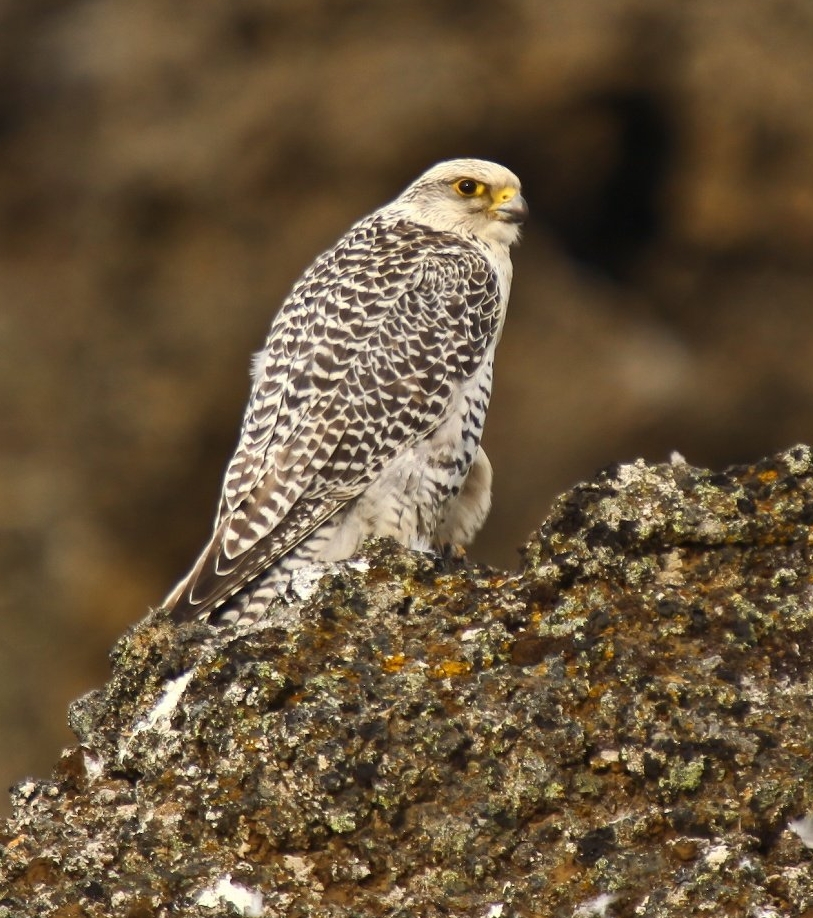 GyrfalconFalco rusticolus
-
 MerlinFalco columbarius
-
 American KestrelFalco sparverius
-
 Saker FalconFalco cherrug
-
 Eurasian HobbyFalco subbuteo
-
 Amur FalconFalco amurensis
Compare
Questions and answers
What is the scientific name of the Eleonora's Falcon?
The scientific name of the Eleonora's Falcon is Falco eleonorae. Written with its author, the full name is Falco eleonorae Géné, 1839.
Which family does the Eleonora's Falcon belong to?
Falco eleonorae belongs to the family Falconidae, in the order Falconiformes and the class Aves.
Where is the Eleonora's Falcon found?
Checklists and occurrence records place Falco eleonorae in 52 countries, including Spain, Greece, France, Cyprus, Italy and Turkey.
What is the conservation status of the Eleonora's Falcon?
The IUCN Red List category recorded for Falco eleonorae is Least Concern (LC).
What habitats do falcons live in?
Eleonora's Falcon breeds on small, rocky, undisturbed islands with little vegetation and on inaccessible coastal cliffs on larger islands and mainland sites in Africa and Turkey. It hunts over open sea, wetlands, grasslands, and occasionally woodlands.[12][13][14]
What does a falcon bird eat?
Eleonora's Falcon feeds primarily on flying insects outside the main bird-hunting period, including dragonflies, Coleoptera, Hymenoptera, and Hemiptera. During breeding, it concentrates its hunting on migrating passerine birds, particularly insectivorous species, and occasionally feeds on bats.[18][25][19][22][24][21]
Sources
Passages the profile rests on
- Eleonora's Falcon has a slim body, long pointed wings, and a long tail. Source passage: “with its long pointed wings, long tail and slim body.” — English Wikipedia
- The species has two colour morphs, dark and light. Source passage: “There are two colour morphs:” — English Wikipedia
- Adult dark-morph individuals have sooty-brown plumage and black underwing coverts. Source passage: “The adult dark morph is all sooty brown, with black underwing coverts.” — English Wikipedia
- Light-morph individuals have buff underparts and black underwing coverts contrasting with paler flight-feather bases. Source passage: “The light morph is more like a juvenile Eurasian hobby, but has buff underparts, and also shows the contrast between the black underwing coverts and paler base to the flight feathers.” — English Wikipedia
- Adults measure 36–42 cm in body length. Source passage: “36–42 cm (14–17 in) long” — English Wikipedia
- The wingspan ranges from 87 to 104 cm. Source passage: “with an 87–104 cm (34–41 in) wingspan.” — English Wikipedia
- Male individuals measure 37–43 cm in length. Source passage: “Males vary in length from 37 to 43 cm” — animaldiversity.org
- Female individuals measure 38.5–45.5 cm in length. Source passage: “females from 38.5 to 45.5 cm” — animaldiversity.org
- Male individuals weigh between 350 and 390 g. Source passage: “in weight, males range from 350 to 390 g” — animaldiversity.org
- Female individuals weigh between 340 and 460 g. Source passage: “females from 340 to 460 g.” — animaldiversity.org
- Large females can have wingspans reaching 103 cm. Source passage: “large females may have a wingspan of up to 103 cm.” — animaldiversity.org
- The species breeds on small, rocky, undisturbed islands with little vegetation. Source passage: “Eleonora’s falcons commonly breed on the ground on small, rocky, undisturbed islands with little vegetation.” — animaldiversity.org
- On larger islands and mainland sites in Africa and Turkey, the species breeds on inaccessible coastal cliffs. Source passage: “On larger islands, such as Sicily and Sardinia, and on the mainland in Africa and Turkey, they seek inaccessible coastal cliffs to breed.” — animaldiversity.org
- The species hunts over open sea, wetlands, grasslands, and occasionally woodlands. Source passage: “They hunt over the open sea, as well as over wetlands, grasslands, and sometimes woodlands.” — animaldiversity.org
- Breeding sites occur from sea level up to 2,000 metres elevation. Source passage: “Nest sites are found from sea-level to an elevation of 2,000 meters.” — animaldiversity.org
- The species breeds on Mediterranean islands, particularly in Greece, where approximately two-thirds of the global population breeds. Source passage: “This species breeds on islands in the Mediterranean particularly off Greece (where two-thirds of the world's population breeds)” — English Wikipedia
- The breeding distribution includes Cyprus, the Canary Islands, Ibiza, Spain, Italy, Croatia, Morocco, and Algeria. Source passage: “but also in Cyprus, the Canary Islands, Ibiza and off Spain, Italy, Croatia, Morocco and Algeria.” — English Wikipedia
- The species catches large insects, including dragonflies, and consumes them while flying. Source passage: “It will take large insects, such as dragonflies, which are transferred from talons to beak and eaten in flight.” — English Wikipedia
- Eleonora's Falcons feed primarily on flying insects outside the main bird-hunting period. Source passage: “Eleonora’s falcons feed primarily on flying insects.” — animaldiversity.org
- The species specializes in catching large winged insects exceeding 10 mm in length throughout the year. Source passage: “highly specialized as an aerial predator of large, winged insects (>10 mm in length) throughout the year” — pmc.ncbi.nlm.nih.gov
- Coleoptera, Hymenoptera, and Hemiptera are the most frequently recorded insect prey orders. Source passage: “Coleoptera, Hymenoptera, and Hemiptera were the most frequent insect orders.” — pmc.ncbi.nlm.nih.gov
- During breeding, the species concentrates its hunting on migrating passerine birds. Source passage: “During the breeding season, however, these falcons switch their hunting behavior and concentrate solely on migrating passerine birds.” — animaldiversity.org
- More than 100 prey bird species have been recorded for Eleonora's Falcon. Source passage: “Over 100 species have been recorded as prey of Eleonora’s falcons.” — animaldiversity.org
- The species consumes insectivorous bird species as its principal bird prey. Source passage: “it mainly preys on insectivorous bird species” — pmc.ncbi.nlm.nih.gov
- The species occasionally feeds on bats. Source passage: “Occasionally, it was observed as feeding on bats.” — English Wikipedia
- The species is a long-distance migrant that winters in Madagascar. Source passage: “This is a long-distance migrant, wintering in Madagascar.” — English Wikipedia
- Individuals have been recorded travelling up to 9,000 km on a single one-way migration. Source passage: “The total distance covered during the flight has reached up to 9,000 km (5,600 mi) for a single one-way trip.” — English Wikipedia
- The species uses aerial speed and aerobatic skills to capture small birds in flight. Source passage: “It captures small birds in flight, using its speed and aerobatic skills.” — English Wikipedia
- Individuals sometimes imprison live prey in rock crevices for later consumption. Source passage: “researchers found that Eleonora's falcons are imprisoning live prey in rock crevices for later consumption.” — English Wikipedia
- The species is gregarious and forms breeding colonies containing as many as 300 pairs. Source passage: “They nest in colonies of up to 300 pairs” — animaldiversity.org
- Outside breeding colonies, individuals are likely to live solitarily. Source passage: “When not occupying breeding colonies, these falcons are likely to be solitary.” — animaldiversity.org
- During the pre-breeding season, individuals can travel up to 600 km from their breeding colonies to find prey. Source passage: “During this time, birds can travel distances of up to 600 km from their breeding colonies in search of prey” — pmc.ncbi.nlm.nih.gov
- During autumn, individuals forage in groups mainly in the morning and evening. Source passage: “At this time, they hunt in groups, primarily during the morning and evening hours” — pmc.ncbi.nlm.nih.gov
- Eleonora's Falcons are monogamous colonial breeders. Source passage: “Eleonora’s falcons are monogamous, colonial breeders.” — animaldiversity.org
- Breeding territories begin to be occupied in late April, although breeding begins in late July. Source passage: “Breeding sites are occupied starting in late April, though breeding does not start until late July.” — animaldiversity.org
- Clutches usually contain one to four eggs, with five occurring rarely. Source passage: “Clutch size ranges from 1 to 4 eggs, rarely 5.” — animaldiversity.org
- Incubation lasts between 28 and 30 days. Source passage: “Incubation lasts between 28 and 30 days” — animaldiversity.org
- Young individuals hatch between late August and early September. Source passage: “The young hatch in late August to early September” — animaldiversity.org
- Young individuals fledge 35–40 days after hatching. Source passage: “the young fledge after another 35 to 40 days.” — animaldiversity.org
- Both parents participate in incubating, protecting, and feeding their offspring. Source passage: “both males and females contribute to incubating, protecting, and nourishing their offspring.” — animaldiversity.org
- Eleonora's Falcon is included in Annex I of European Directive 2009/147/EC. Source passage: “Eleonora’s falcon (Falco eleonorae Géné, 1839) is included in Annex I of the European Directive 2009/147/EC.” — pmc.ncbi.nlm.nih.gov
- The species receives protection under local, regional, national, and European frameworks. Source passage: “It is protected by local, regional, national, and European frameworks” — pmc.ncbi.nlm.nih.gov
- Eleonora's Falcon is designated a priority species for conservation. Source passage: “and it constitutes a priority species for conservation” — pmc.ncbi.nlm.nih.gov
Data
- Catalogue of Life, 2026-10-16 XR cc by
- Global Biodiversity Information Facility CC BY 4.0
- Wikidata CC0
- GeoNames CC BY 4.0
- Wikimedia Commons per image; credit shown with each image
- Within the Catalogue of Life, this name comes from The Integrated Taxonomic Information System cc0
References
- Gené, Giuseppe. 1839. Nouvelle espèce européenne du genre faucon. Revue Zoologique, par la Société Cuvierienne 2: 105. where the name was published
- Mayr, Ernst, and G. William Cottrell, eds. (1979). Check-List of Birds of the World, Vol. 1, Second Edition.
- Dickinson, Edward C., ed. (2003). The Howard and Moore Complete Checklist of the Birds of the World, 3rd Edition.
- Gill, Frank, & and Minturn Wright. (2006). Birds of the World: Recommended English Names.
- Dickinson, E. C., and J. V. Remsen Jr., eds. (2013). The Howard and Moore Complete Checklist of the Birds of the World, 4th Edition, Vol. 1 Non-Passerines.
This species in other databases
- Catalogue of Life 3DTG5
- Wikidata Q212243
- iNaturalist 4671
- WoRMS urn:lsid:marinespecies.org:taxname:212680
- Avibase elefal1
Page built on 27 November 2026. See how the catalog is made and all sources and licences.
Cite this page
ScientificNames.org. (2026). Falco eleonorae (Eleonora's Falcon). Retrieved November 27, 2026, from https://scientificnames.org/species/falco-eleonorae
“Falco eleonorae (Eleonora's Falcon).” ScientificNames.org, 2026, scientificnames.org/species/falco-eleonorae. Accessed 27 Nov. 2026.
ScientificNames.org. “Falco eleonorae (Eleonora's Falcon).” Accessed November 27, 2026. https://scientificnames.org/species/falco-eleonorae.
@misc{scientificnames_falco_eleonorae_eleonoras_falcon,
  author = {{ScientificNames.org}},
  title = {Falco eleonorae (Eleonora's Falcon)},
  year = {2026},
  url = {https://scientificnames.org/species/falco-eleonorae},
  note = {Accessed 2026-11-27}
}