Species · Birds
Prairie Falcon Falco mexicanus
The scientific name of the Prairie Falcon is Falco mexicanus. It is a species of bird in the family Falconidae (falcons), order Falconiformes. The name dates from 1850.
- Scientific name
- Falco mexicanus Schlegel, 1850
- Common name
- Prairie Falcon
- Genus
- Falco
- Family
- Falconidae (Falcons)
- Order
- Falconiformes
- Class
- Aves
- Red List category
- LC Least Concern
- Environment
- terrestrial
- Recorded in
- 3 countries
- Name status
- accepted in the Catalogue of Life

Overview
Falco mexicanus occurs in western North America, from Canada through the western United States to northern Mexico. It has warm gray-brown upper plumage, pale underparts with dark mottling, and predominantly very dark brown axillars and underwing coverts.
Written 26 November 2026 from the sources listed below. Each statement was checked against the passage it cites; statements that could not be supported were removed.
Appearance
The upper plumage is warm gray-brown, while the underparts are pale with dark mottling. The head has a thin malar stripe and a white line above the eye.[1][2]
Adult birds generally have yellow skin around the eyes, cere, legs, and talons, sometimes with orange or green tinges. Juveniles generally have gray skin in these areas.[3][4]
Adult males measure 37–38 cm in length and weigh 500–635 g. Adult females measure approximately 45 cm in length and weigh 762–970 g, and the wingspan of a large female can reach 1.1 m.[5][6][7]
Habitat
Its natural habitat consists primarily of open, often arid country. Summer habitats include alpine tundra, shortgrass prairie, and high desert.[8][9]
During winter, it occupies low deserts and occasionally towns.[10]
The species occurs in western North America, from Canada through the western United States to northern Mexico. Its breeding range extends from southern Saskatchewan, Alberta, and south-central British Columbia through the western United States to Baja California, Durango, and northern San Luis Potosí in Mexico.[11][12]
In winter, its range extends south to Baja California Sur, Jalisco, and Hidalgo.[13]
Diet
Its diet consists mainly of small mammals, particularly during summer, and small to medium-sized birds. It occasionally consumes reptiles.[14][15]
Mammalian prey includes ground squirrels, prairie dogs, voles, chipmunks, gophers, and rabbits. Avian prey includes horned larks, meadow larks, sparrows, starlings, grackles, doves, quail, pigeons, coots, teal, and mallards.[16][17]
Most of its prey weighs 150 g or less. It usually captures prey smaller than itself that it can carry to a nest or safe perch.[18][19]
Behaviour
The species is less migratory than other North American falcons. Its estimated cruising speed is approximately 72 km/h.[20][21]
It hunts by flying fast and low, sometimes only a few metres above the ground. It can perform low-altitude attacks after diving from higher elevations at speeds exceeding 100 mph.[22][23]
It sometimes uses terrain as cover before climbing rapidly into flocks of birds to attack.[24]
Adult calls near the nest include repetitive kree and kik notes and are higher-pitched than those of the peregrine.[25]
Reproduction and life cycle
Mated pairs occupy nesting territories ranging from less than 30 to more than 400 square kilometres. The species nests on cliff ledges and does not construct its own nest, instead using abandoned nests of other birds or rock-face alcoves.[26][27][28]
The average clutch contains five eggs. The eggs are subelliptical and pinkish, with brown, reddish-brown, and purplish dots.[29][30]
Incubation lasts 29–39 days and begins with the penultimate or final egg. Females perform most incubation, while males contribute up to approximately 30% of the time.[31][32]
Young birds first fly 36–41 days after hatching and become self-sufficient at approximately 65 days of age.[33][34]
The female performs most brooding, while the male supplies most of the food.[35]
Similar species
The peregrine falcon is the principal similar species within its range. The Prairie Falcon has a proportionally longer tail and a more tubular body than the peregrine falcon.[36][37]
Its wing joint is positioned farther from the body than that of the peregrine falcon.[38]
Classification of the Prairie Falcon
| Kingdom | Animalia |
|---|---|
| Phylum | Chordata |
| Subphylum | Vertebrata |
| Infraphylum | Gnathostomata |
| Parvphylum | Osteichthyes |
| Megaclass | Tetrapoda |
| Class | Aves (Bird) |
| Order | Falconiformes (Falcons) |
| Family | Falconidae (Falcons) |
| Subfamily | Falconinae |
| Genus | Falco (Falcons) |
| Species | Falco mexicanus Schlegel, 1850 |
Where the Prairie Falcon is found
Checklists and occurrence records place Falco mexicanus in 3 countries across North America. GBIF holds 200,242 georeferenced records of it.
Countries
Regions and cities with the most records
- California, United States 41,277
- Colorado, United States 26,064
- Arizona, United States 17,776
- Oregon, United States 16,081
- Utah, United States 9,926
- Montana, United States 9,571
- Idaho, United States 9,062
- Washington, United States 7,957
- New Mexico, United States 7,577
- Nevada, United States 6,630
- Alberta, Canada 6,454
- Texas, United States 5,919
- Wyoming, United States 5,414
- Kansas, United States 3,554
- Columbine, United States 3,087
- Colorado Springs, United States 2,984
- Arvada, United States 2,933
- Ken Caryl, United States 2,865
- Catalina Foothills, United States 2,857
- Englewood, United States 2,813
- Littleton, United States 2,806
- Lakewood, United States 2,770
- Dakota Ridge, United States 2,757
- Wheat Ridge, United States 2,726
- Tucson, United States 2,690
- Flowing Wells, United States 2,601
- Casas Adobes, United States 2,594
- Lafayette, United States 2,531
- Louisville, United States 2,488
- Thornton, United States 2,437
- Broomfield, United States 2,422
- Denver, United States 2,401
- Highlands Ranch, United States 2,341
- Boulder, United States 2,306
- Oro Valley, United States 2,265
- Northglenn, United States 2,205
Range as the checklists state it
Middle America
North America
A number beside a place is its count of GBIF occurrence records. A place without a number comes from a checklist alone. Records show where a species has been observed or collected, which can include escapes and vagrants.
Common names
English
- Prairie Falcon
Names in 28 other languages
- Arabic
- صقر البراري
- Bulgarian
- Прериен сокол
- Catalan
- falcó de les praderies
- Chinese
- 草原隼
- Croatian
- prerijski sokol
- Czech
- raroh prériový
- Danish
- Præriefalk
- Dutch
- Prairievalk
- Esperanto
- preria falko
- Estonian
- preeriapistrik
- Finnish
- preeriahaukka
- French
- Faucon des prairies
- German
- Präriefalke
- Hungarian
- prérisólyom
- Italian
- Falco di prateria
- Japanese
- ソウゲンハヤブサ
- Latvian
- prēriju piekūns
- Lithuanian
- prerinis sakalas
- Polish
- sokół preriowy
- Portuguese
- falcão-das-pradarias
- Russian
- Мексиканский сокол
- Serbian
- Prerijski soko
- Slovak
- sokol prériový
- Spanish
- Halcón mexicano
- Swedish
- präriefalk
- Turkish
- Kır doğanı, Çayır Doğanı
- Ukrainian
- сокіл прерієвий
- Welsh
- hebog paith
Related species
-
 Peregrine FalconFalco peregrinus
-
 Common KestrelFalco tinnunculus
-
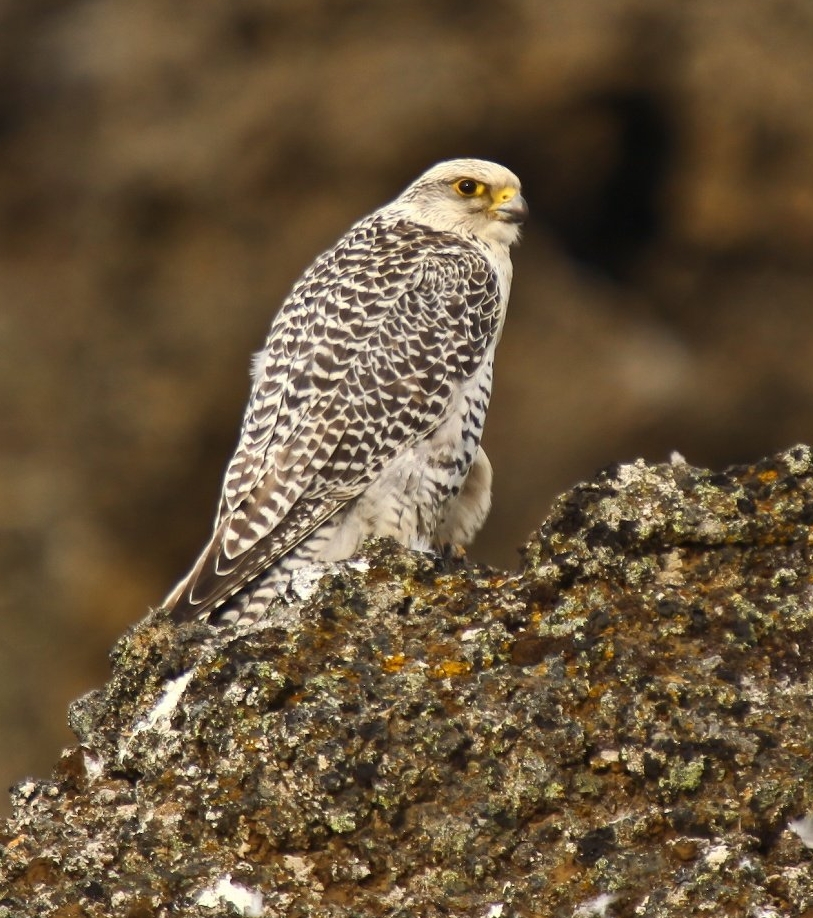 GyrfalconFalco rusticolus
-
 MerlinFalco columbarius
-
 American KestrelFalco sparverius
-
 Saker FalconFalco cherrug
-
 Eurasian HobbyFalco subbuteo
-
 Amur FalconFalco amurensis
Compare
Questions and answers
What is the scientific name of the Prairie Falcon?
The scientific name of the Prairie Falcon is Falco mexicanus. Written with its author, the full name is Falco mexicanus Schlegel, 1850.
Which family does the Prairie Falcon belong to?
Falco mexicanus belongs to the family Falconidae, in the order Falconiformes and the class Aves.
Where is the Prairie Falcon found?
Checklists and occurrence records place Falco mexicanus in 3 countries: United States, Canada and Mexico.
What is the conservation status of the Prairie Falcon?
The IUCN Red List category recorded for Falco mexicanus is Least Concern (LC).
What do Prairie Falcons eat?
Prairie Falcons eat mainly small mammals and small to medium-sized birds, and occasionally reptiles. Their prey includes ground squirrels, prairie dogs, voles, chipmunks, gophers, rabbits, larks, sparrows, starlings, grackles, doves, quail, pigeons, coots, teal, and mallards.[14][16][17][15]
What habitats do falcons live in?
The Prairie Falcon occupies open, often arid country, including alpine tundra, shortgrass prairie, high desert, and low deserts. It occasionally occupies towns during winter.[8][9][10]
Where do Prairie Falcons live?
Prairie Falcons occur in western North America, from Canada through the western United States to northern Mexico. Their breeding range extends to Baja California, Durango, and northern San Luis Potosí in Mexico, while their winter range extends south to Baja California Sur, Jalisco, and Hidalgo.[11][12][13]
Sources
Passages the profile rests on
- The upper plumage is warm gray-brown, while the underparts are pale with dark mottling. Source passage: “Plumage is warm gray-brown (sometimes called "sandy") above and pale with dark mottling below.” — English Wikipedia
- The head has a thin malar stripe and a white line above the eye. Source passage: “The head has a thin "moustache" mark, called a malar stripe, that is characteristic of falcons, and a white line over the eye.” — English Wikipedia
- Juveniles generally have gray skin around the eyes, cere, legs, and talons. Source passage: “Skin tends to be gray in juveniles.” — English Wikipedia
- Adult birds generally have yellow skin around the eyes, cere, legs, and talons, sometimes with orange or green tinges. Source passage: “Skin around eyes, above beak (cere) and on legs and talons tends to be more yellow and sometimes with tinges of orange or green in adults.” — English Wikipedia
- Adult males measure 37–38 cm in length and weigh 500–635 g. Source passage: “Male prairie falcons are usually 37 to 38 cm in length (~15 inches) and weigh 500 to 635g (1.1 to 1.4 lbs).” — English Wikipedia
- Adult females measure approximately 45 cm in length and weigh 762–970 g. Source passage: “Females are about 45 cm in length (17.7 inches) and weigh 762 to 970g (1.7 to 2.1 lbs).” — English Wikipedia
- The wingspan of a large female can reach 1.1 m. Source passage: “A large female can be nearly twice the size of a small male, with wingspan reaching to 1.1 meters (3.5 feet)” — English Wikipedia
- Its natural habitat consists primarily of open, often arid country. Source passage: “The natural habitat of the prairie falcon is open country, especially arid” — English Wikipedia
- Its summer habitats include alpine tundra, shortgrass prairie, and high desert. Source passage: “in summer including alpine tundra to shortgrass prairie and high desert.” — English Wikipedia
- During winter, it occupies low deserts and occasionally towns. Source passage: “In winter it is more widespread, ranging to low deserts and occasionally to towns.” — English Wikipedia
- The species occurs in western North America, from Canada through the western United States to northern Mexico. Source passage: “The prairie falcon is resident from Canada (mainly Alberta, British Columbia and Saskatchewan) through the Western United States (west of the Mississippi) and south into Northern Mexico.” — English Wikipedia
- Its breeding range extends from southern Saskatchewan, Alberta, and south-central British Columbia through the western United States to Baja California, Durango, and northern San Luis Potosí in Mexico. Source passage: “It breeds from southern Saskatchewan, Alberta and south-central British Columbia south through the western United States–roughly between the eastern edge of the Mountain Time Zone and the Cascade Mountains, as well as the Central Valley of California–to the Mexican states of Baja California, Durango, and northern San Luis Potosí.” — English Wikipedia
- In winter, its range extends south to Baja California Sur, Jalisco, and Hidalgo. Source passage: “south to Baja California Sur, Jalisco, and Hidalgo.” — English Wikipedia
- Its diet consists mainly of small mammals, particularly during summer, and small to medium-sized birds. Source passage: “The prairie falcon eats mostly small mammals (especially in summer) and small to medium-sized birds caught in flight” — English Wikipedia
- The species occasionally consumes reptiles. Source passage: “Reptiles are also sometimes taken.” — English Wikipedia
- Its mammalian prey includes ground squirrels, prairie dogs, voles, chipmunks, gophers, and rabbits. Source passage: “Common mammalian prey for prairie falcons includes ground squirrels, prairie dogs, voles, chipmunks, gophers, and rabbits of various species.” — English Wikipedia
- Its avian prey includes horned larks, meadow larks, sparrows, starlings, grackles, doves, quail, pigeons, coots, teal, and mallards. Source passage: “Bird prey commonly includes horned larks, meadow larks, sparrows, starlings, grackles, doves, quail, pigeons, coots, teal, and mallards” — English Wikipedia
- Most of its prey weighs 150 g or less. Source passage: “The majority of prey is 150g or less” — English Wikipedia
- It usually captures prey smaller than itself that it can carry to a nest or safe perch. Source passage: “it usually takes prey smaller than itself that it may safely subdue and which can be carried to the nest or to a safe perch to consume.” — English Wikipedia
- The species is less migratory than other North American falcons. Source passage: “It is much less migratory than the other North American falcons” — English Wikipedia
- Its estimated cruising speed is approximately 72 km/h. Source passage: “Its cruising speed is estimated at 72 km/h (45 mph)” — English Wikipedia
- It hunts by flying fast and low, sometimes only a few metres above the ground. Source passage: “Like the merlin, it often hunts by flying fast and low, at a height of only a few meters or so” — English Wikipedia
- It can perform low-altitude attacks after diving from higher elevations at speeds exceeding 100 mph. Source passage: “initially traveling at more than 100 mph at altitudes of a meter or two” — English Wikipedia
- It sometimes uses terrain as cover before climbing rapidly into flocks of birds to attack. Source passage: “using terrain as cover to approach beneath a flock of birds, then using its speed to perform a rapid climbing surprise attack into the flock.” — English Wikipedia
- Adult calls near the nest include repetitive kree and kik notes and are higher-pitched than those of the peregrine. Source passage: “Adult calls, heard mostly near the nest, are described as repetitive kree kree kree…, kik kik kik…, and the like, similar to the peregrine's call but higher-pitched.” — English Wikipedia
- Mated pairs occupy nesting territories ranging from less than 30 to more than 400 square kilometres. Source passage: “Territories of mated pairs in nesting season range from under 30 square kilometers to over 400 square kilometers.” — English Wikipedia
- The species nests on cliff ledges. Source passage: “Prairie Falcons nests on cliff ledges.” — English Wikipedia
- It does not construct its own nest but uses abandoned nests of other birds or rock-face alcoves. Source passage: “They do not build their own nests, but instead take over an unoccupied nest built by red-tailed hawks, golden eagles, ferruginous hawks, or ravens or nest in alcoves directly on the rock face.” — English Wikipedia
- The average clutch contains five eggs. Source passage: “The clutch averages five eggs” — English Wikipedia
- The eggs are subelliptical and pinkish, with brown, reddish-brown, and purplish dots. Source passage: “which are subelliptical and pinkish with brown, reddish-brown, and purplish dots.” — English Wikipedia
- Incubation lasts 29–39 days and begins with the penultimate or final egg. Source passage: “The incubation period is 29-39 days, beginning with the 2nd to last or last egg laid.” — English Wikipedia
- Females perform most incubation, while males contribute up to approximately 30% of the time. Source passage: “Females do the bulk of the incubation but males assist with incubation up to ~30% of the time.” — English Wikipedia
- Young birds first fly 36–41 days after hatching. Source passage: “The young fledge (first fly) from 36 to 41 days after hatching.” — English Wikipedia
- Young birds become self-sufficient at approximately 65 days of age. Source passage: “At approximately 65 days of age they are ready to be self-sufficient, and disperse from their natal area.” — English Wikipedia
- The female performs most brooding, while the male supplies most of the food. Source passage: “the female does most of the incubating and brooding, and the male brings most of the food” — English Wikipedia
- The peregrine falcon is the principal similar species within its range. Source passage: “generally the only similar species in its range” — English Wikipedia
- The prairie falcon has a proportionally longer tail and a more tubular body than the peregrine falcon. Source passage: “The prairie falcon has a longer tail in proportion to its size; a more tubular, less stocky body” — English Wikipedia
- Its wing joint is positioned farther from the body than that of the peregrine falcon. Source passage: “and the wing joint is farther from the body.” — English Wikipedia
Data
- Catalogue of Life, 2026-10-16 XR cc by
- Global Biodiversity Information Facility CC BY 4.0
- Wikidata CC0
- GeoNames CC BY 4.0
- Wikimedia Commons per image; credit shown with each image
- Within the Catalogue of Life, this name comes from The Integrated Taxonomic Information System cc0
References
- Abh. Geb. Zool. Bergl. Anat. 3: 15. 1851 where the name was published
- Mayr, Ernst, and G. William Cottrell, eds. (1979). Check-List of Birds of the World, Vol. 1, Second Edition.
- Banks, R. C., R. W. McDiarmid, and A. L. Gardner. (1987). Checklist of Vertebrates of the United States, the U.S. Territories, and Canada. Resource Publication, No. 166.
- Dickinson, Edward C., ed. (2003). The Howard and Moore Complete Checklist of the Birds of the World, 3rd Edition.
- Gill, Frank, & and Minturn Wright. (2006). Birds of the World: Recommended English Names.
- Dickinson, E. C., and J. V. Remsen Jr., eds. (2013). The Howard and Moore Complete Checklist of the Birds of the World, 4th Edition, Vol. 1 Non-Passerines.
This species in other databases
Page built on 27 November 2026. See how the catalog is made and all sources and licences.
Cite this page
ScientificNames.org. (2026). Falco mexicanus (Prairie Falcon). Retrieved November 27, 2026, from https://scientificnames.org/species/falco-mexicanus
“Falco mexicanus (Prairie Falcon).” ScientificNames.org, 2026, scientificnames.org/species/falco-mexicanus. Accessed 27 Nov. 2026.
ScientificNames.org. “Falco mexicanus (Prairie Falcon).” Accessed November 27, 2026. https://scientificnames.org/species/falco-mexicanus.
@misc{scientificnames_falco_mexicanus_prairie_falcon,
  author = {{ScientificNames.org}},
  title = {Falco mexicanus (Prairie Falcon)},
  year = {2026},
  url = {https://scientificnames.org/species/falco-mexicanus},
  note = {Accessed 2026-11-27}
}