Species · Birds
Banded Kestrel Falco zoniventris
The scientific name of the Banded Kestrel is Falco zoniventris. It is a species of bird in the family Falconidae (falcons), order Falconiformes. The name dates from 1854.
- Scientific name
- Falco zoniventris W. Peters, 1854
- Common name
- Banded Kestrel
- Genus
- Falco
- Family
- Falconidae (Falcons)
- Order
- Falconiformes
- Class
- Aves
- Red List category
- LC Least Concern
- Recorded in
- 1 country
- Name status
- accepted in the Catalogue of Life

Overview
Falco zoniventris is endemic to Madagascar, where it occurs in southern and western areas and is more locally distributed in the north and east. Adults have grey upperparts, a dark tail, whitish underparts with dark grey markings, and yellow feet, eyes and cere.
Written 26 November 2026 from the sources listed below. Each statement was checked against the passage it cites; statements that could not be supported were removed.
Similar species
Its closest relatives are the Grey Kestrel and Dickinson's Kestrel of mainland Africa.[1]
Appearance
The adult Banded Kestrel has grey upperparts and a dark tail. Its underparts are whitish, with dark grey streaks on the throat and upper breast and dark grey barring on the lower breast and belly.[2][3]
Its feet, eyes and cere are yellow, and bare yellow skin surrounds its eyes. Its wingspan measures 60–68 cm.[4][5][6]
Juveniles are browner than adults, with darker eyes and less bare skin around the eye.[7][8]
Habitat
The Banded Kestrel inhabits clearings and edges in forests and woodlands, at elevations from sea level to 2,000 metres. It has a medium dependency on forest habitat.[9][10][11]
The species is fairly common in southern and western Madagascar and more locally distributed in northern and eastern Madagascar. It is absent from Madagascar's central plateau.[12][13][14]
A study of its breeding biology was conducted in forest-edge habitat on the Masoala Peninsula in northeastern Madagascar.[15]
Diet
The Banded Kestrel feeds on small reptiles, including chameleons and day geckos. Large insects, including grasshoppers and beetles, are also part of its diet.[16][17]
The species occasionally feeds on birds.[18]
Behaviour
The Banded Kestrel rarely hovers and prefers hunting from a perch. It catches prey on the ground or takes it from branches and tree trunks.[19][20]
The species produces a sharp, screaming call and is usually silent outside the breeding season.[21][22]
Reproduction and life cycle
The Banded Kestrel's breeding season extends from September to December. It constructs a simple scrape for its nest, usually using an old nest belonging to another bird.[23][24]
It particularly often uses old nests of the Sickle-billed Vanga. It also nests in tree holes or among epiphytic growth.[25][26]
The Banded Kestrel lays three yellowish eggs.[27]
Classification of the Banded Kestrel
| Kingdom | Animalia |
|---|---|
| Phylum | Chordata |
| Subphylum | Vertebrata |
| Infraphylum | Gnathostomata |
| Parvphylum | Osteichthyes |
| Megaclass | Tetrapoda |
| Class | Aves (Bird) |
| Order | Falconiformes (Falcons) |
| Family | Falconidae (Falcons) |
| Subfamily | Falconinae |
| Genus | Falco (Falcons) |
| Species | Falco zoniventris W. Peters, 1854 |
Where the Banded Kestrel is found
Checklists and occurrence records place Falco zoniventris in 1 country across Africa. GBIF holds 655 georeferenced records of it.
Countries
Regions and cities with the most records
- Sakaraha, Madagascar 48
- Ambato Boeny, Madagascar 45
- Amboasary, Madagascar 18
- Toliara, Madagascar 15
- Moramanga, Madagascar 10
- Morondava, Madagascar 9
- Ambohidratrimo, Madagascar 4
- Anjozorobe, Madagascar 4
- Antananarivo, Madagascar 4
- Andapa, Madagascar 3
- Ivato, Madagascar 3
- Maroantsetra, Madagascar 3
- Tôlanaro, Madagascar 3
Range as the checklists state it
Africa
A number beside a place is its count of GBIF occurrence records. A place without a number comes from a checklist alone. Records show where a species has been observed or collected, which can include escapes and vagrants.
Common names
English
- Banded Kestrel
Names in 28 other languages
- Arabic
- عوسق مخطط
- Catalan
- xoriguer ratllat
- Chinese
- 馬達加斯加斑隼, 马岛斑隼
- Croatian
- mrka vjetruša
- Czech
- poštolka proužkovaná
- Danish
- Gråstribet Tårnfalk
- Dutch
- Gebandeerde Torenvalk
- Esperanto
- striventra falko
- Estonian
- vöötkõht-tuuletallaja
- Finnish
- raitatuulihaukka
- French
- Faucon à ventre rayé
- German
- Bindenfalke
- Hungarian
- karvalyvércse
- Italian
- Gheppio fasciato
- Japanese
- ヨコジマチョウゲンボウ
- Lithuanian
- dryžasis pelėsakalis
- Malagasy
- Hitsikitsikala
- Norwegian
- gråstripefalk
- Polish
- pustułka prążkowana
- Portuguese
- francelho-listrado, peneireiro-listado
- Russian
- Мадагаскарская полосатая пустельга, Полосатая пустельга
- Serbian
- Prugasta vetruška
- Slovak
- sokol madagaskarský
- Spanish
- Cernícalo malgache
- Swedish
- bandad falk
- Turkish
- Çizgili Kerkenez
- Ukrainian
- боривітер смугастогрудий
- Welsh
- cudyll rhesog
Related species
-
 Peregrine FalconFalco peregrinus
-
 Common KestrelFalco tinnunculus
-
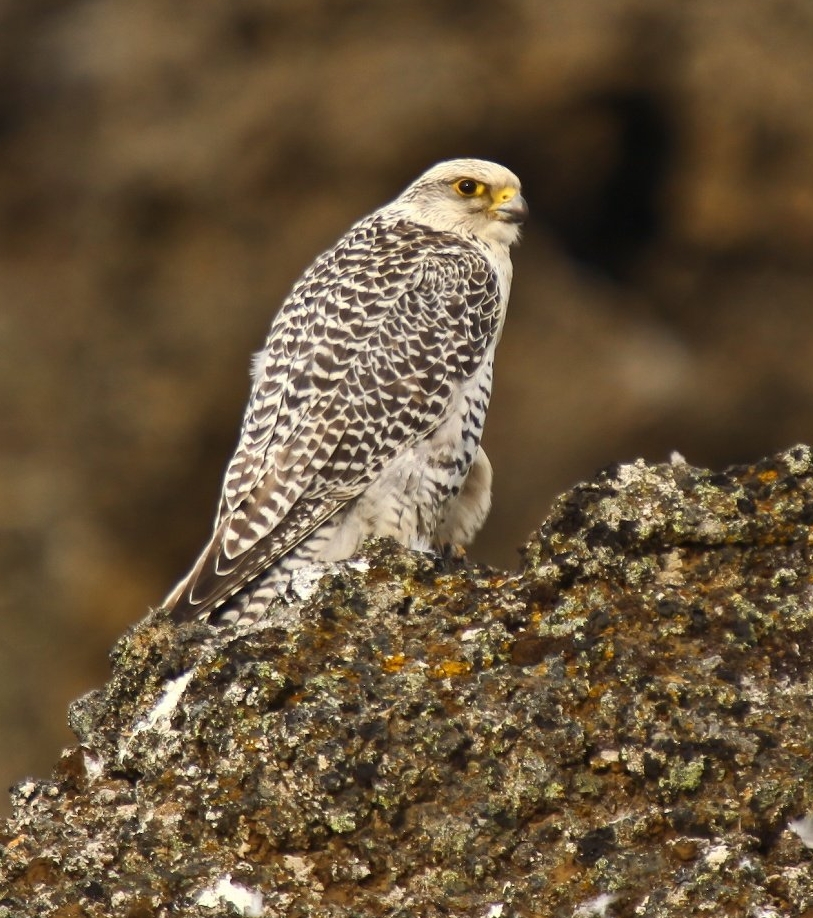 GyrfalconFalco rusticolus
-
 MerlinFalco columbarius
-
 American KestrelFalco sparverius
-
 Saker FalconFalco cherrug
-
 Eurasian HobbyFalco subbuteo
-
 Amur FalconFalco amurensis
Compare
Questions and answers
What is the scientific name of the Banded Kestrel?
The scientific name of the Banded Kestrel is Falco zoniventris. Written with its author, the full name is Falco zoniventris W. Peters, 1854.
Which family does the Banded Kestrel belong to?
Falco zoniventris belongs to the family Falconidae, in the order Falconiformes and the class Aves.
Where is the Banded Kestrel found?
Checklists and occurrence records place Falco zoniventris in 1 country: Madagascar.
What is the conservation status of the Banded Kestrel?
The IUCN Red List category recorded for Falco zoniventris is Least Concern (LC).
Sources
Passages the profile rests on
- Its closest relatives are the Grey Kestrel and Dickinson's Kestrel of mainland Africa. Source passage: “Its closest relatives are the grey kestrel and Dickinson's kestrel of mainland Africa” — English Wikipedia
- The adult Banded Kestrel has grey upperparts and a dark tail. Source passage: “The upperparts are grey and the tail is dark.” — English Wikipedia
- Its underparts are whitish, with dark grey streaks on the throat and upper breast and dark grey barring on the lower breast and belly. Source passage: “The underparts are whitish with dark grey streaks on the throat and upper breast and dark grey barring on the lower breast and belly.” — English Wikipedia
- Its wingspan measures 60–68 cm. Source passage: “with a wingspan of 60–68 cm.” — English Wikipedia
- Its feet, eyes and cere are yellow. Source passage: “The feet, eyes and cere are yellow” — English Wikipedia
- The species has bare yellow skin surrounding its eyes. Source passage: “there is bare yellow skin around the eye.” — English Wikipedia
- Juvenile Banded Kestrels are browner than adults. Source passage: “Juvenile birds are browner than the adults” — English Wikipedia
- Juvenile birds have darker eyes and less bare skin around the eye than adults. Source passage: “with darker eyes and less bare skin around the eye.” — English Wikipedia
- The Banded Kestrel occurs at elevations from sea level to 2,000 metres. Source passage: “It occurs from sea level up to 2000 metres.” — English Wikipedia
- The species inhabits clearings and edges in forests and woodlands. Source passage: “It inhabits clearings and edges in forest and woodland.” — English Wikipedia
- The Banded Kestrel has a medium dependency on forest habitat. Source passage: “This species is considered to have a medium dependency on forest habitat” — datazone.birdlife.org
- The species is fairly common in southern and western Madagascar. Source passage: “It is fairly common in the southern and western parts of Madagascar” — English Wikipedia
- The Banded Kestrel is more locally distributed in northern and eastern Madagascar. Source passage: “but more local in the north and east” — English Wikipedia
- The species is absent from Madagascar's central plateau. Source passage: “and absent from the central plateau.” — English Wikipedia
- A study of the Banded Kestrel's breeding biology was conducted in forest-edge habitat on the Masoala Peninsula in northeastern Madagascar. Source passage: “We studied the breeding biology of the Banded Kestrel (Falco zoniventris) in the forest edge habitat of Masoala Peninsula of northeastern Madagascar from ...” — academia.edu
- The Banded Kestrel feeds on small reptiles, including chameleons and day geckos. Source passage: “It feeds on small reptiles such as chamaeleons and day geckos” — English Wikipedia
- Large insects, including grasshoppers and beetles, are part of the Banded Kestrel's diet. Source passage: “large insects such as grasshoppers and beetles” — English Wikipedia
- The species occasionally feeds on birds. Source passage: “and occasionally on birds.” — English Wikipedia
- The Banded Kestrel rarely hovers and prefers hunting from a perch. Source passage: “It rarely hovers, preferring to hunt from a perch.” — English Wikipedia
- The Banded Kestrel catches prey on the ground or takes it from branches and tree trunks. Source passage: “Prey is caught on the ground or snatched from a branch or tree trunk.” — English Wikipedia
- The species also produces a sharp, screaming call. Source passage: “and a sharp, screaming call” — English Wikipedia
- The Banded Kestrel is usually silent outside the breeding season. Source passage: “but is usually silent outside the breeding season.” — English Wikipedia
- The Banded Kestrel's breeding season extends from September to December. Source passage: “Breeding takes place from September to December.” — English Wikipedia
- The species constructs a simple scrape for its nest, usually using an old nest belonging to another bird. Source passage: “The nest is a simple scrape, usually in the old nest of another bird” — English Wikipedia
- The Banded Kestrel particularly often uses old nests of the Sickle-billed Vanga. Source passage: “especially the sickle-billed vanga.” — English Wikipedia
- The species nests in tree holes or among epiphytic growth. Source passage: “The nest is located in a tree hole or amongst epiphytic growth.” — English Wikipedia
- The Banded Kestrel lays three yellowish eggs. Source passage: “Three yellowish eggs are laid.” — English Wikipedia
Data
- Catalogue of Life, 2026-10-16 XR cc by
- Global Biodiversity Information Facility CC BY 4.0
- Wikidata CC0
- GeoNames CC BY 4.0
- Wikimedia Commons per image; credit shown with each image
- Within the Catalogue of Life, this name comes from The Integrated Taxonomic Information System cc0
References
- Mayr, Ernst, and G. William Cottrell, eds. (1979). Check-List of Birds of the World, Vol. 1, Second Edition.
- Dickinson, Edward C., ed. (2003). The Howard and Moore Complete Checklist of the Birds of the World, 3rd Edition.
- Gill, Frank, & and Minturn Wright. (2006). Birds of the World: Recommended English Names.
- Dickinson, E. C., and J. V. Remsen Jr., eds. (2013). The Howard and Moore Complete Checklist of the Birds of the World, 4th Edition, Vol. 1 Non-Passerines.
This species in other databases
Page built on 29 November 2026. See how the catalog is made and all sources and licences.
Cite this page
ScientificNames.org. (2026). Falco zoniventris (Banded Kestrel). Retrieved November 29, 2026, from https://scientificnames.org/species/falco-zoniventris
“Falco zoniventris (Banded Kestrel).” ScientificNames.org, 2026, scientificnames.org/species/falco-zoniventris. Accessed 29 Nov. 2026.
ScientificNames.org. “Falco zoniventris (Banded Kestrel).” Accessed November 29, 2026. https://scientificnames.org/species/falco-zoniventris.
@misc{scientificnames_falco_zoniventris_banded_kestrel,
  author = {{ScientificNames.org}},
  title = {Falco zoniventris (Banded Kestrel)},
  year = {2026},
  url = {https://scientificnames.org/species/falco-zoniventris},
  note = {Accessed 2026-11-29}
}