Species · Flowering plants
× Fatshedera Fatshedera lizei
The scientific name of the × Fatshedera is Fatshedera lizei. It is a species of flowering plant in the family Araliaceae (ginseng family), order Apiales.
- Scientific name
- Fatshedera lizei (Cochet) Guillaumin
- Common name
- × Fatshedera
- Genus
- Fatshedera
- Family
- Araliaceae (Ginseng Family)
- Order
- Apiales
- Class
- Magnoliopsida
- Recorded in
- 3 countries
- Name status
- accepted in the Catalogue of Life
Overview
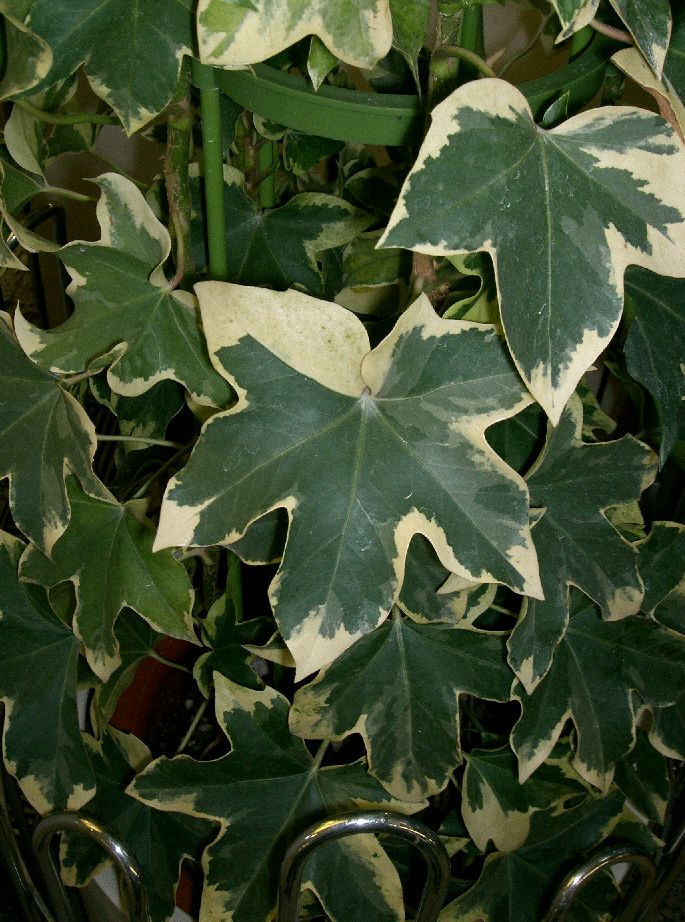
× Fatshedera is an evergreen shrub or vine in the family Araliaceae, produced from a cross between Fatsia japonica and Hedera helix. The plant grows best in shaded locations. It has glossy, leathery, dark green leaves divided palmately into five lobes and a semi-climbing growth habit.
Written 26 November 2026 from the sources listed below. Each statement was checked against the passage it cites; statements that could not be supported were removed.
Appearance
× Fatshedera combines a shrub-like growth form with the five-lobed leaves characteristic of Hedera. Its leaves are leathery, glossy, dark green and palmately divided into five lobes.[1][2]
The plant is an evergreen shrub or vine with a semi-climbing growth habit. Its leaf blades measure 7–25 centimetres in both length and width, and its leaf stalks measure 5–20 centimetres in length.[3][4][5][6]
Habitat
The plant appears to grow best in shaded locations.[7]
Behaviour
× Fatshedera does not readily climb independently and requires assistance to grow as a vine. Its relatively weak branches tend to bend under their own weight when the plant grows beyond shrub height.[8][9]
As a shrub, the plant can reach approximately 1.2 metres in height. When trained onto a support, it can grow as a vine reaching 3–4 metres in height.[10][11]
Reproduction and life cycle
The plant produces yellowish-white flowers in dense umbels during late autumn or early winter. The flowers measure approximately 4–6 millimetres in diameter.[12][13]
The flowers are usually sterile and do not develop into fruit. Some specimens have been reported to produce flowers and clusters of berries.[14][15]
The hybrid was produced using Fatsia japonica 'Moserii' as the seed parent and Hedera helix as the pollen parent. The artificial hybrid is identified by the parent combination Fatsia japonica and Hedera hibernica.[16][17]
Uses
× Fatshedera is cultivated outdoors as a garden plant and indoors as a houseplant. Its tolerance of shaded conditions is valued when it is grown indoors.[18][19]
The plant grows well indoors in bright indirect light. It can tolerate outdoor winter temperatures as low as −15 °C and can also be cultivated indoors at temperatures that remain at or above 20 °C.[20][21][22]
Several cultivated varieties have leaves ranging from dark green to white- or yellow-variegated forms.[23]
Similar species
The plant has an appearance intermediate between its two parental species, Fatsia japonica and Hedera helix.[24]
Conservation
The species has received the Royal Horticultural Society's Award of Garden Merit.[25]
Classification of the × Fatshedera
| Kingdom | Plantae |
|---|---|
| Subkingdom | Pteridobiotina |
| Phylum | Tracheophyta |
| Class | Magnoliopsida |
| Order | Apiales |
| Family | Araliaceae (Ginseng Family) |
| Subfamily | Aralioideae |
| Genus | Fatshedera |
| Species | Fatshedera lizei (Cochet) Guillaumin |
This name was added to the Catalogue of Life from a contributing dataset by automated merging and has not yet been reviewed by its editors.
Where the × Fatshedera is found
Checklists and occurrence records place Fatshedera lizei in 3 countries. GBIF holds 40 georeferenced records of it.
Countries
Regions and cities with the most records
A number beside a place is its count of GBIF occurrence records. A place without a number comes from a checklist alone. Records show where a species has been observed or collected, which can include escapes and vagrants.
Common names
English
- × Fatshedera
Names in 1 other language
- Chinese
- 熊掌木
Synonyms
One other scientific name has been used for this species and is now treated as a synonym of Fatshedera lizei.
- Aralia lizei Cochet
Related species
-
 Common IvyHedera helix
-
 Asian GinsengPanax ginseng
-
 American GinsengPanax quinquefolius
-
 Japanese AraliaFatsia japonica
-
 Australian Umbrella TreeHeptapleurum actinophyllum
-
 Devil's ClubOplopanax horridus
-
 Devil's WalkingstickAralia spinosa
-
 Ming AraliaPolyscias fruticosa
Compare
Questions and answers
What is the scientific name of the × Fatshedera?
The scientific name of the × Fatshedera is Fatshedera lizei. Written with its author, the full name is Fatshedera lizei (Cochet) Guillaumin.
Which family does the × Fatshedera belong to?
Fatshedera lizei belongs to the family Araliaceae, in the order Apiales and the class Magnoliopsida.
Where is the × Fatshedera found?
Checklists and occurrence records place Fatshedera lizei in 3 countries: United States, Japan and Spain.
Do fatsias like shade or sun?
× Fatshedera appears to grow best in shaded locations.[7]
Where does Fatsia grow best?
× Fatshedera appears to grow best in shaded locations.[7]
How cold can Fatsia tolerate?
× Fatshedera can tolerate outdoor winter temperatures as low as −15 °C.[21]
Sources
Passages the profile rests on
- The plant has a shrub-like growth form combined with the five-lobed leaves characteristic of Hedera. Source passage: “The plant combines the shrubby shape of Fatsia with the five-lobed leaves of Hedera.” — English Wikipedia
- Its leaves are leathery, glossy, dark green and palmately divided into five lobes. Source passage: “Leaves alternate, simple, leathery, lustrous dark green, 10-25 cm across, 5 lobed palmate” — landscapeplants.oregonstate.edu
- The plant is an evergreen shrub or vine. Source passage: “Evergreen shrub or vine, 4-6 ft (1.2-1.8 m)” — landscapeplants.oregonstate.edu
- The plant has a semi-climbing growth habit. Source passage: “a semi-climbing, evergreen shrub or vine.” — ask.ifas.ufl.edu
- Its leaf blades measure 7–25 centimetres in both length and width. Source passage: “The leaf blades are 7–25 cm (2.8–9.8 in) long and broad” — English Wikipedia
- Its leaf stalks measure 5–20 centimetres in length. Source passage: “with a 5–20 cm (2.0–7.9 in) petiole.” — English Wikipedia
- The plant appears to grow best in shaded locations. Source passage: “but seems to grow best in shade.” — landscapeplants.oregonstate.edu
- The plant does not readily climb independently and requires assistance to grow as a vine. Source passage: “unlike Hedera, it does not readily climb without assistance.” — English Wikipedia
- Its relatively weak branches tend to bend under their own weight when the plant grows beyond shrub height. Source passage: “above which the weight of the fairly weak branches makes them tend to bend over.” — English Wikipedia
- As a shrub, the plant can reach approximately 1.2 metres in height. Source passage: “As a shrub, × F. lizei can grow up to 1.2 m (3.9 ft) tall” — English Wikipedia
- When trained onto a support, the plant can grow as a vine reaching 3–4 metres in height. Source passage: “grow into a vine up to 3–4 m (9.8–13.1 ft) tall” — English Wikipedia
- Its flowers measure approximately 4–6 millimetres in diameter. Source passage: “The flowers are 4–6 mm in diameter” — English Wikipedia
- The plant produces yellowish-white flowers in dense umbels during late autumn or early winter. Source passage: “The flowers are 4–6 mm in diameter, yellowish-white, produced in late autumn or early winter in dense umbels” — English Wikipedia
- The flowers are usually sterile and do not develop into fruit. Source passage: “they are usually sterile and do not produce any fruit.” — English Wikipedia
- Some specimens have been reported to produce flowers and clusters of berries. Source passage: “specimens have been reported which did produce not only flowers but also clusters of berries” — English Wikipedia
- The artificial hybrid is identified by the parent combination Fatsia japonica and Hedera hibernica. Source passage: “The hybrid formula of this artificial cross is Fatsia japonica × Hedera hibernica.” — powo.science.kew.org
- The hybrid was produced using Fatsia japonica 'Moserii' as the seed parent and Hedera helix as the pollen parent. Source passage: “Fatsia japonica 'Moserii' (Moser's Japanese fatsia, the seed parent) and Hedera helix (common ivy, the pollen parent)” — English Wikipedia
- The plant is cultivated outdoors as a garden plant and indoors as a houseplant. Source passage: “It is grown both as a garden plant outdoors and as a houseplant indoors” — English Wikipedia
- Its tolerance of shaded conditions is valued when it is grown indoors. Source passage: “where its tolerance of shady conditions is valued.” — English Wikipedia
- The plant grows well indoors in bright indirect light. Source passage: “Inside, it grows well in bright indirect light.” — English Wikipedia
- The plant can tolerate outdoor winter temperatures as low as −15 °C. Source passage: “Outdoors, it can tolerate winter temperatures down to −15 °C (5 °F)” — English Wikipedia
- The plant can also be cultivated indoors at temperatures that remain at or above 20 °C. Source passage: “but can also be grown successfully indoors with temperatures never falling below 20 °C (68 °F).” — English Wikipedia
- Several cultivated varieties have leaves ranging from dark green to white- or yellow-variegated forms. Source passage: “Several cultivars have been selected, with dark green to variously white- or yellow-variegated leaves.” — English Wikipedia
- The plant has an appearance intermediate between its two parental species, Fatsia japonica and Hedera helix. Source passage: “Its appearance is generally intermediate between that of the two parents.” — landscapeplants.oregonstate.edu
- The species has received the Royal Horticultural Society's Award of Garden Merit. Source passage: “× Fatshedera lizei, together with the cultivars 'Annemieke' and 'Variegata' have gained the Royal Horticultural Society's Award of Garden Merit.” — English Wikipedia
Data
- Catalogue of Life, 2026-10-16 XR cc by
- Global Biodiversity Information Facility CC BY 4.0
- Wikidata CC0
- GeoNames CC BY 4.0
- Wikimedia Commons per image; credit shown with each image
- Within the Catalogue of Life, this name comes from Pinopsida from WFO cc0
References
- J. Soc. Natl. Hort. France, sér. 4, 34: 524 (1923) where the name was published
- POWO record for urn:lsid:ipni.org:names:90493-1 Link
This species in other databases
Page built on 28 November 2026. See how the catalog is made and all sources and licences.
Cite this page
ScientificNames.org. (2026). Fatshedera lizei (× Fatshedera). Retrieved November 28, 2026, from https://scientificnames.org/species/fatshedera-lizei
“Fatshedera lizei (× Fatshedera).” ScientificNames.org, 2026, scientificnames.org/species/fatshedera-lizei. Accessed 28 Nov. 2026.
ScientificNames.org. “Fatshedera lizei (× Fatshedera).” Accessed November 28, 2026. https://scientificnames.org/species/fatshedera-lizei.
@misc{scientificnames_fatshedera_lizei_x_fatshedera,
  author = {{ScientificNames.org}},
  title = {Fatshedera lizei (× Fatshedera)},
  year = {2026},
  url = {https://scientificnames.org/species/fatshedera-lizei},
  note = {Accessed 2026-11-28}
}