Species · Flowering plants
Devil's Walkingstick Aralia spinosa
The scientific name of the Devil's Walkingstick is Aralia spinosa. It is a species of flowering plant in the family Araliaceae (ginseng family), order Apiales.
- Scientific name
- Aralia spinosa L.
- Common name
- Devil's Walkingstick
- Genus
- Aralia
- Family
- Araliaceae (Ginseng Family)
- Order
- Apiales
- Class
- Magnoliopsida
- Red List category
- LC Least Concern
- Recorded in
- 2 countries
- Name status
- accepted in the Catalogue of Life
Overview
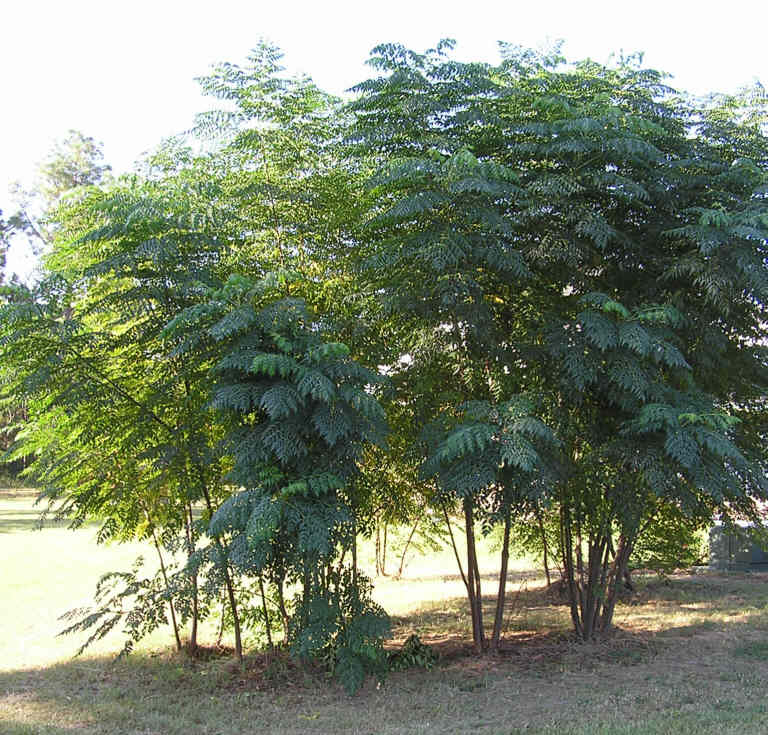
The species is native to eastern North America, with its United States range extending from New York to Florida along the Atlantic coast and westward to Ohio, Illinois, and Texas. It is an aromatic, spiny, deciduous shrub or small tree with large compound leaves, creamy-white flowers, and purplish-black berries.
Written 26 November 2026 from the sources listed below. Each statement was checked against the passage it cites; statements that could not be supported were removed.
Appearance
Devil's walkingstick is an aromatic, spiny, deciduous shrub or small tree that typically grows between 2 and 8 metres tall. Its trunks can reach 15–20 centimetres in diameter, and it commonly grows in clusters of branchless trunks.[1][2][3][4]
Its young stems are thickly covered with sharp spines. The leaf petioles are prickly and have swollen bases, and the leaves are bipinnate or tripinnate and clustered at the ends of branches.[5][6][7]
Its compound leaves can measure 70–120 centimetres long and can reach approximately one metre in length and 76 centimetres in width. The leaflets are generally ovate, serrate or dentate, and acute.[8][9][10]
The flowers are creamy-white, with individual flowers approximately 5 mm in diameter. They are arranged in large compound panicles approximately 30–60 centimetres long.[11][12][13][14]
Its fruit is a purplish-black berry approximately 6–8 mm in diameter at maturity. Its autumn leaves turn bronze-red with yellow coloration.[15][16][17]
Its bark is light brown and divided into rounded, broken ridges. Its wood is brown with yellow streaks and is light, soft, brittle, and close-grained.[18][19]
Habitat
Devil's walkingstick prefers deep, moist soil. It typically grows in forest understories and along forest edges.[20][21]
Reproduction and life cycle
Devil's walkingstick flowers in late summer. Its flowers can be perfect or polygamomonoecious.[22][23]
The species can be propagated using seeds or root cuttings.[24]
Behaviour
Devil's walkingstick often forms clonal thickets through root sprouting. It commonly grows in clusters of branchless trunks.[25][4]
Diet
Its young leaves can be eaten as a cooked pot herb when collected before their prickles harden.[26]
Uses
Devil's walkingstick has been cultivated for ornamental purposes because of its decorative foliage, prickly stems, large flower panicles, and distinctive autumn coloration. It was introduced into cultivation in 1688.[27][28][29]
Early American settlers used the plant for its alleged toothache-curing properties. It was also used medicinally during the American Civil War.[30][31]
Laboratory extracts of the plant demonstrated antimicrobial activity against multidrug-resistant bacteria associated with wound infections.[32]
The Iroquois planted saplings near their villages and on islands to protect the fruit from animals. Indigenous peoples incorporated the fruit into foods.[33][34]
The flowers were placed in women's hair because of their lemony fragrance.[35]
Classification of the Devil's Walkingstick
| Kingdom | Plantae |
|---|---|
| Subkingdom | Pteridobiotina |
| Phylum | Tracheophyta |
| Class | Magnoliopsida |
| Order | Apiales |
| Family | Araliaceae (Ginseng Family) |
| Subfamily | Aralioideae |
| Tribe | Aralieae |
| Genus | Aralia (Spikenard) |
| Species | Aralia spinosa L. |
Where the Devil's Walkingstick is found
Checklists and occurrence records place Aralia spinosa in 2 countries across North America. GBIF holds 12,601 georeferenced records of it.
Countries
Regions and cities with the most records
- Virginia, United States 1,189
- Maryland, United States 978
- North Carolina, United States 956
- Tennessee, United States 821
- Georgia, United States 811
- Alabama, United States 676
- Florida, United States 656
- Pennsylvania, United States 562
- Arkansas, United States 543
- Texas, United States 415
- Mississippi, United States 378
- South Carolina, United States 346
- Kentucky, United States 335
- Louisiana, United States 335
- Illinois, United States 273
- Brookhaven, United States 228
- Tysons, United States 226
- Idylwood, United States 223
- McLean, United States 223
- Sandy Springs, United States 223
- Merrifield, United States 218
- West Falls Church, United States 218
- Vienna, United States 217
- Arlington, United States 216
- Annandale, United States 215
- Chamblee, United States 210
- Dunwoody, United States 210
- Burke, United States 207
- Belvedere Park, United States 206
- North Druid Hills, United States 203
- Candler-McAfee, United States 200
- Baileys Crossroads, United States 199
- Fairfax, United States 199
- West Springfield, United States 198
- Oakton, United States 195
- North Decatur, United States 193
8 more countries have a few records outside this range
These countries hold a few records of Aralia spinosa but lie outside the range the checklists give for it. Such records are often zoo or garden specimens, museum material or vagrants, so the species is not counted as occurring there.
Range as the checklists state it
USA (Alabama, Arkansas, Connecticut, District of Columbia, Delaware, Florida, Georgia, Illinois, Indiana, Kentucky, Louisiana, Massachusetts, Maryland, Maine, Missouri, Mississippi, North Carolina, New Jersey, New York, Ohio, Oklahoma, Pennsylvania, Rhode Island, South Carolina, Tennessee, Texas, Virginia, West Virginia)
A number beside a place is its count of GBIF occurrence records. A place without a number comes from a checklist alone. Records show where a species has been observed or collected, which can include escapes and vagrants.
Common names
English
- Devil's Walkingstick
- American Angelica-tree
- Hercules'-club
- Devil's Walking-stick
- Prickly-ash
Names in 10 other languages
- Chinese
- 剌楤木, 多刺楤木
- Czech
- arálie ostnitá
- Finnish
- lännenaralia
- French
- Gourdin d'Hercule, angélique en arbre, angélique épineuse, aralie épineuse, bâton du diable
- German
- Herkuleskeule
- Portuguese
- Bengala-do-diabo
- Russian
- Аралия колючая
- Slovak
- aralka ostnatá
- Swedish
- taggaralia
- akz
- Atchòobittabi
Synonyms
9 other scientific names have been used for this species and are now treated as synonyms of Aralia spinosa.
- Aralia georgica Miq.
- Aralia leroana K.Koch
- Aralia spinosa f. subinermis Moldenke
- Aralia spinosa var. glabra Nutt. ex Miq.
- Aralia spinosa var. inermis Pursh
- Aralia spinosa var. spinosa
- Aralia spinosa var. subinermis K.Koch
- Chaerophyllum arborescens L.
- Myrrhis arborescens Spreng.
Related species
-
 Japanese Angelica TreeAralia elata
-
 Wild LicoriceAralia nudicaulis
-
 Japanese SpikenardAralia cordata
-
 American SpikenardAralia racemosa
-
 Elk-cloverAralia californica
-
 Dwarf-elderAralia hispida
-
 Chinese Angelica TreeAralia chinensis
-
 Aralia rex
Compare
Questions and answers
What is the scientific name of the Devil's Walkingstick?
The scientific name of the Devil's Walkingstick is Aralia spinosa. Written with its author, the full name is Aralia spinosa L..
Which family does the Devil's Walkingstick belong to?
Aralia spinosa belongs to the family Araliaceae, in the order Apiales and the class Magnoliopsida.
Where is the Devil's Walkingstick found?
Checklists and occurrence records place Aralia spinosa in 2 countries: United States and Canada.
What is the conservation status of the Devil's Walkingstick?
The IUCN Red List category recorded for Aralia spinosa is Least Concern (LC).
What other names does the Devil's Walkingstick have?
Aralia spinosa is also known in English as American Angelica-tree, Hercules'-club, Devil's Walking-stick and Prickly-ash.
What does prickly ash do for your body?
Early American settlers used devil's walkingstick for its alleged toothache-curing properties, and the plant was used medicinally during the American Civil War. Laboratory extracts demonstrated antimicrobial activity against multidrug-resistant bacteria associated with wound infections.[30][31][32]
Can you eat Devil's Walking Stick fruit?
The fruit was incorporated into foods prepared by Indigenous peoples.[34]
What is Devil's Walking Stick used for?
Devil's walkingstick is cultivated as an ornamental plant for its foliage, prickly stems, large flower panicles, and autumn coloration. Its young leaves can be eaten as a cooked pot herb before their prickles harden. The plant has also been used medicinally, and its fruit has been incorporated into foods prepared by Indigenous peoples.[26][27][29][30][31][34]
Sources
Passages the profile rests on
- Aralia spinosa is an aromatic, spiny, deciduous shrub or small tree. Source passage: “Aralia spinosa is an aromatic, spiny deciduous shrub or small tree” — English Wikipedia
- The plant typically grows between 2 and 8 metres tall. Source passage: “growing 2–8 m (7–26 ft) tall.” — English Wikipedia
- Its trunks can reach 15–20 centimetres in diameter. Source passage: “The trunks are up to 15–20 cm (6–8 in) in diameter” — English Wikipedia
- The species commonly grows in clusters of branchless trunks. Source passage: “The plants generally grow in clusters of branchless trunks” — English Wikipedia
- Its young stems are thickly covered with sharp spines. Source passage: “The young stems are stout and thickly covered with sharp spines.” — English Wikipedia
- Its leaves are bipinnate or tripinnate and clustered at the ends of branches. Source passage: “Leaves: Clustered at the end of the branches, compound, bi- and tri-pinnate” — English Wikipedia
- The leaf petioles are prickly and have swollen bases. Source passage: “The petioles are prickly with swollen bases.” — English Wikipedia
- Its compound leaves can reach approximately one metre in length and 76 centimetres in width. Source passage: “Each may be about one metre (3.3 ft) long and 76 centimetres (2.5 ft) wide” — English Wikipedia
- The leaflets are generally ovate, serrate or dentate, and acute. Source passage: “The last leaflets are ovate, two to three inches long, wedge-shaped or rounded at base, serrate or dentate and acute.” — English Wikipedia
- Its compound leaves can measure 70–120 centimetres long. Source passage: “very large bipinnate leaves 70–120 cm (30–45 in) long.” — English Wikipedia
- The flowers are creamy-white. Source passage: “The flowers are creamy-white.” — English Wikipedia
- Individual flowers are approximately 5 mm in diameter. Source passage: “Each individual flower is small (about 5 mm or 3⁄16 in across)” — English Wikipedia
- The flowers are arranged in large compound panicles. Source passage: “but produced in a large composite panicles which is 30–60 cm (12–24 in) long.” — English Wikipedia
- Its flower panicles are approximately 30–60 centimetres long. Source passage: “30–60 cm (12–24 in) long.” — English Wikipedia
- Its fruit is a purplish-black berry. Source passage: “The fruit is a purplish-black berry” — English Wikipedia
- Its mature fruit is approximately 6–8 mm in diameter. Source passage: “that is 6–8 mm (1⁄4–5⁄16 in) in diameter” — English Wikipedia
- Its autumn leaves turn bronze-red with yellow coloration. Source passage: “In the autumn the leaves turn to a peculiar bronze red (touched with yellow)” — English Wikipedia
- Its bark is light brown and divided into rounded, broken ridges. Source passage: “Bark: Light brown, divided into rounded, broken ridges.” — English Wikipedia
- Its wood is brown with yellow streaks and is light, soft, brittle, and close-grained. Source passage: “Wood: Brown with yellow streaks. Light, soft, brittle and close-grained.” — English Wikipedia
- The species prefers deep, moist soil. Source passage: “It prefers a deep moist soil.” — English Wikipedia
- It typically grows in forest understories and along forest edges. Source passage: “The plants typically grow in the forest understory or at the edges of forests.” — English Wikipedia
- The species flowers in late summer. Source passage: “Flowering is in late summer.” — English Wikipedia
- Its flowers can be perfect or polygamomonoecious. Source passage: “Perfect or polygamomonoecious, cream white” — English Wikipedia
- The species can be propagated using seeds or root cuttings. Source passage: “These plants can be propagated from seeds or root cuttings.” — English Wikipedia
- The species often forms clonal thickets through root sprouting. Source passage: “They often form clonal thickets by sprouting from the roots.” — English Wikipedia
- Its young leaves can be eaten as a cooked pot herb when collected before their prickles harden. Source passage: “The young leaves can be eaten if gathered before the prickles harden. They are then chopped finely and cooked as a pot herb.” — English Wikipedia
- Aralia spinosa has been cultivated for its decorative foliage, prickly stems, large flower panicles, and distinctive autumn coloration. Source passage: “is still grown for its decorative foliage, prickly stems, large showy flower panicles (clusters) and distinctive fall color.” — English Wikipedia
- The species was introduced into cultivation in 1688. Source passage: “Aralia spinosa was introduced into cultivation in 1688” — English Wikipedia
- Its foliage and appearance have made it a plant cultivated for ornamental purposes. Source passage: “Aralia spinosa is occasionally cultivated for its exotic or tropical appearance because of its large lacy compound leaves.” — English Wikipedia
- Early American settlers used the plant for its alleged toothache-curing properties. Source passage: “Early American settlers used the plant for its alleged properties for curing toothaches.” — English Wikipedia
- The plant was used medicinally during the American Civil War. Source passage: “The plant was used as a medicine during the American Civil War.” — English Wikipedia
- Laboratory extracts of the plant demonstrated antimicrobial activity against multidrug-resistant bacteria associated with wound infections. Source passage: “extracts from the plant showed antimicrobial activity against multidrug-resistant bacteria associated with wound infections.” — English Wikipedia
- The Iroquois planted saplings near their villages and on islands to protect the fruit from animals. Source passage: “The Iroquois would take the saplings of the tree and plant them near their villages and on islands so that animals wouldn't eat the valuable fruit.” — English Wikipedia
- The fruit was incorporated into foods prepared by Indigenous peoples. Source passage: “The fruit was used in many of the natives' foods.” — English Wikipedia
- The flowers were placed in women's hair because of their lemony fragrance. Source passage: “The women would take the flowers and put them in their hair because of the lemony smell.” — English Wikipedia
Data
- Catalogue of Life, 2026-10-16 XR cc by
- Global Biodiversity Information Facility CC BY 4.0
- Wikidata CC0
- GeoNames CC BY 4.0
- Wikimedia Commons per image; credit shown with each image
- iNaturalist per image; credit shown with each image
- Within the Catalogue of Life, this name comes from Synonymic Checklists of the Vascular Plants of the World cc by
References
- L. (1753). Sp. Pl. [Linnaeus] 1: 273 (1753). where the name was published
This species in other databases
- Catalogue of Life G4Y9
- Wikidata Q2666305
- iNaturalist 82813
- World Flora Online wfo-0000259375
- GRIN 102537
Page built on 26 November 2026. See how the catalog is made and all sources and licences.
Cite this page
ScientificNames.org. (2026). Aralia spinosa (Devil's Walkingstick). Retrieved November 26, 2026, from https://scientificnames.org/species/aralia-spinosa
“Aralia spinosa (Devil's Walkingstick).” ScientificNames.org, 2026, scientificnames.org/species/aralia-spinosa. Accessed 26 Nov. 2026.
ScientificNames.org. “Aralia spinosa (Devil's Walkingstick).” Accessed November 26, 2026. https://scientificnames.org/species/aralia-spinosa.
@misc{scientificnames_aralia_spinosa_devils_walkingstick,
  author = {{ScientificNames.org}},
  title = {Aralia spinosa (Devil's Walkingstick)},
  year = {2026},
  url = {https://scientificnames.org/species/aralia-spinosa},
  note = {Accessed 2026-11-26}
}