Species · Flowering plants
Batoko Plum Flacourtia inermis
The scientific name of the Batoko Plum is Flacourtia inermis. It is a species of flowering plant in the family Salicaceae (willow family), order Malpighiales.
- Scientific name
- Flacourtia inermis Roxb.
- Common name
- Batoko Plum
- Genus
- Flacourtia
- Family
- Salicaceae (Willow Family)
- Order
- Malpighiales
- Class
- Magnoliopsida
- Recorded in
- 16 countries
- Name status
- accepted in the Catalogue of Life

Overview
Batoko plum (Flacourtia inermis Roxb.) is a medium-sized flowering tree without spines. The species is native to the Philippines and Indonesia and has naturalized around the edges of tropical Asia and Africa. Its round, shiny fruits grow in bunches, ripen from light green to deep red, and have crunchy, sour flesh.
Written 26 November 2026 from the sources listed below. Each statement was checked against the passage it cites; statements that could not be supported were removed.
Appearance
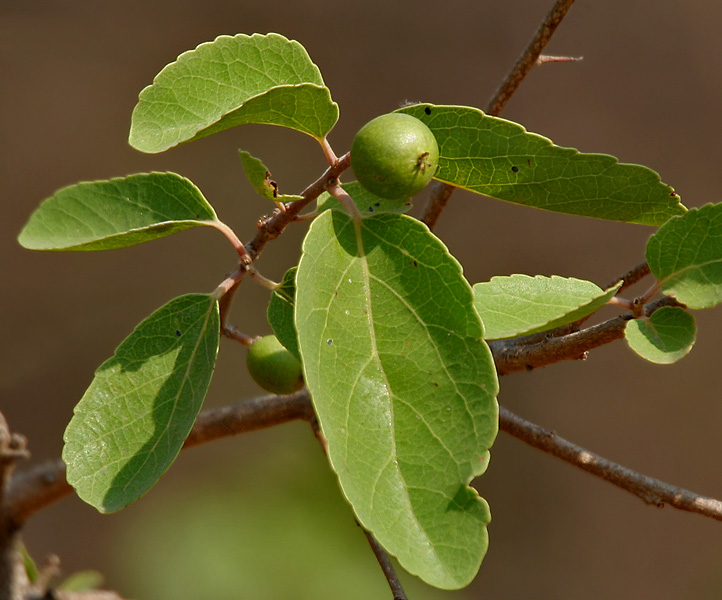
Batoko plum is a medium-sized tree without spines. It can reach a height of 15 metres.[1][2]
Mature leaves are oblong or elliptic, glossy on their upper surfaces, and have toothed margins. They measure approximately 8–20 centimetres in length and 3–15 centimetres in width.[3][4][5]
Young leaves are bright orange to reddish before turning green as they mature.[6]
The fruits grow in bunches and resemble cherries. They are round and shiny, changing from light green to deep red as they ripen, and measure approximately 1–3 centimetres in diameter.[7][8][9]
The fruit flesh is crunchy and has a sour, acidic taste.[10]
Habitat
Batoko plum is native to the Philippines and Indonesia. It has naturalized around the edges of tropical Asia and Africa.[11][12]
Uses
The fruits are edible raw or cooked. They are generally processed into jams, preserves, and syrups rather than eaten fresh.[13][14]
Classification of the Batoko Plum
| Kingdom | Plantae |
|---|---|
| Subkingdom | Pteridobiotina |
| Phylum | Tracheophyta |
| Class | Magnoliopsida |
| Order | Malpighiales |
| Family | Salicaceae (Willow Family) |
| Tribe | Flacourtieae |
| Genus | Flacourtia |
| Species | Flacourtia inermis Roxb. |
Where the Batoko Plum is found
Checklists and occurrence records place Flacourtia inermis in 16 countries across Asia, North America and Oceania. GBIF holds 310 georeferenced records of it.
Countries where it is native or its origin is not stated
- French Polynesia 3
- India 22
- Indonesia 105
- Malaysia 16
- Palau 1
- Papua New Guinea 14
- Philippines 15
- Singapore 87
- Solomon Islands 19
- Taiwan 10
- Thailand 5
Countries where it has been introduced
Regions and cities with the most records
- Ang Mo Kio New Town, Singapore 85
- Novena, Singapore 85
- Sembawang Estate, Singapore 85
- Singapore, Singapore 85
- Sungai Simpang, Singapore 85
- Yio Chu Kang, Singapore 85
- Yishun New Town, Singapore 85
- Eunos, Singapore 84
- MacPherson, Singapore 84
- Matilda Estate, Singapore 83
- Sengkang New Town, Singapore 83
- Bukit Timah, Singapore 81
- Marine Parade, Singapore 81
- Queenstown Estate, Singapore 81
- Woodlands, Singapore 81
- Punggol, Singapore 80
- Bedok New Town, Singapore 79
- Ulu Bedok, Singapore 79
- Kampong Pasir Ris, Singapore 72
- Anak Bukit, Singapore 71
- Bukit Panjang New Town, Singapore 69
- Choa Chu Kang New Town, Singapore 68
- Keat Hong Village, Singapore 68
- Teck Whye, Singapore 68
- Jurong East, Singapore 67
- Marsiling, Singapore 67
- Yew Tee, Singapore 67
- Jurong West, Singapore 66
- Jurong Town, Singapore 64
- Johor Bahru, Malaysia 60
- Boon Lay, Singapore 56
- Kampung Pasir Gudang Baru, Malaysia 53
- Pasir Gudang, Malaysia 52
- Kampong Loyang, Singapore 48
- Masai, Malaysia 45
- Bandar Seri Alam, Malaysia 40
4 more countries have a few records outside this range
These countries hold a few records of Flacourtia inermis but lie outside the range the checklists give for it. Such records are often zoo or garden specimens, museum material or vagrants, so the species is not counted as occurring there.
Range as the checklists state it
India (Kerala, Maharashtra); Sri Lanka [I]; Bangladesh [I]; Myanmar [I]; peninsular Malaysia; Sumatera; Borneo; Sulawesi; Jawa; Lesser Sunda Isl. (Bali, etc.); Moluccas; New Guinea (Irian Jaya, Papua New Guinea); Bismarck Arch. (New Britain); Palau (Babeldaob); Honduras [I]; Puerto Rico [I]
A number beside a place is its count of GBIF occurrence records. A place without a number comes from a checklist alone. Records show where a species has been observed or collected, which can include escapes and vagrants.
Common names
English
- Batoko Plum
- Lovi-lovi
- Plum-of-Martinique
Names in 4 other languages
- Chinese
- 罗比梅, 羅比梅
- French
- prunier de la Martinique
- Indonesian
- lobi-lobi
- Spanish
- louvi malayo
Synonyms
One other scientific name has been used for this species and is now treated as a synonym of Flacourtia inermis.
- Flacourtia quintuplinervis Turcz.
Subspecies and varieties
Related species
-
 Indian PlumFlacourtia jangomas
-
 Governor's PlumFlacourtia indica
-
 Flacourtia rukam
- Broad-leaved Coffee-plumFlacourtia latifolia
- Flacourtia kinabaluensis
- Flacourtia mollis
- Flacourtia tomentella
- Flacourtia vitiensis
Compare
Questions and answers
What is the scientific name of the Batoko Plum?
The scientific name of the Batoko Plum is Flacourtia inermis. Written with its author, the full name is Flacourtia inermis Roxb..
Which family does the Batoko Plum belong to?
Flacourtia inermis belongs to the family Salicaceae, in the order Malpighiales and the class Magnoliopsida.
Where is the Batoko Plum found?
Checklists and occurrence records place Flacourtia inermis in 16 countries, including Indonesia, Singapore, India, Solomon Islands, Malaysia and Philippines.
What other names does the Batoko Plum have?
Flacourtia inermis is also known in English as Lovi-lovi and Plum-of-Martinique.
Sources
Passages the profile rests on
- Flacourtia inermis is a medium-sized tree without spines. Source passage: “It is a medium-sized spineless tree” — English Wikipedia
- The tree can reach a height of 15 metres. Source passage: “may grow up to 15 metres (49 feet).” — English Wikipedia
- Mature leaves are oblong or elliptic, glossy on their upper surfaces, and have toothed margins. Source passage: “The mature leaves are oblong and elliptic in shape and glossy on the upper side, with a toothed margin.” — English Wikipedia
- The mature leaves measure approximately 8–20 centimetres in length. Source passage: “They are about 8 to 20 centimetres (3 to 8 inches) long” — English Wikipedia
- The mature leaves measure approximately 3–15 centimetres in width. Source passage: “and 3 to 15 cm (1 to 6 in) wide.” — English Wikipedia
- Young leaves are bright orange to reddish before turning green as they mature. Source passage: “The young leaves are bright orange to reddish in color, turning green as they mature.” — English Wikipedia
- The fruits grow in bunches and resemble cherries. Source passage: “The fruits are produced in bunches and resemble cherries.” — English Wikipedia
- The fruits are round and shiny, changing from light green to deep red as they ripen. Source passage: “The fruit is round and shiny, turning from light green to a deep red colour upon ripening.” — English Wikipedia
- Individual fruits measure approximately 1–3 centimetres in diameter. Source passage: “Each fruit measures 1 to 3 cm (1⁄2 to 1+1⁄4 in) in diameter.” — English Wikipedia
- The fruit flesh is crunchy and has a sour, acidic taste. Source passage: “The flesh is crunchy but sour and acidic in taste.” — English Wikipedia
- The species is native to the Philippines and Indonesia. Source passage: “native to the Philippines and Indonesia” — English Wikipedia
- The species has naturalized around the edges of tropical Asia and Africa. Source passage: “has naturalized around the edges of tropical Asia and Africa.” — English Wikipedia
- The fruits are edible either raw or cooked. Source passage: “The fruits are edible raw or cooked” — English Wikipedia
- The fruits are generally processed into jams, preserves, and syrups rather than eaten fresh. Source passage: “but usually not eaten fresh, instead being used in jams, preserves, and syrups.” — English Wikipedia
Data
- Catalogue of Life, 2026-10-16 XR cc by
- Global Biodiversity Information Facility CC BY 4.0
- Wikidata CC0
- GeoNames CC BY 4.0
- Wikimedia Commons per image; credit shown with each image
- Within the Catalogue of Life, this name comes from Synonymic Checklists of the Vascular Plants of the World cc by
References
- Roxb. Hort. Bengal. 73 (1814), nomen, Fl. Ind. [Roxburgh] 833 (1832). where the name was published
This species in other databases
Page built on 28 November 2026. See how the catalog is made and all sources and licences.
Cite this page
ScientificNames.org. (2026). Flacourtia inermis (Batoko Plum). Retrieved November 28, 2026, from https://scientificnames.org/species/flacourtia-inermis
“Flacourtia inermis (Batoko Plum).” ScientificNames.org, 2026, scientificnames.org/species/flacourtia-inermis. Accessed 28 Nov. 2026.
ScientificNames.org. “Flacourtia inermis (Batoko Plum).” Accessed November 28, 2026. https://scientificnames.org/species/flacourtia-inermis.
@misc{scientificnames_flacourtia_inermis_batoko_plum,
  author = {{ScientificNames.org}},
  title = {Flacourtia inermis (Batoko Plum)},
  year = {2026},
  url = {https://scientificnames.org/species/flacourtia-inermis},
  note = {Accessed 2026-11-28}
}