Species · Flowering plants
Indian Plum Flacourtia jangomas
The scientific name of the Indian Plum is Flacourtia jangomas. It is a species of flowering plant in the family Salicaceae (willow family), order Malpighiales.
- Scientific name
- Flacourtia jangomas (Lour.) Raeusch.
- Common name
- Indian Plum
- Genus
- Flacourtia
- Family
- Salicaceae (Willow Family)
- Order
- Malpighiales
- Class
- Magnoliopsida
- Recorded in
- 49 countries
- Name status
- accepted in the Catalogue of Life

Overview
Indian plum (Flacourtia jangomas) is a small, deciduous shrub or tree in the family Salicaceae, order Malpighiales and class Magnoliopsida. It occurs in lowland and mountain rain forests and is native to Assam, Tripura, Bangladesh, South-Central and Southeast China, the East Himalaya, Hainan, Myanmar, and Nepal. The species is dioecious, with male and female flowers occurring on separate individuals.
Written 26 November 2026 from the sources listed below. Each statement was checked against the passage it cites; statements that could not be supported were removed.
Appearance
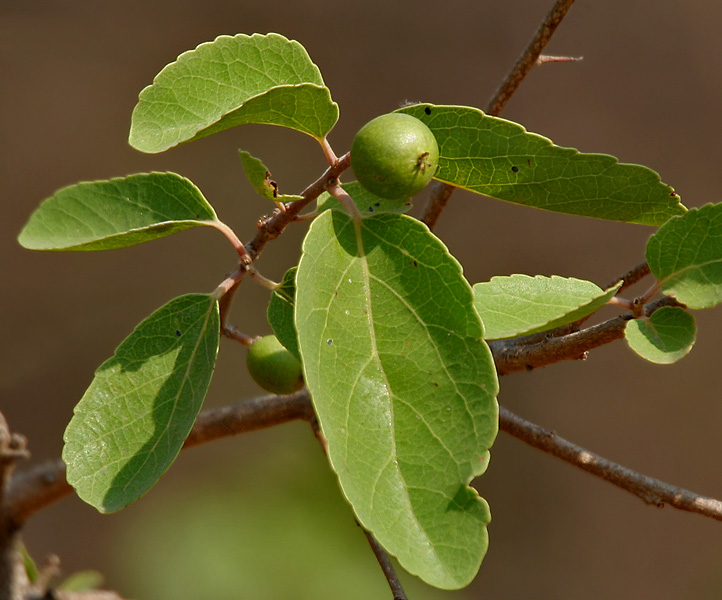
Indian plum is a small, deciduous shrub or tree that grows to a height of 6–10 metres. Older trees commonly have thornless trunks and branches, while young trees have numerous simple or branched, blunt woody thorns.[1][2][3][4][5]
The bark is light brown to copper red and has a flaky texture. The leaves are light green and narrow ovate.[6][7]
The flowers are small, white to whitish green, and fragrant. The fruits are rounded, range in colour from pink to dark red, and have greenish yellow flesh.[8][9][10]
The fruits are approximately 1.5–2.5 centimetres wide.[11]
Habitat
Indian plum occurs in lowland and mountain rain forests.[12]
The species is native to Assam and Tripura, Bangladesh, South-Central and Southeast China, the East Himalaya, Hainan, Myanmar, and Nepal.[13][14][15][16][17]
It has been introduced to Borneo, Cambodia, the Cook Islands, Fiji, India, Java, Kenya, Laos, the Leeward Islands, Malaysia, Mauritius, New Caledonia, the Nicobar Islands, Queensland, Réunion, the Seychelles, Tanzania, Thailand, Trinidad and Tobago, Venezuela, Vietnam, and the Windward Islands.[18][19][20][21][22][23][24][25][26][27]
Behaviour
Reproduction and life cycle
Indian plum is dioecious, with male and female flowers occurring on separate individuals.[28]
Uses
The fruits are widely eaten raw and cooked in South Asia and have a mildly sour and tangy taste. They are pickled, dried with salt, or cooked in Indian curries, and are also processed into juices, jams, and marmalades.[29][30][31][32]
Commercial coffee plum jams and pickles are exported internationally, mainly from Kerala.[33]
The fruits and leaves are used in South Asian folk medicine to treat diarrhoea. Dried leaves are reportedly used to treat bronchitis, and the roots are traditionally used to suppress toothache.[34][35][36]
The bark contains antifungal and antibacterial constituents and is used as an ingredient in some Ayurvedic medicines. Ground bark paste is used for treating common ailments in tribal settlements of the Western Ghats.[37][38]
The wood is harvested for lumber in Tamil Nadu, Kerala, and Karnataka. It is often used as a cheaper alternative to teak and other expensive timber.[39][40]
The leaves and roots contain tannin.[41]
Classification of the Indian Plum
| Kingdom | Plantae |
|---|---|
| Subkingdom | Pteridobiotina |
| Phylum | Tracheophyta |
| Class | Magnoliopsida |
| Order | Malpighiales |
| Family | Salicaceae (Willow Family) |
| Tribe | Flacourtieae |
| Genus | Flacourtia |
| Species | Flacourtia jangomas (Lour.) Raeusch. |
Where the Indian Plum is found
Checklists and occurrence records place Flacourtia jangomas in 49 countries across Africa, Asia, North America, Oceania and South America. GBIF holds 737 georeferenced records of it.
Countries where it is native or its origin is not stated
- Barbados 4
- Brazil 34
- Cameroon 4
- Cook Islands 23
- Cuba 4
- Democratic Republic of the Congo 11
- French Guiana 18
- Honduras 3
- Indonesia 30
- Ivory Coast 4
- Malawi 4
- Malaysia 42
- Mayotte 7
- New Caledonia 6
- Niue 9
- Puerto Rico 7
- Reunion 67
- Seychelles 29
- Sri Lanka 3
- Tanzania 13
- United States 37
Countries where it has been introduced
- Australia 73
- Bangladesh 1
- Belize 2
- Bhutan 1
- Cambodia 3
- China 8
- Dominica 13
- Fiji
- Grenada 3
- Guadeloupe 14
- India 87
- Laos 7
- Madagascar 4
- Martinique 12
- Mauritius 13
- Montserrat 12
- Myanmar 20
- Nepal 8
- Nicaragua 2
- Pakistan
- Panama 11
- Philippines 8
- Singapore 8
- Taiwan 10
- Thailand 31
- Trinidad and Tobago 2
- Venezuela 5
- Vietnam 20
Regions and cities with the most records
- Queensland, Australia 53
- Le Tampon, Reunion 47
- Saint-Pierre, Reunion 43
- Saint-Louis, Reunion 41
- Piton Saint-Leu, Reunion 28
- Saint-Joseph, Reunion 24
- Victoria, Seychelles 15
- Saint-Leu, Reunion 13
- Saint-Paul, Reunion 12
- Le Lamentin, Martinique 9
- New South Wales, Australia 9
- Saint-Joseph, Martinique 9
- Ducos, Martinique 8
- Fort-de-France, Martinique 8
- Kerala, India 8
- La Digue and Inner Islands, Seychelles 8
- Le François, Martinique 8
- Le Robert, Martinique 8
- La Possession, Reunion 7
- Le Port, Reunion 7
- Cayenne, French Guiana 6
- La Trinité, Martinique 6
- Matoury, French Guiana 6
- Rémire-Montjoly, French Guiana 6
- Sainte-Marie, Martinique 6
- Ancón, Panama 5
- Arraiján, Panama 5
- Curundú, Panama 5
- Le Gosier, Guadeloupe 5
- Les Abymes, Guadeloupe 5
- Panama City, Panama 5
- Sainte-Marie, Reunion 5
- Veracruz, Panama 5
- Bambous, Mauritius 4
- Beau Bassin-Rose Hill, Mauritius 4
- Bel Air Rivière Sèche, Mauritius 4
Range as the checklists state it
not known in the wild, possibly native in tropical Asia; Madagascar [I]; Mauritius [I]; La Réunion [I]; China [I] (W-Guangxi [I], S-Hainan [I], S-Yunnan [I]); Taiwan [I]; Pakistan [I]; Nepal [I]; Bhutan [I]; India [I] (Uttar Pradesh [I], Bihar [I], West Bengal [I], Assam [I], Meghalaya [I], Manipur [I], Tripura [I], Odisha [I], Andhra Pradesh [I]); Bangladesh [I]; Nicobar Isl. [I] (Central Nicobar Isl. [I]); Myanmar [I] (Mandalay [I], Taninthayi [I], Yangon [I]); Thailand [I]; Laos [I]; Cambodia [I]; Vietnam [I]; peninsular Malaysia [I]; Singapore [I]; Sumatera [I]; Borneo [I]; Philippines [I] (Luzon [I]); Jawa [I]; Australia [I] (Queensland [I]); Fiji [I]; Cook Isl. [I] (Rarotonga [I], Mangaia [I]); Belize [I]; Nicaragua [I]; Panama [I]; Montserrat [I]; Guadeloupe [I]; Dominica [I]; Martinique [I]; St. Lucia [I]; Grenadines [I]; St. Vincent [I]; Grenada [I]; Trinidad & Tobago [I]; Venezuela [I]
A number beside a place is its count of GBIF occurrence records. A place without a number comes from a checklist alone. Records show where a species has been observed or collected, which can include escapes and vagrants.
Common names
English
- Indian Plum
- Indian-plum
- Greater Krekup
- Runeala-plum
Names in 5 other languages
- Chinese
- 云南刺篱木, 羅旦梅
- French
- prunier d'Inde
- German
- Paniala
- Portuguese
- ameixa-da-Índia
- Spanish
- ciruela forastera
Synonyms
5 other scientific names have been used for this species and are now treated as synonyms of Flacourtia jangomas.
- Flacourtia jangomas (Lour.) Steud.
- Rumea jangomas (Lour.) Spreng.
- Stigmarota jangomas Lour.
- Xylosma borneensis Ridl.
- Flacourtia cataphracta Roxb. ex Willd. ambiguous synonym
Related species
-
 Governor's PlumFlacourtia indica
-
 Batoko PlumFlacourtia inermis
-
 Flacourtia rukam
- Broad-leaved Coffee-plumFlacourtia latifolia
- Flacourtia kinabaluensis
- Flacourtia mollis
- Flacourtia tomentella
- Flacourtia vitiensis
Compare
Questions and answers
What is the scientific name of the Indian Plum?
The scientific name of the Indian Plum is Flacourtia jangomas. Written with its author, the full name is Flacourtia jangomas (Lour.) Raeusch..
Which family does the Indian Plum belong to?
Flacourtia jangomas belongs to the family Salicaceae, in the order Malpighiales and the class Magnoliopsida.
Where is the Indian Plum found?
Checklists and occurrence records place Flacourtia jangomas in 49 countries, including Reunion, Malaysia, United States, Brazil, Indonesia and Seychelles.
What other names does the Indian Plum have?
Flacourtia jangomas is also known in English as Indian-plum, Greater Krekup and Runeala-plum.
Is Indian plum fruit edible?
Yes. The fruits are widely eaten raw and cooked in South Asia. They have a mildly sour and tangy taste.[29][30]
What is Indian plum good for?
Indian plum fruits are eaten raw and cooked, pickled, dried with salt, and processed into juices, jams, and marmalades. Its fruits and leaves are used in South Asian folk medicine to treat diarrhoea, dried leaves are reportedly used to treat bronchitis, and roots are traditionally used to suppress toothache.[29][31][32][34][35][36]
What are the benefits of flacourtia jangomas?
Its fruits are used as food and processed into juices, jams, and marmalades. Its fruits, leaves, roots, and bark have traditional medicinal uses, including treating diarrhoea, bronchitis, toothache, and common ailments.[29][32][34][35][36][37][38]
Sources
Passages the profile rests on
- Flacourtia jangomas is a small, deciduous shrub or tree. Source passage: “Flacourtia jangomas is a small, deciduous shrub or tree” — English Wikipedia
- Older trees commonly have thornless trunks and branches. Source passage: “Trunk and branches are commonly thornless in old trees” — English Wikipedia
- Young trees have numerous simple or branched, blunt woody thorns. Source passage: “densely beset with simple or branched, blunt woody thorns when younger.” — English Wikipedia
- The plant grows to a height of 6–10 metres. Source passage: “grows to a height of 6–10 m (20–33 ft).” — English Wikipedia
- The species is deciduous. Source passage: “a small, deciduous shrub or tree” — English Wikipedia
- The bark is light brown to copper red and has a flaky texture. Source passage: “Bark is light-brown to copper-red with a flaky texture” — English Wikipedia
- The leaves are light green and narrow ovate. Source passage: “the leaves are light green and narrow ovate in shape.” — English Wikipedia
- The flowers are small, white to whitish green, and fragrant. Source passage: “It produces small white to whitish green fragrant flowers.” — English Wikipedia
- The fruits are rounded and range in colour from pink to dark red. Source passage: “The relatively juicy fruits are rounded pink to dark red” — English Wikipedia
- The fruit flesh is greenish yellow. Source passage: “The flesh is greenish yellow.” — English Wikipedia
- The fruits are approximately 1.5–2.5 centimetres wide. Source passage: “about 0.6–1 inch (1.5–2.5 cm) wide.” — English Wikipedia
- The species occurs in lowland and mountain rain forests. Source passage: “This lowland and mountain rain forest tree” — English Wikipedia
- The species is native to Assam and Tripura. Source passage: “It is native to Assam, Tripura, Bangladesh,” — English Wikipedia
- The species is native to Bangladesh. Source passage: “Bangladesh, South-Central and Southeast China,” — English Wikipedia
- The species is native to South-Central and Southeast China. Source passage: “South-Central and Southeast China,” — English Wikipedia
- The species is native to the East Himalaya. Source passage: “East Himalaya, Hainan, Myanmar, and Nepal.” — English Wikipedia
- The species is native to Hainan, Myanmar, and Nepal. Source passage: “Hainan, Myanmar, and Nepal.” — English Wikipedia
- The species has been introduced to Borneo, Cambodia, and the Cook Islands. Source passage: “introduced species in Borneo, Cambodia, the Cook Islands,” — English Wikipedia
- The species has been introduced to Fiji, India, and Java. Source passage: “Fiji, India, Java, Kenya, Laos,” — English Wikipedia
- The species has been introduced to Kenya and Laos. Source passage: “Java, Kenya, Laos, the Leeward Islands,” — English Wikipedia
- The species has been introduced to the Leeward Islands and Malaysia. Source passage: “the Leeward Islands, Malaysia, Mauritius,” — English Wikipedia
- The species has been introduced to Mauritius and New Caledonia. Source passage: “Malaysia, Mauritius, New Caledonia,” — English Wikipedia
- The species has been introduced to the Nicobar Islands and Queensland. Source passage: “the Nicobar Islands, Queensland, Réunion,” — English Wikipedia
- The species has been introduced to Réunion and the Seychelles. Source passage: “Queensland, Réunion, the Seychelles,” — English Wikipedia
- The species has been introduced to Tanzania and Thailand. Source passage: “the Seychelles, Tanzania, Thailand,” — English Wikipedia
- The species has been introduced to Trinidad and Tobago and Venezuela. Source passage: “Trinidad and Tobago, Venezuela, Vietnam,” — English Wikipedia
- The species has been introduced to Vietnam and the Windward Islands. Source passage: “Venezuela, Vietnam, and the Windward Islands.” — English Wikipedia
- The species is dioecious, with male and female flowers occurring on separate individuals. Source passage: “The plant is dioecious, having separate reproductive organs on different individuals, producing either male or female flowers.” — English Wikipedia
- The fruits are widely eaten raw and cooked in South Asia. Source passage: “fruits are widely eaten around South Asia, both raw and cooked.” — English Wikipedia
- The fruits have a mildly sour and tangy taste. Source passage: “They are noted for their mild sour and tangy taste.” — English Wikipedia
- The fruits are pickled, dried with salt, or cooked in Indian curries. Source passage: “The fruits are pickled, salt-dried or cooked in Indian curries.” — English Wikipedia
- The fruits are processed into juices, jams, and marmalades. Source passage: “They can also be blended into juices or made into jams and marmalades” — English Wikipedia
- Commercial coffee plum jams and pickles are exported internationally, mainly from Kerala. Source passage: “Commercially produced coffee plum jams and pickles are exported across the world by various companies, mainly from Kerala.” — English Wikipedia
- The fruits and leaves are used in South Asian folk medicine to treat diarrhoea. Source passage: “the fruits and leaves of Indian coffee plum are used against diarrhea.” — English Wikipedia
- Dried leaves are reportedly used to treat bronchitis. Source passage: “Dried leaves are reportedly effective for bronchitis” — English Wikipedia
- The roots are traditionally used to suppress toothache. Source passage: “roots are said to suppress toothache.” — English Wikipedia
- The bark contains antifungal and antibacterial constituents and is used as an ingredient in some Ayurvedic medicines. Source passage: “The bark of Flacourtia jangomas has various antifungal and antibacterial constituents which makes it an important ingredient for a few Ayurvedic drugs.” — English Wikipedia
- Ground bark paste is used for treating common ailments in tribal settlements of the Western Ghats. Source passage: “Ground bark paste is also used for curing many common ailments in the tribal settlements of Western Ghat.” — English Wikipedia
- The wood is harvested for lumber in Tamil Nadu, Kerala, and Karnataka. Source passage: “The wood is sometimes harvested for lumber in the Indian states of Tamil Nadu, Kerala and Karnataka.” — English Wikipedia
- The wood is often used as a cheaper alternative to teak and other expensive timber. Source passage: “It is often used as a cheaper alternative to Teak and other expensive wood.” — English Wikipedia
- The leaves and roots contain tannin. Source passage: “The leaves and roots contain tannin.” — English Wikipedia
Data
- Catalogue of Life, 2026-10-16 XR cc by
- Global Biodiversity Information Facility CC BY 4.0
- Wikidata CC0
- GeoNames CC BY 4.0
- Wikimedia Commons per image; credit shown with each image
- Within the Catalogue of Life, this name comes from Synonymic Checklists of the Vascular Plants of the World cc by
References
- Raeusch. (1797). Nomencl. Bot. [Raeuschel] ed. 3: 290 (1797). where the name was published
This species in other databases
Page built on 27 November 2026. See how the catalog is made and all sources and licences.
Cite this page
ScientificNames.org. (2026). Flacourtia jangomas (Indian Plum). Retrieved November 27, 2026, from https://scientificnames.org/species/flacourtia-jangomas
“Flacourtia jangomas (Indian Plum).” ScientificNames.org, 2026, scientificnames.org/species/flacourtia-jangomas. Accessed 27 Nov. 2026.
ScientificNames.org. “Flacourtia jangomas (Indian Plum).” Accessed November 27, 2026. https://scientificnames.org/species/flacourtia-jangomas.
@misc{scientificnames_flacourtia_jangomas_indian_plum,
  author = {{ScientificNames.org}},
  title = {Flacourtia jangomas (Indian Plum)},
  year = {2026},
  url = {https://scientificnames.org/species/flacourtia-jangomas},
  note = {Accessed 2026-11-27}
}