Species · Fishes
Bayou Killifish Fundulus pulvereus
The scientific name of the Bayou Killifish is Fundulus pulvereus. It is a species of fish in the family Fundulidae (fundulines), order Cyprinodontiformes. The name dates from 1892.
- Scientific name
- Fundulus pulvereus (Evermann, 1892)
- Common name
- Bayou Killifish
- Genus
- Fundulus
- Family
- Fundulidae (Fundulines)
- Order
- Cyprinodontiformes
- Class
- Teleostei
- Red List category
- LC Least Concern
- Environment
- brackish, freshwater, marine
- Recorded in
- 1 country
- Name status
- accepted in the Catalogue of Life

Overview
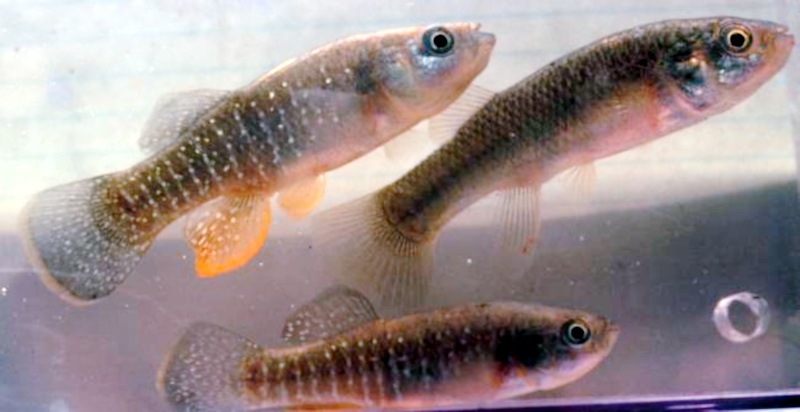
Fundulus pulvereus inhabits brackish bays and estuaries, as well as freshwater and marine environments. Males have 12–17 narrow dark bars, while females have numerous large black spots along their flanks.
Written 27 November 2026 from the sources listed below. Each statement was checked against the passage it cites; statements that could not be supported were removed.
Appearance
The bayou killifish has a slender, laterally compressed body and a flattened head with a convex upper profile. Its short, rounded snout is approximately equal to or slightly shorter than the eye.[1][2]
The species has a small, oblique, protrusible mouth positioned at or slightly above the center of the eye. Its jaws bear an outer row of pointed conical teeth and an inner band of simple teeth, and its maxilla has a concave edge near the rear.[3][4][5]
The species has seven short, blunt gill rakers. Its dorsal fin has 9–11 rays and originates before the anal fin, which has 9–10 rays, with its third ray branched.[6][7][8]
The pectoral fins have a narrow base, rounded shape, low insertion, and 18–19 rays. The tail fin is bluntly rounded and attached to a slender tail base.[9][10]
The species has 33–37 rows of small, smooth scales along its midlateral region. Its lateral line is reduced to a series of pits along the body.[11][12]
Female bayou killifish are olive above and yellowish below, with numerous large black flank spots, some arranged in lines. They also have a dark spot near the rear of the dorsal fin.[13][14]
Male bayou killifish are olive above and yellowish below, with 12–17 narrow dark bars. They have small pearl spots on the rear body and inner portions of the dorsal, anal, and tail fins.[15][16]
Male bayou killifish sometimes have a large dark spot at the rear of the dorsal fin.[17]
The bayou killifish typically reaches a maximum length of 5–7 centimetres.[18]
Habitat
The bayou killifish inhabits brackish bays and estuaries and occurs in freshwater, brackish, and marine environments.[19][20]
The species is associated with soft-bottom habitats containing mud, sand, or gravel. It inhabits moderately warm coastal waters with temperatures ranging from 15 to 26 °C.[21][22]
Diet
The bayou killifish feeds on aquatic insects and isopods. Its diet also includes insects and mobile benthic crustaceans.[23][24]
Reproduction and life cycle
The bayou killifish reproduces sexually and lays eggs.[25]
The species spawns mainly during spring tides. This spawning activity is associated with semi-lunar periods occurring every two weeks.[26][27]
Similar species
Male bayou killifish resemble longnose killifish but can be distinguished by their thicker stripes.[28]
The bayou killifish resembles the diamond killifish but lacks its pointed snout.[29]
Classification of the Bayou Killifish
| Kingdom | Animalia |
|---|---|
| Phylum | Chordata |
| Subphylum | Vertebrata |
| Infraphylum | Gnathostomata |
| Parvphylum | Osteichthyes |
| Gigaclass | Actinopterygii |
| Superclass | Actinopteri |
| Class | Teleostei (Teleost) |
| Order | Cyprinodontiformes |
| Family | Fundulidae (Fundulines) |
| Genus | Fundulus (Topminnows) |
| Species | Fundulus pulvereus (Evermann, 1892) |
Where the Bayou Killifish is found
Checklists and occurrence records place Fundulus pulvereus in 1 country. GBIF holds 746 georeferenced records of it.
Countries
Regions and cities with the most records
- Texas, United States 310
- Louisiana, United States 137
- Mississippi, United States 102
- Gautier, United States 73
- Ocean Springs, United States 67
- Biloxi, United States 66
- Pascagoula, United States 54
- Texas City, United States 39
- Alabama, United States 33
- La Marque, United States 32
- Port Arthur, United States 32
- Groves, United States 27
- Galveston, United States 25
- League City, United States 23
- Dickinson, United States 21
- Nederland, United States 20
- Deer Park, United States 19
- La Porte, United States 19
- Long Beach, United States 19
- Slidell, United States 19
- Channelview, United States 18
- Gulfport, United States 18
- Pasadena, United States 18
- Baytown, United States 17
- West Gulfport, United States 17
- Fairhope, United States 15
- Orange, United States 15
- Friendswood, United States 13
- Beaumont, United States 12
- Kenner, United States 12
- Chalmette, United States 11
- Foley, United States 11
- Laplace, United States 11
- East Pensacola Heights, United States 10
- Pensacola, United States 10
- Brent, United States 9
A number beside a place is its count of GBIF occurrence records. A place without a number comes from a checklist alone. Records show where a species has been observed or collected, which can include escapes and vagrants.
Common names
English
- Bayou Killifish
- Bayou Topminnow
Names in 3 other languages
- Czech
- fundul žlutolemý
- Russian
- Серый фундулюс
- Spanish
- sardinilla mulata
Synonyms
5 other scientific names have been used for this species and are now treated as synonyms of Fundulus pulvereus.
- Fundulus funduloides (Evermann, 1892)
- Fundulus limbatus Krøyer, 1896
- Fundulus spilotus Putnam, 1863
- Zygonectes funduloides Evermann, 1892
- Zygonectes pulvereus Evermann, 1892
Related species
-
 MummichogFundulus heteroclitus
-
 Banded KillifishFundulus diaphanus
-
 Blackstripe TopminnowFundulus notatus
-
 Gulf KillifishFundulus grandis
-
 Golden TopminnowFundulus chrysotus
-
 Striped KillifishFundulus majalis
-
 California KillifishFundulus parvipinnis
-
 Northern StudfishFundulus catenatus
Compare
Questions and answers
What is the scientific name of the Bayou Killifish?
The scientific name of the Bayou Killifish is Fundulus pulvereus. Written with its author, the full name is Fundulus pulvereus (Evermann, 1892).
Which family does the Bayou Killifish belong to?
Fundulus pulvereus belongs to the family Fundulidae, in the order Cyprinodontiformes and the class Teleostei.
Where is the Bayou Killifish found?
Checklists and occurrence records place Fundulus pulvereus in 1 country: United States.
What is the conservation status of the Bayou Killifish?
The IUCN Red List category recorded for Fundulus pulvereus is Least Concern (LC).
What other names does the Bayou Killifish have?
Fundulus pulvereus is also known in English as Bayou Topminnow.
Sources
Passages the profile rests on
- The bayou killifish has a slender, laterally compressed body and a flattened head with a convex upper profile. Source passage: “Body slender, compressed; head flattened above, with convex upper profile” — biogeodb.stri.si.edu
- The species has a short, rounded snout approximately equal to or slightly shorter than the eye. Source passage: “snout short (equal to or slightly < eye), rounded” — biogeodb.stri.si.edu
- The bayou killifish has a small, oblique, protrusible mouth positioned at or slightly above the center of the eye. Source passage: “mouth small, oblique, opens at front, protrusible, at or slightly above level of center of eye” — biogeodb.stri.si.edu
- Its jaws bear an outer row of pointed conical teeth and an inner band of simple teeth. Source passage: “jaws with outer row of pointed conical teeth, inner band of simple teeth” — biogeodb.stri.si.edu
- The bayou killifish has a concave edge near the rear of its maxilla. Source passage: “the maxilla has a distinctly concave edge near the back of the bone, toward the brain.” — English Wikipedia
- The species has seven short, blunt gill rakers. Source passage: “gill rakers short, blunt 7” — biogeodb.stri.si.edu
- The dorsal fin has 9–11 rays and originates before the anal fin. Source passage: “dorsal fin short based, its origin before anal fin origin, 9-11 rays” — biogeodb.stri.si.edu
- The anal fin has 9–10 rays, with its third ray branched. Source passage: “anal fin with 3rd fin ray branched, 9-10 rays” — biogeodb.stri.si.edu
- The pectoral fins have a narrow base, rounded shape, low insertion, and 18–19 rays. Source passage: “pectoral with narrow base, rounded, inserted low on side, 18-19 rays” — biogeodb.stri.si.edu
- The tail fin is bluntly rounded and attached to a slender tail base. Source passage: “tail base slender; tail fin bluntly rounded” — biogeodb.stri.si.edu
- The species has 33–37 rows of small, smooth scales along its midlateral region. Source passage: “small smooth scales, 33-37 midlateral rows” — biogeodb.stri.si.edu
- Its lateral line is reduced to a series of pits along the body. Source passage: “lateral line reduced to a series of pits along side of body.” — biogeodb.stri.si.edu
- Female bayou killifish are olive above, yellowish below, and have numerous large black flank spots, some arranged in lines. Source passage: “Females olive above, yellowish below, with many large black spots along flank, some in lines” — biogeodb.stri.si.edu
- Female bayou killifish have a dark spot near the rear of the dorsal fin. Source passage: “dorsal fin with a dark spot at rear.” — biogeodb.stri.si.edu
- Male bayou killifish are olive above and yellowish below, with 12–17 narrow dark bars. Source passage: “Male olive above, yellowish below, with 12-17 narrow dark bars” — biogeodb.stri.si.edu
- Male bayou killifish have small pearl spots on the rear body and inner portions of the dorsal, anal, and tail fins. Source passage: “rear of body and inner parts of dorsal, anal and tail fins with small pearl spots” — biogeodb.stri.si.edu
- Male bayou killifish sometimes have a large dark spot at the rear of the dorsal fin. Source passage: “sometimes a large dark spot at rear of dorsal fin.” — biogeodb.stri.si.edu
- The bayou killifish typically reaches a maximum length of 5–7 centimetres. Source passage: “the bayou killifish usually grows to a maximum length of 5–7 centimetres (2.0–2.8 in)” — English Wikipedia
- The species inhabits brackish bays and estuaries. Source passage: “Brackish bays and estuaries; brackish and marine.” — biogeodb.stri.si.edu
- The bayou killifish occurs in freshwater, brackish, and marine environments. Source passage: “Freshwater Estuary Beach Soft bottom (mud/sand/gravel/beach/estuary/mangrove/seagrass)” — biogeodb.stri.si.edu
- The species is associated with soft-bottom habitats containing mud, sand, or gravel. Source passage: “Soft bottom (mud/sand/gravel/beach/estuary/mangrove/seagrass)” — biogeodb.stri.si.edu
- The bayou killifish inhabits moderately warm coastal waters with temperatures ranging from 15 to 26 °C. Source passage: “They often inhabit moderately warm waters with temperatures ranging from 15–26 °C (59–79 °F).” — English Wikipedia
- The bayou killifish feeds on aquatic insects and isopods. Source passage: “their main food source consists of small aquatic insects and isopods.” — English Wikipedia
- The species feeds on insects and mobile benthic crustaceans. Source passage: “Insects Data Mobile benthic crustacea (shrimps/crabs)” — biogeodb.stri.si.edu
- The bayou killifish reproduces sexually and lays eggs. Source passage: “Bayou killifish reproduce sexually and are oviparous” — English Wikipedia
- The species spawns mainly during spring tides. Source passage: “this species of killifish spawns mainly during the spring, more specifically during the spring tides” — English Wikipedia
- Its spring-tide spawning is associated with semi-lunar periods occurring every two weeks. Source passage: “periods of 3 to 6 days biweekly, that occur in a period known as the semi-lunar phase.” — English Wikipedia
- Male bayou killifish resemble longnose killifish but can be distinguished by their thicker stripes. Source passage: “Males are similar in structure and appearance to the longnose killifish, with the bayou killifish being distinguishable by their thicker stripes.” — English Wikipedia
- The bayou killifish resembles the diamond killifish but lacks its pointed snout. Source passage: “Bayou killifish also resemble the diamond killifish, but have no pointed snout as the diamond killifish does.” — English Wikipedia
- The species occurs in the temperate coastal waters of the North American Atlantic coast and the Gulf of Mexico. Source passage: “Most populations of bayou killifish can be found in the temperate coastal waters of the Atlantic coast of North America, as well as the Gulf of Mexico.” — English Wikipedia
- The bayou killifish is identified as an endemic species of the western Atlantic. Source passage: “West Atlantic Endemic” — biogeodb.stri.si.edu
Data
- Catalogue of Life, 2026-10-16 XR cc by
- Global Biodiversity Information Facility CC BY 4.0
- Wikidata CC0
- GeoNames CC BY 4.0
- Wikimedia Commons per image; credit shown with each image
- Within the Catalogue of Life, this name comes from World Register of Marine Species cc by
This species in other databases
- Catalogue of Life 6JRHH
- Wikidata Q1809387
- iNaturalist 101068
- WoRMS urn:lsid:marinespecies.org:taxname:276033
- ITIS 165656
Page built on 27 November 2026. See how the catalog is made and all sources and licences.
Cite this page
ScientificNames.org. (2026). Fundulus pulvereus (Bayou Killifish). Retrieved November 27, 2026, from https://scientificnames.org/species/fundulus-pulvereus
“Fundulus pulvereus (Bayou Killifish).” ScientificNames.org, 2026, scientificnames.org/species/fundulus-pulvereus. Accessed 27 Nov. 2026.
ScientificNames.org. “Fundulus pulvereus (Bayou Killifish).” Accessed November 27, 2026. https://scientificnames.org/species/fundulus-pulvereus.
@misc{scientificnames_fundulus_pulvereus_bayou_killifish,
  author = {{ScientificNames.org}},
  title = {Fundulus pulvereus (Bayou Killifish)},
  year = {2026},
  url = {https://scientificnames.org/species/fundulus-pulvereus},
  note = {Accessed 2026-11-27}
}