Species · Fishes
Mosquitofish Gambusia affinis
The scientific name of the Mosquitofish is Gambusia affinis. It is a species of fish in the family Poeciliidae (topminnows), order Cyprinodontiformes. The name dates from 1853.
- Scientific name
- Gambusia affinis (Baird & Girard, 1853)
- Common name
- Mosquitofish
- Genus
- Gambusia
- Family
- Poeciliidae (Topminnows)
- Order
- Cyprinodontiformes
- Class
- Teleostei
- Red List category
- LC Least Concern
- Environment
- brackish, freshwater
- Recorded in
- 39 countries
- Name status
- accepted in the Catalogue of Life
Overview
The native range extends from southern Illinois and Indiana along the Mississippi River and its tributaries to the northeastern Mexican Gulf Coast. It is a live-bearing species that has been extensively used for biological control of mosquitoes.
Written 26 November 2026 from the sources listed below. Each statement was checked against the passage it cites; statements that could not be supported were removed.
Appearance
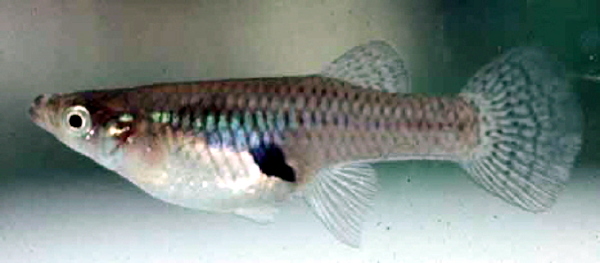
Mosquitofish have dull grey coloration, a large abdomen, rounded dorsal and caudal fins, and an upturned mouth. Adult females have a gravid spot on the posterior of the abdomen.[1][2]
Adult males reach a maximum overall length of 4 cm. Newborn individuals measure approximately 8–9 mm in length.[3][4]
Habitat
Mosquitofish occur most abundantly in shallow water protected from larger fish.[5]
The species tolerates low dissolved oxygen concentrations and salt concentrations up to twice that of seawater. It can withstand temperatures reaching 42 °C for short periods.[6][7][8]
Diet
Mosquitofish consume zooplankton, small insects, insect larvae, and detritus. Their diet also includes beetles, mayflies, caddisflies, and mites.[9][10]
Mosquito larvae constitute only a small proportion of the overall diet. Adult females can consume hundreds of mosquito larvae in a day.[11][12]
The species can exhibit cannibalism by eating its own young.[13]
Behaviour
Mosquitofish feed on mosquito larvae at every life stage when those larvae are available.[14]
The species can consume or injure other small fish.[15]
Reproduction and life cycle
Mosquitofish are viviparous and give birth to live young. Fertilization is internal, and males transfer milt into the female genital aperture using a modified anal fin called a gonopodium.[16][17][18]
Females give birth approximately 16–28 days after mating. They can produce between two and six broods during one reproductive season, commonly containing up to or more than 60 young.[19][20][21]
The number of offspring per brood generally decreases as the reproductive season progresses. Females can store sperm from multiple males for subsequent fertilization of ova.[22][23]
Newborn broods generally have approximately equal numbers of males and females.[24]
Males generally reach sexual maturity between 43 and 62 days of age. Females born early in the reproductive season can reach sexual maturity within 21–28 days, while females born later reach maturity during the following season, at six to seven months of age.[25][26][27]
Conservation
The western mosquitofish is considered a noxious pest in Australia. Introduced populations can threaten native fish and frog populations in Australia.[28][29]
The species is listed as an invasive alien species of Union concern in the European Union.[30]
Uses
Mosquitofish have been extensively used for biological control of mosquitoes.[31]
The species has been distributed to residents in several California counties for use in human-made ponds and pools as part of mosquito abatement programs.[32]
Similar species
The eastern mosquitofish (Gambusia holbrooki) is a closely related sister species that is also commonly called mosquitofish.[33]
Classification of the Mosquitofish
| Kingdom | Animalia |
|---|---|
| Phylum | Chordata |
| Subphylum | Vertebrata |
| Infraphylum | Gnathostomata |
| Parvphylum | Osteichthyes |
| Gigaclass | Actinopterygii |
| Superclass | Actinopteri |
| Class | Teleostei (Teleost) |
| Order | Cyprinodontiformes |
| Family | Poeciliidae (Topminnows) |
| Subfamily | Poeciliinae |
| Genus | Gambusia (Gambusias) |
| Species | Gambusia affinis (Baird & Girard, 1853) |
Where the Mosquitofish is found
Checklists and occurrence records place Gambusia affinis in 39 countries. GBIF holds 91,319 georeferenced records of it.
Countries
- Afghanistan 3
- Australia 28
- Bahamas 8
- Bulgaria 33
- Canada 144
- Chile 353
- China 333
- Croatia 8
- Cyprus 6
- Dominican Republic 9
- Fiji 27
- France 5,785
- French Polynesia 3
- Greece 72
- Guam 6
- Hong Kong 60
- India 16
- Indonesia 49
- Iran 25
- Israel 279
- Italy 44
- Japan 1,650
- Macao 22
- Malaysia 24
- Mexico 1,975
- New Zealand 5,436
- Northern Mariana Islands 3
- Panama 18
- Papua New Guinea 16
- Philippines 31
- Portugal 15
- Puerto Rico 12
- Singapore 68
- Spain 1,664
- Taiwan 2,148
- Thailand 69
- Turkey 30
- United States 70,840
- Vietnam 7
Regions and cities with the most records
- Texas, United States 21,207
- New Mexico, United States 10,216
- Oklahoma, United States 8,776
- California, United States 4,159
- Alabama, United States 2,992
- Florida, United States 2,820
- Waikato Region, New Zealand 2,635
- Occitanie, France 2,371
- Louisiana, United States 2,123
- Utah, United States 2,068
- Mississippi, United States 2,056
- Arizona, United States 1,805
- Taiwan, Taiwan 1,560
- Illinois, United States 1,191
- Nebraska, United States 1,184
- Kansas, United States 1,079
- Arkansas, United States 1,047
- Austin, United States 852
- Hamilton, New Zealand 824
- Auckland, New Zealand 822
- Northland, New Zealand 793
- Missouri, United States 781
- Mauguio, France 772
- Rio Rancho, United States 769
- South Valley, United States 757
- Tennessee, United States 745
- Ohio, United States 737
- Roswell, United States 731
- Albuquerque, United States 730
- Papillion, United States 648
- La Vista, United States 647
- Bellevue, United States 646
- Council Bluffs, United States 645
- Kentucky, United States 645
- Omaha, United States 645
- Hawke's Bay Region, New Zealand 609
14 more countries have a few records outside this range
These countries hold a few records of Gambusia affinis but lie outside the range the checklists give for it. Such records are often zoo or garden specimens, museum material or vagrants, so the species is not counted as occurring there.
A number beside a place is its count of GBIF occurrence records. A place without a number comes from a checklist alone. Records show where a species has been observed or collected, which can include escapes and vagrants.
Common names
English
- Mosquitofish
- Spotted Gambusia
- Western Mosquitofish
Names in 24 other languages
- Afrikaans
- Muskietvis
- Arabic
- جامبوزيا غربية, سمك البعوض الغربي
- Chinese
- 大肚仔, 大肚魚, 胎鱂, 食蚊魚 (大肚魚)
- Czech
- gambusie komáří
- Dutch
- westelijk muskietenvisje
- Finnish
- Moskiittokala
- French
- Gambusie de l’Ouest, Guppy sauvage, gambusie
- German
- Koboldkärpfling
- Greek
- Κουνουπόψαρο
- Hebrew
- גמבוזיה מצויה
- Hungarian
- szúnyogirtó fogasponty
- Indonesian
- Cere
- Italian
- Gambusia occidentale
- Japanese
- カダヤシ
- Korean
- 모기송사리
- Latvian
- Parastā gambūzija
- Mandarin Chinese
- 食蚊魚
- Polish
- Gambuzja pospolita
- Portuguese
- Peixe-mosquito
- Russian
- Обыкновенная гамбузия
- Spanish
- Gambusa, Pez Mosquito, guayacón mosquito
- Swedish
- Västlig moskitfisk
- Thai
- ปลากินยุง
- Turkish
- Sivrisinek Balığı
Synonyms
13 other scientific names have been used for this species and are now treated as synonyms of Gambusia affinis.
- Fundulus inurus (Jordan & Gilbert, 1882)
- Gambusia affinis affinis (Baird & Girard, 1853)
- Gambusia affinis katruelis (Baird & Girard, 1853)
- Gambusia gracilis Girard, 1859
- Gambusia humilis Günther, 1866
- Gambusia patruelis (Baird & Girard, 1853)
- Haplochilus melanops Cope, 1870
- Heterandria affinis Baird & Girard, 1853
- Heterandria patruelis Baird & Girard, 1853
- Zygonectes brachypterus Cope, 1880
- Zygonectes gracilis (Girard, 1859)
- Zygonectes inurus Jordan & Gilbert, 1882
- Zygonectes patruelis (Baird & Girard, 1853)
Related species
-
 Eastern MosquitofishGambusia holbrooki
- San Marcos GambusiaGambusia georgei
- Amistad GambusiaGambusia amistadensis
-
 Pecos GambusiaGambusia nobilis
- Domingo GambusiaGambusia dominicensis
-
 Big Bend GambusiaGambusia gaigei
-
 Tex-Mex GambusiaGambusia speciosa
- Widemouth GambusiaGambusia eurystoma
Compare
Questions and answers
What is the scientific name of the Mosquitofish?
The scientific name of the Mosquitofish is Gambusia affinis. Written with its author, the full name is Gambusia affinis (Baird & Girard, 1853).
Which family does the Mosquitofish belong to?
Gambusia affinis belongs to the family Poeciliidae, in the order Cyprinodontiformes and the class Teleostei.
Where is the Mosquitofish found?
Checklists and occurrence records place Gambusia affinis in 39 countries, including United States, France, New Zealand, Taiwan, Mexico and Spain.
What is the conservation status of the Mosquitofish?
The IUCN Red List category recorded for Gambusia affinis is Least Concern (LC).
What other names does the Mosquitofish have?
Gambusia affinis is also known in English as Spotted Gambusia and Western Mosquitofish.
Why is Gambusia called mosquito fish?
Mosquitofish feed on mosquito larvae at every life stage when those larvae are available. They have been extensively used for biological control of mosquitoes.[14][31]
Why are mosquito fish a problem?
Introduced populations can threaten native fish and frog populations in Australia. The species is considered a noxious pest in Australia and is listed as an invasive alien species of Union concern in the European Union.[28][29][30]
What are the different types of mosquitofish?
The eastern mosquitofish (Gambusia holbrooki) is a closely related sister species that is also commonly called mosquitofish.[33]
Sources
Passages the profile rests on
- The western mosquitofish has dull grey coloration, a large abdomen, rounded dorsal and caudal fins, and an upturned mouth. Source passage: “Mosquitofish are small and of a dull grey coloring, with a large abdomen, and have rounded dorsal and caudal fins and an upturned mouth.” — English Wikipedia
- Adult females have a gravid spot on the posterior of their abdomen. Source passage: “Adult female mosquitofish can be identified by a gravid spot they possess on the posterior of their abdomens.” — English Wikipedia
- Adult males reach a maximum overall length of 4 cm. Source passage: “while males reach only 4 cm (1.6 in).” — English Wikipedia
- Newborn western mosquitofish measure approximately 8–9 mm in length. Source passage: “After birth, newborn mosquitofish are about 8 to 9 mm (0.31 to 0.35 in) in length.” — English Wikipedia
- The species occurs most abundantly in shallow water protected from larger fish. Source passage: “They are found most abundantly in shallow water protected from larger fish.” — English Wikipedia
- The species can tolerate low dissolved oxygen concentrations. Source passage: “Mosquitofish can survive relatively inhospitable environments, and are resilient to low oxygen concentrations” — English Wikipedia
- The species can tolerate salt concentrations up to twice that of seawater. Source passage: “high salt concentrations (up to twice that of sea water)” — English Wikipedia
- The species can withstand temperatures reaching 42 °C for short periods. Source passage: “and temperatures up to 42 °C (108 °F) for short periods.” — English Wikipedia
- The western mosquitofish consumes zooplankton, small insects, insect larvae, and detritus. Source passage: “Their diet consists of zooplankton, small insects and insect larvae, and detritus material.” — English Wikipedia
- The species also consumes beetles, mayflies, caddisflies, and mites. Source passage: “Gambusia typically eat zooplankton, beetles, mayflies, caddisflies, mites, and other invertebrates;” — English Wikipedia
- Mosquito larvae constitute only a small proportion of the species' overall diet. Source passage: “mosquito larvae make up only a small portion of their diet.” — English Wikipedia
- Adult females can consume hundreds of mosquito larvae in a day. Source passage: “Adult females can consume up to hundreds of mosquito larvae in one day.” — English Wikipedia
- The species can exhibit cannibalism by eating its own young. Source passage: “mosquitofish have also shown cannibalistic behavior on the young of their own species.” — English Wikipedia
- Western mosquitofish feed on mosquito larvae at every life stage when those larvae are available. Source passage: “Mosquitofish feed on mosquito larvae at all stages of life, if mosquito larvae are available in the environment.” — English Wikipedia
- The species can consume or injure other small fish. Source passage: “Mosquitofish can consume or injure other small fish or otherwise harm them through competition.” — English Wikipedia
- Fertilization in western mosquitofish is internal. Source passage: “Fertilization is internal;” — English Wikipedia
- Males transfer milt into the female genital aperture using a modified anal fin called a gonopodium. Source passage: “The male mosquitofish uses this tubular fin to secrete milt into the female's genital aperture in the process of internal fertilization.” — English Wikipedia
- The species is viviparous and gives birth to live young. Source passage: “Mosquitofish are viviparous, which means after the gestation of a brood, the female will have live birth.” — English Wikipedia
- Females give birth approximately 16–28 days after mating. Source passage: “Within 16 to 28 days after mating, the female gives birth to about 60 young.” — English Wikipedia
- A female can produce between two and six broods during one reproductive season. Source passage: “In one reproductive season, a female may fertilize, with stored milt, two to six broods of embryos,” — English Wikipedia
- Females commonly produce broods containing up to or more than 60 young. Source passage: “Many females have a brood quantity of up to or more than 60 young.” — English Wikipedia
- The number of offspring per brood generally decreases as the reproductive season progresses. Source passage: “with the size of the brood decreasing as the season progresses.” — English Wikipedia
- Females can store sperm from multiple males for subsequent fertilization of ova. Source passage: “Inside the female, sperm from multiple males can be stored to later fertilize ova.” — English Wikipedia
- Newborn broods generally have approximately equal numbers of males and females. Source passage: “In most cases, the newborn brood will have an equal male to female sex ratio.” — English Wikipedia
- Males generally reach sexual maturity between 43 and 62 days of age. Source passage: “The males reach sexual maturity within 43 to 62 days.” — English Wikipedia
- Females born early in the reproductive season can reach sexual maturity within 21–28 days. Source passage: “The females, if born early in the reproductive season, reach sexual maturity within 21 to 28 days;” — English Wikipedia
- Females born later in the reproductive season reach sexual maturity during the following season, at six to seven months of age. Source passage: “females born later in the season reach sexual maturity the next season, in six to seven months.” — English Wikipedia
- The western mosquitofish is considered a noxious pest in Australia. Source passage: “Mosquitofish in Australia are classified as a noxious pest” — English Wikipedia
- Introduced populations can threaten native fish and frog populations in Australia. Source passage: “Mosquitofish in Australia are considered noxious pests where they pose a threat to native fish and frog populations” — English Wikipedia
- The species is listed as an invasive alien species of Union concern in the European Union. Source passage: “In the European Union, due to the significant negative impacts of its introduction to the ecosystem, it is included in the list of invasive alien species of Union concern” — English Wikipedia
- Western mosquitofish have been extensively used for biological control of mosquitoes. Source passage: “has been used more than any other fishes for the biological control of mosquitoes.” — English Wikipedia
- The species has been distributed to residents in several California counties for use in human-made ponds and pools as part of mosquito abatement programs. Source passage: “Several counties in California distribute mosquitofish at no charge to residents with human-made fish ponds and pools as part of their mosquito abatement programs.” — English Wikipedia
- The eastern mosquitofish (Gambusia holbrooki) is a closely related sister species that is also commonly called mosquitofish. Source passage: “Its sister species, the eastern mosquitofish (Gambusia holbrooki) is also referred to by these names.” — English Wikipedia
Data
- Catalogue of Life, 2026-10-16 XR cc by
- Global Biodiversity Information Facility CC BY 4.0
- Wikidata CC0
- GeoNames CC BY 4.0
- Wikimedia Commons per image; credit shown with each image
- Within the Catalogue of Life, this name comes from World Register of Marine Species cc by
References
- Baird, S. F. & Girard, C. F. (1853) Descriptions of new species of fishes collected by Mr. John H. Clark, on the U. S. and Mexican Boundary Survey, under Lt. Col. Jas. D. Graham. Proceedings of the Academy of Natural Sciences of Philadelphia, 6, 387 - 390. where the name was published
This species in other databases
- Catalogue of Life 6K97T
- Wikidata Q723904
- iNaturalist 59115
- WoRMS urn:lsid:marinespecies.org:taxname:159325
- ITIS 165878
Page built on 28 November 2026. See how the catalog is made and all sources and licences.
Cite this page
ScientificNames.org. (2026). Gambusia affinis (Mosquitofish). Retrieved November 28, 2026, from https://scientificnames.org/species/gambusia-affinis
“Gambusia affinis (Mosquitofish).” ScientificNames.org, 2026, scientificnames.org/species/gambusia-affinis. Accessed 28 Nov. 2026.
ScientificNames.org. “Gambusia affinis (Mosquitofish).” Accessed November 28, 2026. https://scientificnames.org/species/gambusia-affinis.
@misc{scientificnames_gambusia_affinis_mosquitofish,
  author = {{ScientificNames.org}},
  title = {Gambusia affinis (Mosquitofish)},
  year = {2026},
  url = {https://scientificnames.org/species/gambusia-affinis},
  note = {Accessed 2026-11-28}
}