Species · Fishes
Eastern Mosquitofish Gambusia holbrooki
The scientific name of the Eastern Mosquitofish is Gambusia holbrooki. It is a species of fish in the family Poeciliidae (topminnows), order Cyprinodontiformes. The name dates from 1859.
- Scientific name
- Gambusia holbrooki Girard, 1859
- Common name
- Eastern Mosquitofish
- Genus
- Gambusia
- Family
- Poeciliidae (Topminnows)
- Order
- Cyprinodontiformes
- Class
- Teleostei
- Red List category
- LC Least Concern
- Environment
- brackish, freshwater
- Recorded in
- 29 countries
- Name status
- accepted in the Catalogue of Life

Overview
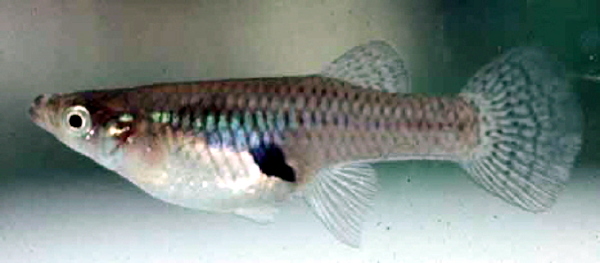
The Eastern Mosquitofish (Gambusia holbrooki Girard, 1859) is a fish in the family Poeciliidae, order Cyprinodontiformes and class Teleostei. It inhabits shallow standing or slowly flowing freshwater, particularly vegetated ponds, lakes and sloughs. It has a small, light-coloured body, semitransparent fins and an upturned mouth, with males possessing an enlarged gonopodium.
Written 26 November 2026 from the sources listed below. Each statement was checked against the passage it cites; statements that could not be supported were removed.
Appearance
The Eastern Mosquitofish has a small, light-coloured body and semitransparent fins. Its upper body is green to brown, its sides are grey with a bluish sheen, and its underside is silvery-white.[1][2]
It has a dorsally flattened head, an upturned small mouth, prominent eyes, a rounded tail fin and one dorsal fin. Females commonly display a dark stripe near the eyes, and adult females frequently have a black marking on the underside near the vent.[3][4][5]
Both sexes can have pale spots on their dorsal and caudal fins, and some individuals develop black spots in a melanistic colour pattern resembling a Dalmatian dog. Males possess an enlarged gonopodium formed from thickened anal-fin rays.[3][6][7]
Adult males generally reach approximately 3.8 cm in length, while adult females generally reach approximately 6.4 cm.[8][9]
Habitat
The Eastern Mosquitofish inhabits shallow standing or slowly flowing freshwater, particularly vegetated ponds, lakes and sloughs. It prefers warm water with little or gentle current.[10][11]
It can tolerate temperatures ranging from below freezing conditions under ice to approximately 44 °C. It can also survive across salinity conditions ranging from freshwater to marine environments.[12][13]
Diet
The Eastern Mosquitofish consumes phytoplankton, algae and detritus. Its diet also includes insects and aquatic invertebrates.[14][15]
It can consume zooplankton, invertebrates, fish and amphibian larvae, and animals associated with aquatic plants when food competition increases. Its food also includes fish and amphibian eggs and larval stages.[16][15]
Detritus and Cladocera were the dominant dietary items in studied Italian and Spanish populations. Documented food items in Australia include ants, flies, aquatic bugs and beetles.[17][18]
The species can adjust its dietary composition according to the food resources available in its environment.[19]
Behaviour
Males can exhibit strong sexual aggression that reduces female feeding efficiency by more than half. Females frequently form shoals to reduce unwanted sexual attention from males.[20][21]
The Eastern Mosquitofish displays aggressive fin-nipping behaviour towards other fish. In Australian freshwater habitats, it can outcompete smaller native fish.[22][23]
Reproduction and life cycle
Females give birth to live offspring rather than depositing eggs in a clutch. The breeding season generally extends from mid-spring until mid-autumn, with reproductive activity peaking around summer.[24][25]
Females can produce as many as nine broods during one breeding season. The gestation period lasts approximately 22–25 days.[26][27]
Brood sizes vary from approximately five to 100 offspring on average, depending on factors including temperature, maternal age and nutrient availability. Females can produce an average of approximately 50 offspring per brood, with recorded broods reaching 300.[28][29]
Females can store sperm for fertilisation during a subsequent breeding season. Newborn larvae measure only a few millimetres in length, and young individuals reach maturity in less than two months.[30][31][32]
Conservation
The Eastern Mosquitofish is classified among the world's 100 most invasive species. Introduced populations have become established in more than 50 countries.[33][34]
The species is included on the European Union list of invasive alien species of Union concern. Its inclusion prohibits its importation, breeding, transport, commercialisation and intentional release.[35]
Uses
In Australia, the species has not proved more effective at controlling mosquito populations than native fish.[36]
Similar species
Within its native range, the Eastern Mosquitofish can be confused with the western mosquitofish (Gambusia affinis) and sailfin molly (Poecilia latipinna). Male Eastern Mosquitofish can be distinguished from western mosquitofish by the hooked third ray of the gonopodium.[37][38]
Female and juvenile Pacific blue-eyes (Pseudomugil signifer) in eastern Australia resemble the Eastern Mosquitofish but have forked tail fins.[39]
Classification of the Eastern Mosquitofish
| Kingdom | Animalia |
|---|---|
| Phylum | Chordata |
| Subphylum | Vertebrata |
| Infraphylum | Gnathostomata |
| Parvphylum | Osteichthyes |
| Gigaclass | Actinopterygii |
| Superclass | Actinopteri |
| Class | Teleostei (Teleost) |
| Order | Cyprinodontiformes |
| Family | Poeciliidae (Topminnows) |
| Subfamily | Poeciliinae |
| Genus | Gambusia (Gambusias) |
| Species | Gambusia holbrooki Girard, 1859 |
Where the Eastern Mosquitofish is found
Checklists and occurrence records place Gambusia holbrooki in 29 countries. GBIF holds 57,844 georeferenced records of it.
Countries
- Albania 11
- Australia 30,308
- Belgium 3
- Bermuda 17
- Bosnia and Herzegovina 13
- Bulgaria 68
- Chile 391
- Croatia 142
- Cyprus 22
- Dominican Republic 11
- France 1,581
- Germany 13
- Gibraltar 3
- Greece 418
- Hungary 20
- Italy 927
- Malta 9
- Mexico 7
- Montenegro 32
- Panama 3
- Papua New Guinea 10
- Portugal 522
- Puerto Rico 7
- Romania 10
- Russia 60
- Slovenia 14
- Spain 7,631
- Timor Leste 12
- United States 15,579
Regions and cities with the most records
- Victoria, Australia 12,319
- South Australia, Australia 8,313
- Florida, United States 7,772
- New South Wales, Australia 4,550
- Queensland, Australia 4,498
- North Carolina, United States 2,705
- Valencia, Spain 1,943
- Georgia, United States 1,029
- South Carolina, United States 965
- Balwyn North, Australia 949
- Brisbane, Australia 904
- Melbourne, Australia 827
- St Albans, Australia 821
- Virginia, United States 808
- Burwood, Australia 802
- Winter Springs, United States 780
- Casselberry, United States 768
- Logan City, Australia 762
- Maitland, United States 738
- Altamonte Springs, United States 734
- Alafaya, United States 732
- Winter Park, United States 726
- Almonte, Spain 717
- Maryland, United States 715
- Oviedo, United States 714
- Orlando, United States 670
- Capalaba, Australia 616
- Frankston East, Australia 610
- Sueca, Spain 596
- Algemesí, Spain 586
- Silla, Spain 550
- Picassent, Spain 546
- Occitanie, France 539
- Valencia, Spain 534
- Cullera, Spain 521
- Parramatta, Australia 520
21 more countries have a few records outside this range
These countries hold a few records of Gambusia holbrooki but lie outside the range the checklists give for it. Such records are often zoo or garden specimens, museum material or vagrants, so the species is not counted as occurring there.
A number beside a place is its count of GBIF occurrence records. A place without a number comes from a checklist alone. Records show where a species has been observed or collected, which can include escapes and vagrants.
Common names
English
- Eastern Mosquitofish
- Bore-drain Fish
- Eastern Gambusia
- Gambies
- Plague Minnow
- Starling's Perch
- Top Minnow
Names in 19 other languages
- Albanian
- barkuleci, peshku i mushkonjave
- Arabic
- جامبوزيا شرقية, سمك البعوض الشرقي
- Asturian
- gambusia
- Catalan
- Gambúsia
- Czech
- gambusie Holbrookova
- Dutch
- Oostelijk Muskietenvisje
- Finnish
- marmorimoskiittokala
- French
- Gambusie, Gambusie de l’Est, Poisson-moustique de l'Est
- German
- Östlicher Moskitofisch
- Greek
- Κουνουπόψαρο
- Italian
- Gambusia orientale
- Polish
- Gambuzja kropkowana
- Portuguese
- Peixe-mosquito
- Russian
- Гамбрузия Хольбрука, Гамбузия хольбрукская
- Spanish
- Pez Mosquito Oriental
- Swedish
- östlig moskitfisk
- Turkish
- Doğu Sivrisinek Balığı, Sivrisinek Balığı, sivrisinek baligi
- Ukrainian
- Гамбузія східна, Гамбузія хольбрукська
- ext
- Barrigón
Synonyms
9 other scientific names have been used for this species and are now treated as synonyms of Gambusia holbrooki.
- Gambusia affinis holbrocki (Girard, 1859)
- Gambusia affinis holbrooki (Girard, 1859)
- Gambusia holbrocki Girard, 1859
- Gambusia holbrookii Girard, 1859
- Gambusia modesta Ahl, 1923
- Gambusia patruelis holbrooki (Girard, 1859)
- Heterandria holbrooki (Girard, 1859)
- Schizophallus holbrooki (Girard, 1859)
- Zygonectes atrilatus Jordan & Brayton, 1878
Related species
-
 MosquitofishGambusia affinis
- San Marcos GambusiaGambusia georgei
- Amistad GambusiaGambusia amistadensis
-
 Pecos GambusiaGambusia nobilis
- Domingo GambusiaGambusia dominicensis
-
 Big Bend GambusiaGambusia gaigei
-
 Tex-Mex GambusiaGambusia speciosa
- Widemouth GambusiaGambusia eurystoma
Compare
Questions and answers
What is the scientific name of the Eastern Mosquitofish?
The scientific name of the Eastern Mosquitofish is Gambusia holbrooki. Written with its author, the full name is Gambusia holbrooki Girard, 1859.
Which family does the Eastern Mosquitofish belong to?
Gambusia holbrooki belongs to the family Poeciliidae, in the order Cyprinodontiformes and the class Teleostei.
Where is the Eastern Mosquitofish found?
Checklists and occurrence records place Gambusia holbrooki in 29 countries, including Australia, United States, Spain, France, Italy and Portugal.
What is the conservation status of the Eastern Mosquitofish?
The IUCN Red List category recorded for Gambusia holbrooki is Least Concern (LC).
What other names does the Eastern Mosquitofish have?
Gambusia holbrooki is also known in English as Bore-drain Fish, Eastern Gambusia, Gambies, Plague Minnow, Starling's Perch and Top Minnow.
Are eastern mosquitofish invasive?
Yes. The Eastern Mosquitofish is classified among the world's 100 most invasive species, and introduced populations have become established in more than 50 countries.[33][34]
Are mosquitofish native to Florida?
Yes. The native distribution of the Eastern Mosquitofish extends across the eastern and southern United States, from Florida to New Jersey and inland to Alabama and Tennessee.[40]
Sources
Passages the profile rests on
- This species has a small, light-coloured body and semitransparent fins. Source passage: “The eastern mosquitofish is a small, light-colored fish with semitransparent fins.” — English Wikipedia
- Its upper body is green to brown, its sides are grey with a bluish sheen, and its underside is silvery-white. Source passage: “It is green to brown on the above, grey with a bluish sheen on the sides and silvery-white on the belly.” — australian.museum
- Females commonly display a dark stripe near the eyes, while both sexes can have pale spots on their dorsal and caudal fins. Source passage: “The females usually have a black stripe near their eye area and light spots can be seen on the caudal and dorsal fins of both sexes.” — English Wikipedia
- The species has a dorsally flattened head, an upturned small mouth, prominent eyes, a rounded tail fin and one dorsal fin. Source passage: “The Eastern Gambusia can be recognised by its dorsally flattened head, small, upturned mouth, large eyes, rounded caudal fin and single dorsal fin.” — australian.museum
- Adult females frequently have a black marking on the underside near the vent. Source passage: “Adult females often have a black mark on the side of the belly above the vent.” — australian.museum
- Some individuals develop black spots in a melanistic colour pattern resembling a Dalmatian dog. Source passage: “Mosquitofish may have a melanistic color pattern with black spots, resembling a dalmatian.” — English Wikipedia
- Males possess an enlarged gonopodium formed from thickened anal-fin rays. Source passage: “Males have a large gonopodium. This structure (clearly visible in both images) is formed by the thickened anal fin rays” — australian.museum
- Adult males generally reach approximately 3.8 cm in length. Source passage: “Generally, males reach 1.5 in (3.8 cm)” — English Wikipedia
- Adult females generally reach approximately 6.4 cm in length. Source passage: “females 2.5 in (6.4 cm).” — English Wikipedia
- The species inhabits shallow standing or slowly flowing freshwater, particularly vegetated ponds, lakes and sloughs. Source passage: “Eastern mosquitofish are found in shallow, standing to slow-flowing water, mostly in vegetated ponds, lakes, and sloughs.” — English Wikipedia
- It prefers warm water with little or gentle current. Source passage: “It prefers warm water that is still or gently flowing.” — australian.museum
- The species can tolerate temperatures ranging from below freezing conditions under ice to approximately 44 °C. Source passage: “It can tolerate a wide range of temperatures (under ice to 44oC)” — australian.museum
- It can survive across salinity conditions ranging from freshwater to marine environments. Source passage: “such as salinities from freshwater to marine.” — australian.museum
- Its diet includes phytoplankton, algae and detritus. Source passage: “With an increase of competition, this species will switch from a diet rich in phytoplankton, algae, and detritus” — English Wikipedia
- The species consumes insects, aquatic invertebrates, algae, and fish and amphibian eggs and larval stages. Source passage: “eastern mosquitofish feed on a variety of items, ranging from detritus to organisms such as insects, aquatic invertebrates, algae, and fish and amphibian eggs and larval stages” — pmc.ncbi.nlm.nih.gov
- When food competition increases, the species can consume zooplankton, invertebrates, fish and amphibian larvae, and animals associated with aquatic plants. Source passage: “to one consisting of zooplankton, invertebrates, the larvae of many other fish and amphibian species, and plant-associated animals.” — English Wikipedia
- Its food includes detritus and Cladocera, which were the dominant dietary items in the studied Italian and Spanish populations. Source passage: “Our results confirmed our first prediction, because mosquitofish fed on a variety of diet items, among which detritus and Cladocera dominated.” — pmc.ncbi.nlm.nih.gov
- Its documented food items in Australia include ants, flies, aquatic bugs and beetles. Source passage: “Its wide range of food items include ants, flies, aquatic bugs and beetles.” — australian.museum
- The species can adjust its dietary composition according to the food resources available in its environment. Source passage: “They are therefore considered adaptable omnivores or even generalist predators, capable of changing the composition of their diet depending on food availability” — pmc.ncbi.nlm.nih.gov
- Males can exhibit strong sexual aggression that reduces female feeding efficiency by more than half. Source passage: “This aggression can reduce female foraging efficiency by more than half.” — English Wikipedia
- Females frequently form shoals as a means of reducing unwanted sexual attention from males. Source passage: “Females frequently form shoals to reduce sexual harassment from males.” — English Wikipedia
- The species displays aggressive fin-nipping behaviour towards other fish. Source passage: “Mosquitofish are aggressive, fin-nipping harassers of other fish” — English Wikipedia
- In Australian freshwater habitats, this species can outcompete smaller native fish. Source passage: “The species shows aggressive fin-nipping behaviour and often outcompetes small native fishes.” — australian.museum
- Females give birth to live offspring rather than depositing eggs in a clutch. Source passage: “This species is also known to give birth to live young instead of laying a clutch of eggs.” — English Wikipedia
- The breeding season generally extends from mid-spring until mid-autumn, with reproductive activity peaking around summer. Source passage: “The breeding season is between midspring and midautumn, with the peak breeding time being around summer.” — English Wikipedia
- Females can produce as many as nine broods during one breeding season. Source passage: “Females can have up to nine broods per mating season” — English Wikipedia
- The gestation period lasts approximately 22–25 days. Source passage: “The gestation period for this species is between 22 and 25 days.” — English Wikipedia
- Brood sizes vary from approximately five to 100 offspring on average, depending on factors including temperature, maternal age and nutrient availability. Source passage: “the average size ranging from five to 100. The variability of the average brood size is due to many variables, including temperature, age, and available nutrients.” — English Wikipedia
- Females can produce an average of approximately 50 offspring per brood, with recorded broods reaching 300. Source passage: “producing an average of 50 young per brood although up to 300 have been recorded.” — australian.museum
- Females can store sperm for fertilisation during a subsequent breeding season. Source passage: “Females can store sperm and self-fertilize in the next season” — australian.museum
- Newborn larvae measure only a few millimetres in length. Source passage: “then larvae of a few millimetres in length are born.” — australian.museum
- Young individuals reach maturity in less than two months. Source passage: “Young fish mature in under two months.” — australian.museum
- Introduced populations have become established in more than 50 countries. Source passage: “as a consequence, have successfully colonized over 50 countries” — pmc.ncbi.nlm.nih.gov
- The species is classified among the world's 100 most invasive species. Source passage: “The negative impacts of G. holbrooki on native biota have led the species to be listed among the 100 most invasive species worldwide” — pmc.ncbi.nlm.nih.gov
- The species is included on the European Union list of invasive alien species of Union concern, which prohibits its importation, breeding, transport, commercialisation and intentional release. Source passage: “In the European Union, it is included in the list of invasive alien species of Union concern and hence cannot be imported, bred, transported, commercialized, or intentionally released into the environment in any of its member states.” — English Wikipedia
- In Australia, the species has not proved more effective at controlling mosquito populations than native fish. Source passage: “In Australia, however the Eastern Gambusia appears no more effective at controlling mosquito populations than native fishes.” — australian.museum
- The species can be confused with the western mosquitofish (Gambusia affinis) and sailfin molly (Poecilia latipinna) within its native range. Source passage: “In its native range, eastern mosquitofish may be confused with the western mosquitofish (Gambusia affinis) or the sailfin molly (Poecilia latipinna).” — English Wikipedia
- Male eastern mosquitofish can be distinguished from western mosquitofish by the hooked third ray of the gonopodium. Source passage: “It can be distinguished from G. affinis on the basis of its hooked third ray on the male gonopodium.” — English Wikipedia
- Female and juvenile Pacific blue-eyes (Pseudomugil signifer) in eastern Australia resemble this species but have forked tail fins. Source passage: “In eastern Australia, the female and juvenile local Pacific blue-eye (Pseudomugil signifer) are similar in appearance but have a forked tail fin.” — English Wikipedia
- The native distribution extends across the eastern and southern United States, from Florida to New Jersey and inland to Alabama and Tennessee. Source passage: “The eastern mosquitofish is native to the eastern and southern United States from Florida to New Jersey and inland to Alabama and Tennessee” — English Wikipedia
- The species is native to rivers in southeastern America. Source passage: “The Eastern Gambusia is native to the rivers of south-eastern America.” — australian.museum
Data
- Catalogue of Life, 2026-10-16 XR cc by
- Global Biodiversity Information Facility CC BY 4.0
- Wikidata CC0
- GeoNames CC BY 4.0
- Wikimedia Commons per image; credit shown with each image
- Within the Catalogue of Life, this name comes from World Register of Marine Species cc by
References
- Girard, C. F. (1859). Ichthyological notices. Proceedings of the Academy of Natural Sciences of Philadelphia, v. 11: 56–68. ;v. 11:91. where the name was published
This species in other databases
- Catalogue of Life 3F7VR
- Wikidata Q1930449
- iNaturalist 101204
- WoRMS urn:lsid:marinespecies.org:taxname:276134
- ITIS 165878-165896
Page built on 28 November 2026. See how the catalog is made and all sources and licences.
Cite this page
ScientificNames.org. (2026). Gambusia holbrooki (Eastern Mosquitofish). Retrieved November 28, 2026, from https://scientificnames.org/species/gambusia-holbrooki
“Gambusia holbrooki (Eastern Mosquitofish).” ScientificNames.org, 2026, scientificnames.org/species/gambusia-holbrooki. Accessed 28 Nov. 2026.
ScientificNames.org. “Gambusia holbrooki (Eastern Mosquitofish).” Accessed November 28, 2026. https://scientificnames.org/species/gambusia-holbrooki.
@misc{scientificnames_gambusia_holbrooki_eastern_mosquitofish,
  author = {{ScientificNames.org}},
  title = {Gambusia holbrooki (Eastern Mosquitofish)},
  year = {2026},
  url = {https://scientificnames.org/species/gambusia-holbrooki},
  note = {Accessed 2026-11-28}
}