Species · Insects
Banded Redeye Gangara lebadea
The scientific name of the Banded Redeye is Gangara lebadea. It is a species of insect in the family Hesperiidae (skipper), order Lepidoptera. The name dates from 1868.
- Scientific name
- Gangara lebadea (Hewitson, 1868)
- Common name
- Banded Redeye
- Genus
- Gangara
- Family
- Hesperiidae (Skipper)
- Order
- Lepidoptera
- Class
- Insecta
- Recorded in
- 5 countries
- Name status
- accepted in the Catalogue of Life

Overview
The species is reported from Southeast Asia and was described from Borneo.
Written 27 November 2026 from the sources listed below. Each statement was checked against the passage it cites; statements that could not be supported were removed.
Appearance
Male forewings are dark fuliginous brown on the upper surface, with a large discal patch of dark fuscous silky hairs. The hindwings have a pale ochraceous fringe and two raised, elongated discal glandular pouches.[1][2]
The underside of the male hindwings has a transverse pale ochraceous discal band. The antennae are blackish with ochraceous hooked tips.[3][4]
Females have paler and duller wings with a purple gloss, and their forewings are spotted. The forewings bear three semi-transparent yellow lustrous spots and a smaller elongated opaque yellow spot.[5][6]
Female antennae are purplish brown, with a bright luteous underside to the club.[7]
Males of the local race andamanica have dark brown upper wings with a slightly greenish tinge and no spots. Their forewing uppersides have a large, dense, pear-shaped patch of silky setae.[8][9]
The male of andamanica has a purple-glossed hindwing upperside with two raised longitudinal lines of modified scales. Its forewing underside has a brilliant amethyst-purple patch, and its hindwing underside has an interrupted transverse band of white scales.[10][11][12]
The male of andamanica has pale yellow forewing cilia instead of white ones. The local race also has a prominent oblique powdery patch of violet scales beneath the forewing.[13][14]
Behaviour
The male has a yellow setal tuft on the underside of the forewing that is suggested to function as a scent fan. The raised modified scales on the hindwing are suggested to cover scent glands.[15][16]
Classification of the Banded Redeye
| Kingdom | Animalia |
|---|---|
| Phylum | Arthropoda |
| Subphylum | Hexapoda |
| Class | Insecta (Insect) |
| Order | Lepidoptera |
| Superfamily | Papilionoidea |
| Family | Hesperiidae (Skipper) |
| Subfamily | Hesperiinae |
| Genus | Gangara |
| Species | Gangara lebadea (Hewitson, 1868) |
Where the Banded Redeye is found
Checklists and occurrence records place Gangara lebadea in 5 countries. GBIF holds 45 georeferenced records of it.
Countries
Regions and cities with the most records
- Anak Bukit, Singapore 17
- Ang Mo Kio New Town, Singapore 17
- Bedok New Town, Singapore 17
- Boon Lay, Singapore 17
- Bukit Panjang New Town, Singapore 17
- Bukit Timah, Singapore 17
- Choa Chu Kang New Town, Singapore 17
- Eunos, Singapore 17
- Johor Bahru, Malaysia 17
- Jurong East, Singapore 17
- Jurong Town, Singapore 17
- Jurong West, Singapore 17
- Kampong Pasir Ris, Singapore 17
- Kampung Pasir Gudang Baru, Malaysia 17
- Keat Hong Village, Singapore 17
- MacPherson, Singapore 17
- Marine Parade, Singapore 17
- Marsiling, Singapore 17
- Masai, Malaysia 17
- Matilda Estate, Singapore 17
- Novena, Singapore 17
- Pasir Gudang, Malaysia 17
- Punggol, Singapore 17
- Queenstown Estate, Singapore 17
- Sembawang Estate, Singapore 17
- Sengkang New Town, Singapore 17
- Singapore, Singapore 17
- Sungai Simpang, Singapore 17
- Taman Permas Jaya, Malaysia 17
- Teck Whye, Singapore 17
- Ulu Bedok, Singapore 17
- Woodlands, Singapore 17
- Yew Tee, Singapore 17
- Yio Chu Kang, Singapore 17
- Yishun New Town, Singapore 17
- Bandar Seri Alam, Malaysia 16
A number beside a place is its count of GBIF occurrence records. A place without a number comes from a checklist alone. Records show where a species has been observed or collected, which can include escapes and vagrants.
Common names
English
- Banded Redeye
Names in 2 other languages
- Chinese
- 尖翅椰弄蝶
- Thai
- ผีเสื้อตาแดงคาดขาว
Synonyms
2 other scientific names have been used for this species and are now treated as synonyms of Gangara lebadea.
- Hesperia lebadea Hewitson, 1868
- Paduka glandulosa Distant, 1886
Subspecies and varieties
- Gangara lebadea andamanica subspecies
- Gangara lebadea subfasciata subspecies
Related species
-
 Giant RedeyeGangara thyrsis
- Gangara sanguinocculus
-
 Long-tailed SkipperUrbanus proteus
-
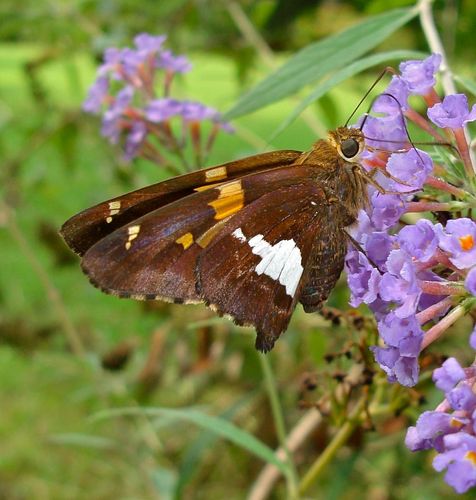 Silver-spotted SkipperEpargyreus clarus
-
 Field SkipperAtalopedes campestris
-
 Common Checkered SkipperBurnsius communis
-
 Common Branded SkipperHesperia comma
-
 Arctic SkipperCarterocephalus palaemon
Compare
Questions and answers
What is the scientific name of the Banded Redeye?
The scientific name of the Banded Redeye is Gangara lebadea. Written with its author, the full name is Gangara lebadea (Hewitson, 1868).
Which family does the Banded Redeye belong to?
Gangara lebadea belongs to the family Hesperiidae, in the order Lepidoptera and the class Insecta.
Where is the Banded Redeye found?
Checklists and occurrence records place Gangara lebadea in 5 countries: Singapore, Malaysia, Cambodia, India and Thailand.
What is the yellow tuft beneath the male forewing thought to do?
It is suggested to function as a scent fan.[15]
What are the raised modified scales on the male hindwing thought to cover?
They are suggested to cover scent glands.[16]
Where was Gangara lebadea lebadea recorded as a resident butterfly in 2013?
It was recorded in Singapore.[17]
Sources
Passages the profile rests on
- Male forewings are dark fuliginous brown on the upper surface and have a large discal patch of dark fuscous silky hairs. Source passage: “Wings above dark fuliginous brown; anterior wings with a large discal patch of dark fuscous silky hairs” — English Wikipedia
- Male hindwings have a pale ochraceous fringe and two raised, elongated discal glandular pouches. Source passage: “posterior wings with the fringe pale ochraceous, and with two pale raised discal elongate glandular pouches” — English Wikipedia
- The underside of the male hindwings has a transverse pale ochraceous discal band. Source passage: “posterior wings with a transverse discal pale ochraceous fascia.” — English Wikipedia
- The male's antennae are blackish and have ochraceous hooked tips. Source passage: “Antennae blackish, their hooked apices ochraceous.” — English Wikipedia
- The female has paler and duller wings with a purple gloss, and its forewings are spotted. Source passage: “Female. All the wings above and below paler and duller and glossed with purple, the anterior ones spotted.” — English Wikipedia
- The female forewings bear three semi-transparent yellow lustrous spots and a smaller elongated opaque yellow spot. Source passage: “three semi-transparent yellow lustrous spots of the same size, relative proportions, and shape as in C. [Unkana] attina, Hewitson, with a fourth smaller and elongate yellow opaque spot” — English Wikipedia
- The female's antennae are purplish brown with a bright luteous underside to the club. Source passage: “Antennae purplish brown with the club bright luteous below.” — English Wikipedia
- The male of the local race andamanica has dark brown upper wings with a slightly greenish tinge and no spots. Source passage: “Male. Wings above dark brown of a slightly greenish tinge, all without spots.” — English Wikipedia
- The male of the local race andamanica has a large, dense, pear-shaped patch of silky setae on the forewing upperside. Source passage: “Anterior wings bearing a huge and dense pear-shaped sericeous patch of setae” — English Wikipedia
- The male of the local race andamanica has a purple-glossed hindwing upperside with two raised longitudinal lines of modified scales. Source passage: “Posterior wings purple-glossed, with two subparallel raised discal longitudinal lines of modified scales” — English Wikipedia
- The male of the local race andamanica has a brilliant amethyst-purple patch on the underside of the forewings. Source passage: “Anterior wings below bronzy-brown with a patch of brilliant amethyst purple” — English Wikipedia
- The male of the local race andamanica has an interrupted transverse band of white scales on the underside of the hindwings. Source passage: “with an interrupted transverse discal band of white scales” — English Wikipedia
- The male of the local race andamanica has pale yellow forewing cilia instead of white ones. Source passage: “the cilia of the forewing pale yellow instead of white” — English Wikipedia
- The local race andamanica has a prominent oblique powdery patch of violet scales beneath the forewing. Source passage: “the presence on the underside of the forewing of a prominent oblique powdery patch of violet scales” — English Wikipedia
- The male has a yellow setal tuft on the underside of the forewing that is suggested to function as a scent fan. Source passage: “the yellow tuft (which probably serves as a scent-fan)” — English Wikipedia
- The male's raised modified scales on the hindwing are suggested to cover scent glands. Source passage: “the lines of modified scales (which probably cover the scent glands” — English Wikipedia
- Gangara lebadea lebadea was recorded as a resident butterfly in Singapore in 2013. Source passage: “Gangara lebadea lebadea Banded redeye Resident 2013” — academia.edu
Data
- Catalogue of Life, 2026-10-16 XR cc by
- Global Biodiversity Information Facility CC BY 4.0
- Wikidata CC0
- GeoNames CC BY 4.0
- Wikimedia Commons per image; credit shown with each image
- Within the Catalogue of Life, this name comes from Global Lepidoptera Index cc by
This species in other databases
Page built on 28 November 2026. See how the catalog is made and all sources and licences.
Cite this page
ScientificNames.org. (2026). Gangara lebadea (Banded Redeye). Retrieved November 28, 2026, from https://scientificnames.org/species/gangara-lebadea
“Gangara lebadea (Banded Redeye).” ScientificNames.org, 2026, scientificnames.org/species/gangara-lebadea. Accessed 28 Nov. 2026.
ScientificNames.org. “Gangara lebadea (Banded Redeye).” Accessed November 28, 2026. https://scientificnames.org/species/gangara-lebadea.
@misc{scientificnames_gangara_lebadea_banded_redeye,
  author = {{ScientificNames.org}},
  title = {Gangara lebadea (Banded Redeye)},
  year = {2026},
  url = {https://scientificnames.org/species/gangara-lebadea},
  note = {Accessed 2026-11-28}
}