Species · Mammals
Dorcas Gazelle Gazella dorcas
The scientific name of the Dorcas Gazelle is Gazella dorcas. It is a species of mammal in the family Bovidae (goats), order Artiodactyla. The name dates from 1758.
- Scientific name
- Gazella dorcas (Linnaeus, 1758)
- Common name
- Dorcas Gazelle
- Genus
- Gazella
- Family
- Bovidae (Goats)
- Order
- Artiodactyla
- Class
- Mammalia
- Red List category
- VU Vulnerable
- Recorded in
- 18 countries
- Name status
- accepted in the Catalogue of Life
Overview
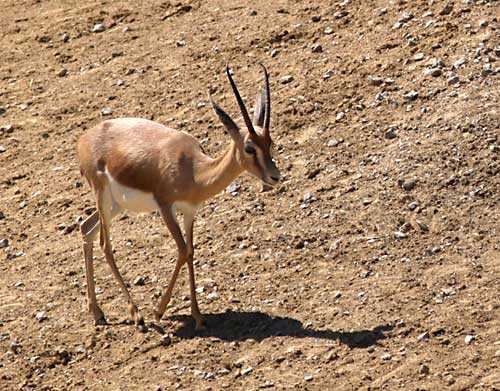
Gazella dorcas occurs in northern Africa, including Morocco, Algeria, Tunisia, Libya, Chad, Somalia and Ethiopia, as well as parts of Israel and the Sinai region. It has pale coloration, a white underside bordered by two brown stripes, and pronouncedly curved horns.
Written 26 November 2026 from the sources listed below. Each statement was checked against the passage it cites; statements that could not be supported were removed.
Appearance
The Dorcas Gazelle stands approximately 55–65 cm tall at the shoulder, and its head and body length ranges from 90 to 110 cm. Its reported body weight ranges from 15 to 20 kg.[1][2][3]
Adult males average 16.5 kg, while females average approximately 12.6 kg. Male horns measure 250–280 mm and typically have 20–24 rings, while female horns measure 170–190 mm and typically have 16–18 rings.[4][5][6]
The species generally has pale coloration and a white underside bordered by two brown stripes. Individuals in the northern Sahara have ochre coloration and darker flank stripes, while individuals near the Red Sea have reddish-brown coloration and less conspicuous, lighter flank stripes.[7][8][9]
The head is darker than the remainder of the body. The horns have pronounced curvature that varies among subspecies.[10][11]
Habitat
The Dorcas Gazelle inhabits savannahs, semi-deserts, small sand dune fields, consolidated dune areas and wadis. It also occurs in grassland, steppe, mountain desert and semidesert environments.[12][13]
High densities occur in sand dune fields containing abundant Pancratium sickenbergeri.[14]
Diet
The Dorcas Gazelle feeds on flowers, leaves and pods of Acacia trees, as well as fruits and leaves from various bushes.[15][16]
In the Negev Desert, it feeds on Madonna lilies (Pancratium sickenbergeri). During summer, individuals dig into sand to obtain Madonna lily stems and bulbs, while following winter rains they consume newly sprouted leaves.[17][18][19]
The Moroccan subspecies shows a strong dietary preference for nine identified plant taxa, including Acacia gummifera and Zizyphus lotus. In the studied reserve, its diet included 71 plant taxa belonging to 57 genera and 29 families.[20][21]
The Moroccan subspecies' diet contained 40–41 plant taxa during spring and summer and 49 taxa during autumn in the 2009 study.[22]
Behaviour
The species uses a short barking sound as an alarm call. Individuals communicate extreme danger or pain using a louder vocalization, while females use a low grunt to call their young.[23][24][25]
When threatened, individuals may twitch their tails and perform bouncing leaps with their heads raised. They can reach running speeds of up to 80 km/h and may attain 96 km/h.[26][27]
Reproduction and life cycle
Females in the wild usually begin reproducing at approximately two years of age. Approximately 90% of wild females became pregnant in the reported study, and pregnancy lasts approximately six months.[28][29][30]
Females generally give birth to one offspring per pregnancy. Newborn fawns are born with hair and open eyes.[31][32]
Females nurse their young several times daily for approximately three months. Male individuals do not appear to participate directly in offspring care, apart from indirectly defending resources for the group.[33][34]
Conservation
The Dorcas Gazelle is considered threatened and was previously classified as vulnerable by the IUCN. Habitat destruction and illegal hunting are ongoing threats to the species.[35][36]
Human settlement expansion reduces available habitat by converting it to farmland and introducing competing domestic sheep and goats.[37]
The Moroccan subspecies is endemic to the Atlantic plateaux of Morocco. Its last surviving wild population is located in the M’Sabih Talaa Reserve north of the Atlas Mountains and comprises approximately 100 individuals.[38][39][40]
Uses
The species is hunted as a source of food. Dorcas Gazelle pelts and horns are traded in Morocco for decorative and medicinal purposes.[41][42]
Similar species
The Dorcas Gazelle is similar in appearance to the mountain gazelle but is smaller. It has longer ears and more strongly curved horns than the mountain gazelle.[43][44]
Classification of the Dorcas Gazelle
| Kingdom | Animalia |
|---|---|
| Phylum | Chordata |
| Subphylum | Vertebrata |
| Infraphylum | Gnathostomata |
| Parvphylum | Osteichthyes |
| Megaclass | Tetrapoda |
| Class | Mammalia (Mammal) |
| Subclass | Theria |
| Infraclass | Eutheria |
| Order | Artiodactyla (Artiodactyls) |
| Family | Bovidae (Goats) |
| Subfamily | Antilopinae |
| Tribe | Antilopini |
| Genus | Gazella (Gazelle) |
| Species | Gazella dorcas (Linnaeus, 1758) |
Where the Dorcas Gazelle is found
Checklists and occurrence records place Gazella dorcas in 18 countries across Africa. GBIF holds 33,286 georeferenced records of it.
Countries
- Algeria 177
- Chad 41
- Djibouti 10
- Egypt 219
- Ethiopia 22
- Israel 31,956
- Kenya 5
- Libya 22
- Mauritania 53
- Morocco 69
- Niger 57
- Nigeria 8
- Senegal 3
- Somalia 10
- Spain 444
- Sudan 108
- Tanzania 3
- Tunisia 79
Regions and cities with the most records
- Southern District, Israel 31,781
- Eilat, Israel 3,831
- Arad, Israel 511
- Almería, Spain 437
- Roquetas de Mar, Spain 437
- Vícar, Spain 437
- Dimona, Israel 373
- ‘Ar‘ara BaNegev, Israel 206
- Segev Shalom, Israel 201
- Beersheba, Israel 121
- Tel Sheva‘, Israel 91
- Rafaḩ, Egypt 72
- Ofaqim, Israel 63
- Kuseifa, Israel 45
- Dakhlet Nouadhibou, Mauritania 44
- H̱ura, Israel 36
- Ait Melloul, Morocco 27
- Ben Jerrar, Morocco 27
- Inezgane, Morocco 27
- Aswan, Egypt 26
- Lqoliaa, Morocco 26
- Maradi Region, Niger 26
- My Drarga, Morocco 26
- Tamanrasset, Algeria 26
- Laqiyya, Israel 23
- Rahat, Israel 22
- Oadar Temsia, Morocco 21
- Agadir, Morocco 18
- Ash Shaykh Zuwayd, Egypt 16
- Darāw, Egypt 16
- Kom Ombo, Egypt 16
- Netivot, Israel 16
- Tozeur, Tunisia 16
- Tozeur Governorate, Tunisia 16
- Tine Biougra, Morocco 15
- Kasserine Governorate, Tunisia 14
8 more countries have a few records outside this range
These countries hold a few records of Gazella dorcas but lie outside the range the checklists give for it. Such records are often zoo or garden specimens, museum material or vagrants, so the species is not counted as occurring there.
Range as the checklists state it
Africa
A number beside a place is its count of GBIF occurrence records. A place without a number comes from a checklist alone. Records show where a species has been observed or collected, which can include escapes and vagrants.
Common names
English
- Dorcas Gazelle
Names in 29 other languages
- Arabic
- عفري, غزال الأريل, غزال دوركاس
- Breton
- Gazelenn Dorkas
- Bulgarian
- Газела доркас
- Catalan
- Gasela comuna
- Chinese
- 小鹿瞪羚
- Czech
- gazela dorkas
- Esperanto
- Dorkas-gazelo
- Finnish
- aavikkogaselli
- French
- Gazelle Dorcas
- German
- Dorkasgazelle
- Greek
- Δορκάδα Γαζέλα
- Hebrew
- צבי הנגב
- Hungarian
- dorkászgazella
- Italian
- Gazzella dorcade
- Japanese
- ドルカスガゼル
- Korean
- 도르카스가젤
- Lithuanian
- Dorkas
- Norwegian Bokmål
- Dorcasgaselle
- Persian
- جبیر
- Polish
- gazela pustynna
- Portuguese
- Gazela-dorcas
- Russian
- Газель-доркас
- Serbian
- Доркас газела
- Spanish
- Gacela Dorcas, Gacela común o dorcas
- Swedish
- Dorkagasell, dorkasgasell
- Tamil
- இந்திய சிறுமான் (சிங்கார மான்)
- Turkish
- Ceylan Gazel
- Ukrainian
- Газель доркас
- pnb
- ڈورکاس غزال
Synonyms
One other scientific name has been used for this species and is now treated as a synonym of Gazella dorcas.
- Capra dorcas Linnaeus, 1758
Subspecies and varieties
- Gazella dorcas beccarii subspecies
- Gazella dorcas dorcas subspecies
- Gazella dorcas isabella subspecies
- Gazella dorcas massaesyla (Moroccan Dorcas Gazelle) subspecies
- Gazella dorcas osiris subspecies
Related species
-
 Goitered GazelleGazella subgutturosa
-
 Mountain GazelleGazella gazella
-
 Arabian GazelleGazella arabica
- Arabian GazelleGazella erlangeri
-
 Arabian Sand GazelleGazella marica
-
 Rhim GazelleGazella leptoceros
-
 Cuvier's GazelleGazella cuvieri
-
 Saudi GazelleGazella saudiya
Compare
Questions and answers
What is the scientific name of the Dorcas Gazelle?
The scientific name of the Dorcas Gazelle is Gazella dorcas. Written with its author, the full name is Gazella dorcas (Linnaeus, 1758).
Which family does the Dorcas Gazelle belong to?
Gazella dorcas belongs to the family Bovidae, in the order Artiodactyla and the class Mammalia.
Where is the Dorcas Gazelle found?
Checklists and occurrence records place Gazella dorcas in 18 countries, including Israel, Spain, Egypt, Algeria, Sudan and Tunisia.
What is the conservation status of the Dorcas Gazelle?
The IUCN Red List category recorded for Gazella dorcas is Vulnerable (VU).
What are some interesting facts about Dorcas gazelles?
Dorcas Gazelles can reach running speeds of up to 80 km/h and may attain 96 km/h. They use short barking sounds as alarm calls and can perform bouncing leaps when threatened. Females generally give birth to one offspring per pregnancy.[23][26][27][31]
What is the scientific name of gazelle?
The scientific name of the Dorcas Gazelle is Gazella dorcas. The name derives from the Ancient Greek word dorkas, which referred to a roe deer, gazelle or antelope.[45]
What is a Dorcas gazelle?
The Dorcas Gazelle (Gazella dorcas) is a mammal belonging to the family Bovidae, order Artiodactyla and class Mammalia. It is similar in appearance to the mountain gazelle but is smaller.[44]
What do Dorcas gazelles eat?
Dorcas Gazelles eat flowers, leaves and pods of Acacia trees, as well as fruits and leaves from various bushes. In the Negev Desert, they also feed on Madonna lilies (Pancratium sickenbergeri), digging into sand during summer to obtain their stems and bulbs.[15][16][17][18]
What habitat do gazelles live in?
The Dorcas Gazelle inhabits savannahs, semi-deserts, sand dune fields, consolidated dune areas, wadis, grassland, steppe and mountain desert environments.[12][13]
How do Dorcas gazelle survive in the desert?
Dorcas Gazelles feed on desert plants, including Madonna lilies. During summer, individuals dig into sand to obtain Madonna lily stems and bulbs, and following winter rains they consume newly sprouted leaves. They may concentrate their activity around dawn and dusk during hot summers.[17][18][19][46]
Sources
Passages the profile rests on
- The dorcas gazelle stands approximately 55–65 cm tall at the shoulder. Source passage: “The dorcas gazelle stands about 55–65 cm (1.8–2.1 feet) at the shoulder” — English Wikipedia
- Its head and body length ranges from 90 to 110 cm. Source passage: “with a head and body length of 90–110 cm (3–3.5 feet)” — English Wikipedia
- Its reported body weight ranges from 15 to 20 kg. Source passage: “and a weight of 15–20 kg (33–44 pounds).” — English Wikipedia
- Adult males average 16.5 kg, while females average approximately 12.6 kg. Source passage: “Adult males average 16.5 kg, while the females are about 12.6 kg” — animaldiversity.org
- Male horns measure 250–280 mm and typically have 20–24 rings. Source passage: “Horns of males are 250-280 mm long and have 20-24 rings.” — animaldiversity.org
- Female horns measure 170–190 mm and typically have 16–18 rings. Source passage: “Female's horns are smaller (170-190 mm) and straighter with 16-18 rings.” — animaldiversity.org
- The species generally has pale coloration and a white underside bordered by two brown stripes. Source passage: “They are generally pale colored and have a white underbelly with two brown stripes on either side.” — animaldiversity.org
- Individuals in the northern Sahara have ochre coloration and darker stripes along their flanks. Source passage: “In the northern Sahara they are an ochre color with darker flanking stripes.” — animaldiversity.org
- Individuals near the Red Sea have reddish-brown coloration and less conspicuous, lighter flank stripes. Source passage: “Near the Red Sea, they are reddish-brown with less conspicuous, light flanking stripes.” — animaldiversity.org
- The head is darker in coloration than the remainder of the body. Source passage: “The head is darker than the rest of the body.” — animaldiversity.org
- The horns have a pronounced curvature, varying in degree among subspecies. Source passage: “Their horns have the most pronounced curve of members of Gazella , and within the subspecies the amount of curve in the horn varies.” — animaldiversity.org
- The species inhabits savannahs, semi-deserts, small sand dune fields, consolidated dune areas and wadis. Source passage: “They are found in a variety of habitats: savannahs, semi-deserts, small sand dune fields, consolidated dune areas, and wadis” — animaldiversity.org
- The species inhabits grassland, steppe, wadis, mountain desert and semidesert environments. Source passage: “The numerous subspecies survive on vegetation in grassland, steppe, wadis, mountain desert and in semidesert climates of Africa and Arabia.” — English Wikipedia
- High densities occur in sand dune fields containing abundant Pancratium sickenbergeri. Source passage: “High densities of G. dorcas are found in sand dune fields with high concentrations of Pancratium sickenbergeri , a preferred food.” — animaldiversity.org
- The species feeds on flowers, leaves and pods of Acacia trees. Source passage: “Gazella dorcas individuals feed on the flowers, leaves, and pods of Acacia trees in many of the areas they inhabit.” — animaldiversity.org
- Its diet also includes fruits and leaves from various bushes. Source passage: “They also feed on fruits and leaves of a variety of bushes.” — animaldiversity.org
- In the Negev Desert, the species feeds on Madonna lilies (Pancratium sickenbergeri). Source passage: “In the Negev Desert, G. dorcas feeds on Madonna lilies ( Pancratium sickenbergeri ).” — animaldiversity.org
- During summer, individuals dig into sand to obtain Madonna lily stems and bulbs. Source passage: “In summer gazelles dig holes in the sand to remove the stem and bulb of Madonna lilies.” — animaldiversity.org
- Following winter rains, individuals consume newly sprouted leaves. Source passage: “After winter rains, gazelles eat freshly sprouted leaves.” — animaldiversity.org
- The Moroccan subspecies shows a strong dietary preference for nine identified plant taxa, including Acacia gummifera and Zizyphus lotus. Source passage: “Moroccan dorcas gazelle showed a high preference to Acacia gummifera, Anagallis arvensis, Glebionis coronaria, Cladanthus arabicus, Diplotaxis tenuisiliqua, Erodium salzmannii, Limonium thouini, Lotus arenarius and Zizyphus lotus.” — pmc.ncbi.nlm.nih.gov
- The Moroccan subspecies consumed 71 plant taxa belonging to 57 genera and 29 families in the studied reserve. Source passage: “The diet composition revealed to be much more diversified (71 plant taxa belonging to 57 genus and 29 families)” — pmc.ncbi.nlm.nih.gov
- The Moroccan subspecies' diet contained 40–41 plant taxa during spring and summer and 49 taxa during autumn in the 2009 study. Source passage: “Seasonal variations occurred in both number (40–41 taxa in spring-summer and 49 taxa in autumn” — pmc.ncbi.nlm.nih.gov
- The species uses a short barking sound as an alarm call. Source passage: “Gazelles have an alarm call which sounds like a short bark.” — animaldiversity.org
- Individuals communicate extreme danger or pain using a louder vocalization. Source passage: “They also use a louder call made in cases of extreme danger or pain.” — animaldiversity.org
- Females use a low grunt to call their young. Source passage: “Females have a low grunt to call the young” — animaldiversity.org
- When threatened, individuals may twitch their tails and perform bouncing leaps with their heads raised. Source passage: “When threatened, they tail-twitch and make bouncing leaps with their heads held high” — English Wikipedia
- Individuals can reach running speeds of up to 80 km/h and may attain 96 km/h. Source passage: “Dorcas gazelles can run at speeds up to 80 km/h (50 mph) and may even reach 96 km/h (60 mph).” — English Wikipedia
- Females in the wild usually begin reproducing at approximately two years of age. Source passage: “In the wild, females will usually begin reproducing around age two.” — animaldiversity.org
- Approximately 90% of wild females became pregnant in the reported study. Source passage: “About 90% of females in the wild became pregnant.” — animaldiversity.org
- Pregnancy lasts approximately six months. Source passage: “Pregnancy lasts around six months” — animaldiversity.org
- Females generally give birth to one offspring per pregnancy. Source passage: “They give birth to only one offspring per pregnancy in almost all cases.” — animaldiversity.org
- Newborn fawns are born with hair and open eyes. Source passage: “the fawn is born with hair and open eyes.” — animaldiversity.org
- Females nurse their young several times daily for approximately three months. Source passage: “Females nurse their young for one to two minutes several times a day for around 3 months.” — animaldiversity.org
- Male individuals do not appear to participate directly in offspring care, apart from indirectly defending resources for the group. Source passage: “Males do not seem to participate in the care of the young, except indirectly through resource defense for the group.” — animaldiversity.org
- The species is considered threatened, having previously been classified as vulnerable by the IUCN. Source passage: “This species is considered threatened and in the past was classified as vulnerable by the IUCN.” — animaldiversity.org
- Habitat destruction and illegal hunting are ongoing threats to the species. Source passage: “The ongoing threats to this species are habitat destruction and illegal hunting.” — animaldiversity.org
- Human settlement expansion reduces available habitat by converting it to farmland and introducing competing domestic sheep and goats. Source passage: “which shrinks the gazelle's habitat by converting it to farmland, and by introducing new flocks of domestic sheep and goats which compete with gazelles for grassland.” — English Wikipedia
- The Moroccan subspecies is endemic to the Atlantic plateaux of Morocco. Source passage: “The Moroccan dorcas gazelle (Gazella dorcas massaesyla) is endemic to the Atlantic plateaux’s” — pmc.ncbi.nlm.nih.gov
- The last surviving wild population of the Moroccan subspecies is located in the M’Sabih Talaa Reserve north of the Atlas Mountains. Source passage: “The last surviving wild population of this subspecies is gathered in the M’Sabih Talaa Reserve, north of the Atlas Mountains” — pmc.ncbi.nlm.nih.gov
- The Moroccan subspecies' surviving wild population in the M’Sabih Talaa Reserve comprises approximately 100 individuals. Source passage: “where live a herd of about 100 individuals” — pmc.ncbi.nlm.nih.gov
- The species is hunted as a source of food. Source passage: “Gazella dorcas is hunted as a food source.” — animaldiversity.org
- Dorcas gazelle pelts and horns are traded in Morocco for decorative and medicinal purposes. Source passage: “Dorcas gazelle pelts and horns are traded in Morocco for decorative and medicinal purposes” — English Wikipedia
- The species has longer ears and more strongly curved horns than the mountain gazelle. Source passage: “Dorcas gazelles have longer ears and more strongly curved horns, which bow outwards then turn inwards and forwards at the tips.” — English Wikipedia
- The dorcas gazelle is similar in appearance to the mountain gazelle but is smaller. Source passage: “The dorcas gazelle is similar in appearance to, yet smaller than, the closely related mountain gazelle (G. gazella).” — English Wikipedia
- The scientific name Gazella dorcas derives from the Ancient Greek word dorkas, which referred to a roe deer, gazelle or antelope. Source passage: “The scientific name of the dorcas gazelle is Gazella dorcas, the name coming from Ancient Greek δορκάς (dorkas), which referred to a roe deer, gazelle or antelope.” — English Wikipedia
- The species is primarily active from dawn to dusk during hot conditions, with activity concentrated around dawn and dusk in hot summers. Source passage: “In hot summers these gazelles are mostly active at dawn and dusk.” — animaldiversity.org
Data
- Catalogue of Life, 2026-10-16 XR cc by
- Global Biodiversity Information Facility CC BY 4.0
- Wikidata CC0
- GeoNames CC BY 4.0
- Wikimedia Commons per image; credit shown with each image
- Within the Catalogue of Life, this name comes from The Integrated Taxonomic Information System cc0
References
- Syst. Nat., 10th ed. vol.1 p.69 where the name was published
- Wilson, Don E., and DeeAnn M. Reeder, eds. (1993). Mammal Species of the World: A Taxonomic and Geographic Reference, 2nd Ed., 3rd Printing.
- Wilson, Don E., and F. Russell Cole. (2000). Common Names of Mammals of the World.
- Wilson, Don E., and DeeAnn M. Reeder, eds. (2005). Mammal Species of the World: A Taxonomic and Geographic Reference, 3rd Ed., Vols. 1 & 2.
- Wilson, D. E., and R. A. Mittermeier, eds. (2011). Handbook of the Mammals of the World, Vol. 2: Hoofed Mammals.
- Burgin, Connor J., Don E. Wilson, Russell A. Mittermeier, Anthony B. Rylands, et al. (2020). Illustrated Checklist of the Mammals of the World. Vol. 2. Eulipotyphla to Carnivora.
This species in other databases
Page built on 27 November 2026. See how the catalog is made and all sources and licences.
Cite this page
ScientificNames.org. (2026). Gazella dorcas (Dorcas Gazelle). Retrieved November 27, 2026, from https://scientificnames.org/species/gazella-dorcas
“Gazella dorcas (Dorcas Gazelle).” ScientificNames.org, 2026, scientificnames.org/species/gazella-dorcas. Accessed 27 Nov. 2026.
ScientificNames.org. “Gazella dorcas (Dorcas Gazelle).” Accessed November 27, 2026. https://scientificnames.org/species/gazella-dorcas.
@misc{scientificnames_gazella_dorcas_dorcas_gazelle,
  author = {{ScientificNames.org}},
  title = {Gazella dorcas (Dorcas Gazelle)},
  year = {2026},
  url = {https://scientificnames.org/species/gazella-dorcas},
  note = {Accessed 2026-11-27}
}