Species · Mammals
Goitered Gazelle Gazella subgutturosa
The scientific name of the Goitered Gazelle is Gazella subgutturosa. It is a species of mammal in the family Bovidae (goats), order Artiodactyla. The name dates from 1780.
- Scientific name
- Gazella subgutturosa (Güldenstaedt, 1780)
- Common name
- Goitered Gazelle
- Genus
- Gazella
- Family
- Bovidae (Goats)
- Order
- Artiodactyla
- Class
- Mammalia
- Red List category
- VU Vulnerable
- Environment
- terrestrial
- Recorded in
- 12 countries
- Name status
- accepted in the Catalogue of Life

Overview
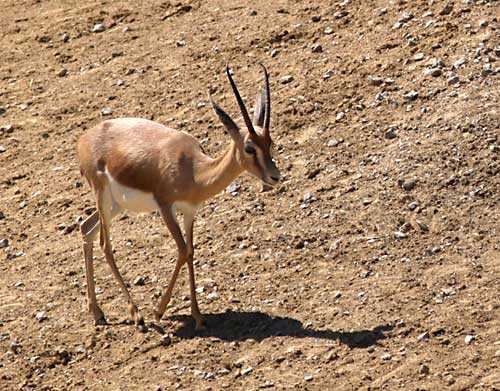
The Goitered Gazelle inhabits arid and semi-arid regions, including sandy and gravel plains and limestone plateaus. Males develop an enlargement of the neck and throat during the mating season.
Written 26 November 2026 from the sources listed below. Each statement was checked against the passage it cites; statements that could not be supported were removed.
Similar species
The Goitered Gazelle is also known as the black-tailed gazelle.[1]
Appearance
Males develop an enlargement of the neck and throat during the mating season.[2]
The specific name subgutturosa refers to fullness below the throat.[3]
Habitat
The Goitered Gazelle occupies arid and semi-arid regions. Its habitats include sandy and gravel plains as well as limestone plateaus.[4][5]
Diet
The primary dietary plant families include Chenopodiaceae, Rosaceae, Gramineae, Asteraceae and Fabaceae. Chenopodiaceae accounts for approximately 20.2% of the documented diet, Rosaceae for approximately 19.5%, Fabaceae for approximately 11.5%, Asteraceae for approximately 10.1% and Gramineae for approximately 9.4%.[6][7][8][9][10][11]
Krascheninnikovia arborescens accounts for approximately 13.4% of the diet, while Prunus sibirica accounts for approximately 16.3%.[12][13]
Forbs constitute approximately 50.4% of the annual diet and reach their highest dietary proportion in spring, at approximately 72.9%. Trees account for approximately 36.7% of the diet in autumn, their highest seasonal proportion.[14][15][16]
Shrubs reach their highest dietary proportion in winter, at approximately 22.0%, while graminoids reach their highest proportion in winter, at approximately 14.8%. The species exhibits seasonal variation in food composition and dietary preferences.[17][18][19]
Goitered gazelles in Bahrain primarily consume food sources with high water content or high protein content. Those in the Ibex Reserve of Saudi Arabia predominantly consume woody plants.[20][21]
Two forb species were identified as the principal dietary components in the Karameili Mountains of Xinjiang, China.[22]
Behaviour
The Goitered Gazelle is solitary or lives in small groups containing 2–10 individuals. Populations across much of its range migrate seasonally.[23][24]
Herds travel approximately 10–30 km daily during winter. Daily herd movements decrease to approximately 1–3 km during summer.[25][26]
The species runs at high speed without the leaping and bounding gait characteristic of other gazelles.[27]
Reproduction and life cycle
The Goitered Gazelle has a polygynous mating system, with mating usually occurring in early winter.[28]
Conservation
The Goitered Gazelle is listed as a Class II nationally protected animal in China. Its population has experienced a significant decline in recent years.[29][30]
Global climate change, habitat fragmentation and human interference are identified as factors contributing to population decline.[31]
The estimated global population was between 120,000 and 140,000 individuals in 2001 and between 42,000 and 49,000 individuals in 2016.[32][33]
The species has been declared extinct in Georgia, Armenia, Kuwait and Qatar. Its geographic range has diminished since the beginning of the twentieth century.[34][35]
Uses
Goitered gazelles were historically captured and killed using desert kites in the Near East approximately 6,000 years ago. Rock art discovered in Jordan suggests that goitered gazelles were ritually slaughtered.[36][37]
Classification of the Goitered Gazelle
| Kingdom | Animalia |
|---|---|
| Phylum | Chordata |
| Subphylum | Vertebrata |
| Infraphylum | Gnathostomata |
| Parvphylum | Osteichthyes |
| Megaclass | Tetrapoda |
| Class | Mammalia (Mammal) |
| Subclass | Theria |
| Infraclass | Eutheria |
| Order | Artiodactyla (Artiodactyls) |
| Family | Bovidae (Goats) |
| Subfamily | Antilopinae |
| Tribe | Antilopini |
| Genus | Gazella (Gazelle) |
| Species | Gazella subgutturosa (Güldenstaedt, 1780) |
Where the Goitered Gazelle is found
Checklists and occurrence records place Gazella subgutturosa in 12 countries. GBIF holds 684 georeferenced records of it.
Countries
- Afghanistan 7
- Azerbaijan 91
- China 140
- Georgia 48
- Iran 114
- Iraq 35
- Kazakhstan 101
- Mongolia 119
- Pakistan 4
- Syria 5
- Turkey 12
- Uzbekistan 8
Regions and cities with the most records
- Almaty Region, Kazakhstan 80
- Ömnögovĭ, Mongolia 55
- Qinghai, China 48
- Salyan, Azerbaijan 42
- Kakheti, Georgia 27
- Hovd, Mongolia 17
- Razavi Khorasan, Iran 16
- Isfahan, Iran 13
- Neftçala, Azerbaijan 9
- North Khorasan, Iran 9
- Bushehr, Iran 8
- Gansu, China 8
- Baghdad, Iraq 7
- Sadr City, Iraq 7
- Semnan, Iran 7
- Şanlıurfa, Turkey 7
- Ahram, Iran 6
- Övörhangay, Mongolia 6
- Abū Ghurayb, Iraq 5
- Baghdad, Iraq 5
- Yazd Province, Iran 5
- Diyala, Iraq 4
- Gotvand, Iran 4
- Karamay, China 4
- Khuzestan, Iran 4
- Sühbaatar, Mongolia 4
- Şanlıurfa, Turkey 4
- Bāqershahr, Iran 3
- Chahār Dangeh, Iran 3
- Fars, Iran 3
- Kahrīzak, Iran 3
- Kīsh, Iran 3
- Morteẕá Gerd, Iran 3
- Shahrak-e ‘Alā’īn, Iran 3
- Tajrīsh, Iran 3
- Tehran, Iran 3
3 more countries have a few records outside this range
These countries hold a few records of Gazella subgutturosa but lie outside the range the checklists give for it. Such records are often zoo or garden specimens, museum material or vagrants, so the species is not counted as occurring there.
Range as the checklists state it
Europe & Northern Asia (excluding China)
A number beside a place is its count of GBIF occurrence records. A place without a number comes from a checklist alone. Records show where a species has been observed or collected, which can include escapes and vagrants.
Common names
English
- Goitered Gazelle
- Black-tailed Gazelle
- Persian Gazelle
Names in 25 other languages
- Arabic
- غزال أسود الذيل, غزال الريم, غزال درقي, غزال درقي، ريم، غزال فارسي
- Azerbaijani
- Jeyran
- Belarusian
- Джэйран
- Chinese
- 鵝喉羚, 鹅喉羚
- Czech
- džejran
- Dutch
- Kropgazelle
- Finnish
- kuhertajagaselli
- French
- Gazella à goître, Gazelle goitreuse, Gazelle à goitre, Gazelle à goître
- German
- Kropfgazelle, Persische Kropfgazelle
- Greek
- Μαυρόουρη Γαζέλα
- Hungarian
- golyvás gazella
- Italian
- Gazzella gozzuta
- Japanese
- コウジョウセンガゼル
- Kazakh
- Қарақұйрық
- Korean
- 갑상선가젤
- Mongolian
- Khar sult
- Norwegian Bokmål
- Persiagaselle
- Persian
- Ahu, آهوی ایرانی
- Polish
- Dżejran, gazela czarnoogonowa
- Russian
- Dzheiran
- Slovenian
- golšasta gazela
- Spanish
- Gacela de bocio, gacela persa
- Swedish
- krävgasell
- Turkish
- ceylan
- Ukrainian
- Джейран
Synonyms
8 other scientific names have been used for this species and are now treated as synonyms of Gazella subgutturosa.
- Antilope dorcas var. persica Gray, 1843
- Antilope subgutturosa Güldenstaedt, 1780
- Gazella mongolica Heude, 1894
- Gazella seistanica Lydekker, 1910
- Gazella subgutturosa reginae Adlerberg, 1931
- Gazella subgutturosa sairensis Lydekker, 1900
- Gazella subgutturosa subgutturosa (Güldenstaedt, 1780)
- Gazella subgutturosa typica Lydekker, 1900
Related species
-
 Dorcas GazelleGazella dorcas
-
 Mountain GazelleGazella gazella
-
 Arabian GazelleGazella arabica
- Arabian GazelleGazella erlangeri
-
 Arabian Sand GazelleGazella marica
-
 Rhim GazelleGazella leptoceros
-
 Cuvier's GazelleGazella cuvieri
-
 Saudi GazelleGazella saudiya
Compare
Questions and answers
What is the scientific name of the Goitered Gazelle?
The scientific name of the Goitered Gazelle is Gazella subgutturosa. Written with its author, the full name is Gazella subgutturosa (Güldenstaedt, 1780).
Which family does the Goitered Gazelle belong to?
Gazella subgutturosa belongs to the family Bovidae, in the order Artiodactyla and the class Mammalia.
Where is the Goitered Gazelle found?
Checklists and occurrence records place Gazella subgutturosa in 12 countries, including China, Mongolia, Iran, Kazakhstan, Azerbaijan and Georgia.
What is the conservation status of the Goitered Gazelle?
The IUCN Red List category recorded for Gazella subgutturosa is Vulnerable (VU).
What other names does the Goitered Gazelle have?
Gazella subgutturosa is also known in English as Black-tailed Gazelle and Persian Gazelle.
What is the diet of a gazelle?
The Goitered Gazelle's diet includes plants from Chenopodiaceae, Rosaceae, Gramineae, Asteraceae and Fabaceae. Forbs constitute approximately 50.4% of its annual diet.[6][14]
Sources
Passages the profile rests on
- The species is also known as the black-tailed gazelle. Source passage: “The goitered gazelle (Gazella subgutturosa) or black-tailed gazelle” — English Wikipedia
- Males develop an enlargement of the neck and throat during the mating season. Source passage: “The specific name, meaning "full below the throat", refers to the male having an enlargement of the neck and throat during the mating season.” — English Wikipedia
- The specific name subgutturosa refers to fullness below the throat. Source passage: “The specific name, meaning "full below the throat"” — English Wikipedia
- The species occupies arid and semi-arid regions. Source passage: “Goitered gazelle, belonging to the family Bovidae, play a crucial ecological role in arid and semi-arid regions [12].” — pmc.ncbi.nlm.nih.gov
- The species inhabits sandy and gravel plains as well as limestone plateaus. Source passage: “The goitered gazelle inhabits sands and gravel plains and limestone plateau.” — English Wikipedia
- The primary dietary plant families include Chenopodiaceae, Rosaceae, Gramineae, Asteraceae and Fabaceae. Source passage: “The primary foods of the goitered gazelles included Chenopodiaceae, Rosaceae, Gramineae, Asteraceae, and Fabaceae.” — pmc.ncbi.nlm.nih.gov
- Fabaceae accounts for approximately 11.5% of the documented diet. Source passage: “Fabaceae (11.5%), Gramineae (9.4%), Chenopodiaceae (20.2%), Asteraceae (10.1%), and Rosaceae (19.5%) formed the primary dietary components of goitered gazelle.” — pmc.ncbi.nlm.nih.gov
- Gramineae accounts for approximately 9.4% of the documented diet. Source passage: “Fabaceae (11.5%), Gramineae (9.4%), Chenopodiaceae (20.2%), Asteraceae (10.1%), and Rosaceae (19.5%) formed the primary dietary components of goitered gazelle.” — pmc.ncbi.nlm.nih.gov
- Chenopodiaceae accounts for approximately 20.2% of the documented diet. Source passage: “Fabaceae (11.5%), Gramineae (9.4%), Chenopodiaceae (20.2%), Asteraceae (10.1%), and Rosaceae (19.5%) formed the primary dietary components of goitered gazelle.” — pmc.ncbi.nlm.nih.gov
- Asteraceae accounts for approximately 10.1% of the documented diet. Source passage: “Fabaceae (11.5%), Gramineae (9.4%), Chenopodiaceae (20.2%), Asteraceae (10.1%), and Rosaceae (19.5%) formed the primary dietary components of goitered gazelle.” — pmc.ncbi.nlm.nih.gov
- Rosaceae accounts for approximately 19.5% of the documented diet. Source passage: “Fabaceae (11.5%), Gramineae (9.4%), Chenopodiaceae (20.2%), Asteraceae (10.1%), and Rosaceae (19.5%) formed the primary dietary components of goitered gazelle.” — pmc.ncbi.nlm.nih.gov
- Krascheninnikovia arborescens accounts for approximately 13.4% of the diet. Source passage: “Additionally, Krascheninnikovia arborescens (13.4%) and Prunus sibirica (16.3%) were identified as the key forage plants.” — pmc.ncbi.nlm.nih.gov
- Prunus sibirica accounts for approximately 16.3% of the diet. Source passage: “Additionally, Krascheninnikovia arborescens (13.4%) and Prunus sibirica (16.3%) were identified as the key forage plants.” — pmc.ncbi.nlm.nih.gov
- Forbs constitute approximately 50.4% of the annual diet. Source passage: “Forbs (50.4%) were the predominant plants for grazing throughout the year” — pmc.ncbi.nlm.nih.gov
- Forbs reach their highest dietary proportion in spring, at approximately 72.9%. Source passage: “particularly in the spring (72.9%).” — pmc.ncbi.nlm.nih.gov
- Trees account for approximately 36.7% of the diet in autumn, their highest seasonal proportion. Source passage: “The proportion of trees in the diet was highest in the autumn (36.7%) and comparatively lower in other seasons.” — pmc.ncbi.nlm.nih.gov
- Shrubs reach their highest dietary proportion in winter, at approximately 22.0%. Source passage: “Furthermore, the proportions of shrubs (22.0%) and graminoids (14.8%) both reached their peaks in the winter.” — pmc.ncbi.nlm.nih.gov
- Graminoids reach their highest dietary proportion in winter, at approximately 14.8%. Source passage: “Furthermore, the proportions of shrubs (22.0%) and graminoids (14.8%) both reached their peaks in the winter.” — pmc.ncbi.nlm.nih.gov
- The species exhibits seasonal variation in food composition and dietary preferences. Source passage: “Furthermore, there was seasonal variation in the food composition and dietary preferences of the species.” — pmc.ncbi.nlm.nih.gov
- Goitered gazelles in Bahrain primarily consume food sources with high water content or high protein content. Source passage: “In Bahrain, the main food sources for goitered gazelle have a high water content or are rich in protein” — pmc.ncbi.nlm.nih.gov
- Goitered gazelles in the Ibex Reserve of Saudi Arabia predominantly consume woody plants. Source passage: “Another study reported that goitered gazelle in the Ibex Reserve of Saudi Arabia predominantly consume woody plants” — pmc.ncbi.nlm.nih.gov
- Two forb species were identified as the principal dietary components in the Karameili Mountains of Xinjiang, China. Source passage: “In the study conducted in the Karameili Mountains of Xinjiang, China, two forbs were determined as the principal dietary components” — pmc.ncbi.nlm.nih.gov
- The species is solitary or lives in small groups containing 2–10 individuals. Source passage: “It is solitary or occurs in small groups of 2–10 individuals [14].” — pmc.ncbi.nlm.nih.gov
- Populations across much of the species' range migrate seasonally. Source passage: “Throughout much of its range, the goitered gazelle migrates seasonally.” — English Wikipedia
- Herds travel approximately 10–30 km daily during winter. Source passage: “Herds cover 10–30 km (6.2–18.6 mi) per day in the winter” — English Wikipedia
- Daily herd movements decrease to approximately 1–3 km during summer. Source passage: “with these distances being reduced to about 1–3 km (0.62–1.86 mi) in summer.” — English Wikipedia
- The species runs at high speed without the leaping and bounding gait characteristic of other gazelles. Source passage: “It runs at high speed, without the leaping, bounding gait seen in other gazelle species.” — English Wikipedia
- The species has a polygynous mating system, with mating usually occurring in early winter. Source passage: “Its mating behaviour is polygynous and usually occurs in the early winter.” — English Wikipedia
- The species is listed as a Class II nationally protected animal in China. Source passage: “The species has been listed as a national key protected animal of class II in China [13].” — pmc.ncbi.nlm.nih.gov
- The species' population has experienced a significant decline in recent years. Source passage: “In recent years, there has been a significant decline in the population of goitered gazelles, a representative species in arid and semi-arid regions.” — pmc.ncbi.nlm.nih.gov
- Global climate change, habitat fragmentation and human interference are identified as factors contributing to population decline. Source passage: “Global climate change, habitat fragmentation, and human interference have resulted in a significant, ongoing decline in the population of goitered gazelles.” — pmc.ncbi.nlm.nih.gov
- The estimated global population was between 120,000 and 140,000 individuals in 2001. Source passage: “In 2001, the population of goitered gazelle was estimated to be between 120,000 and 140,000 individuals [20].” — pmc.ncbi.nlm.nih.gov
- The estimated population was between 42,000 and 49,000 individuals in 2016. Source passage: “In 2016, the population was estimated to be within the range of 42,000 to 49,000 individuals [23].” — pmc.ncbi.nlm.nih.gov
- The species has been declared extinct in Georgia, Armenia, Kuwait and Qatar. Source passage: “Furthermore, the species has been officially declared extinct in Georgia, Armenia, Kuwait, and Qatar [24].” — pmc.ncbi.nlm.nih.gov
- The species' geographic range has diminished since the beginning of the twentieth century. Source passage: “Since the beginning of the 20th century, the range has been diminishing” — pmc.ncbi.nlm.nih.gov
- Goitered gazelles were historically captured and killed using desert kites in the Near East approximately 6,000 years ago. Source passage: “Some 6,000 years ago, they were captured and killed with the help of desert kites.” — English Wikipedia
- Rock art discovered in Jordan suggests that goitered gazelles were ritually slaughtered. Source passage: “Rock art found in Jordan suggests that it was slaughtered ritually.” — English Wikipedia
Data
- Catalogue of Life, 2026-10-16 XR cc by
- Global Biodiversity Information Facility CC BY 4.0
- Wikidata CC0
- GeoNames CC BY 4.0
- Wikimedia Commons per image; credit shown with each image
- Within the Catalogue of Life, this name comes from The Integrated Taxonomic Information System cc0
References
- Acta Acad. Sci. Petropoli for 1778 vol.1 p.251 where the name was published
- Wilson, Don E., and DeeAnn M. Reeder, eds. (1993). Mammal Species of the World: A Taxonomic and Geographic Reference, 2nd Ed., 3rd Printing.
- Wilson, Don E., and F. Russell Cole. (2000). Common Names of Mammals of the World.
- Wilson, Don E., and DeeAnn M. Reeder, eds. (2005). Mammal Species of the World: A Taxonomic and Geographic Reference, 3rd Ed., Vols. 1 & 2.
This species in other databases
- Catalogue of Life 3FG3N
- Wikidata Q460977
- iNaturalist 568727
- WoRMS urn:lsid:marinespecies.org:taxname:1537938
Page built on 29 November 2026. See how the catalog is made and all sources and licences.
Cite this page
ScientificNames.org. (2026). Gazella subgutturosa (Goitered Gazelle). Retrieved November 29, 2026, from https://scientificnames.org/species/gazella-subgutturosa
“Gazella subgutturosa (Goitered Gazelle).” ScientificNames.org, 2026, scientificnames.org/species/gazella-subgutturosa. Accessed 29 Nov. 2026.
ScientificNames.org. “Gazella subgutturosa (Goitered Gazelle).” Accessed November 29, 2026. https://scientificnames.org/species/gazella-subgutturosa.
@misc{scientificnames_gazella_subgutturosa_goitered_gazelle,
  author = {{ScientificNames.org}},
  title = {Gazella subgutturosa (Goitered Gazelle)},
  year = {2026},
  url = {https://scientificnames.org/species/gazella-subgutturosa},
  note = {Accessed 2026-11-29}
}