Species · Reptiles
Common Four-clawed Gecko Gehyra mutilata
The scientific name of the Common Four-clawed Gecko is Gehyra mutilata. It is a species of reptile in the family Gekkonidae (geckos), order Squamata. The name dates from 1834.
- Scientific name
- Gehyra mutilata (Wiegmann, 1834)
- Common name
- Common Four-clawed Gecko
- Genus
- Gehyra
- Family
- Gekkonidae (Geckos)
- Order
- Squamata
- Class
- Reptilia
- Red List category
- LC Least Concern
- Recorded in
- 12 countries
- Name status
- accepted in the Catalogue of Life
Overview
Gehyra mutilata is native to Southeast Asia and has a recorded distribution that includes Borneo, southeastern China, French Polynesia, Hawaii, India, Indonesia, Malaysia, Singapore, the Mascarene Islands, western Mexico, Myanmar, Thailand, New Guinea, the Philippines, the Pitcairn Islands, Seychelles, and Sri Lanka. A distinguishing identification feature is the absence of a claw on the innermost digit.
Written 26 November 2026 from the sources listed below. Each statement was checked against the passage it cites; statements that could not be supported were removed.
Appearance
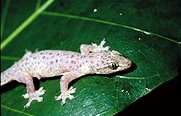
The head is longer than it is broad, and the snout is approximately 1.3 times the diameter of the eye orbit. The body and limbs are moderately elongated and flattened, and the digits are short and partially webbed at their bases.[1][2][3][4]
The upper body and throat are covered with small granular scales, which are largest and flattest on the back. The upper body coloration ranges from greyish to reddish brown and may be uniform, dotted, or patterned with darker markings, while the underside is uniformly whitish.[5][6][7]
The tail is flattened and normally has a slightly sharp, finely serrated edge along each side. The absence of a claw on the innermost digit is a distinguishing identification feature.[8][9]
The Common Four-clawed Gecko can reach a snout-to-vent length of 5.7 cm. Its tail can reach a length equal to its snout-to-vent length.[10][11]
Habitat
The Common Four-clawed Gecko typically inhabits woodlands, rocky areas, and human dwellings. It occurs at elevations ranging from sea level to 1,400 metres.[12][13]
The species is common on sandy beaches in Hawaii and frequently occupies human houses.[14][15]
The species is native to Southeast Asia. Its recorded distribution includes Borneo, southeastern China, French Polynesia, Hawaii, India, Indonesia, Malaysia, Singapore, the Mascarene Islands, western Mexico, Myanmar, Thailand, New Guinea, the Philippines, the Pitcairn Islands, Seychelles, and Sri Lanka.[16][17][18]
Diet
The Common Four-clawed Gecko preys on isopods, termites, and other small insects.[19]
Behaviour
The Common Four-clawed Gecko is primarily active at night. It commonly spends time high on walls and ceilings.[20][21]
The species can produce vocalizations to communicate. Its call sounds like 'tock' and is repeated six to eight times with increasing volume.[22][23]
The species can run faster than other house geckos. It is described as unobtrusive in human dwellings.[24][25]
Reproduction and life cycle
The Common Four-clawed Gecko is oviparous. Its clutch contains one to three eggs, usually two.[26][27]
Similar species
The common house gecko (Hemidactylus frenatus) is a species with which the Common Four-clawed Gecko is compared in appearance. The two species are often reported not to occur in the same locations, although this pattern varies geographically.[28][29]
Conservation
The Common Four-clawed Gecko is considered invasive on Hawaiian sand beaches.[30]
Classification of the Common Four-clawed Gecko
| Kingdom | Animalia |
|---|---|
| Phylum | Chordata |
| Subphylum | Vertebrata |
| Infraphylum | Gnathostomata |
| Parvphylum | Osteichthyes |
| Megaclass | Tetrapoda |
| Class | Reptilia (Reptile) |
| Order | Squamata (Snakes) |
| Suborder | Gekkota |
| Family | Gekkonidae (Geckos) |
| Genus | Gehyra (Dtellas) |
| Species | Gehyra mutilata (Wiegmann, 1834) |
Where the Common Four-clawed Gecko is found
Checklists and occurrence records place Gehyra mutilata in 12 countries across Africa. GBIF holds 6,092 georeferenced records of it.
Countries
- Hong Kong 530
- Indonesia 1,015
- Madagascar 104
- Malaysia 304
- Mauritius 99
- Mayotte 9
- Mexico 877
- Philippines 1,547
- Reunion 187
- Seychelles 212
- Thailand 633
- United States 575
Regions and cities with the most records
- Hawaii, United States 442
- Tsing Yi Town, Hong Kong 413
- Mei Foo, Hong Kong 410
- Mei Foo Sun Chuen, Hong Kong 409
- Tsuen Wan, Hong Kong 406
- Discovery Park, Hong Kong 401
- Hoi Lai Estate, Hong Kong 400
- Kwai Chung, Hong Kong 400
- Shek Lei, Hong Kong 400
- Tai Wo Hau, Hong Kong 400
- So Uk Estate, Hong Kong 397
- Ting Kau, Hong Kong 397
- So Uk, Hong Kong 395
- Un Chau Estate, Hong Kong 391
- Fu Cheong Estate, Hong Kong 387
- Tai Wai, Hong Kong 384
- Discovery Bay, Hong Kong 383
- Keng Hau, Hong Kong 383
- Nam Cheong, Hong Kong 383
- San Tin, Hong Kong 380
- Sun Tin Wai, Hong Kong 380
- Sha Tin, Hong Kong 379
- Sham Shui Po, Hong Kong 379
- Shek Kip Mei Estate, Hong Kong 378
- Pak Tin Estate, Hong Kong 376
- Pok Hong, Hong Kong 376
- Sha Tin Wai, Hong Kong 376
- Shek Kip Mei, Hong Kong 376
- Shui Chuen O, Hong Kong 375
- Wong Tai Sin, Hong Kong 375
- Wo Che, Hong Kong 373
- City One, Hong Kong 370
- Nayarit, Mexico 369
- Olympic, Hong Kong 369
- Fo Tan, Hong Kong 367
- Tai Kok Tsui, Hong Kong 367
33 more countries have a few records outside this range
These countries hold a few records of Gehyra mutilata but lie outside the range the checklists give for it. Such records are often zoo or garden specimens, museum material or vagrants, so the species is not counted as occurring there.
- American Samoa 17
- Australia 28
- Brunei 12
- Cambodia 18
- China 188
- Christmas Island 74
- Cocos Islands 57
- Cook Islands 29
- Fiji 13
- France 6
- French Guiana 123
- French Polynesia 197
- Guam 273
- India 96
- Japan 126
- Kiribati 18
- Laos 13
- Micronesia 195
- Myanmar 79
- Northern Mariana Islands 272
- Palau 284
- Papua New Guinea 289
- Pitcairn 22
- Samoa 43
- Singapore 102
- Solomon Islands 7
- Sri Lanka 245
- Taiwan 24
- Timor Leste 41
- Tonga 64
- United States Minor Outlying Islands 12
- Vanuatu 20
- Vietnam 167
Range as the checklists state it
Madagascar, Mascarene Islands (Mauritius, Reunion, Rodrigues), Seychelles, Nossi Be = Nosy Bé,
A number beside a place is its count of GBIF occurrence records. A place without a number comes from a checklist alone. Records show where a species has been observed or collected, which can include escapes and vagrants.
Common names
English
- Common Four-clawed Gecko
- Butler's Dtella
- Butler's Four-clawed Gecko
- Butler’s Four-clawed Gecko
- Butler’s Four-clawed Gecko [butleri]
- Four-clawed Gecko
- Mutilating Gecko
- Pacific Stump-toed Gecko
- Skin-shedding Dtella
- Stump-tailed Gecko
- Stump-toed Gecko
Names in 11 other languages
- Chinese
- 截趾虎, 裂足虎, 裂足蝎虎
- Danish
- Almindelig Stumpfingergekko
- French
- Gecko mutilé, Gecko mutilé (Le), Margouillat blanc
- German
- Butlers Vierkrallengecko, Butlers Vierkrallengecko [butleri], Gewöhnlicher Vierkrallengecko, ewöhnlicher Vierkrallengecko
- Indonesian
- Cecak Gula, Cicak gula
- Italian
- Geco dai quattro artigli di Butler
- Japanese
- オンナダケヤモリ
- Korean
- 네발톱도마뱀부치
- Russian
- Тихоокеанская гехира
- Spanish
- Geco, Geco plano, Salamanquesa que Mutila, geco del Pacífico
- Thai
- จิ้งจกหินสีจาง
Synonyms
13 other scientific names have been used for this species and are now treated as synonyms of Gehyra mutilata.
- Gecko pardus Tytler, 1865
- Gehyra butleri Boulenger, 1900
- Gehyra mugtilata Pernetta & Burgin, 1980
- Hemidactylus (Peropus) mutilatus Wiegmann ex Meyen, 1834
- Hemidactylus leiurus Gray, 1845
- Hemidactylus navarri Dugés, 1883
- Hemidactylus peronii Duméril & Bibron, 1836
- Hemidactylus platurus Bleeker, 1857
- Hemidactylus platurus Bleeker, 1859
- Hemidactylus pristiurus Wiegmann ex Meyen, 1834
- Peropus multilatus Mckeon, 1978
- Peropus mutilatus (Wiegmann, 1834)
- Peropus packardii Cope, 1869
Related species
-
 Dubious DtellaGehyra dubia
-
 House GeckoGehyra australis
-
 Halmahera Giant GeckoGehyra marginata
-
 Pacific DtellaGehyra oceanica
-
 Voracious DtellaGehyra vorax
-
 Tree DtellaGehyra variegata
-
 Western Giant Stump-toed GeckoGehyra georgpotthasti
- Kimberley DtellaGehyra kimberleyi
Compare
Questions and answers
What is the scientific name of the Common Four-clawed Gecko?
The scientific name of the Common Four-clawed Gecko is Gehyra mutilata. Written with its author, the full name is Gehyra mutilata (Wiegmann, 1834).
Which family does the Common Four-clawed Gecko belong to?
Gehyra mutilata belongs to the family Gekkonidae, in the order Squamata and the class Reptilia.
Where is the Common Four-clawed Gecko found?
Checklists and occurrence records place Gehyra mutilata in 12 countries, including Philippines, Indonesia, Mexico, Thailand, United States and Hong Kong.
What is the conservation status of the Common Four-clawed Gecko?
The IUCN Red List category recorded for Gehyra mutilata is Least Concern (LC).
What other names does the Common Four-clawed Gecko have?
Gehyra mutilata is also known in English as Butler's Dtella, Butler's Four-clawed Gecko, Butler’s Four-clawed Gecko, Butler’s Four-clawed Gecko [butleri], Four-clawed Gecko and Mutilating Gecko.
What is the diet of a gecko?
The Common Four-clawed Gecko preys on isopods, termites, and other small insects.[19]
Sources
Passages the profile rests on
- The head is longer than it is broad. Source passage: “The head of G. mutilata is longer than broad.” — English Wikipedia
- The snout is approximately 1.3 times the diameter of the eye orbit. Source passage: “about 1.3 times the diameter of the orbit.” — English Wikipedia
- The body and limbs are moderately elongated and flattened. Source passage: “The body and limbs are moderately elongate and depressed.” — English Wikipedia
- The digits are short and partially webbed at their bases. Source passage: “The digits are short and more or less webbed at the base.” — English Wikipedia
- The upper body and throat are covered with small granular scales, which are largest and flattest on the back. Source passage: “The upper surface of the body and the throat are covered with small granular scales, which are largest and flat on the back.” — English Wikipedia
- The upper body coloration ranges from greyish to reddish brown and may be uniform, dotted, or patterned with darker markings. Source passage: “G. mutilata is greyish or reddish brown above, uniform or dotted or variegated with darker.” — English Wikipedia
- The underside is uniformly whitish. Source passage: “The lower surfaces are uniform whitish.” — English Wikipedia
- The tail is flattened and normally has a slightly sharp, finely serrated edge along each side. Source passage: “The tail is depressed, normally with a sharpish, minutely serrated lateral edge.” — English Wikipedia
- A distinguishing identification feature is the absence of a claw on the innermost digit. Source passage: “A key identification character is the absence of a claw on the innermost digit.” — English Wikipedia
- The species can reach a snout-to-vent length of 5.7 cm. Source passage: “may attain a snout-to-vent length (SVL) of 2.25 in (5.7 cm)” — English Wikipedia
- Its tail can reach a length equal to its snout-to-vent length. Source passage: “with a tail length equal to SVL.” — English Wikipedia
- The species typically inhabits woodlands, rocky areas, and human dwellings. Source passage: “it usually prefers woodlands, rocky areas, and human dwellings” — English Wikipedia
- It occurs at elevations ranging from sea level to 1,400 metres. Source passage: “at altitudes from sea level to 1,400 m (4,600 ft).” — English Wikipedia
- The species is common on sandy beaches in Hawaii. Source passage: “It is also very common on sand beaches in Hawaii” — English Wikipedia
- The species frequently occupies human houses. Source passage: “It makes itself at home in people's houses” — English Wikipedia
- The species is native to Southeast Asia. Source passage: “The species is native to Southeast Asia.” — English Wikipedia
- Its recorded distribution includes Borneo, southeastern China, French Polynesia, Hawaii, India, Indonesia, Malaysia, and Singapore. Source passage: “widely distributed throughout Borneo, southeastern China, French Polynesia, Hawaii (Maui), India, Indonesia, Malaysia, Singapore” — English Wikipedia
- Its recorded distribution also includes the Mascarene Islands, western Mexico, Myanmar, Thailand, New Guinea, the Philippines, the Pitcairn Islands, Seychelles, and Sri Lanka. Source passage: “the Mascarene Islands, western Mexico, Myanmar, Thailand, New Guinea, the Philippines, the Pitcairn Islands, Seychelles, and Sri Lanka.” — English Wikipedia
- The species preys on isopods, termites, and other small insects. Source passage: “G. mutilata preys upon isopods, termites, and other small insects.” — English Wikipedia
- The species is primarily active at night. Source passage: “being a nocturnally active species” — English Wikipedia
- It commonly spends time high on walls and ceilings. Source passage: “it spends much of its time high up on walls and ceilings.” — English Wikipedia
- The species can produce vocalizations to communicate. Source passage: “G. mutilata is able to make noises to communicate.” — English Wikipedia
- Its call sounds like 'tock' and is repeated six to eight times with increasing volume. Source passage: “Its call, which sounds like "tock", is repeated six to eight times with increasing volume.” — English Wikipedia
- The species can run faster than other house geckos. Source passage: “It is also capable of running faster than other house geckos.” — English Wikipedia
- The species is described as unobtrusive in human dwellings. Source passage: “It is quite unobtrusive” — English Wikipedia
- The species is oviparous. Source passage: “G. mutilata is oviparous.” — English Wikipedia
- Its clutch contains one to three eggs, usually two. Source passage: “Clutch size is one to three eggs, usually two.” — English Wikipedia
- The common house gecko (Hemidactylus frenatus) is a species with which G. mutilata is compared in appearance. Source passage: “Compared to the common house gecko (Hemidactylus frenatus)” — English Wikipedia
- G. mutilata is often reported not to occur in the same locations as Hemidactylus frenatus, although this pattern varies geographically. Source passage: “it is often said that G. mutilata will not be found around H. frenatus although this pattern can differ depending on location.” — English Wikipedia
- The species is considered invasive on Hawaiian sand beaches. Source passage: “where it is considered an invasive species.” — English Wikipedia
Data
- Catalogue of Life, 2026-10-16 XR cc by
- Global Biodiversity Information Facility CC BY 4.0
- Wikidata CC0
- GeoNames CC BY 4.0
- Wikimedia Commons per image; credit shown with each image
- Within the Catalogue of Life, this name comes from The Reptile Database cc by
References
- Wiegmann, A. F. A. (1834). In: Dr. F. J. F. Meyen: Beiträge zur Zoologie gesammelt auf einer Reise um die Erde. Siebente Abhandlung. Amphibien. Nova Acta Physico-Medica Academia Caesarea Leopoldino-Carolina (Halle) 17: 185-268 [1835].
- Duméril, A.M. C. and G. Bibron. (1836). Erpetologie Générale ou Histoire Naturelle Complete des Reptiles. Vol. 3. Libr. Encyclopédique Roret, Paris, 528 Pp.
- Girard, C. (1858). Descriptions of some new Reptiles, collected by the US. Exploring Expedition under the command of Capt. Charles Wilkes, U.S.N. Fourth Part. Proc. Acad. Nat. Sci Philadelphia 1857: 195-199.
- Bleeker, P. (1859). Hemidactylus platurus. Natuurkundig Tijdschrift Voor Nederlandsch Indie, 16:30-31.
- Tytler, R. C. (1865). Observations on a few species of geckos alive in the possession of the author. J. Asiatic Soc. Bengal 33 [1864]:535—548.
- Cope, E. D. (1869). Observations on Reptiles of the old world. Proc. Acad. Nat. Sci. Philadelphia 1868: 316-323.
- Stoliczka, F. (1870). Observations on some Indian and Malayan Amphibia and Reptilia. J. Asiat. Soc. Bengal 39: 134-228.
- Günther, A. (1873). Notes on some reptiles and batrachians obtained by Dr. Bernhard Meyer in Celebes and the Philippine Islands. Proc. Zool. Soc. London 1873: 165-172.
- Ferguson, W. (1877). Reptile fauna of Ceylon. Letter on a collection sent to the Colombo Museum. Herbert, Ceylon.
- Dugés, A. (1884). Una nueva especie de Salamanquesa (Hemidactylus navarri, Alfr. Dugés.). La Naturaleza, 6:309-312 [1883].
- Boulenger, G. A. (1885). Catalogue of the lizards in the British Museum (Nat. Hist.) I. Geckonidae, Eublepharidae, Uroplatidae, Pygopodidae, Agamidae. London: 450 Pp.
- Fischer, J. G. (1886). Ueber eine Kollektion Reptilien und Amphibien von der Insel Nias und über eine zweite Art der Gattung Anniella GRAY. Abh. Naturw. Ver. Hamburg 19 (1): 3-10.
- Stejneger, L. (1899). The land reptiles of the Hawaiian Islands. Proc. US Natl. Mus. 21:783-813.
- Boulenger, G. A. (1900). Description of two new lizards from Selangor. J. Bombay Nat. Hist. Soc. 13: 333-334.
- McGregor, Richard C. (1904). Notes on Hawaiian Reptiles from the Island of Maui. Proc. US Natl. Mus. 28 (1383): 115-118.
- Stejneger, LEONHARD H. (1907). Herpetology of Japan and adjacent territory. Bull. US Natl. Mus. 58: Xx, 1-577.
- Stejneger, L. (1910). The batrachians and reptiles of Formosa. Proc. US Natl. Mus. 38: 91-114.
- Annandale, N. (1913). Some new and interesting batrachia and lizards from India, Ceylon and Borneo. Records of the Indian Museum 9: 301-307.
- Fowler, H. W. (1914). Note on Hawaiian Geckos. Copeia 1914 (15): 4.
- de Rooij, & de, N. (1915). The Reptiles of the Indo-Australian Archipelago. I. Lacertilia, Chelonia, Emydosauria. Leiden (E. J. Brill), Xiv + 384 Pp.
- Snyder, & John Otterbein. (1917). Notes on Hawaiian lizards. Proc. US Natl. Mus. 54 (2224): 19-25 [1919].
- Taylor, E. H. (1922). The lizards of the Philippine Islands. Department of Agriculture and Natural Resources, Bureau of Science, Government of the Philippine Islands, Manila, Publication No. 17: 269 Pp.
- Dunn, E. R. (1923). On a collection of reptiles from Sarawak. J. Malay. Br. Roy. As. Soc., Singapore, 1: 1-4.
- Mertens, R. (1930). Die Amphibien und Reptilien der Inseln Bali, Lombok, Sumbawa und Flores. Senck. Naturf. Gesell., Frankfurt Am Main, Abhandl. 42(3): 117-344.
- Smith, M. A. (1930). The Reptilia and Amphibia of the Malay Peninsula fromt he Isthmus of Kra to Singapore, including the adjacent Islands. A Supplement to G.A. Boulenger’s Reptilia and Batrachia 1912. Bull. Raffles Mus. No. 3: 1-149.
This species in other databases
Page built on 26 November 2026. See how the catalog is made and all sources and licences.
Cite this page
ScientificNames.org. (2026). Gehyra mutilata (Common Four-clawed Gecko). Retrieved November 26, 2026, from https://scientificnames.org/species/gehyra-mutilata
“Gehyra mutilata (Common Four-clawed Gecko).” ScientificNames.org, 2026, scientificnames.org/species/gehyra-mutilata. Accessed 26 Nov. 2026.
ScientificNames.org. “Gehyra mutilata (Common Four-clawed Gecko).” Accessed November 26, 2026. https://scientificnames.org/species/gehyra-mutilata.
@misc{scientificnames_gehyra_mutilata_common_four_clawed_gecko,
  author = {{ScientificNames.org}},
  title = {Gehyra mutilata (Common Four-clawed Gecko)},
  year = {2026},
  url = {https://scientificnames.org/species/gehyra-mutilata},
  note = {Accessed 2026-11-26}
}