Species · Reptiles
Tree Dtella Gehyra variegata
The scientific name of the Tree Dtella is Gehyra variegata. It is a species of reptile in the family Gekkonidae (geckos), order Squamata. The name dates from 1836.
- Scientific name
- Gehyra variegata (Duméril & Bibron, 1836)
- Common name
- Tree Dtella
- Genus
- Gehyra
- Family
- Gekkonidae (Geckos)
- Order
- Squamata
- Class
- Reptilia
- Red List category
- LC Least Concern
- Recorded in
- 2 countries
- Name status
- accepted in the Catalogue of Life

Overview
Gehyra variegata is native to inland Australia, excluding the north-west and south-east. It has variable grey to brown dorsal coloration, an irregular reticulate pattern and a long, tapering tail.
Written 27 November 2026 from the sources listed below. Each statement was checked against the passage it cites; statements that could not be supported were removed.
Appearance
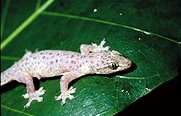
The dorsal coloration varies from grey to brown. Eastern populations have dark and pale blotches or marbling, while western populations have white to pale brown spots with dark bars. The dorsal markings form an irregular reticulate pattern across the entire upper surface.[1][2]
The body has small, uniform scales. The inter-orbital scales are considerably smaller than the loreal scales, and the rostral scale has steeply sloping upper edges.[3][4][5]
Several dark lines occur on the sides of the head, and the underside of the body is whitish. The tail is long, tapering to a point, and generally measures 55% of the snout-vent length.[6][7]
The fingers and toes have claws, large pads at their tips and divided subdigital lamellae. All inner digits lack claws, and the third and fourth toes lack webbing.[8][9][10]
The snout-vent length reaches 55 mm, and the tail reaches 70 mm in length.[11][12]
Habitat
The Tree Dtella inhabits arid to sub-humid environments, including woodland, shrubland and rocky areas. It uses both trees and rocky substrates as habitats.[13][14]
It shelters beneath loose bark and in tree hollows, as well as in rock crevices and beneath exfoliating rock. When sheltering in trees, it prefers protected sites more than one metre above the ground.[15][16][17]
It can also shelter beneath ground debris. In fragmented remnant vegetation, individuals shelter in logs and eucalyptus trees.[18][19]
Diet
The diet includes beetles, termites, grasshoppers, cockroaches and spiders.[20]
Behaviour
The Tree Dtella is primarily nocturnal and forages during the first three hours after dark. Individuals generally remain within 10 metres of their home while foraging.[21][22][23]
During cooler months, individuals bask in sunlight and may remain active under cover during daylight. They regulate their body temperature by changing their position beneath tree bark as different parts of the tree warm during the day.[24][25]
Males are territorial, and a single male may share a site with several females. The species may inhabit human dwellings, and individuals may hunt insects around street lights at night.[26][27][28]
The species can produce a shrill squeak.[29]
Reproduction and life cycle
Females lay one hard-shelled egg beneath cover, commonly bark, logs or holes beneath rocks, twice during a breeding season. The two eggs are usually laid approximately one month apart, with the first egg laid during late November.[30][31][32]
The eggs measure approximately 10 by 11 mm and hatch after approximately 61–79 days. Hatchlings measure approximately 45 mm in total length.[33][34][35]
Communal nests have been recorded containing as many as 35 eggs.[36]
Conservation
The Tree Dtella can persist in small patches of disturbed land by adjusting its habitat use to environmental changes.[37]
Classification of the Tree Dtella
| Kingdom | Animalia |
|---|---|
| Phylum | Chordata |
| Subphylum | Vertebrata |
| Infraphylum | Gnathostomata |
| Parvphylum | Osteichthyes |
| Megaclass | Tetrapoda |
| Class | Reptilia (Reptile) |
| Order | Squamata (Snakes) |
| Suborder | Gekkota |
| Family | Gekkonidae (Geckos) |
| Genus | Gehyra (Dtellas) |
| Species | Gehyra variegata (Duméril & Bibron, 1836) |
Where the Tree Dtella is found
Checklists and occurrence records place Gehyra variegata in 2 countries across Oceania. GBIF holds 20,053 georeferenced records of it.
Countries
Regions and cities with the most records
- Western Australia, Australia 9,187
- New South Wales, Australia 3,566
- South Australia, Australia 3,294
- Northern Territory, Australia 1,072
- Queensland, Australia 850
- Victoria, Australia 474
- Alice Springs, Australia 230
- Perth, Australia 102
- Western Province, Papua New Guinea 100
- Mildura, Australia 94
- Geraldton, Australia 72
- Karratha, Australia 58
- Kalgoorlie, Australia 42
- Port Hedland, Australia 25
- Broken Hill, Australia 15
- Dubbo, Australia 15
- Griffith, Australia 10
- Kwinana, Australia 6
- Darwin, Australia 5
- Mount Isa, Australia 5
- Palmerston, Australia 5
- Whyalla, Australia 5
- Milne Bay Province, Papua New Guinea 4
- Tamworth, Australia 4
Range as the checklists state it
Australia (Northern Territory, Queensland, South Australia, Victoria,Western Australia)
A number beside a place is its count of GBIF occurrence records. A place without a number comes from a checklist alone. Records show where a species has been observed or collected, which can include escapes and vagrants.
Common names
English
- Tree Dtella
- Cope's Scaly-toed Gecko
- Varied Dtella
- Variegated Tree Dtella
- Variegated Dtella
- Western Tree Dtella
Names in 3 other languages
- Danish
- Sydvestlig Broget Stumpfingergekko
- German
- Bunter Vierkrallengecko
- Russian
- Изменчивая гехира
Synonyms
5 other scientific names have been used for this species and are now treated as synonyms of Gehyra variegata.
- Lepidodactylus pusillus (Cope, 1869)
- Peropus pusillus Cope, 1869
- Dactyloperus lazelli Wells & Wellington, 1985 ambiguous synonym
- Gehyra australis Gray, 1845 ambiguous synonym
- Hemidactylus variegatus Duméril & Bibron, 1836 ambiguous synonym
Related species
-
 Dubious DtellaGehyra dubia
-
 Common Four-clawed GeckoGehyra mutilata
-
 House GeckoGehyra australis
-
 Halmahera Giant GeckoGehyra marginata
-
 Pacific DtellaGehyra oceanica
-
 Voracious Four-clawed GeckoGehyra vorax
-
 Western Giant Stump-toed GeckoGehyra georgpotthasti
- Kimberley DtellaGehyra kimberleyi
Compare
Questions and answers
What is the scientific name of the Tree Dtella?
The scientific name of the Tree Dtella is Gehyra variegata. Written with its author, the full name is Gehyra variegata (Duméril & Bibron, 1836).
Which family does the Tree Dtella belong to?
Gehyra variegata belongs to the family Gekkonidae, in the order Squamata and the class Reptilia.
Where is the Tree Dtella found?
Checklists and occurrence records place Gehyra variegata in 2 countries: Australia and Papua New Guinea.
What is the conservation status of the Tree Dtella?
The IUCN Red List category recorded for Gehyra variegata is Least Concern (LC).
What other names does the Tree Dtella have?
Gehyra variegata is also known in English as Cope's Scaly-toed Gecko, Varied Dtella, Variegated Tree Dtella, Variegated Dtella and Western Tree Dtella.
Where is the Tree Dtella native to?
It is native to inland Australia, excluding the north-west and south-east.[38][39]
How large does the Tree Dtella grow?
Its snout-vent length reaches 55 mm, and its tail reaches 70 mm.[11][12]
What does the Tree Dtella eat?
Its diet includes beetles, termites, grasshoppers, cockroaches and spiders.[20]
When is the Tree Dtella active?
It is primarily nocturnal and forages during the first three hours after dark. During cooler months, individuals may bask in sunlight and remain active under cover during daylight.[21][23][24]
How does the Tree Dtella reproduce?
Females lay one hard-shelled egg twice during a breeding season, usually approximately one month apart. Eggs hatch after approximately 61–79 days.[30][31][34]
How long does the Tree Dtella live?
The species has a documented lifespan of at least five years. Individuals reach maturity at approximately three years of age.[40][41]
How does the Tree Dtella regulate its body temperature?
It is an ectotherm that relies on heat exchange with the substrate to regulate body temperature. Its behavioural thermoregulation is considered related to high thermal requirements for digestion.[42][43]
Can the Tree Dtella live in disturbed habitats?
It can persist in small patches of disturbed land by adjusting its habitat use to environmental changes.[37]
Sources
Passages the profile rests on
- The dorsal coloration varies from grey to brown, with dark and pale blotches or marbling in eastern populations and white to pale brown spots with dark bars in western populations. Source passage: “Colours range from population to population from grey to brown with chequered dark and pale blotches and marbling in the eastern populations with western populations being marked with white to pale brown spots with dark bars.” — English Wikipedia
- The dorsal markings form an irregular reticulate pattern across the entire upper surface. Source passage: “These patterns form an irregular reticulate pattern over the entire dorsal surface.” — English Wikipedia
- The body has small, uniform scales. Source passage: “The scales on the body of the tree dtella are small and uniform” — English Wikipedia
- The inter-orbital scales are considerably smaller than the loreal scales. Source passage: “the inter-orbital scales on its head are much smaller than the loreal scales.” — English Wikipedia
- The rostral scale has steeply sloping upper edges. Source passage: “The rostral scale on its nose has steeply sloping upper edges.” — English Wikipedia
- Several dark lines occur on the sides of the head, and the underside of the body is whitish. Source passage: “There are several dark lines on the sides of the head of the tree dtella, with a whitish underside of the body.” — English Wikipedia
- The tail is long, tapering to a point, and generally measures 55% of the snout-vent length. Source passage: “It has a long tail which tapers to a point and is generally 55% of the snout-vent length.” — English Wikipedia
- The fingers and toes have claws and large pads at their tips. Source passage: “The fingers and toes of the tree dtella are clawed with large pads at the tips, enabling it to climb.” — English Wikipedia
- All inner digits lack claws. Source passage: “All inner digits are claw-free, a trait of the genus Gehyra.” — English Wikipedia
- The fingers and toes have divided subdigital lamellae, and the third and fourth toes lack webbing. Source passage: “The fingers and toes have divided subdigital lamellae and the third and fourth toes do not feature webbing.” — English Wikipedia
- The snout-vent length reaches 55 mm. Source passage: “The tree dtella's body (snout-vent) reaches a length of 55mm” — English Wikipedia
- The tail reaches 70 mm in length. Source passage: “and a tail length of 70mm.” — English Wikipedia
- The species inhabits arid to sub-humid environments, including woodland, shrubland and rocky areas. Source passage: “The tree dtella lives in arid to sub-humid areas, including woodland, shrubland and rocky environments” — English Wikipedia
- The species uses both trees and rocky substrates as habitats. Source passage: “It is both arboreal and saxicolous” — English Wikipedia
- It shelters beneath loose bark and in tree hollows. Source passage: “found under loose bark and hollows on trees” — English Wikipedia
- It also shelters in rock crevices and beneath exfoliating rock. Source passage: “in crevices and under exfoliating rock.” — English Wikipedia
- When sheltering in trees, it prefers protected sites more than one metre above the ground. Source passage: “In trees, the tree dtella prefers sheltered sites greater than 1 metre from the ground” — English Wikipedia
- The species can also shelter beneath ground debris. Source passage: “and can also be found under ground debris.” — English Wikipedia
- In fragmented remnant vegetation, individuals shelter in logs and eucalyptus trees. Source passage: “populations in small fragmented remnant vegetation sheltering in logs and eucalyptus trees.” — English Wikipedia
- The diet includes beetles, termites, grasshoppers, cockroaches and spiders. Source passage: “The diet of the tree dtella consists of beetles, termites, grasshoppers, cockroaches and spiders.” — English Wikipedia
- The species forages during the first three hours after dark. Source passage: “The tree dtella forages in the first 3 hours after dark” — English Wikipedia
- Individuals generally remain within 10 metres of their home while foraging. Source passage: “tends to stay within 10 metres of its home.” — English Wikipedia
- The species is primarily nocturnal. Source passage: “Although a nocturnal animal” — English Wikipedia
- During cooler months, individuals bask in sunlight and may remain active under cover during daylight. Source passage: “in the cooler months it basks in the sun and is also active under cover during the day.” — English Wikipedia
- Individuals regulate their body temperature by changing their position beneath tree bark as different parts of the tree warm during the day. Source passage: “by changing its location under the bark of trees as the sun warms different parts of the tree throughout the day.” — English Wikipedia
- Males are territorial, and a single male may share a site with several females. Source passage: “Males are territorial with several females and one male often sharing a site.” — English Wikipedia
- The species may inhabit human dwellings. Source passage: “The tree dtella also lives in human dwellings” — English Wikipedia
- Individuals may hunt insects around street lights at night. Source passage: “can be seen around street lights at night hunting insects.” — English Wikipedia
- The species can produce a shrill squeak. Source passage: “The tree dtella can also emit a shrill squeak.” — English Wikipedia
- Females lay one hard-shelled egg beneath cover, commonly bark, logs or holes beneath rocks, twice during a breeding season. Source passage: “with one hard shelled egg being laid beneath cover, usually bark, logs and holes under rocks twice in a breeding season” — English Wikipedia
- The two eggs in a breeding season are usually laid approximately one month apart. Source passage: “usually 1 month apart.” — English Wikipedia
- The first egg is laid during late November. Source passage: “with the first egg laid during late November.” — English Wikipedia
- The eggs measure approximately 10 by 11 mm. Source passage: “These eggs measure 10 by 11 mm” — English Wikipedia
- Eggs hatch after approximately 61–79 days. Source passage: “with hatching occurring after 61–79 days.” — English Wikipedia
- Hatchlings measure approximately 45 mm in total length. Source passage: “Hatchlings are 45mm in total length.” — English Wikipedia
- Communal nests have been recorded containing as many as 35 eggs. Source passage: “Nests are often communal, with 35 eggs in one nest having been found.” — English Wikipedia
- The species can persist in small patches of disturbed land by adjusting its habitat use to environmental changes. Source passage: “The tree dtella has the ability to survive in small patches of disturbed land, due to its ability to alter its habitat use in response to changes in the environment.” — English Wikipedia
- The species is native to inland Australia. Source passage: “native to inland Australia.” — inaturalist.org
- Its inland Australian distribution excludes the north-west and south-east. Source passage: “Inland Australia, except in the north-west and south-east.” — English Wikipedia
- The species has a documented lifespan of at least five years. Source passage: “The tree dtella has a lifespan of at least 5 years” — English Wikipedia
- Individuals reach maturity at approximately three years of age. Source passage: “reaching maturity at the age of 3.” — English Wikipedia
- The species is an ectotherm that relies on heat exchange with the substrate to regulate body temperature. Source passage: “The tree dtella is an ectotherm, falling into the subgroup of thigmotherms that depend on heat exchange with the substrate for maintenance of body temperature.” — English Wikipedia
- Its behavioural thermoregulation is considered related to high thermal requirements for digestion. Source passage: “This behavioural thermoregulation is believed to be related to high thermal requirements for digestion.” — English Wikipedia
Data
- Catalogue of Life, 2026-10-16 XR cc by
- Global Biodiversity Information Facility CC BY 4.0
- Wikidata CC0
- GeoNames CC BY 4.0
- Wikimedia Commons per image; credit shown with each image
- Within the Catalogue of Life, this name comes from The Reptile Database cc by
References
- Dumeril, A. M. C. & Bibron, G. (1836) Erpetologie Generale, ou Histoire Naturelle complete des Reptiles. Vol. III. Roret, Paris, iv + 517 pp. where the name was published
- Duméril, A.M. C. and G. Bibron. (1836). Erpetologie Générale ou Histoire Naturelle Complete des Reptiles. Vol. 3. Libr. Encyclopédique Roret, Paris, 528 Pp.
- Cope, E. D. (1869). Observations on Reptiles of the old world. Proc. Acad. Nat. Sci. Philadelphia 1868: 316-323.
- Günther, A. (1875). A list of the saurians of Australia and New Zealand. Pp. 9-19. In: Richardson, J., and J. E. Gray. The zoology of the voyage of H.M.S. Erebus and Terror, during the years 1839 to 1843. By authority of the Lords Commissioners of the Admiralty. Vol. 2. Reptiles, fishes, crustacea, insects, mollusca. E. W. Janson, London.
- Müller, F. (1880). Erster Nachtrag zum Katalog der herpetologischen Sammlung des Basler Museums. Verh. Naturf. Ges. Basel 7: 120-165.
- Boulenger, G. A. (1885). Catalogue of the lizards in the British Museum (Nat. Hist.) I. Geckonidae, Eublepharidae, Uroplatidae, Pygopodidae, Agamidae. London: 450 Pp.
- Garman, S. (1901). Some reptiles and batrachians from Australasia. Bull. Mus. Comp. Zool. Harvard 39: 1-14.
- Werner, F. (1910). Reptilia (Geckonidae und Scincidae). In: Michaelsen, W., and R. Hartmeyer: Die Fauna Südwest-Australiens. Vol. 2. G. Fischer, Jena, Pp. 451-493.
- de Rooij, & de, N. (1915). The Reptiles of the Indo-Australian Archipelago. I. Lacertilia, Chelonia, Emydosauria. Leiden (E. J. Brill), Xiv + 384 Pp.
- Kinghorn, & Roy, J. (1924). Reptiles and batrachians from south and south-west Australia. Rec. Austral. Mus. 14 (3): 163-183.
- Sternfeld, R. (1925). Beiträge zur Herpetologie Inner-Australiens. Abhandlungen Herausgegeben von Der Senckenbergischen Naturforschenden Gesellschaft, 38: 221—251.
- Loveridge, A. (1934). Australian reptiles in the Museum of Comparative Zoology, Cambridge, Massachusetts. Bull. Mus. Comp. Zool. Harvard 77: 243-383.
- Nakamura K, & Uéno SI. (1963). Japanese Reptiles and Amphibians in Colour [in Japanese]. Hoikusha, Osaka.
- Mitchell, F. J. (1965). Australian geckos assigned to the genus Gehyra Gray (Reptilia, Gekkonidae). Senckenbergiana Biologica 46: 287—319.
- Bustard, H. R. (1965). The systematic status of the Australian geckos Gehyra variegata (Dumeril and Bibron, 1836) and Gehyra australis Gray 1845. Herpetologica 20 (4): 259-272.
- Bustard, H. R. (1965). The systematic status of the Australian gecko Gehyra variegata punctata (Fry). Herpetologica 21 (2): 157-158.
- Dawson, W.R., Shoemaker, V.H. and Licht, P. (1966). Evaporative Water Losses of Some Small Australian Lizards. Ecology, 47: 589-594.
- Bustard, H. R. (1967). Activity Cycle and Thermoregulation in the Australian Gecko Gehyra variegata. Copeia 1967 (4): 753-758.
- Pianka, E. R. (1969). Habitat specificity, speciation, and species density in Australian desert lizards. Ecology 50 (3): 498-502.
- Bustard, & Robert, H. (1970). The Role of Behavior in the Nature Regulation of Numbers in the Gekkonid Lizard Gehyra Variegata. Ecology 51 (4): 723-728.
- Pianka, E. R., & Pianka, H. D. (1976). Comparative ecology of twelve species of nocturnal lizards (Gekkonidae) in the western Australian desert. Copeia 1976 (1): 125-142.
- King, & Max. (1979). Karyotypic evolution in Gehyra (Gekkonidae: Reptilia) I. The Gehyra variegata-punctata complex. Australian Journal of Zoology 27: 373-393.
- Bush, B. (1981). Reptiles of the Kalgoorlie-Esperance Region. B. Bush, Perth, 46 Pp.
- Kluge, A. G. (1982). The status of the parthenogenetic gekkonid lizard Gehyra variegata ogasawarasimae Okada. Journal of Herpetology 16 (1): 86-87.
- Wells, R. W. and Wellington, C. R. (1985). A classification of the Amphibia and Reptilia of Australia. Australian Journal of Herpetology, Supplementary Series (1): 1-61 [Sometimes Cited as 1983].
This species in other databases
Page built on 28 November 2026. See how the catalog is made and all sources and licences.
Cite this page
ScientificNames.org. (2026). Gehyra variegata (Tree Dtella). Retrieved November 28, 2026, from https://scientificnames.org/species/gehyra-variegata
“Gehyra variegata (Tree Dtella).” ScientificNames.org, 2026, scientificnames.org/species/gehyra-variegata. Accessed 28 Nov. 2026.
ScientificNames.org. “Gehyra variegata (Tree Dtella).” Accessed November 28, 2026. https://scientificnames.org/species/gehyra-variegata.
@misc{scientificnames_gehyra_variegata_tree_dtella,
  author = {{ScientificNames.org}},
  title = {Gehyra variegata (Tree Dtella)},
  year = {2026},
  url = {https://scientificnames.org/species/gehyra-variegata},
  note = {Accessed 2026-11-28}
}