Species · Fishes
Bellus Lyretail Angelfish Genicanthus bellus
The scientific name of the Bellus Lyretail Angelfish is Genicanthus bellus. It is a species of fish in the family Pomacanthidae (angelfishes), order Acanthuriformes. The name dates from 1975.
- Scientific name
- Genicanthus bellus Randall, 1975
- Common name
- Bellus Lyretail Angelfish
- Genus
- Genicanthus
- Family
- Pomacanthidae (Angelfishes)
- Order
- Acanthuriformes
- Class
- Teleostei
- Red List category
- LC Least Concern
- Environment
- marine
- Recorded in
- 6 countries
- Name status
- accepted in the Catalogue of Life
Overview
Genicanthus bellus inhabits deep reefs at depths of 25–100 metres in the western Pacific Ocean and eastern Indian Ocean. It exhibits sexual dichromatism, with males displaying golden stripes and females and juveniles displaying black bands and a blue longitudinal stripe.
Written 26 November 2026 from the sources listed below. Each statement was checked against the passage it cites; statements that could not be supported were removed.
Appearance
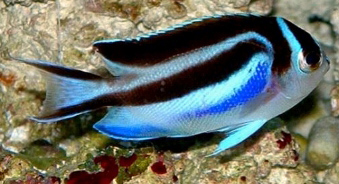
The species exhibits sexual dichromatism, with males and females displaying different colouration and patterns. Females and juveniles have greyish to bluish backgrounds with broad black bands and a blue longitudinal stripe on their lower flanks.[1][2]
Males have pale bluish to greyish backgrounds with horizontal golden stripes along the centre of their flanks and lower backs. Their pectoral and dorsal fin bases match the colour of their body stripes.[3][4]
The caudal fin is unpigmented and frequently bears orange patches, filamentous extensions and bright blue markings. The lips are bright blue.[5][6]
Females and juveniles have a black stripe extending vertically from the nape through the eye to the lower part of the orbit. Females have two silvery-white dots on their black upper lips.[7][8]
The dorsal fin normally consists predominantly of black coloration. The anal fin may have either one or two orange marginal stripes, or no orange stripe.[9][10]
The dorsal fin has 15 spines and 15–16 soft rays. The anal fin has 3 spines and 16–17 soft rays.[11][12]
The species reaches a maximum total length of 18 centimetres.[13]
Habitat
The Bellus Lyretail Angelfish inhabits depths of 25–100 metres. It lives on deep reefs, frequently on outer drop-offs exposed to strong currents.[14][15]
Diet
The species feeds mainly on plankton. It also consumes benthic polychaetes and bryozoans.[16][17]
Behaviour
The species is sociable and lives in schools. Its schools contain harems consisting of three to seven fish.[18][19]
It forms midwater shoals while feeding on plankton.[20]
Reproduction and life cycle
The species is a sequential protogynous hermaphrodite, with newly adult individuals being female. Dominant females can change sex to male in as little as two weeks when a male is absent.[21][22]
Uses
The species is traded in the aquarium industry but is rarely collected because it inhabits deep waters. Its availability in the aquarium trade can increase when collection efforts intensify.[23][24]
Specimens collected for the aquarium trade can experience high mortality. Healthy specimens that have acclimated to captivity can be hardy and resilient.[25][26]
Similar species
The ornate angelfish is known to hybridize only with the blackstriped angelfish (Genicanthus lamarck).[27]
Classification of the Bellus Lyretail Angelfish
| Kingdom | Animalia |
|---|---|
| Phylum | Chordata |
| Subphylum | Vertebrata |
| Infraphylum | Gnathostomata |
| Parvphylum | Osteichthyes |
| Gigaclass | Actinopterygii |
| Superclass | Actinopteri |
| Class | Teleostei (Teleost) |
| Order | Acanthuriformes |
| Family | Pomacanthidae (Angelfishes) |
| Genus | Genicanthus (Swallowtail Angelfishes) |
| Species | Genicanthus bellus Randall, 1975 |
Where the Bellus Lyretail Angelfish is found
Checklists and occurrence records place Genicanthus bellus in 6 countries. GBIF holds 67 georeferenced records of it.
Countries
Regions and cities with the most records
A number beside a place is its count of GBIF occurrence records. A place without a number comes from a checklist alone. Records show where a species has been observed or collected, which can include escapes and vagrants.
Common names
English
- Bellus Lyretail Angelfish
- Ornate Angelfish
Names in 12 other languages
- Catalan
- Peix àngel ornamentat
- Cebuano
- Boray-boray
- Chinese
- 美麗月蝶魚
- Czech
- pomec zdobený
- Danish
- Pyntet Kejserfisk
- French
- Poisson-ange gracieux
- German
- Pracht-Lyrakaiserfisch
- Italian
- Pesce angelo ornato
- Japanese
- フカミヤッコ
- Mandarin Chinese
- 美丽月蝶鱼
- Portuguese
- Peixe-anjo-ornato
- tah
- 'atoti
Related species
-
 Masked AngelGenicanthus personatus
-
 Blackstriped AngelfishGenicanthus lamarck
-
 Japanese SwallowGenicanthus semifasciatus
-
 Blackspot AngelfishGenicanthus melanospilos
-
 Zebra AngelfishGenicanthus caudovittatus
-
 Blackedged AngelfishGenicanthus watanabei
- Spotted AngelfishGenicanthus takeuchii
-
 Halfbanded AngelfishGenicanthus semicinctus
Compare
Questions and answers
What is the scientific name of the Bellus Lyretail Angelfish?
The scientific name of the Bellus Lyretail Angelfish is Genicanthus bellus. Written with its author, the full name is Genicanthus bellus Randall, 1975.
Which family does the Bellus Lyretail Angelfish belong to?
Genicanthus bellus belongs to the family Pomacanthidae, in the order Acanthuriformes and the class Teleostei.
Where is the Bellus Lyretail Angelfish found?
Checklists and occurrence records place Genicanthus bellus in 6 countries: French Polynesia, Philippines, Japan, Australia, Cocos Islands and Marshall Islands.
What is the conservation status of the Bellus Lyretail Angelfish?
The IUCN Red List category recorded for Genicanthus bellus is Least Concern (LC).
What other names does the Bellus Lyretail Angelfish have?
Genicanthus bellus is also known in English as Ornate Angelfish.
How big do Bellus angelfish get?
The Bellus Lyretail Angelfish reaches a maximum total length of 18 centimetres.[13]
What is the best diet for angelfish?
The Bellus Lyretail Angelfish feeds mainly on plankton and also consumes benthic polychaetes and bryozoans.[16][17]
Where do angelfish live in their natural habitat?
The Bellus Lyretail Angelfish lives on deep reefs, frequently on outer drop-offs exposed to strong currents, at depths of 25–100 metres.[14][15]
How big can a Bellus angelfish get?
It can reach a maximum total length of 18 centimetres.[13]
Sources
Passages the profile rests on
- The species exhibits sexual dichromatism, with males and females displaying different colouration and patterns. Source passage: “Genicanthus bellus Is sexually dichromatic, the males and females show different colouration and patterning.” — English Wikipedia
- Females and juveniles have greyish to bluish backgrounds with broad black bands and a blue longitudinal stripe on their lower flanks. Source passage: “The females, and the juveniles, have greyish to bluish background colouration and are marked with wide black bands and a blue longitudinal stripe on the lower flanks.” — English Wikipedia
- Males have pale bluish to greyish backgrounds with horizontal golden stripes along the centre of their flanks and lower backs. Source passage: “The males' background colour is pale bluish to greyish and they have horizontal golden stripes along the centre of the flanks and another along the lower back.” — English Wikipedia
- Male pectoral and dorsal fin bases match the colour of their body stripes. Source passage: “Also in the males the bases of the pectoral and dorsal fins are the same colour as the stripes on the body.” — English Wikipedia
- The caudal fin is unpigmented and frequently bears orange patches, filamentous extensions and bright blue markings. Source passage: “The caudal fin are unpigmented frequently marked with patches of orange, these have filamentous extensions and are bright blue.” — English Wikipedia
- The lips are bright blue. Source passage: “The lips are also bright blue.” — English Wikipedia
- Females and juveniles have a black stripe extending vertically from the nape through the eye to the lower part of the orbit. Source passage: “In the females and juveniles there is a black stripe which runs vertically from the nape through and engulfing the eye but does not extend past the lower part of the orbit.” — English Wikipedia
- Females have two silvery-white dots on their black upper lips. Source passage: “There are two silvery-white dots on the black upper lips of the females too.” — English Wikipedia
- The dorsal fin normally consists predominantly of black coloration. Source passage: “The dorsal fin is normally largely black” — English Wikipedia
- The anal fin may have either one or two orange marginal stripes, or no orange stripe. Source passage: “The colour of the anal fin varies and it may have either a double or single orange stripe at the margin, however, this stripe can also be absent.” — English Wikipedia
- The dorsal fin has 15 spines and 15–16 soft rays. Source passage: “The dorsal fin contains 15 spines and 15–16 soft rays” — English Wikipedia
- The anal fin has 3 spines and 16–17 soft rays. Source passage: “the anal fin has 3 spines and 16–17 soft rays.” — English Wikipedia
- The species reaches a maximum total length of 18 centimetres. Source passage: “This species attains a maximum total length of 18 centimetres (7.1 in).” — English Wikipedia
- The species inhabits depths of 25–100 metres. Source passage: “Genicanthus bellus is found at depths between 25 and 100 metres (82 and 328 ft).” — English Wikipedia
- The species lives on deep reefs, frequently on outer drop-offs exposed to strong currents. Source passage: “Here it lives on deep reefs, frequently in areas which are swept by strong currents on the outer drop-offs.” — English Wikipedia
- The species feeds mainly on plankton. Source passage: “They feed mainly on plankton” — English Wikipedia
- The species also consumes benthic polychaetes and bryozoans. Source passage: “This species will also feed on benthic invertebrates like polychaetes and bryozoans, as well as algae.” — English Wikipedia
- The species is sociable and lives in schools. Source passage: “It is a sociable species which lives in schools” — English Wikipedia
- Its schools contain harems consisting of three to seven fish. Source passage: “within these there are harems of 3–7 fish” — English Wikipedia
- The species forms midwater shoals while feeding on plankton. Source passage: “forming shoals in midwater to feed.” — English Wikipedia
- The species is a sequential protogynous hermaphrodite, with newly adult individuals being female. Source passage: “All angelfish are sequential protogynous hermaphrodites, all newly adult fish are female” — English Wikipedia
- Dominant females can change sex to male in as little as two weeks when a male is absent. Source passage: “the dominant females can increase the production of testosterone in the absence of a male and change sex to male in as short a time as a fortnight.” — English Wikipedia
- The species is traded in the aquarium industry but is rarely collected because it inhabits deep waters. Source passage: “Genicanthus bellus is very infrequent and fetches high prices in the aquarium trade as it is rarely collected because of the depths at which it lives.” — English Wikipedia
- Its availability in the aquarium trade can increase when collection efforts intensify. Source passage: “It is some times more numerous in the trade when collecting effort is increased.” — English Wikipedia
- Specimens collected for the aquarium trade can experience high mortality. Source passage: “There can be high mortality in specimens collected for the trade” — English Wikipedia
- Healthy specimens that have acclimated to captivity can be hardy and resilient. Source passage: “but healthy, acclimated fish can be very hardy and resilient in captivity.” — English Wikipedia
- The ornate angelfish is known to hybridize only with the blackstriped angelfish (Genicanthus lamarck). Source passage: “The ornate angelfish is only known to hybridise with the blackstriped angelfish (Genicanthus lamarck).” — English Wikipedia
Data
- Catalogue of Life, 2026-10-16 XR cc by
- Global Biodiversity Information Facility CC BY 4.0
- Wikidata CC0
- GeoNames CC BY 4.0
- Wikimedia Commons per image; credit shown with each image
- Within the Catalogue of Life, this name comes from World Register of Marine Species cc by
References
- Randall, J. E. (1975). A revision of the Indo-Pacific angelfish genus Genicanthus, with descriptions of three new species. Bulletin of Marine Science, 25 (3): 393–421, 1 pl. where the name was published
This species in other databases
- Catalogue of Life 3FKTX
- Wikidata Q744838
- iNaturalist 101331
- WoRMS urn:lsid:marinespecies.org:taxname:279092
- ITIS 169643
Page built on 28 November 2026. See how the catalog is made and all sources and licences.
Cite this page
ScientificNames.org. (2026). Genicanthus bellus (Bellus Lyretail Angelfish). Retrieved November 28, 2026, from https://scientificnames.org/species/genicanthus-bellus
“Genicanthus bellus (Bellus Lyretail Angelfish).” ScientificNames.org, 2026, scientificnames.org/species/genicanthus-bellus. Accessed 28 Nov. 2026.
ScientificNames.org. “Genicanthus bellus (Bellus Lyretail Angelfish).” Accessed November 28, 2026. https://scientificnames.org/species/genicanthus-bellus.
@misc{scientificnames_genicanthus_bellus_bellus_lyretail_angelfish,
  author = {{ScientificNames.org}},
  title = {Genicanthus bellus (Bellus Lyretail Angelfish)},
  year = {2026},
  url = {https://scientificnames.org/species/genicanthus-bellus},
  note = {Accessed 2026-11-28}
}