Species · Fishes
Blackstriped Angelfish Genicanthus lamarck
The scientific name of the Blackstriped Angelfish is Genicanthus lamarck. It is a species of fish in the family Pomacanthidae (angelfishes), order Acanthuriformes. The name dates from 1802.
- Scientific name
- Genicanthus lamarck (Lacepède, 1802)
- Common name
- Blackstriped Angelfish
- Genus
- Genicanthus
- Family
- Pomacanthidae (Angelfishes)
- Order
- Acanthuriformes
- Class
- Teleostei
- Red List category
- LC Least Concern
- Environment
- marine
- Recorded in
- 10 countries
- Name status
- accepted in the Catalogue of Life

Overview
The Blackstriped Angelfish (Genicanthus lamarck) is a fish belonging to the family Pomacanthidae, order Acanthuriformes and class Teleostei. It occurs in the Indo-West Pacific region, from the Gulf of Thailand through the Malayan Archipelago to the Solomon Islands, reaching southern Japan in the north and the Great Barrier Reef in the south. Adults have pale greyish to whitish bodies with four to five irregular black undulating stripes extending along their flanks.
Written 26 November 2026 from the sources listed below. Each statement was checked against the passage it cites; statements that could not be supported were removed.
Appearance
Adults have pale greyish to whitish bodies marked by four to five irregular black undulating stripes extending horizontally along their flanks from the eye. The dorsal fin has a wide black submarginal band, and the caudal fin is finely spotted.[1][2]
The dorsal fin has 15 spines and 15–16 soft rays. The anal fin has three spines and 16–17 soft rays.[3][4]
Habitat
The Blackstriped Angelfish inhabits depths of 10–50 metres. It occurs in areas of dense coral growth on seaward reef slopes and steep drop-offs.[5][6]
Diet
The Blackstriped Angelfish normally feeds on zooplankton.[7][8]
Behaviour
Individuals are normally observed above the seabed in small harems consisting of one dominant male and two to six females.[9]
Reproduction and life cycle
The Blackstriped Angelfish is a sequential protogynous hermaphrodite. When a harem's male disappears, its dominant female changes sex and becomes male.[10][11]
Uses
The Blackstriped Angelfish is frequently traded in the aquarium industry. It is regarded as a delicacy in the Moluccas.[12][13]
Similar species
The Blackstriped Angelfish is known to hybridise with the ornate angelfish, Genicanthus bellus.[14]
Classification of the Blackstriped Angelfish
| Kingdom | Animalia |
|---|---|
| Phylum | Chordata |
| Subphylum | Vertebrata |
| Infraphylum | Gnathostomata |
| Parvphylum | Osteichthyes |
| Gigaclass | Actinopterygii |
| Superclass | Actinopteri |
| Class | Teleostei (Teleost) |
| Order | Acanthuriformes |
| Family | Pomacanthidae (Angelfishes) |
| Genus | Genicanthus (Swallowtail Angelfishes) |
| Species | Genicanthus lamarck (Lacepède, 1802) |
Where the Blackstriped Angelfish is found
Checklists and occurrence records place Genicanthus lamarck in 10 countries. GBIF holds 650 georeferenced records of it.
Countries
- Australia 31
- Indonesia 163
- Japan 160
- Malaysia 7
- Papua New Guinea 12
- Philippines 234
- Solomon Islands 16
- Taiwan 5
- Timor Leste 10
- Vietnam 12
Regions and cities with the most records
- Bauan, Philippines 21
- Danao, Philippines 21
- Wongsorejo, Indonesia 18
- San Pascual, Philippines 17
- Batangas, Philippines 15
- Tagbilaran City, Philippines 11
- Dumaguete, Philippines 10
- Sibulan, Philippines 9
- Calapan, Philippines 8
- Nishinoomote, Japan 8
- Apas, Philippines 7
- Cebu City, Philippines 7
- Consolacion, Philippines 7
- Lapu-Lapu City, Philippines 7
- Liloan, Philippines 7
- Mandaue City, Philippines 7
- Rosario, Philippines 7
- Taal, Philippines 7
- Bitung, Indonesia 6
- Compostela, Philippines 6
- Daanbantayan, Philippines 6
- Amlapura, Indonesia 5
- Amlapura city, Indonesia 5
- Bedugul, Indonesia 5
- Gushikawa, Japan 5
- Ishikawa, Japan 5
- Nago, Japan 5
- Uruma, Japan 5
- Yomitan, Japan 5
- Bali, Indonesia 4
- Guihulñgan, Philippines 4
- Katsuren-haebaru, Japan 4
- Taiwan, Taiwan 4
- Talisay, Philippines 4
- Danao, Philippines 3
- Klungkung, Indonesia 3
A number beside a place is its count of GBIF occurrence records. A place without a number comes from a checklist alone. Records show where a species has been observed or collected, which can include escapes and vagrants.
Common names
English
- Blackstriped Angelfish
- Freckletail Lyretail Angelfish
- Lamarck's Angelfish
- Lamark's Angelfish
Names in 14 other languages
- Catalan
- Peix àngel de Lamarck
- Chinese
- 拉馬克神仙, 月蝶魚, 頰刺魚
- Czech
- pomec Lamarckův
- Danish
- Svalehalekejserfisk
- German
- Lamarcks Lyrakaiserfisch
- Italian
- Pesce angelo di Lamarck
- Japanese
- Tatejimayakko, タテジマヤッコ
- Portuguese
- Peixe-anjo-de-Lamarck
- Russian
- Четырёхполосая лирохвостая рыба-ангел
- Spanish
- Pez Ángel de Lamarck
- Tagalog
- Paru-parang dagat
- Vietnamese
- Cá Bướm la-ma
- ilo
- Kulibangbang
- war
- Adlo
Synonyms
5 other scientific names have been used for this species and are now treated as synonyms of Genicanthus lamarck.
- Genicanthus lamarcki (Lacepède, 1802)
- Genicanthus lamark (Lacepède, 1802)
- Holacanthus chapmani Herre, 1933
- Holacanthus lamarck Lacepède, 1802
- Holacanthus lamarcki japonicus Schmidt, 1931
Related species
-
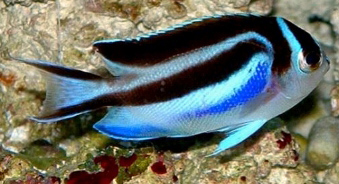 Bellus Lyretail AngelfishGenicanthus bellus
-
 Masked AngelGenicanthus personatus
-
 Japanese SwallowGenicanthus semifasciatus
-
 Blackspot AngelfishGenicanthus melanospilos
-
 Zebra AngelfishGenicanthus caudovittatus
-
 Blackedged AngelfishGenicanthus watanabei
- Spotted AngelfishGenicanthus takeuchii
-
 Halfbanded AngelfishGenicanthus semicinctus
Compare
Questions and answers
What is the scientific name of the Blackstriped Angelfish?
The scientific name of the Blackstriped Angelfish is Genicanthus lamarck. Written with its author, the full name is Genicanthus lamarck (Lacepède, 1802).
Which family does the Blackstriped Angelfish belong to?
Genicanthus lamarck belongs to the family Pomacanthidae, in the order Acanthuriformes and the class Teleostei.
Where is the Blackstriped Angelfish found?
Checklists and occurrence records place Genicanthus lamarck in 10 countries, including Philippines, Indonesia, Japan, Australia, Solomon Islands and Papua New Guinea.
What is the conservation status of the Blackstriped Angelfish?
The IUCN Red List category recorded for Genicanthus lamarck is Least Concern (LC).
What other names does the Blackstriped Angelfish have?
Genicanthus lamarck is also known in English as Freckletail Lyretail Angelfish, Lamarck's Angelfish and Lamark's Angelfish.
How big does a Lamarck angelfish get?
The Blackstriped Angelfish reaches a maximum total length of 25 centimetres.[15]
What is the scientific name of angelfish?
The scientific name of the Blackstriped Angelfish is Genicanthus lamarck.[1]
Sources
Passages the profile rests on
- Adults have pale greyish to whitish bodies marked by four to five irregular black undulating stripes extending horizontally along their flanks from the eye. Source passage: “Genicanthus lamarck adults are pale greyish to whitish in colour marked with 4-5 irregular black undulating stripes which radiate out from the eye and run horizontally along the flanks.” — English Wikipedia
- The dorsal fin has a wide black submarginal band, and the caudal fin is finely spotted. Source passage: “There is a wide black submarginal band on the dorsal fin, and the caudal fin is finely spotted.” — English Wikipedia
- The dorsal fin has 15 spines and 15–16 soft rays. Source passage: “The dorsal fin contains 15 spines and 15-16 soft rays” — English Wikipedia
- The anal fin has three spines and 16–17 soft rays. Source passage: “the anal fin has 3 spines and 16-17soft rays.” — English Wikipedia
- The species inhabits depths of 10–50 metres. Source passage: “Genicanthus lamarck is found at depths between 10 and 50 metres (33 and 164 ft).” — English Wikipedia
- The species occurs in areas of dense coral growth on seaward reef slopes and steep drop-offs. Source passage: “It is found in areas of dense coral growth on the seaward slopes of reefs and on steep drop-offs.” — English Wikipedia
- The species normally feeds on zooplankton. Source passage: “Its normal diet is zooplankton.” — English Wikipedia
- Angelfish belonging to the genus Genicanthus forage on zooplankton. Source passage: “Angelfish of the Genicanthus genus forage on zooplankton.” — wildnet.science-data.qld.gov.au
- Individuals are normally observed above the seabed in small harems consisting of one dominant male and two to six females. Source passage: “They are normally observed over the bottom in small harems with a dominant male and 2-6 females.” — English Wikipedia
- The species is a sequential protogynous hermaphrodite. Source passage: “They are sequential protogynous hermaphrodites” — English Wikipedia
- When a harem's male disappears, its dominant female changes sex and becomes male. Source passage: “if the male in a harem goes missing the dominant female changes sex to become male.” — English Wikipedia
- The species is frequently traded in the aquarium industry. Source passage: “Genicanthus lamarck is frequently found in the aquarium trade.” — English Wikipedia
- The species is regarded as a delicacy in the Moluccas. Source passage: “It is also regarded as a delicacy in the Moluccas.” — English Wikipedia
- The species is known to hybridise with the ornate angelfish, Genicanthus bellus. Source passage: “This species is known to hybridise with the ornate angelfish (Genicanthus bellus).” — English Wikipedia
- The species reaches a maximum total length of 25 centimetres. Source passage: “This species attains a maximum total length of 25 centimetres (9.8 in).” — English Wikipedia
Data
- Catalogue of Life, 2026-10-16 XR cc by
- Global Biodiversity Information Facility CC BY 4.0
- Wikidata CC0
- GeoNames CC BY 4.0
- Wikimedia Commons per image; credit shown with each image
- Within the Catalogue of Life, this name comes from World Register of Marine Species cc by
References
- Lacépède, Bernard G. É. de. 1802. Histoire naturelle des poissons. Plasson, Paris. Vol. 4: i-xliv, 1-728, pls. 1-16. where the name was published
This species in other databases
- Catalogue of Life 3FKTZ
- Wikidata Q1076108
- iNaturalist 101333
- WoRMS urn:lsid:marinespecies.org:taxname:211793
- ITIS 169641
Page built on 28 November 2026. See how the catalog is made and all sources and licences.
Cite this page
ScientificNames.org. (2026). Genicanthus lamarck (Blackstriped Angelfish). Retrieved November 28, 2026, from https://scientificnames.org/species/genicanthus-lamarck
“Genicanthus lamarck (Blackstriped Angelfish).” ScientificNames.org, 2026, scientificnames.org/species/genicanthus-lamarck. Accessed 28 Nov. 2026.
ScientificNames.org. “Genicanthus lamarck (Blackstriped Angelfish).” Accessed November 28, 2026. https://scientificnames.org/species/genicanthus-lamarck.
@misc{scientificnames_genicanthus_lamarck_blackstriped_angelfish,
  author = {{ScientificNames.org}},
  title = {Genicanthus lamarck (Blackstriped Angelfish)},
  year = {2026},
  url = {https://scientificnames.org/species/genicanthus-lamarck},
  note = {Accessed 2026-11-28}
}