Species · Fishes
White Croaker Genyonemus lineatus
The scientific name of the White Croaker is Genyonemus lineatus. It is a species of fish in the family Sciaenidae (drums), order Perciformes. The name dates from 1855.
- Scientific name
- Genyonemus lineatus (Ayres, 1855)
- Common name
- White Croaker
- Genus
- Genyonemus
- Family
- Sciaenidae (Drums)
- Order
- Perciformes
- Class
- Teleostei
- Red List category
- LC Least Concern
- Environment
- marine
- Recorded in
- 3 countries
- Name status
- accepted in the Catalogue of Life

Overview
Genyonemus lineatus occurs in the Eastern Pacific, from Magdalena Bay in Baja California Sur to Vancouver Island in British Columbia. It is the only species in the genus Genyonemus.
Written 26 November 2026 from the sources listed below. Each statement was checked against the passage it cites; statements that could not be supported were removed.
Appearance
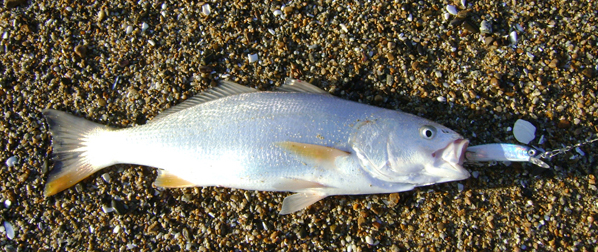
White Croaker has an elongated, somewhat compressed body and an oblong head with a bluntly rounded shape. Its mouth is positioned somewhat underneath its head.[1][2][3]
Its back is incandescent brownish to yellowish, transitioning to a silvery underside. Its fins are yellow to white, and its first dorsal fin has 12 to 15 spines.[4][5][6]
Habitat
White Croaker swims in loose schools at or near the bottom of sandy areas. It sometimes aggregates in surf zones, shallow bays, and lagoons.[7][8]
It is usually found offshore at depths of 3 to 30 meters and occasionally occurs at depths reaching 200 meters.[9][10]
The species occurs in the Eastern Pacific, from Magdalena Bay in Baja California Sur to Vancouver Island in British Columbia. It is not abundant north of San Francisco.[11][12]
Diet
White Croaker consumes fishes, squid, shrimp, octopus, worms, small crabs, and clams. It eats both living and dead food items.[13][14]
Behaviour
White Croaker puts up little or no fight when hooked.[15]
Reproduction and life cycle
Some individuals spawn for the first time between two and three years of age. At first spawning, they measure approximately 12 to 15 cm in length and weigh less than 45 grams.[16][17][18]
The reported minimum batch fecundity is 800.[19]
Conservation
White Croakers caught around Los Angeles are discouraged from being eaten because of their high exposure to DDT and other contaminants. Caution is advised when consuming White Croaker throughout California, particularly Southern California.[20][21]
Uses
White Croaker meat has been used as an ingredient in the production of crab sticks.[22]
Similar species
A fossil relative, G. whistleri, is known from the Late Miocene-aged Puente Formation in the Los Angeles Basin.[23]
Classification of the White Croaker
| Kingdom | Animalia |
|---|---|
| Phylum | Chordata |
| Subphylum | Vertebrata |
| Infraphylum | Gnathostomata |
| Parvphylum | Osteichthyes |
| Gigaclass | Actinopterygii |
| Superclass | Actinopteri |
| Class | Teleostei (Teleost) |
| Order | Perciformes |
| Suborder | Percoidei |
| Family | Sciaenidae (Drums) |
| Genus | Genyonemus |
| Species | Genyonemus lineatus (Ayres, 1855) |
Where the White Croaker is found
Checklists and occurrence records place Genyonemus lineatus in 3 countries. GBIF holds 7,316 georeferenced records of it.
Countries
Regions and cities with the most records
- Torrance, United States 1,438
- Redondo Beach, United States 1,400
- Gardena, United States 1,382
- Hermosa Beach, United States 1,380
- Manhattan Beach, United States 1,367
- El Segundo, United States 1,366
- Lawndale, United States 1,345
- Hawthorne, United States 1,340
- Inglewood, United States 1,240
- Lennox, United States 1,240
- Westmont, United States 1,232
- Lomita, United States 1,104
- West Carson, United States 1,091
- Rancho Palos Verdes, United States 1,048
- Carson, United States 1,036
- Santa Monica, United States 931
- Port Hueneme, United States 917
- Willowbrook, United States 913
- Oxnard, United States 908
- San Clemente, United States 783
- Dana Point, United States 780
- Compton, United States 712
- California, United States 665
- San Juan Capistrano, United States 664
- Newport Beach, United States 599
- Camarillo, United States 588
- Huntington Beach, United States 544
- Seal Beach, United States 539
- Fountain Valley, United States 514
- Long Beach, United States 513
- Westminster, United States 482
- Costa Mesa, United States 475
- Ventura, United States 433
- Garden Grove, United States 400
- Cypress, United States 394
- Stanton, United States 382
A number beside a place is its count of GBIF occurrence records. A place without a number comes from a checklist alone. Records show where a species has been observed or collected, which can include escapes and vagrants.
Common names
English
- White Croaker
- Croaker
- King Croaker
- King-fish
- Kingfish
- Roncador
- Tomcod
Names in 8 other languages
- Czech
- smuha bělavá
- French
- Courbine Blanche, Maigre Argenté, tambour rayé
- German
- Weißer Umberfisch
- Japanese
- Shiroguchi
- Polish
- Kulbiniec kalifornijski
- Portuguese
- Corvina-de-San-Francisco, Rabeta-branca
- Russian
- Белый ронкадор
- Spanish
- Roncador Blanco, corvineta blanca
Synonyms
One other scientific name has been used for this species and is now treated as a synonym of Genyonemus lineatus.
- Leiostomus lineatus Ayres, 1855
Related species
-
 Red DrumSciaenops ocellatus
-
 TotoabaTotoaba macdonaldi
-
 Freshwater DrumAplodinotus grunniens
-
 Atlantic CroakerMicropogonias undulatus
-
 MeagreArgyrosomus regius
-
 MullowayArgyrosomus japonicus
-
 Black DrumPogonias cromis
-
 Corvina DrumCilus gilberti
Compare
Questions and answers
What is the scientific name of the White Croaker?
The scientific name of the White Croaker is Genyonemus lineatus. Written with its author, the full name is Genyonemus lineatus (Ayres, 1855).
Which family does the White Croaker belong to?
Genyonemus lineatus belongs to the family Sciaenidae, in the order Perciformes and the class Teleostei.
Where is the White Croaker found?
Checklists and occurrence records place Genyonemus lineatus in 3 countries: United States, Mexico and Canada.
What is the conservation status of the White Croaker?
The IUCN Red List category recorded for Genyonemus lineatus is Least Concern (LC).
What other names does the White Croaker have?
Genyonemus lineatus is also known in English as Croaker, King Croaker, King-fish, Kingfish, Roncador and Tomcod.
Are white croaker good to eat?
White Croaker meat has been used as an ingredient in the production of crab sticks. However, White Croakers caught around Los Angeles are discouraged from being eaten because of their high exposure to DDT and other contaminants.[22][20]
What is croaker fish called in the USA?
Recorded English names include Croaker, King Croaker, King-fish, Kingfish, Roncador, Tomcod, White croaker, and white croaker. Other recorded names include Pasadena trout, tommy croaker, and little bass.[24]
Is croaker a safe fish to eat?
Caution is advised when consuming White Croaker throughout California, particularly Southern California. White Croakers caught around Los Angeles are discouraged from being eaten because of their high exposure to DDT and other contaminants.[20][21]
Sources
Passages the profile rests on
- The species has an elongated, somewhat compressed body. Source passage: “The body of the white croaker is elongate and somewhat compressed.” — English Wikipedia
- The species has an oblong head with a bluntly rounded shape. Source passage: “The head is oblong and bluntly rounded” — English Wikipedia
- The species has a mouth positioned somewhat underneath its head. Source passage: “with a mouth that is somewhat underneath the head.” — English Wikipedia
- Its back is incandescent brownish to yellowish, transitioning to a silvery underside. Source passage: “The color is incandescent brownish to yellowish on the back becoming silvery below.” — English Wikipedia
- The species has yellow to white fins. Source passage: “The fins are yellow to white.” — English Wikipedia
- The species has 12 to 15 spines in its first dorsal fin. Source passage: “The 12 to 15 spines in the first dorsal fin serve to distinguish white croakers” — English Wikipedia
- The species swims in loose schools at or near the bottom of sandy areas. Source passage: “White croakers swim in loose schools at or near the bottom of sandy areas.” — English Wikipedia
- The species sometimes aggregates in surf zones, shallow bays, and lagoons. Source passage: “Sometimes they aggregate in the surf zone or in shallow bays and lagoons.” — English Wikipedia
- The species is usually found offshore at depths of 3 to 30 meters. Source passage: “Most of the time they are found in offshore areas at depths of 3 to 30 meters (10 to 100 ft).” — English Wikipedia
- The species occasionally occurs at depths reaching 200 meters. Source passage: “On rare occasions they are fairly abundant at depths as great as 200 meters (660 feet).” — English Wikipedia
- The species occurs in the Eastern Pacific, from Magdalena Bay in Baja California Sur to Vancouver Island in British Columbia. Source passage: “White croakers have been taken from Magdalena Bay, Baja California Sur, to Vancouver Island, British Columbia” — English Wikipedia
- The species is not abundant north of San Francisco. Source passage: “but are not abundant north of San Francisco.” — English Wikipedia
- The species consumes fishes, squid, shrimp, octopus, worms, small crabs, and clams. Source passage: “White croakers eat a variety of fishes, squid, shrimp, octopus, worms, small crabs, clams” — English Wikipedia
- The species consumes both living and dead food items. Source passage: “and other items, either living or dead.” — English Wikipedia
- The species puts up little or no fight when hooked. Source passage: “When hooked, they put up little or no fight.” — English Wikipedia
- Some individuals spawn for the first time between two and three years of age. Source passage: “Some spawn for the first time when they are between 2 and 3 years old.” — English Wikipedia
- Individuals spawning for the first time measure approximately 12 to 15 cm in length. Source passage: “At this age they are only 12 to 15 cm (4.7 to 5.9 in) long” — English Wikipedia
- Individuals spawning for the first time weigh less than 45 grams. Source passage: “and weigh less than 45 grams (0.099 pounds).” — English Wikipedia
- The reported minimum batch fecundity is 800. Source passage: “Min batch fecundity = 800” — fishbase.se
- White croakers caught around Los Angeles are discouraged from being eaten because of their high exposure to DDT and other contaminants. Source passage: “White Croaker caught around Los Angeles should not be eaten due to their especially high exposure to the DDT and other contaminants material dumped in the water there.” — English Wikipedia
- Caution is advised when consuming white croaker throughout California, particularly Southern California. Source passage: “Caution is advisable across all of California and especially Southern California.” — English Wikipedia
- White croaker meat has been used as an ingredient in the production of crab sticks. Source passage: “White croaker meat has been used as a co-ingredient in creating Crab stick.” — English Wikipedia
- A fossil relative, G. whistleri, is known from the Late Miocene-aged Puente Formation in the Los Angeles Basin. Source passage: “A fossil relative, G. whistleri, is known from the Late Miocene-aged Puente Formation of the Los Angeles Basin.” — English Wikipedia
- The species has also been called Pasadena trout, tommy croaker, and little bass. Source passage: “Other common names for the fish include Pasadena trout, tommy croaker, and little bass.” — English Wikipedia
Data
- Catalogue of Life, 2026-10-16 XR cc by
- Global Biodiversity Information Facility CC BY 4.0
- Wikidata CC0
- GeoNames CC BY 4.0
- Wikimedia Commons per image; credit shown with each image
- Within the Catalogue of Life, this name comes from World Register of Marine Species cc by
This species in other databases
- Catalogue of Life 3FNSP
- Wikidata Q692905
- iNaturalist 101346
- WoRMS urn:lsid:marinespecies.org:taxname:280830
- ITIS 169257
Page built on 27 November 2026. See how the catalog is made and all sources and licences.
Cite this page
ScientificNames.org. (2026). Genyonemus lineatus (White Croaker). Retrieved November 27, 2026, from https://scientificnames.org/species/genyonemus-lineatus
“Genyonemus lineatus (White Croaker).” ScientificNames.org, 2026, scientificnames.org/species/genyonemus-lineatus. Accessed 27 Nov. 2026.
ScientificNames.org. “Genyonemus lineatus (White Croaker).” Accessed November 27, 2026. https://scientificnames.org/species/genyonemus-lineatus.
@misc{scientificnames_genyonemus_lineatus_white_croaker,
  author = {{ScientificNames.org}},
  title = {Genyonemus lineatus (White Croaker)},
  year = {2026},
  url = {https://scientificnames.org/species/genyonemus-lineatus},
  note = {Accessed 2026-11-27}
}