Species · Insects
Green-underside Blue Glaucopsyche alexis
The scientific name of the Green-underside Blue is Glaucopsyche alexis. It is a species of insect in the family Lycaenidae (blues), order Lepidoptera. The name dates from 1761.
- Scientific name
- Glaucopsyche alexis (Poda, 1761)
- Common name
- Green-underside Blue
- Genus
- Glaucopsyche
- Family
- Lycaenidae (Blues)
- Order
- Lepidoptera
- Class
- Insecta
- Red List category
- LC Least Concern
- Recorded in
- 38 countries
- Name status
- accepted in the Catalogue of Life

Overview
Glaucopsyche alexis inhabits xerophytic meadows along river valleys, dry woodlands, wastelands, glades and stony outcrops. It is distinguished by metallic blue-green dusting across the basal half of the hindwing underside and large, rounded black spots on the forewing underside.
Written 26 November 2026 from the sources listed below. Each statement was checked against the passage it cites; statements that could not be supported were removed.
Appearance
Male butterflies have a light blue upper surface with a violet sheen and a narrow black border. Female butterflies have a darker blue upper surface with a black border that gradually extends across nearly the outer half of the wings.[1][2]
The underside of the male butterfly is silver-grey. The forewing underside has five or six large, rounded black spots.[3][4]
The hindwing underside has small ocelli and metallic blue-green dusting across its basal half.[5]
Habitat
The species inhabits xerophytic meadows along river valleys, dry woodlands, wastelands, glades and stony outcrops. It also occurs in sunny, dry meadows within pine forests.[6][7][8][9]
In the southern part of its range, the species inhabits chalk steppes and steppe gullies. In the Caucasus, it occurs in subalpine tall-grass flowering meadows.[10][11]
Diet
The larval host plants include Cytisus, Genista, Astragalus and Melilotus.[12][13][14][15]
Behaviour
Adult butterflies are generally observed singly. The species is mostly common where it occurs.[16][17]
Adults fly along clearings in timber woods and wide roads. They generally fly slowly and straight, with a flapping flight pattern, approximately one to two metres above the ground.[18][19]
The adult flight period extends from April to July, depending on location.[20]
Reproduction and life cycle
The larva may be green or brownish. It has a reddish-brown dorsal line accompanied by closely spaced dark oblique parallel stripes.[21][22]
North of the Alps, the species has one brood. The larva probably overwinters.[23][24]
Classification of the Green-underside Blue
| Kingdom | Animalia |
|---|---|
| Phylum | Arthropoda |
| Subphylum | Hexapoda |
| Class | Insecta (Insect) |
| Order | Lepidoptera |
| Superfamily | Papilionoidea |
| Family | Lycaenidae (Blues) |
| Subfamily | Polyommatinae |
| Tribe | Polyommatini |
| Genus | Glaucopsyche |
| Species | Glaucopsyche alexis (Poda, 1761) |
Where the Green-underside Blue is found
Checklists and occurrence records place Glaucopsyche alexis in 38 countries. GBIF holds 50,536 georeferenced records of it.
Countries
- Aland Islands 3
- Albania 45
- Andorra 4
- Austria 1,166
- Belarus 19
- Belgium 60
- Bosnia and Herzegovina 18
- Bulgaria 223
- Croatia 139
- Czechia 87
- Denmark 4
- Estonia 30
- Finland 4,897
- France 18,230
- Germany 994
- Greece 460
- Hungary 538
- Italy 924
- Kosovo 27
- Liechtenstein 12
- Lithuania 87
- Luxembourg 574
- Moldova 8
- Montenegro 23
- North Macedonia 100
- Norway 1,107
- Poland 368
- Portugal 70
- Romania 396
- Russia 641
- Serbia 1,097
- Slovakia 16
- Slovenia 14
- Spain 5,481
- Sweden 6,099
- Switzerland 5,302
- Turkey 815
- Ukraine 458
Regions and cities with the most records
- Provence-Alpes-Côte d'Azur, France 7,307
- Occitanie, France 3,779
- Valais, Switzerland 3,102
- Auvergne-Rhône-Alpes, France 2,143
- Uppsala, Sweden 1,595
- Sierre, Switzerland 1,493
- Bourgogne-Franche-Comté, France 1,460
- Grand Est, France 1,408
- Sitten, Switzerland 1,209
- Martigny-Ville, Switzerland 1,208
- Stockholm, Sweden 1,143
- Kaarina, Finland 1,093
- Turku, Finland 1,084
- Uppsala, Sweden 1,061
- Monthey, Switzerland 1,039
- Meyrin, Switzerland 1,021
- Vernier, Switzerland 1,021
- Onex, Switzerland 999
- Carouge, Switzerland 994
- Geneva, Switzerland 992
- Catalonia, Spain 946
- Väståboland, Finland 945
- Vence, France 898
- Madrid, Spain 882
- Raisio, Finland 874
- Geneva, Switzerland 864
- Östergötland, Sweden 861
- Naantali, Finland 843
- Grasse, France 761
- Île-de-France, France 749
- Annemasse, France 735
- Montpellier, France 663
- Cagnes-sur-Mer, France 659
- Kalmar, Sweden 657
- Castelnau-le-Lez, France 642
- Saint-Laurent-du-Var, France 629
14 more countries have a few records outside this range
These countries hold a few records of Glaucopsyche alexis but lie outside the range the checklists give for it. Such records are often zoo or garden specimens, museum material or vagrants, so the species is not counted as occurring there.
A number beside a place is its count of GBIF occurrence records. A place without a number comes from a checklist alone. Records show where a species has been observed or collected, which can include escapes and vagrants.
Common names
English
- Green-underside Blue
Names in 27 other languages
- Arabic
- أزرق ذو الجانب السفلي الأخضر
- Catalan
- Turquesa europea
- Chinese
- 燕藍灰蝶
- Croatian
- Zelenokrili plavac
- Czech
- modrásek kozincový
- Danish
- Alexis-blåfugl, Kløverblåfugl
- Dutch
- Bloemenblauwtje
- Estonian
- Lutserni-sinitiib
- Finnish
- virnasinisiipi
- French
- Azuré des Cytises (L'), Azuré des cytises
- German
- Alexis-Bläuling
- Hebrew
- כחליל הדבשה
- Hungarian
- nagyszemes boglárka
- Italian
- Alexis
- Japanese
- ツバメシジミ
- Lithuanian
- Žalsvasis melsvys
- Norwegian Bokmål
- kløverblåvinge
- Norwegian Nynorsk
- kløverblåveng
- Polish
- Modraszek aleksis
- Russian
- Голубянка Алексис
- Serbian
- Zelenotrbi plavac, Зеленотрби плавац
- Slovak
- Modráčik kozincový
- Slovenian
- grahovčev iskrivček
- Spanish
- Manchas Verdes
- Swedish
- klöverblåvinge
- Turkish
- Karagöz Mavisi
- Ukrainian
- Синявець голуб'як
Synonyms
28 other scientific names have been used for this species and are now treated as synonyms of Glaucopsyche alexis.
- Argus cyllarus (Rottemburg, 1775)
- Glaucopsyche alexis alexis (Poda, 1761)
- Glaucopsyche alexis cyllarus (Rottemburg, 1775)
- Glaucopsyche basipuncta Agenjo, 1967
- Glaucopsyche caerulescens Beuret, 1964
- Glaucopsyche completa Verity, 1919
- Glaucopsyche cyllarus (Rottemburg, 1775)
- Glaucopsyche mirabilis Beuret, 1964
- Glaucopsyche naevusnanus Agenjo, 1967
- Glaucopsyche punctata Muschamp, 1909
- Glaucopsyche tenuimarginata Beuret, 1964
- Glaucopsyche violacea Beuret, 1964
- Lycaena cyllarus (Rottemburg, 1775)
- Nomiades cyllarus (Rottemburg, 1775)
- Papilio bronte Bergstrasser, 1779
- Papilio dimus Bergstrasser, 1779
- Papilio dymus Herbst, 1804
- Papilio phobos Bergstrasser, 1779
- Polyommatus cyllarus (Rottemburg, 1775)
- Lycaena caerulea Courvoisier, 1913 ambiguous synonym
- Lycaena cyllarus Stauder, 1915 ambiguous synonym
- Lycaena latimargo Courvoisier, 1913 ambiguous synonym
- Lycaena subtusimpunctata Oberthür, 1896 ambiguous synonym
- Lycaena subtusradiata Oberthür, 1896 ambiguous synonym
- Papilio alexis Poda, 1761 ambiguous synonym
- Papilio cyllarus von Rottemburg, 1775 ambiguous synonym
- Papilio damaetas Hübner ambiguous synonym
- Papilio damoetas [Denis & Schiffermüller], 1776 ambiguous synonym
Subspecies and varieties
- Glaucopsyche alexis aeruginosa subspecies
- Glaucopsyche alexis andereggi subspecies
- Glaucopsyche alexis antolinezi subspecies
- Glaucopsyche alexis helena subspecies
- Glaucopsyche alexis illustris subspecies
- Glaucopsyche alexis latina subspecies
- Glaucopsyche alexis lopedevega subspecies
- Glaucopsyche alexis maritimalpium subspecies
- Glaucopsyche alexis melanoposmater subspecies
- Glaucopsyche alexis melconi subspecies
- Glaucopsyche alexis mironi subspecies
- Glaucopsyche alexis morena subspecies
- Glaucopsyche alexis parvandereggi subspecies
- Glaucopsyche alexis pauperella subspecies
- Glaucopsyche alexis punctata subspecies
- Glaucopsyche alexis safidensis subspecies
- Glaucopsyche alexis subpauper subspecies
- Glaucopsyche alexis superornata subspecies
- Glaucopsyche alexis tristis subspecies
- Glaucopsyche alexis velada subspecies
- Glaucopsyche alexis viriato subspecies
Related species
-
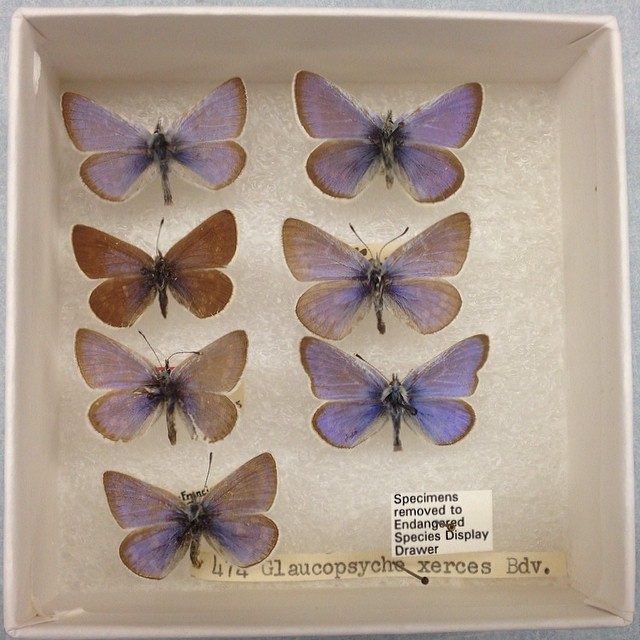 Xerces BlueGlaucopsyche xerces
-
 Silvery BlueGlaucopsyche lygdamus
- Black-eyed BlueGlaucopsyche melanops
-
 Paphos BlueGlaucopsyche paphos
-
 Arrowhead BlueGlaucopsyche piasus
-
 Anatolian Black-eyed BlueGlaucopsyche astraea
-
 Lycormas BlueGlaucopsyche lycormas
-
 Glaucopsyche argali
Compare
Questions and answers
What is the scientific name of the Green-underside Blue?
The scientific name of the Green-underside Blue is Glaucopsyche alexis. Written with its author, the full name is Glaucopsyche alexis (Poda, 1761).
Which family does the Green-underside Blue belong to?
Glaucopsyche alexis belongs to the family Lycaenidae, in the order Lepidoptera and the class Insecta.
Where is the Green-underside Blue found?
Checklists and occurrence records place Glaucopsyche alexis in 38 countries, including France, Sweden, Spain, Switzerland, Finland and Austria.
What is the conservation status of the Green-underside Blue?
The IUCN Red List category recorded for Glaucopsyche alexis is Least Concern (LC).
Sources
Passages the profile rests on
- Male butterflies have a light blue upper surface with a violet sheen and a narrow black border. Source passage: “Male above light cyaneous blue with a violet sheen and narrow black border” — English Wikipedia
- Female butterflies have a darker blue upper surface with a black border that gradually extends across nearly the outer half of the wings. Source passage: “female darker blue with the black border gradually shading off, so that it occupies nearly the whole outer half of the wings.” — English Wikipedia
- The underside of the male butterfly is silver-grey. Source passage: “Beneath silver-grey (male)” — English Wikipedia
- The forewing underside has five or six large, rounded black spots. Source passage: “the forewing with 5 or 6 large rounded black spots” — English Wikipedia
- The hindwing underside has small ocelli and metallic blue-green dusting across its basal half. Source passage: “the hindwing with small ocelli and in its whole basal half with metallic blue-green dusting.” — English Wikipedia
- The species inhabits xerophytic meadows along river valleys. Source passage: “xerophytic meadows along river valleys” — English Wikipedia
- The species occurs in dry woodlands and wastelands. Source passage: “dry woodlands and wastelands” — English Wikipedia
- The species inhabits glades and stony outcrops. Source passage: “glades, stony outcrops” — English Wikipedia
- The species occurs in sunny, dry meadows within pine forests. Source passage: “sunny dry meadows of pine forests” — English Wikipedia
- In the southern part of its range, the species inhabits chalk steppes and steppe gullies. Source passage: “In the south of the range, it inhabits chalk steppes, steppe gullies” — English Wikipedia
- In the Caucasus, the species occurs in subalpine tall-grass flowering meadows. Source passage: “In the Caucasus, it is found in subalpine tall grass flowering meadows.” — English Wikipedia
- The larval host plants include Cytisus. Source passage: “In June and the autumn on Cytisus, Genista, Astragalus, Melilotus, etc.” — English Wikipedia
- The larval host plants include Genista. Source passage: “In June and the autumn on Cytisus, Genista, Astragalus, Melilotus, etc.” — English Wikipedia
- The larval host plants include Astragalus. Source passage: “In June and the autumn on Cytisus, Genista, Astragalus, Melilotus, etc.” — English Wikipedia
- The larval host plants include Melilotus. Source passage: “In June and the autumn on Cytisus, Genista, Astragalus, Melilotus, etc.” — English Wikipedia
- Adult butterflies are generally observed singly. Source passage: “The butterflies occur singly” — English Wikipedia
- The species is mostly common where it occurs. Source passage: “but are mostly common” — English Wikipedia
- Adults fly along clearings in timber woods and wide roads. Source passage: “being found on clearings in timber-woods and on wide roads” — English Wikipedia
- Adults generally fly slowly and straight, with a flapping flight pattern, approximately one to two metres above the ground. Source passage: “flutter along usually 1 to 2 m above the ground, with a slow, straight, flapping flight.” — English Wikipedia
- The adult flight period extends from April to July, depending on location. Source passage: “The butterfly flies from April to July depending on the location” — English Wikipedia
- The larva may be green or brownish. Source passage: “Larva green or brownish” — English Wikipedia
- The larva has a reddish-brown dorsal line accompanied by closely spaced dark oblique parallel stripes. Source passage: “with reddish brown dorsal line accompanied by dark oblique parallel stripes which stand close together” — English Wikipedia
- North of the Alps, the species has one brood. Source passage: “North of the Alps, where occurs only one brood” — English Wikipedia
- North of the Alps, the larva probably overwinters. Source passage: “the larva probably hibernates.” — English Wikipedia
Data
- Catalogue of Life, 2026-10-16 XR cc by
- Global Biodiversity Information Facility CC BY 4.0
- Wikidata CC0
- GeoNames CC BY 4.0
- Wikimedia Commons per image; credit shown with each image
- Within the Catalogue of Life, this name comes from Global Lepidoptera Index cc by
References
- PODA N. 1761. - Insecta musei graecensis, Apud Joannem Baptistam Dietrich, Graecii: [i-vi], 1 - 127, [+ 12: Index], pls [1, 2]. where the name was published
This species in other databases
Page built on 26 November 2026. See how the catalog is made and all sources and licences.
Cite this page
ScientificNames.org. (2026). Glaucopsyche alexis (Green-underside Blue). Retrieved November 26, 2026, from https://scientificnames.org/species/glaucopsyche-alexis
“Glaucopsyche alexis (Green-underside Blue).” ScientificNames.org, 2026, scientificnames.org/species/glaucopsyche-alexis. Accessed 26 Nov. 2026.
ScientificNames.org. “Glaucopsyche alexis (Green-underside Blue).” Accessed November 26, 2026. https://scientificnames.org/species/glaucopsyche-alexis.
@misc{scientificnames_glaucopsyche_alexis_green_underside_blue,
  author = {{ScientificNames.org}},
  title = {Glaucopsyche alexis (Green-underside Blue)},
  year = {2026},
  url = {https://scientificnames.org/species/glaucopsyche-alexis},
  note = {Accessed 2026-11-26}
}