Species · Insects
Silvery Blue Glaucopsyche lygdamus
The scientific name of the Silvery Blue is Glaucopsyche lygdamus. It is a species of insect in the family Lycaenidae (blues), order Lepidoptera. The name dates from 1842.
- Scientific name
- Glaucopsyche lygdamus (Doubleday, 1842)
- Common name
- Silvery Blue
- Genus
- Glaucopsyche
- Family
- Lycaenidae (Blues)
- Order
- Lepidoptera
- Class
- Insecta
- Recorded in
- 3 countries
- Name status
- accepted in the Catalogue of Life

Overview
The species is native to North America and occurs across much of the western United States and most of Canada. It is distinguished by silvery-blue upper wing surfaces in males and rows of round black spots surrounded by white rings on the undersides of both wings.
Written 26 November 2026 from the sources listed below. Each statement was checked against the passage it cites; statements that could not be supported were removed.
Appearance
Male adults have iridescent silvery-blue upper wing surfaces with narrow dark borders. Female adults have darker blue upper wing surfaces with wide borders.[1][2]
Both wings have a row of round black spots surrounded by white rings on their undersides. The spots vary in size geographically.[3][4]
The wingspan ranges from 18 to 28 millimeters.[5]
Habitat
The species occurs in alpine meadows.[6]
In northeastern Alabama, it is associated with rich, moist deciduous woodlands, hardwood forest slopes, ravines, and rocky North Alabama woods.[7]
Diet
The species feeds on plants in the genus Lupinus. In the Alabama account, Carolina Vetch is identified as the primary host plant.[8][9]
Adult butterflies obtain nectar from Carolina Vetch flowers. Caterpillars feed on the buds and flowers of their host plant and occasionally consume its leaves.[10][11]
Use of Crown Vetch as a host plant has been suggested in some states but remains unconfirmed.[12]
Behaviour
Caterpillars are often attended by ants attracted to sugary secretions from specialized glands.[13]
Reproduction and life cycle
Females lay pale blue-green, disc-shaped eggs individually on host-plant buds or tender growth. In the Alabama account, females lay eggs on Carolina Vetch buds.[14][15]
The species has one annual flight in the Alabama account, coinciding with the spring flowering of its preferred host plant.[16]
The caterpillar is gray-green with a dark green dorsal stripe and white dashes. It may develop reddish coloration before pupation.[17][18]
The chrysalis is light brown with dark brown speckles and a bean-like shape. It is probably attached to debris at the bottom of the host plant.[19][20]
The chrysalis is the overwintering stage.[21]
Conservation
The species is considered rare or uncommon in Tennessee and North Carolina. It may be locally extirpated in Georgia.[22][23]
Appalachian Silvery Blue populations persist in highly localized colonies associated with Carolina Vetch. The reasons for the species' scarcity in the Alabama account remain unclear.[24][25]
Similar species
The Eastern Tailed-Blue and Western Tailed-Blue differ from the Silvery Blue by having small tails on their hindwings.[26][27]
The Greenish Blue and Boisduval's Blue have two rows of small black spots on the underside of both wings.[28][29]
Classification of the Silvery Blue
| Kingdom | Animalia |
|---|---|
| Phylum | Arthropoda |
| Subphylum | Hexapoda |
| Class | Insecta (Insect) |
| Order | Lepidoptera |
| Superfamily | Papilionoidea |
| Family | Lycaenidae (Blues) |
| Subfamily | Polyommatinae |
| Tribe | Polyommatini |
| Genus | Glaucopsyche |
| Species | Glaucopsyche lygdamus (Doubleday, 1842) |
Where the Silvery Blue is found
Checklists and occurrence records place Glaucopsyche lygdamus in 3 countries across North America. GBIF holds 37,280 georeferenced records of it.
Countries
Regions and cities with the most records
- Ontario, Canada 7,028
- California, United States 5,198
- British Columbia, Canada 4,061
- Alberta, Canada 3,658
- Vermont, United States 1,803
- Manitoba, Canada 1,600
- Quebec, Canada 1,585
- Alaska, United States 1,121
- Oregon, United States 957
- Washington, United States 851
- Colorado, United States 796
- New Brunswick, Canada 743
- St. Albert, Canada 635
- Yukon, Canada 612
- Saskatchewan, Canada 547
- Aylmer, Canada 502
- Willowdale, Canada 502
- Calgary, Canada 490
- Albany, United States 489
- Edmonton, Canada 486
- Nepean, Canada 469
- Ottawa, Canada 469
- Sherwood Park, Canada 455
- Gloucester, Canada 451
- Michigan, United States 451
- Nova Scotia, Canada 451
- Orinda, United States 451
- Ottawa South, Canada 451
- Kanata, Canada 444
- Oakland, United States 436
- Richmond, United States 427
- El Cerrito, United States 426
- Thornhill, Canada 410
- Idaho, United States 409
- Berkeley, United States 408
- Gatineau, Canada 396
1 more country has a few records outside this range
These countries hold a few records of Glaucopsyche lygdamus but lie outside the range the checklists give for it. Such records are often zoo or garden specimens, museum material or vagrants, so the species is not counted as occurring there.
Range as the checklists state it
North America
A number beside a place is its count of GBIF occurrence records. A place without a number comes from a checklist alone. Records show where a species has been observed or collected, which can include escapes and vagrants.
Common names
English
- Silvery Blue
- Arizona Silvery Blue
Names in 2 other languages
- French
- bleu argenté
- Japanese
- アメリカカバイロシジミ
Synonyms
3 other scientific names have been used for this species and are now treated as synonyms of Glaucopsyche lygdamus.
- Glaucopsyche arizonensis McDunnough, 1936
- Glaucopsyche lygdamus arizonensis McDunnough, 1936
- Polyommatus lygdamus Doubleday, 1842
Subspecies and varieties
- Glaucopsyche lygdamus boydi subspecies
- Glaucopsyche lygdamus columbia (Columbia Blue) subspecies
- Glaucopsyche lygdamus couperi (Silvery Blue) subspecies
- Glaucopsyche lygdamus deserticola (Mojave Silvery Blue) subspecies
- Glaucopsyche lygdamus incognitus (Behr's Silvery Blue) subspecies
- Glaucopsyche lygdamus jacki subspecies
- Glaucopsyche lygdamus leussleri subspecies
- Glaucopsyche lygdamus lygdamus (Georgian Silvery Blue) subspecies
- Glaucopsyche lygdamus medunnoughi subspecies
- Glaucopsyche lygdamus mildredae subspecies
- Glaucopsyche lygdamus minipunctum (Mini-spotted Silvery Blue) subspecies
- Glaucopsyche lygdamus nittanyensis (Appalachian Silvery Blue) subspecies
- Glaucopsyche lygdamus oro subspecies
- Glaucopsyche lygdamus palosverdesensis (Palos Verdes Blue Butterfly) subspecies
- Glaucopsyche lygdamus pseudoxerces subspecies
- Glaucopsyche lygdamus sabulosa subspecies
Related species
-
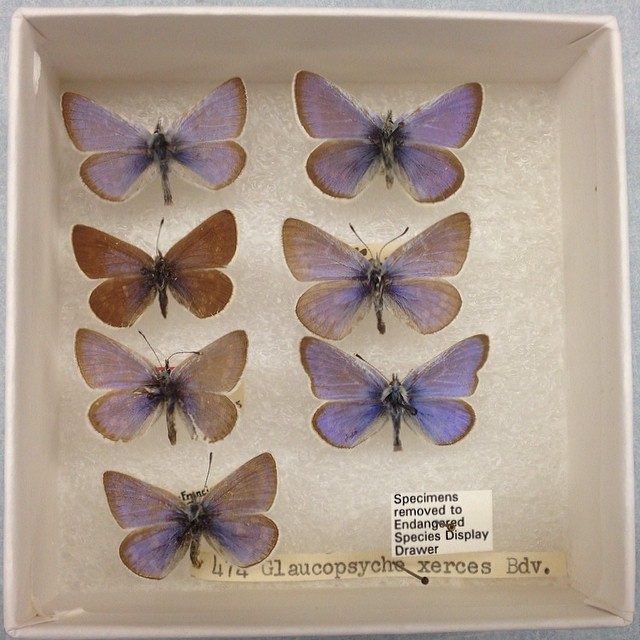 Xerces BlueGlaucopsyche xerces
-
 Green-underside BlueGlaucopsyche alexis
- Black-eyed BlueGlaucopsyche melanops
-
 Paphos BlueGlaucopsyche paphos
-
 Arrowhead BlueGlaucopsyche piasus
-
 Anatolian Black-eyed BlueGlaucopsyche astraea
-
 Lycormas BlueGlaucopsyche lycormas
-
 Glaucopsyche argali
Compare
Questions and answers
What is the scientific name of the Silvery Blue?
The scientific name of the Silvery Blue is Glaucopsyche lygdamus. Written with its author, the full name is Glaucopsyche lygdamus (Doubleday, 1842).
Which family does the Silvery Blue belong to?
Glaucopsyche lygdamus belongs to the family Lycaenidae, in the order Lepidoptera and the class Insecta.
Where is the Silvery Blue found?
Checklists and occurrence records place Glaucopsyche lygdamus in 3 countries: Canada, United States and Mexico.
What other names does the Silvery Blue have?
Glaucopsyche lygdamus is also known in English as Arizona Silvery Blue.
Sources
Passages the profile rests on
- Male adults have iridescent silvery-blue upper wing surfaces with narrow dark borders. Source passage: “Male iridescent silvery blue with narrow dark borders;” — alabama.butterflyatlas.usf.edu
- Female adults have darker blue upper wing surfaces with wide borders. Source passage: “female idarker blue with wide borders.” — alabama.butterflyatlas.usf.edu
- The underside of the wings is gray and has a single row of round spots that vary in size geographically. Source passage: “The underside is gray with a single row of round spots of differing sizes depending upon the region.” — English Wikipedia
- Both wings have a row of round black spots surrounded by white rings on their undersides. Source passage: “both wings with row of white-ringed, round black spots.” — alabama.butterflyatlas.usf.edu
- The wingspan ranges from 18 to 28 millimeters. Source passage: “Wingspan is from 18 to 28 mm.” — English Wikipedia
- The species occurs in alpine meadows. Source passage: “including alpine meadows,” — English Wikipedia
- In northeastern Alabama, the species is associated with rich, moist deciduous woodlands, hardwood forest slopes, ravines, and rocky North Alabama woods. Source passage: “Rich, moist deciduous woodlands, hardwood forest slopes and ravines, and rocky North Alabama woods.” — alabama.butterflyatlas.usf.edu
- The species feeds on plants in the genus Lupinus. Source passage: “It feeds on Lupinus plants.” — English Wikipedia
- Carolina Vetch is identified as the primary host plant in the Alabama account. Source passage: “Carolina Vetch (Vicia caroliniana) is the primary host plant.” — alabama.butterflyatlas.usf.edu
- Adult butterflies obtain nectar from Carolina Vetch flowers. Source passage: “Adults nectar on its flowers” — alabama.butterflyatlas.usf.edu
- Caterpillars feed on the buds and flowers of their host plant and occasionally consume its leaves. Source passage: “Caterpillars feed on buds, flowers, and occasionally leaves,” — alabama.butterflyatlas.usf.edu
- Use of Crown Vetch as a host plant has been suggested in some states but remains unconfirmed. Source passage: “Some states report possible use of Crown Vetch (Securigera varia) as a host, but its useage has not been confirmed.” — alabama.butterflyatlas.usf.edu
- Caterpillars are often attended by ants attracted to sugary secretions from specialized glands. Source passage: “are often attended by ants drawn to sugary secretions produced by specialized glands.” — alabama.butterflyatlas.usf.edu
- Females lay pale blue-green, disc-shaped eggs individually on host-plant buds or tender growth. Source passage: “Pale blue-green; disc shaped. Laid singly on buds or tender growth of host plant.” — alabama.butterflyatlas.usf.edu
- Adult females lay eggs on Carolina Vetch buds. Source passage: “and lay eggs on its buds.” — alabama.butterflyatlas.usf.edu
- The species has one annual flight in the Alabama account, coinciding with the spring flowering of its preferred host plant. Source passage: “Their single annual flight coincides with the spring bloom of preferred host plant,” — alabama.butterflyatlas.usf.edu
- The caterpillar is gray-green with a dark green dorsal stripe and white dashes. Source passage: “Gray green with dark green dorsal stripe and white dashes.” — alabama.butterflyatlas.usf.edu
- The caterpillar may develop reddish coloration before pupation. Source passage: “Reported to turn reddish prior to pupation.” — alabama.butterflyatlas.usf.edu
- The chrysalis is light brown with dark brown speckles and a bean-like shape. Source passage: “Light brown with dark brown speckles. Bean shaped.” — alabama.butterflyatlas.usf.edu
- The chrysalis is probably attached to debris at the bottom of the host plant. Source passage: “Probably attached to debris at the bottom of host plant.” — alabama.butterflyatlas.usf.edu
- The chrysalis is the overwintering stage. Source passage: “The overwintering stage.” — alabama.butterflyatlas.usf.edu
- The species is considered rare or uncommon in Tennessee and North Carolina. Source passage: “they are now regarded as rare or uncommon in Tennessee and North Carolina” — alabama.butterflyatlas.usf.edu
- The species may be locally extirpated in Georgia. Source passage: “and may be extirpated in Georgia.” — alabama.butterflyatlas.usf.edu
- The reasons for the species' scarcity in the Alabama account remain unclear. Source passage: “the reasons for their scarcity remain unclear.” — alabama.butterflyatlas.usf.edu
- Appalachian Silvery Blue populations persist in highly localized colonies associated with Carolina Vetch. Source passage: “For now, they persist only in highly localized colonies associated with Carolina Vetch” — alabama.butterflyatlas.usf.edu
- The Eastern Tailed-Blue differs from this species by having small tails on its hindwings. Source passage: “Eastern tailed-blue (Cupido comyntas) has small 'tails' on hindwings” — English Wikipedia
- The Western Tailed-Blue differs from this species by having small tails on its hindwings. Source passage: “Western tailed-blue (Cupido amyntula) has small 'tails' on hindwings” — English Wikipedia
- The Greenish Blue has two rows of small black spots on the underside of both wings. Source passage: “Greenish blue (Aricia saepiolus) has two rows of small black spots on the underside of both wings” — English Wikipedia
- Boisduval's Blue has two rows of small black spots on the underside of both wings. Source passage: “Boisduval's blue (Aricia icarioides) has two rows of small black spots on the underside of both wings” — English Wikipedia
Data
- Catalogue of Life, 2026-10-16 XR cc by
- Global Biodiversity Information Facility CC BY 4.0
- Wikidata CC0
- GeoNames CC BY 4.0
- Wikimedia Commons per image; credit shown with each image
- Within the Catalogue of Life, this name comes from Global Lepidoptera Index cc by
References
- Doubleday. (1841). Entomologist. 1. http://www.biodiversitylibrary.org/item/43668#page/220/mode/2up Link where the name was published
This species in other databases
Page built on 27 November 2026. See how the catalog is made and all sources and licences.
Cite this page
ScientificNames.org. (2026). Glaucopsyche lygdamus (Silvery Blue). Retrieved November 27, 2026, from https://scientificnames.org/species/glaucopsyche-lygdamus
“Glaucopsyche lygdamus (Silvery Blue).” ScientificNames.org, 2026, scientificnames.org/species/glaucopsyche-lygdamus. Accessed 27 Nov. 2026.
ScientificNames.org. “Glaucopsyche lygdamus (Silvery Blue).” Accessed November 27, 2026. https://scientificnames.org/species/glaucopsyche-lygdamus.
@misc{scientificnames_glaucopsyche_lygdamus_silvery_blue,
  author = {{ScientificNames.org}},
  title = {Glaucopsyche lygdamus (Silvery Blue)},
  year = {2026},
  url = {https://scientificnames.org/species/glaucopsyche-lygdamus},
  note = {Accessed 2026-11-27}
}