Species · Reptiles
Cat Ba Leopard Gecko Goniurosaurus catbaensis
The scientific name of the Cat Ba Leopard Gecko is Goniurosaurus catbaensis. It is a species of reptile in the family Eublepharidae (eublepharid geckos), order Squamata. The name dates from 2008.
- Scientific name
- Goniurosaurus catbaensis Ziegler, Truong, Schmitz, Stenke & Rösler, 2008
- Common name
- Cat Ba Leopard Gecko
- Genus
- Goniurosaurus
- Family
- Eublepharidae (Eublepharid Geckos)
- Order
- Squamata
- Class
- Reptilia
- Red List category
- EN Endangered
- Recorded in
- 1 country
- Name status
- accepted in the Catalogue of Life

Overview
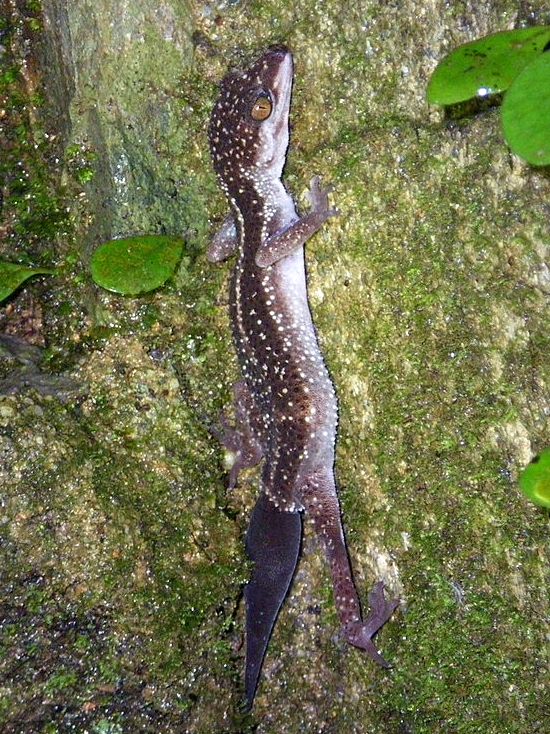
The Cat Ba Leopard Gecko (Goniurosaurus catbaensis) is a reptile in the family Eublepharidae, order Squamata, and class Reptilia. It occurs on Cát Bà Island and smaller islands in Ha Long Bay, Vietnam. It has a slender body, thin yellow body bands with dark borders, and thin white tail bands.
Written 26 November 2026 from the sources listed below. Each statement was checked against the passage it cites; statements that could not be supported were removed.
Appearance
The Cat Ba Leopard Gecko has a slender body and limbs, with three to four thin yellow bands between its arms and legs. The yellow bands have thin, dark-colored borders along their anterior and posterior edges.[1][2][3]
Its tail has four to five thin white bands, and its body base color ranges from dark brown to grey-brown. Its iris is orangeish-brown, and its nuchal loop is thin and extends posteriorly.[4][5][6][7]
Its axillary pockets are deeper than those of other geckos in its genus. Males and females do not show obvious differences in size or morphology.[8][9]
Juveniles have a snout-to-vent length below 85 mm, subadults measure between 85 and 105 mm, and adults measure greater than 105 mm.[10][11][12]
Habitat
The Cat Ba Leopard Gecko occupies limestone rocks, hills, cliffs, and caves. It occurs primarily in poor secondary forests on limestone hills and on forest floors near limestone cave entrances where forest vegetation is present.[13][14][15]
It has also been observed in bamboo forests on Cát Bà Island. It tends to occur within 10 m of a karst rock.[16][17]
Its preferred temperature range is 20.6–30.5°C, and its preferred humidity range is 67–90%.[18][19]
Behaviour
The Cat Ba Leopard Gecko is primarily nocturnal, with greatest activity from evening through late night. It is rarely observed during colder, dry months.[20][21][22]
Reproduction and life cycle
The Cat Ba Leopard Gecko is oviparous. Females are gravid between May and July.[23][24]
Conservation
The Cat Ba Leopard Gecko is listed as endangered by the IUCN. Its conservation status was last assessed in 2016, and observed populations have been small but recently reported as stable.[25][26][27]
Habitat fragmentation and destruction associated with tourism expansion in Vietnam threaten the species. Urbanization and agricultural destruction of karst rocks also negatively affect it.[28][29]
Poaching for traditional medicine has affected its population, and the species has been recorded in the international pet trade.[30][31]
The species is included in group 11B of Vietnam's Governmental Decree 06/2019/ND-CP. Vietnamese regulations prohibit collection and trade of listed species without permits.[32][33]
As of November 2018, IUCN Vietnam training programs intended to improve researcher monitoring skills and population protection were underway.[34]
Uses
The Cat Ba Leopard Gecko has been collected for use in traditional medicine.[35]
Similar species
Goniurosaurus luii is identified as a close relative found in continental northern Vietnam. Unlike Goniurosaurus luii, the Cat Ba Leopard Gecko lacks internasal scales.[36][37]
The top of its head has a dark marbling pattern, unlike the dark brown blotches described for Goniurosaurus luii.[38]
Classification of the Cat Ba Leopard Gecko
| Kingdom | Animalia |
|---|---|
| Phylum | Chordata |
| Subphylum | Vertebrata |
| Infraphylum | Gnathostomata |
| Parvphylum | Osteichthyes |
| Megaclass | Tetrapoda |
| Class | Reptilia (Reptile) |
| Order | Squamata (Snakes) |
| Suborder | Gekkota |
| Family | Eublepharidae (Eublepharid Geckos) |
| Genus | Goniurosaurus (East Asian Leopard Geckos) |
| Species | Goniurosaurus catbaensis Ziegler, Truong, Schmitz, Stenke & Rösler, 2008 |
Origin of the name. Etymology. The specific name refers to the type locality Cat Ba Island. The scientific name emphasizes the importance and uniqueness of the Biosphere Reserve Cat Ba Archipelago, Hai Phong, which also houses an endemic primate, the Cat Ba langur Trachypithecus p. poliocephalus (Roos et al. 2001). We propose the standard name " Cat Ba Leopard Gecko ". FIGURE 5. Goniurosaurus catbaensis sp. n. active at night in its habitat in the surroundings of Trung Trang Cave. Photograph by Thomas Ziegler. FIGURE 6. Snout tip of the holotype of Goniurosaurus catbaensis sp. n. (IEBR A. 0717) from Cat Ba Island, Hai Phong (left), and of G. luii (ZFMK 87057) from Cao Bang Province, continental Vietnam (right); contrary to the situation in G. luii, postrostral (internasal) scales are lacking in G. catbaensis sp. n. and the supranasals are in broad contact behind the rostral suture. Photograph by Thomas Ziegler. Comparisons. The new species most closely resembles G. l u i i, from which it consistently differs by lacking postrostral (internasal) scales and by having the supranasals meeting in midline behind the rostral suture (Fig. 6): Besides the G. l u i i listed in Table 2 we studied thirteen additional G. luii from continental China and Vietnam (i. e., another record from Cao Bang Province, Vietnam, and three specimens from China kept in the Cologne Zoo, as well as nine Chinese specimens from the private holdings of one of the authors [HR]), which all had the supranasals separated by at least one postrostral scale (see holotype description in Grismer et al. 1999: 383), whereas the type series and further records of G. catbaensis sp. n. (n = 7) consistently lacked a postrostral and thus had the supranasals in broad contact. Also the Chinese specimen depicted on page 159 in Seufer et al. (2005) shows the supranasals being separated by at least one postrostral scale. G. catbaensis sp. n. further differs from G. l u i i in having the outer surface of the upper eyelid composed of granular scales of about the same size of those on top of head (versus small granular scales one-half the size of those on top of head in G. luii, see Grismer et al. 1999: 383), including a longish row of ca. six to nine enlarged tubercles (which is lacking in G. luii). In addition, the type series of G. catbaensis sp. n. had fewer dorsal tubercles in the eighth caudal whorl compared with G. luii (one versus 3 - 6), fewer precloacal pores (5 - 21 versus 21 - 29 in G. luii), a lower number of nasal scales surrounding the nare (5.1 ± 0.4 versus 6.8 ± 0.8 in G. l u i i), fewer supra- and sublabial counts (8 - 9 and 6 - 8 versus 9 - 12 and 8 - 11 in G. l u i i), and a lower count of granular scales surrounding the dorsal tubercles (9.8 ± 1.3) versus 12.2 ± 1.3 in the type series of G. l u i i and versus 12.3 ± 1.3 in the four continental G. l u i i listed in Table 2. Concerning the colour pattern, it is most obvious that the nuchal loop is thinner and much more tapered backwards (v-shaped) in G. catbaensis sp. n. than it is the case in G. luii; furthermore, the dark head pattern rather consists of a dark marbling in G. catbaensis sp. n. instead of dark brown blotches in G. l u i i.
Where the Cat Ba Leopard Gecko is found
Checklists and occurrence records place Goniurosaurus catbaensis in 1 country across Asia. GBIF holds 46 georeferenced records of it.
Countries
Regions and cities with the most records
- Cát Bà, Vietnam 31
- Hạ Long, Vietnam 17
- Đố Sơn, Vietnam 15
- Hai Phong, Vietnam 5
- Cẩm Phả, Vietnam 3
- Cẩm Phả Mines, Vietnam 3
- Quảng Ninh, Vietnam 1
Range as the checklists state it
Vietnam (Cat Ba Island; Quang Ninh)
A number beside a place is its count of GBIF occurrence records. A place without a number comes from a checklist alone. Records show where a species has been observed or collected, which can include escapes and vagrants.
Common names
English
- Cat Ba Leopard Gecko
- Cat Ba Tiger Gecko
Names in 3 other languages
- Chinese
- 吉婆島瞼虎
- German
- Cat-Ba-Leopardgecko, Cat-Ba-Tigergecko
- Japanese
- カットバトカゲモドキ
Related species
-
 Chinese Cave GeckoGoniurosaurus hainanensis
-
 Kuroiwa's Ground GeckoGoniurosaurus kuroiwae
- Iheyajima Leopard GeckoGoniurosaurus toyamai
-
 Bawangling Leopard GeckoGoniurosaurus bawanglingensis
- Chinese Leopard GeckoGoniurosaurus luii
- Wu’s Cave GeckoGoniurosaurus wuzhengjuni
- Vietnamese Leopard GeckoGoniurosaurus araneus
-
 Spotted Ground GeckoGoniurosaurus orientalis
Compare
Questions and answers
What is the scientific name of the Cat Ba Leopard Gecko?
The scientific name of the Cat Ba Leopard Gecko is Goniurosaurus catbaensis. Written with its author, the full name is Goniurosaurus catbaensis Ziegler, Truong, Schmitz, Stenke & Rösler, 2008.
Which family does the Cat Ba Leopard Gecko belong to?
Goniurosaurus catbaensis belongs to the family Eublepharidae, in the order Squamata and the class Reptilia.
Where is the Cat Ba Leopard Gecko found?
Checklists and occurrence records place Goniurosaurus catbaensis in 1 country: Vietnam.
What is the conservation status of the Cat Ba Leopard Gecko?
The IUCN Red List category recorded for Goniurosaurus catbaensis is Endangered (EN).
What other names does the Cat Ba Leopard Gecko have?
Goniurosaurus catbaensis is also known in English as Cat Ba Tiger Gecko.
What is the rarest type of leopard gecko?
The Cat Ba Leopard Gecko is listed as endangered by the IUCN, and its observed populations have been small but recently reported as stable.[25][27]
What are some common names for leopard geckos?
The Cat Ba Leopard Gecko is also known as the Cat Ba Tiger Gecko.[39]
Sources
Passages the profile rests on
- The species has a slender body and limbs with thin yellow bands on its body and thin white bands on its tail. Source passage: “Their morphology consists of a thin body and limbs with thin, yellow bands on the body and thin, white bands on the tail.” — English Wikipedia
- The species has three to four thin yellow bands between its arms and legs. Source passage: “Goniurosaurus catbaensis is best described as having a gracile body and limbs with three to four thin, yellow bands located between the arms and the legs.” — English Wikipedia
- Its yellow body bands have thin, dark-colored borders along both their anterior and posterior edges. Source passage: “The thin, yellow bands are outlined both anteriorly and posteriorly with a thin, dark colored border.” — English Wikipedia
- Its tail has four to five thin white bands. Source passage: “There are four to five thin, white bands on the tail of the gecko” — English Wikipedia
- Its body base color ranges from dark brown to grey-brown. Source passage: “the base color of the gecko's body is between a dark brown to a grey brown.” — English Wikipedia
- Its iris is orangeish-brown. Source passage: “The iris color of G.catbaensis is an orangeish-brown” — English Wikipedia
- Its nuchal loop is thin and extends posteriorly. Source passage: “Its nuchal loop is posteriorly protracted and thin, compared to other geckos in its genus.” — English Wikipedia
- Its axillary pockets are deeper than those of other geckos in its genus. Source passage: “its axillary pockets are deeper.” — English Wikipedia
- Males and females do not show obvious differences in size or morphology. Source passage: “Male and female geckos do not exhibit sexual dimorphism as there is no obvious differences in size or morphology.” — English Wikipedia
- Juveniles have a snout-to-vent length below 85 mm. Source passage: “Juvenile geckos' snout to vent length is less than 85mm.” — English Wikipedia
- Subadults have a snout-to-vent length between 85 and 105 mm. Source passage: “Subadults, geckos who have passed the juvenile stage but are not fully developed to be considered within the adult stage, have a snout to vent length that ranges between 85mm and 105mm.” — English Wikipedia
- Adults have a snout-to-vent length greater than 105 mm. Source passage: “Adult geckos have a snout to vent length that is greater than 105mm.” — English Wikipedia
- The species occupies limestone rocks, hills, cliffs, and caves. Source passage: “Goniurosaurus catbaensis lives in the microhabitat of limestone rocks, hills, cliffs, and caves.” — English Wikipedia
- It occurs primarily in poor secondary forests on limestone hills. Source passage: “They can be found primarily in poor secondary forests, forests that are not fully developed after a disturbance, that are on limestone hills” — English Wikipedia
- It occurs on forest floors near entrances to limestone caves where forest vegetation is present. Source passage: “on the forest floor within entrances of limestone caves where forest vegetation is present.” — English Wikipedia
- The species has also been observed in bamboo forests on Cát Bà Island. Source passage: “They have also been spotted in bamboo forests on Cat Ba Island.” — English Wikipedia
- The species tends to occur within 10 m of a karst rock. Source passage: “Goniurosaurus catbaensis tends to be within 10m from a karst rock.” — English Wikipedia
- Its preferred temperature range is 20.6–30.5°C. Source passage: “They prefer temperatures between 20.6 -30.5°C” — English Wikipedia
- Its preferred humidity range is 67–90%. Source passage: “humidity levels between 67-90%” — English Wikipedia
- The species is primarily nocturnal. Source passage: “Goniurosaurus catbaensis is primarily nocturnal” — English Wikipedia
- Its activity is greatest from evening through late night. Source passage: “Goniurosaurus catbaensis is nocturnal with evening to late-night hours producing the most activity.” — English Wikipedia
- The species is rarely observed during colder, dry months. Source passage: “and are rarely observed in colder, dry months.” — English Wikipedia
- Females are gravid between May and July. Source passage: “Females are gravid, pregnant, between the months of May to July.” — English Wikipedia
- The species is oviparous. Source passage: “They are oviparous in terms of reproduction.” — English Wikipedia
- The species is listed as endangered by the IUCN. Source passage: “They are listed as endangered by the IUCN.” — English Wikipedia
- Its IUCN conservation status was last assessed in 2016. Source passage: “It was last assessed in 2016.” — English Wikipedia
- Observed populations have been small but recently reported as stable. Source passage: “Despite being small, recent data has found that the populations are stable and appear to be actively reproducing.” — English Wikipedia
- Habitat fragmentation and destruction associated with tourism expansion in Vietnam threaten the species. Source passage: “The habitat of Goniurosaurus catbaensis has also been fragmented and destroyed because of tourism expansion in Vietnam.” — English Wikipedia
- Urbanization and agricultural destruction of karst rocks negatively affect the species. Source passage: “Habitat destruction, for urbanization and agriculture, of karst rocks has impacted Goniurosaurus catbaensis negatively” — English Wikipedia
- Poaching for traditional medicine has affected the species' population. Source passage: “Because this species has been collected and used for traditional medicine, its population size has been subject to poaching.” — English Wikipedia
- The species has been recorded in the international pet trade. Source passage: “Since the 1990s, tiger geckos have been found in the international pet trade market, and the Cat Ba Tiger Gecko has been found there in recent years.” — English Wikipedia
- The species is included in group 11B of Vietnam's Governmental Decree 06/2019/ND-CP. Source passage: “Goniurosaurus catbaensis has been included in group 11B of the Governmental Decree 06/2019/ND-CP in Vietnam.” — English Wikipedia
- Vietnamese regulations prohibit collection and trade of the listed species without permits. Source passage: “This decree prohibits the collection and trade of the species listed if the person does not have permits in Vietnam.” — English Wikipedia
- IUCN Vietnam training programs intended to improve researcher monitoring skills and population protection were underway as of November 2018. Source passage: “As of November 2018, training programs held by the IUCN Vietnam have been occurring to help the monitoring skills of researchers and to better protect the populations of Goniurosarus catbaensis.” — English Wikipedia
- The species has been collected for use in traditional medicine. Source passage: “Because this species has been collected and used for traditional medicine” — English Wikipedia
- Goniurosaurus luii is identified as a close relative found in continental northern Vietnam. Source passage: “Goniurosaurus luii, found in continental, Northern Vietnam, is closely related to Goniurosaurus catbaensis.” — English Wikipedia
- Unlike Goniurosaurus luii, Goniurosaurus catbaensis lacks internasal scales. Source passage: “G.catbaensis lacks internasal scales” — English Wikipedia
- The top of its head has a dark marbling pattern, unlike the dark brown blotches described for Goniurosaurus luii. Source passage: “the top of its head has a dark marbling pattern compared to G.luii's dark brown blotches head pattern.” — English Wikipedia
- The species is also known as the Cat Ba tiger gecko. Source passage: “Goniurosaurus catbaensis, also known as the Cat Ba leopard gecko or Cat Ba tiger gecko is a gecko endemic to Cát Bà Island in Vietnam.” — inaturalist.org
Data
- Catalogue of Life, 2026-10-16 XR cc by
- Global Biodiversity Information Facility CC BY 4.0
- Wikidata CC0
- GeoNames CC BY 4.0
- Wikimedia Commons per image; credit shown with each image
- Within the Catalogue of Life, this name comes from The Reptile Database cc by
References
- A new species of Goniurosaurus from Cat Ba Island, Hai Phong, northern Vietnam (Squamata: Eublepharidae). (2008). Zootaxa, 1771, 16–30. https://doi.org/10.11646/zootaxa.1771.1.2 Link where the name was published
- Orlov, Nikolai L., Sergei A. Ryabov, Thien T. Nguyen, Quang T. Nguyen and Thu C. Ho. (2008). A new species of Goniurosaurus (Sauria: Gekkota: Eublepharidae) from north Vietnam. Russ. J. Herpetol. 15 (3):229-244.
- Ziegler, T.; Truong, N.Q.; Schmitz, A.; Stenke, R. & Rösler, H. (2008). A new species of Goniurosaurus from Cat Ba Island, Hai Phong, northern Vietnam (Squamata: Eublepharidae). Zootaxa 1771: 16–30.
- Nguyen, S.V., Ho, C.T. and Nguyen, T.Q. (2009). Herpetofauna of Vietnam. Chimaira, Frankfurt, 768 Pp.
- Wang, Y.-Y., & Jian-Huan Yang, a. R.-F. C. (2010). A NEW SPECIES OF GONIUROSAURUS (SQUAMATA: EUBLEPHARIDAE) FROM YINGDE, GUANGDONG PROVINCE, CHINA. Herpetologica 66 (2): 229.
- Ziegler, T. (2012). Erforschung und Erhalt der Artenvielfalt: Neue Wege des Kölner Zoos in Südostasien. Zeitschrift Des Kölner Zoos 55 (3): 111-.
- Wang, Ying-Yong; Jian-Huan Yang, and L. Lee Grismer. (2013). A New Species of Goniurosaurus (Squamata: Eublepharidae) from Libo, Guizhou Province, China. Herpetologica 69 (2): 214-226.
- Wang, Ying-Yong; Meng-Jie Jin, Yu-Long Li, and L. Lee Grismer. (2014). Description of a New Species of Goniurosaurus (Squamata: Eublepharidae) from the Guangdong Province, China, Based on Molecular and Morphological Data. Herpetologica 70 (3): 309-322.
- Chen, Tian-Bo; Yuan-Jun Meng, Ke Jiang,, Pi-Peng Li, Bo-Hao Wen, Wenhua Lu, James Lazell, and Mian Hou. (2014). New Record of the Leopard Gecko Goniurosaurus araneus (Squamata: Eublepharidae) for China and habitat partitioning between geographically and Phylogenetically Close Leopard Geckos. IRCF Reptiles & Amphibians 21 (1): 16–27.
- Ngo HN, Ziegler T, Nguyen TQ, Pham CT, Nguyen TT, Le MD, van Schingen M. (2016). First population assessment of two cryptic Tiger Geckos (Goniurosaurus) from northern Vietnam: Implications for conservation. Amphibian & Reptile Conservation 10(1) [General Section]: 34–45 (E120).
- Rösler, & Herbert. (2017). Gecko-Chorologie (Squamata: Gekkota). Gekkota (4): 1-160.
- Janssen J, Indenbaum RA,. (2018). Endemic Vietnamese Reptiles in Commercial Trade. Journal of Asia-Pacific Biodiversity.
- Ngo HN, Nguyen TQ, Phan TQ, van Schingen M, & Ziegler T. (2019). A case study on trade in threatened Tiger Geckos (Goniurosaurus) in Vietnam including updated information on the abundance of the Endangered G. catbaensis. Nature Conservation 33: 1–19.
- Ngo HN, Le TQ, Pham ML, Nguyen TQ, Le MD, van Schingen M, Ziegler T. (2019). First record of the Cat Ba Tiger Gecko, Goniurosaurus catbaensis, from Ha Long Bay, Quang Ninh Province, Vietnam: microhabitat selection, potential distribution, and evidence of threats. Amphibian & Reptile Conservation 13(2) [General Section]: 1–13 (E183).
- Ziegler, Thomas; & Truong Quang Nguyen. (2019). HERPETOLOGICAL RESEARCH AND CONSERVATION IN VIETNAM AND LAOS IN COMPLIANCE WITH THE ONE PLAN APPROACH. Proc. 4th Nat Sci Conf Amph Rept Vietnam 17-26.
- ZHU, XIAO-YU; GUANG-YU CHEN, CRISTIAN ROMÁN-PALACIOS, ZHENG LI, ZHU-QING HE. (2020). Goniurosaurus gezhi sp. nov., a new gecko species from Guangxi, China (Squamata: Eublepharidae). Zootaxa 4852 (2): 211–222. Link
- SY, LUAN MAI; VINH QUANG LUU, THONG PHAM VAN, CHIN KOLYAN, BENJAMIN LEPRINCE, PHONG BUI DANG, DANIELE DENDI & LUCA LUISELLI. (2021). Ecological notes on the Cát Bà gecko Goniurosaurus catbaensis, a species endemic to the limestone karst islands of northern Vietnam. The Herpetological Bulletin (157).
- ZHU, X. Y., LIU, Y. J., BAI, Y., ROMÁN-PALACIOS, C. R. I. S. T. I. A. N., LI, Z., & HE, Z. Q. (2021). Goniurosaurus chengzheng sp. nov., a new species of Leopard Gecko from Guangxi, China (Squamata: Eublepharidae). Zootaxa 4996 (3): 540-554.
- Grismer, L. L., Ngo, H. N., Qi, S., Wang, Y. Y., Le, M. D., & Ziegler, T. (2021). Phylogeny and evolution of habitat preference in Goniurosaurus (Squamata: Eublepharidae) and their correlation with karst and granite-stream-adapted ecomorphologies in species groups from Vietnam. Vertebrate Zoology, 71: 335-352.
- Poyarkov, Nikolay A.; Tan Van Nguyen, Evgeniy S. Popov,Peter Geissler, Parinya Pawangkhanant, Thy Neang, Chatmongkon Suwannapoom, Natalia B. Ananjeva, and Nikolai L. Orlov. (2023). RECENT PROGRESS IN TAXONOMIC STUDIES, BIOGEOGRAPHIC ANALYSIS, AND REVISED CHECKLIST OF REPTILES IN INDOCHINA. Russian Journal of Herpetology 30 (5): 255-576 (Also as Vol 28 (3A): 1 – 110 [2021]).
- Ngo, H. N., Rödder, D., Grismer, L., Nguyen, T. Q., Le, M. D., Qi, S., & Ziegler, T. (2023). Extraordinary diversity among allopatric species in the genus Goniurosaurus (Squamata: Eublepharidae): understanding niche evolution and the need of conservation measures. Biodiversity and Conservation, 1-23.
- Ziegler, & Thomas. (2025). Fokus „Artenschutz in Vietnam“ bei der „Zootier des Jahres“- Artenschutz-Kampagne 2024 – „Der Gecko. Elaphe 2025 (1): 20-35.
This species in other databases
Page built on 27 November 2026. See how the catalog is made and all sources and licences.
Cite this page
ScientificNames.org. (2026). Goniurosaurus catbaensis (Cat Ba Leopard Gecko). Retrieved November 27, 2026, from https://scientificnames.org/species/goniurosaurus-catbaensis
“Goniurosaurus catbaensis (Cat Ba Leopard Gecko).” ScientificNames.org, 2026, scientificnames.org/species/goniurosaurus-catbaensis. Accessed 27 Nov. 2026.
ScientificNames.org. “Goniurosaurus catbaensis (Cat Ba Leopard Gecko).” Accessed November 27, 2026. https://scientificnames.org/species/goniurosaurus-catbaensis.
@misc{scientificnames_goniurosaurus_catbaensis_cat_ba_leopard_gecko,
  author = {{ScientificNames.org}},
  title = {Goniurosaurus catbaensis (Cat Ba Leopard Gecko)},
  year = {2026},
  url = {https://scientificnames.org/species/goniurosaurus-catbaensis},
  note = {Accessed 2026-11-27}
}