Species · Reptiles
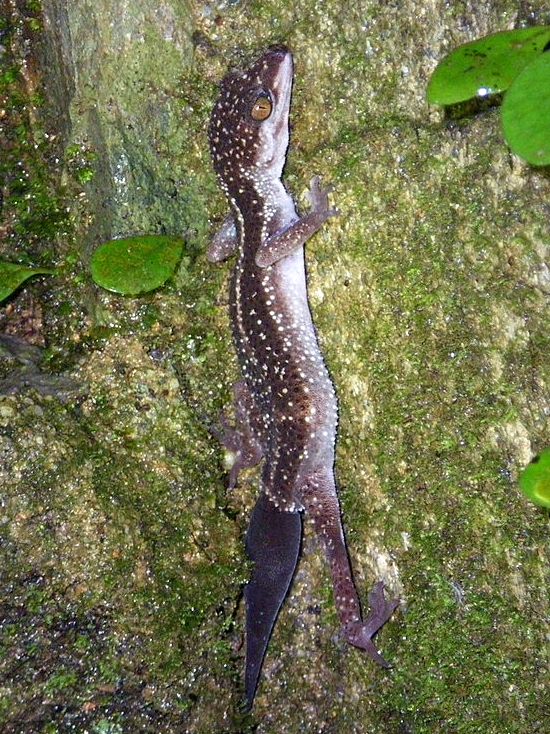
Kuroiwa's Ground Gecko Goniurosaurus kuroiwae
The scientific name of the Kuroiwa's Ground Gecko is Goniurosaurus kuroiwae. It is a species of reptile in the family Eublepharidae (eublepharid geckos), order Squamata. The name dates from 1912.
- Scientific name
- Goniurosaurus kuroiwae (Namiye, 1912)
- Common name
- Kuroiwa's Ground Gecko
- Genus
- Goniurosaurus
- Family
- Eublepharidae (Eublepharid Geckos)
- Order
- Squamata
- Class
- Reptilia
- Red List category
- VU Vulnerable
- Recorded in
- 1 country
- Name status
- accepted in the Catalogue of Life
Overview
The species is restricted to the Okinawa Islands in the Ryukyu Archipelago of Japan. The species commonly hosts the parasite Cryptosporidium serpentis, which can cause severe gastrointestinal problems.
Written 26 November 2026 from the sources listed below. Each statement was checked against the passage it cites; statements that could not be supported were removed.
Habitat
Kuroiwa's Ground Gecko inhabits subtropical forests in karst limestone areas at elevations below 450 metres.[1]
Diet
The species feeds on small invertebrates found in leaf litter.[2]
Behaviour
The species forages at night.[3]
Reproduction and life cycle
Kuroiwa's Ground Gecko is oviparous. Females lay clutches containing one or two eggs.[4][5]
An adult female can produce up to three clutches annually.[6]
Classification of the Kuroiwa's Ground Gecko
| Kingdom | Animalia |
|---|---|
| Phylum | Chordata |
| Subphylum | Vertebrata |
| Infraphylum | Gnathostomata |
| Parvphylum | Osteichthyes |
| Megaclass | Tetrapoda |
| Class | Reptilia (Reptile) |
| Order | Squamata (Snakes) |
| Suborder | Gekkota |
| Family | Eublepharidae (Eublepharid Geckos) |
| Genus | Goniurosaurus (East Asian Leopard Geckos) |
| Species | Goniurosaurus kuroiwae (Namiye, 1912) |
Where the Kuroiwa's Ground Gecko is found
Checklists and occurrence records place Goniurosaurus kuroiwae in 1 country across Asia. GBIF holds 289 georeferenced records of it.
Countries
Regions and cities with the most records
- Nago, Japan 52
- Chatan, Japan 42
- Okinawa, Japan 42
- Naha, Japan 40
- Nishihara, Japan 40
- Urasoe, Japan 40
- Ginowan, Japan 38
- Ishikawa, Japan 38
- Yomitan, Japan 38
- Nakagusuku, Japan 37
- Kishaba, Japan 36
- Tsuha, Japan 35
- Kanegusuku, Japan 34
- Okinawa, Japan 34
- Yonabaru, Japan 34
- Tomigusuku, Japan 33
- Katsuren-haebaru, Japan 29
- Uruma, Japan 28
- Nanjō, Japan 24
- Gushikawa, Japan 23
- Yaese, Japan 22
- Itoman, Japan 21
Range as the checklists state it
Japan (Okinawajima, Sesokojima, and Kourijima)
A number beside a place is its count of GBIF occurrence records. A place without a number comes from a checklist alone. Records show where a species has been observed or collected, which can include escapes and vagrants.
Common names
English
- Kuroiwa's Ground Gecko
- Kuroiwa's Eyelid Gecko
- Kuroiwa’s Leopard Gecko
- Okinawan Ground Gecko
- Ryuku Eyelid Gecko
- Ryukyu Eyelid Gecko
- Tokashiki Gecko
Names in 7 other languages
- Chinese
- 黑岩氏瞼虎
- Czech
- gekončík japonský
- German
- Japanischer Leopardgecko, Okinawa-Krallengecko
- Japanese
- クロイワトカゲモドキ
- Polish
- Powiekowiec riukański
- Portuguese
- Lagartixa-parda-de-Ryukyu
- Russian
- Японский эублефар
Synonyms
2 other scientific names have been used for this species and are now treated as synonyms of Goniurosaurus kuroiwae.
- Eublepharis kuroiwae (Namiye, 1912) — Wermuth, 1965
- Gymnodactylus albofasciatus kuroiwae Namiye, 1912
Related species
-
 Chinese Cave GeckoGoniurosaurus hainanensis
-
 Cat Ba Leopard GeckoGoniurosaurus catbaensis
- Iheyajima Leopard GeckoGoniurosaurus toyamai
-
 Bawangling Leopard GeckoGoniurosaurus bawanglingensis
- Chinese Leopard GeckoGoniurosaurus luii
- Wu’s Cave GeckoGoniurosaurus wuzhengjuni
- Vietnamese Leopard GeckoGoniurosaurus araneus
-
 Spotted Ground GeckoGoniurosaurus orientalis
Compare
Questions and answers
What is the scientific name of the Kuroiwa's Ground Gecko?
The scientific name of the Kuroiwa's Ground Gecko is Goniurosaurus kuroiwae. Written with its author, the full name is Goniurosaurus kuroiwae (Namiye, 1912).
Which family does the Kuroiwa's Ground Gecko belong to?
Goniurosaurus kuroiwae belongs to the family Eublepharidae, in the order Squamata and the class Reptilia.
Where is the Kuroiwa's Ground Gecko found?
Checklists and occurrence records place Goniurosaurus kuroiwae in 1 country: Japan.
What is the conservation status of the Kuroiwa's Ground Gecko?
The IUCN Red List category recorded for Goniurosaurus kuroiwae is Vulnerable (VU).
What other names does the Kuroiwa's Ground Gecko have?
Goniurosaurus kuroiwae is also known in English as Kuroiwa's Eyelid Gecko, Kuroiwa’s Leopard Gecko, Okinawan Ground Gecko, Ryuku Eyelid Gecko, Ryukyu Eyelid Gecko and Tokashiki Gecko.
What type of habitat do geckos live in?
Kuroiwa's Ground Gecko inhabits subtropical forests in karst limestone areas at elevations below 450 metres.[1]
What is the diet of a gecko?
Kuroiwa's Ground Gecko feeds on small invertebrates found in leaf litter.[2]
Sources
Passages the profile rests on
- The species inhabits subtropical forests in karst limestone areas at elevations below 450 metres. Source passage: “Kuroiwa's ground gecko occurs in subtropical forests in karst limestone areas at elevations below 450 m (1,480 ft).” — English Wikipedia
- The species feeds on small invertebrates found in leaf litter. Source passage: “G. kuroiwae forages on small invertebrates in leaf litter at night.” — English Wikipedia
- The species forages at night. Source passage: “G. kuroiwae forages on small invertebrates in leaf litter at night.” — English Wikipedia
- The species is oviparous. Source passage: “G. kuroiwae is oviparous.” — English Wikipedia
- Females lay clutches containing one or two eggs. Source passage: “Clutch size is one or two eggs” — English Wikipedia
- An adult female can produce up to three clutches annually. Source passage: “an adult female may lay as many as three clutches per year.” — English Wikipedia
Data
- Catalogue of Life, 2026-10-16 XR cc by
- Global Biodiversity Information Facility CC BY 4.0
- Wikidata CC0
- GeoNames CC BY 4.0
- Wikimedia Commons per image; credit shown with each image
- Within the Catalogue of Life, this name comes from The Reptile Database cc by
References
- Namiye, M. (1912). The geckos from the Okinawa Islands [in Japanese]. Dobutsugaku Zasshi (Zoological Magazine), Tokyo, 24:442-445.
- Maki, M. (1931). A new banded gecko, Eublepharis orientalis, Sp. Nov. from Riu Kyu. Annotaiones Zoologicae Japonenses, 13:9—11.
- Okada, Y. (1936). A new cave-gecko, Gymnodactylus yamashinae from Kumejima, Okinawa group. Proceedings of the Imperial Academy [of Japan], 12:53-54. Link
- Okada. (1958). Cat. Vertebr. Japan: 104.
- Nakamura, K., and S. I. Uéno. (1959). The geckos found in the limestone caves of the Ryu-Kyu Islands. Memoirs of the College of Science, University of Kyoto, 26:45-52.
- Börner, & ACHIM RÜDIGER. (1981). The genera of Asian eublepharine geckos and a hypothesis on their phylogeny. Miscellaneous Articles in Saurology 9: (1), 1-14 [Privately Printed], Cologne.
- Gericke, F. (1981). Lidgeckos der Gattung Eublepharis. Sauria 3 (4): 11-14.
- Tanaka, S. & M. Nishihira. (1987). A Field Study of Seasonal Daily, and Diel Activity Patterns of Eublepharis kuroiwae kuroiwae. Herpetologica 43 (4): 482-489.
- Ota, H., Matsui, M., Hikida, T., & Tanaka, S. (1987). Karyotype of a gekkonid lizard, Eublepharis kuroiwae kuroiwae. Cellular and Molecular Life Sciences 43(8):924-925.
- Grismer, & Lee, L. (1987). Evidence for the resurrection of Goniurosaurus Barbour (Reptilia: Eublepharidae) with a discussion on geographic variation in Goniurosaurus lichtenfelderi. Acta Herpetologica Sinica 6 (1): 43-47.
- Ota, & Hidetoshi. (1989). A review of the geckos (Lacertilia: Reptilia) of the Ryukyu Archipelago and Taiwan. In: Matsui et Al., Eds; Current Herpetology in East Asia: Proceedings of the Second Japan-China Herpetological Symposium Kyoto, July 1988: 222-261.
- Grismer L L. Ota H. Tanaka S. (1994). Phylogeny, classification, and biogeography of Goniurosaurus kuroiwae (Squamata: Eublepharidae) from the Ryukyu Archipelago, Japan, with description of a new subspecies. Zoological Science (TOKYO) 11 (2): 319-335.
- Rösler, & Herbert. (1995). Geckos der Welt - Alle Gattungen. Urania, Leipzig, 256 Pp.
- Grismer, L. L. (1997). Eublepharid Geckos - Living Relics of Gekkotan Evolution. Fauna 1 (1): 26-33.
- Ota, Hidetoshi; Honda, Masanoa; Kobayashi,Mari; Sengoku,Showichi & Hikida,Tsutomu. (1999). Phylogenetic relationships of eublepharid geckos (Reptilia: Squamata): a molecular approach. Zoological Science 16 (4): 659-666.
- Kaverkin, & Yuri. (1999). Tokage Modoki, Those Wonderful Geckos of the Ryuku Archipelago. Gekko 1 (1): 42-46.
- Ota, H. (2000). Current status of the threatened amphibians and reptiles of Japan. Popul. Ecol. 42: 5-9.
- Kaverkin, Y. (2000). Eublepharoide Geckos der Gattung Goniurosaurus BARBOUR, 1908 - Haltung und Zucht im Terrarium. Sauria 22 (4): 17-22.
- Grismer, & Lee, L. (2002). Goniurosaurus: Ancient Gekkos of the Far East. Gekko 3 (1): 22-28.
- Goris, R. C., & Maeda, N. (2004). Guide to the Amphibians and Reptiles of Japan. Krieger, Malabar, 285 Pp.
- Seufer, H.; Y. Kaverkin & A. Kirschner (eds.). (2005). Die Lidgeckos. Kirschner Und Seufer Verlag, 238 Pp.
- Ziegler, T.; Truong, N.Q.; Schmitz, A.; Stenke, R. & Rösler, H. (2008). A new species of Goniurosaurus from Cat Ba Island, Hai Phong, northern Vietnam (Squamata: Eublepharidae). Zootaxa 1771: 16–30.
- Wang, Y.-Y., & Jian-Huan Yang, a. R.-F. C. (2010). A NEW SPECIES OF GONIUROSAURUS (SQUAMATA: EUBLEPHARIDAE) FROM YINGDE, GUANGDONG PROVINCE, CHINA. Herpetologica 66 (2): 229.
- Beolens, B., & Michael Watkins, a. M. G. (2011). The Eponym Dictionary of Reptiles. Johns Hopkins University Press, Baltimore, USA.
- Wang, Ying-Yong; Jian-Huan Yang, and L. Lee Grismer. (2013). A New Species of Goniurosaurus (Squamata: Eublepharidae) from Libo, Guizhou Province, China. Herpetologica 69 (2): 214-226.
This species in other databases
Page built on 29 November 2026. See how the catalog is made and all sources and licences.
Cite this page
ScientificNames.org. (2026). Goniurosaurus kuroiwae (Kuroiwa's Ground Gecko). Retrieved November 29, 2026, from https://scientificnames.org/species/goniurosaurus-kuroiwae
“Goniurosaurus kuroiwae (Kuroiwa's Ground Gecko).” ScientificNames.org, 2026, scientificnames.org/species/goniurosaurus-kuroiwae. Accessed 29 Nov. 2026.
ScientificNames.org. “Goniurosaurus kuroiwae (Kuroiwa's Ground Gecko).” Accessed November 29, 2026. https://scientificnames.org/species/goniurosaurus-kuroiwae.
@misc{scientificnames_goniurosaurus_kuroiwae_kuroiwas_ground_gecko,
  author = {{ScientificNames.org}},
  title = {Goniurosaurus kuroiwae (Kuroiwa's Ground Gecko)},
  year = {2026},
  url = {https://scientificnames.org/species/goniurosaurus-kuroiwae},
  note = {Accessed 2026-11-29}
}