Species · Other invertebrates
Gurltia paralysans
Gurltia paralysans has no English name on record in the checklists used here. It is a species of animal in the family Metastrongylidae, order Rhabditida. The name dates from 1933.
- Scientific name
- Gurltia paralysans Wolffhügel, 1933
- Genus
- Gurltia
- Family
- Metastrongylidae
- Order
- Rhabditida
- Class
- Chromadorea
- Environment
- terrestrial
- Name status
- accepted in the Catalogue of Life
Overview
Adult specimens inhabit the subarachnoid space and meningeal veins of the spinal cord. The parasite causes chronic meningomyelitis in domestic cats and wild felids belonging to the genus Leopardus.
Written 27 November 2026 from the sources listed below. Each statement was checked against the passage it cites; statements that could not be supported were removed.
Appearance
Adult female nematodes measure 20–30 mm in length and approximately 0.1 mm in width. Adult males measure 12–15 mm in length and approximately 0.1 mm in width.[1][2]
Habitat
Adult nematodes occur particularly in the thoracic, lumbar, and sacral spinal cord segments of infected felids.[3]
The species' eggs and adults have been reported in the cerebrum, cerebellum, and anterior chamber of the eye.[4]
Behaviour
Adult nematodes exhibit angio-neurotropic migration toward spinal subarachnoid veins for mating.[5]
Reproduction and life cycle
The species' life cycle has not yet been fully established.[6]
An infected mollusk may act as an intermediate host in the species' hypothetical life cycle. Birds, amphibians, and reptiles are proposed as possible paratenic hosts.[7][8]
Infective third-stage larvae enter the digestive system's mucosal layer before migrating into the venous or lymphatic system.[9]
Classification of Gurltia paralysans
| Kingdom | Animalia |
|---|---|
| Phylum | Nematoda |
| Class | Chromadorea |
| Subclass | Chromadoria |
| Order | Rhabditida |
| Suborder | Rhabditina |
| Infraorder | Rhabditomorpha |
| Family | Metastrongylidae |
| Genus | Gurltia |
| Species | Gurltia paralysans Wolffhügel, 1933 |
This name was added to the Catalogue of Life from a contributing dataset by automated merging and has not yet been reviewed by its editors.
Where Gurltia paralysans is found
Range as the checklists state it
Los Ríos
A number beside a place is its count of GBIF occurrence records. A place without a number comes from a checklist alone. Records show where a species has been observed or collected, which can include escapes and vagrants.
Related species
-
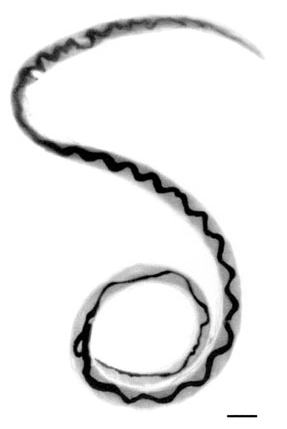 Rat LungwormAngiostrongylus cantonensis
-
 Angiostrongylus vasorum
- Skrjabingylus nasicola
- Aelurostrongylus abstrusus
- Muellerius capillaris
- Angiostrongylus costaricensis
- Crenosoma striatum
- Crenosoma vulpis
Compare
Questions and answers
Where has Gurltia paralysans been recorded?
The species has been recorded in Chile, Argentina, Uruguay, Colombia, and Brazil. It has also been reported in Tenerife in the Canary Islands, Spain, and in a sporadic case in the United States.[10][11][12]
What diseases does Gurltia paralysans cause?
The parasite causes chronic meningomyelitis in domestic cats and wild felids belonging to the genus Leopardus. Infection can cause severe thrombophlebitis and meningomyelitis.[13][14]
What are the signs of infection?
Infected felids may develop progressive hindlimb weakness, pelvic limb ataxia, tail paralysis, and urinary and fecal incontinence.[15]
How many species are currently reported in the genus Gurltia?
Gurltia paralysans is the only species currently reported in the genus Gurltia.[16]
What is the origin of the genus name Gurltia?
The genus name Gurltia derives from Ernst Friedrich Gurlt, a German veterinarian and anatomist who lived from 1794 to 1882.[17]
Sources
Passages the profile rests on
- Adult females measure 20–30 mm in length and approximately 0.1 mm in width. Source passage: “female 20–30 mm × 0.1 mm” — pmc.ncbi.nlm.nih.gov
- Adult males measure 12–15 mm in length and approximately 0.1 mm in width. Source passage: “males 12–15 mm × 0.1 mm” — pmc.ncbi.nlm.nih.gov
- Adult nematodes occur particularly in the thoracic, lumbar, and sacral spinal cord segments of infected felids. Source passage: “reside in the subarachnoid space, specifically in the thoracic, lumbar and sacral spinal cord segments of affected wild or domestic cats” — pmc.ncbi.nlm.nih.gov
- The species' eggs and adults have been reported in the cerebrum, cerebellum, and anterior chamber of the eye. Source passage: “the presence of G. paralysans eggs and adults in remote anatomic sites, such as the cerebrum, cerebellum and, in more recent reports, in the anterior chamber of the eye” — pmc.ncbi.nlm.nih.gov
- Adult nematodes exhibit angio-neurotropic migration toward spinal subarachnoid veins for mating. Source passage: “adult nematodes migrating to the veins of spinal subarchnoid space for mating purposes” — pmc.ncbi.nlm.nih.gov
- The species' life cycle has not yet been fully established. Source passage: “The life cycle of G. paralysans is still not fully understood” — pmc.ncbi.nlm.nih.gov
- An infected mollusk may act as an intermediate host in the species' hypothetical life cycle. Source passage: “hypothetically either an infected-mollusk intermediate host (IH)” — pmc.ncbi.nlm.nih.gov
- Birds, amphibians, and reptiles are proposed as possible paratenic hosts. Source passage: “or an infected-bird, −amphibian and/or –reptile, acting as paratenic host (PH)” — pmc.ncbi.nlm.nih.gov
- Infective third-stage larvae enter the digestive system's mucosal layer before migrating into the venous or lymphatic system. Source passage: “The infective third-stage larvae (L3) migrate through the mucosal layer of the digestive system to the venous or lymphatic system of the abdominal viscera” — pmc.ncbi.nlm.nih.gov
- The species has been recorded in Chile, Argentina, Uruguay, Colombia, and Brazil. Source passage: “The geographic range of G. paralysans encompasses rural and peri-urban regions of Chile, Argentina, Uruguay, Colombia and Brazil.” — pmc.ncbi.nlm.nih.gov
- The species has also been reported in Tenerife in the Canary Islands, Spain. Source passage: “Recently, there have been reports of the first case outside of South America in Tenerife (Canary Islands, Spain)” — pmc.ncbi.nlm.nih.gov
- A sporadic case has also been reported in the United States. Source passage: “and a sporadic anecdotal case in USA previously (14).” — pmc.ncbi.nlm.nih.gov
- The parasite causes chronic meningomyelitis in domestic cats and wild felids belonging to the genus Leopardus. Source passage: “The nematode Gurltia paralysans is a neglected angio-neurotropic parasite causing chronic meningomyelitis in domestic cats (Felis catus) as well as wild felids of the genus Leopardus in South America.” — pmc.ncbi.nlm.nih.gov
- Infection with this parasite can cause severe thrombophlebitis and meningomyelitis in affected felids. Source passage: “G. paralysans nematode still represents an important etiology of severe thrombophlebitis and meningomyelitis” — pmc.ncbi.nlm.nih.gov
- Infected felids may develop progressive hindlimb weakness, pelvic limb ataxia, tail paralysis, and urinary and fecal incontinence. Source passage: “G. paralysans-induced meningomyelitis causes symptoms of progressive hindlimb weakness, pelvic limb ataxia, tail paralysis, urinary, and fecal incontinence (2–5).” — pmc.ncbi.nlm.nih.gov
- Gurltia paralysans is the only species currently reported in the genus Gurltia. Source passage: “the only member so far reported for the genus Gurltia” — pmc.ncbi.nlm.nih.gov
- The genus name Gurltia derives from Ernst Friedrich Gurlt, a German veterinarian and anatomist who lived from 1794 to 1882. Source passage: “The genus name comes from Ernst Friedrich Gurlt (1794–1882), a German veterinarian and anatomist.” — English Wikipedia
Data
- Catalogue of Life, 2026-10-16 XR cc by
- Wikidata CC0
- Within the Catalogue of Life, this name comes from World Register of Marine Species cc by
References
- Muñoz, P.; Hirzmann, J.; Rodriguez, E.; Moroni, M.; Taubert, A.; Gibbons, L.; Hermosilla, C.; Gómez, M. (2017). Redescription and first molecular characterization of the little known feline neurotropic nematode Gurltia paralysans (Nematoda: Metastrongyloidea). Veterinary Parasitology: Regional Studies and Reports. 10: 119-125.
This species in other databases
Page built on 28 November 2026. See how the catalog is made and all sources and licences.
Cite this page
ScientificNames.org. (2026). Gurltia paralysans. Retrieved November 28, 2026, from https://scientificnames.org/species/gurltia-paralysans
“Gurltia paralysans.” ScientificNames.org, 2026, scientificnames.org/species/gurltia-paralysans. Accessed 28 Nov. 2026.
ScientificNames.org. “Gurltia paralysans.” Accessed November 28, 2026. https://scientificnames.org/species/gurltia-paralysans.
@misc{scientificnames_gurltia_paralysans,
  author = {{ScientificNames.org}},
  title = {Gurltia paralysans},
  year = {2026},
  url = {https://scientificnames.org/species/gurltia-paralysans},
  note = {Accessed 2026-11-28}
}