Species · Flowering plants
Sweet Rein Orchid Habenaria halata
The scientific name of the Sweet Rein Orchid is Habenaria halata. It is a species of flowering plant in the family Orchidaceae (orchid), order Asparagales.
- Scientific name
- Habenaria halata D.L.Jones
- Common name
- Sweet Rein Orchid
- Genus
- Habenaria
- Family
- Orchidaceae (Orchid)
- Order
- Asparagales
- Class
- Liliopsida
- Recorded in
- 1 country
- Name status
- accepted in the Catalogue of Life
Overview
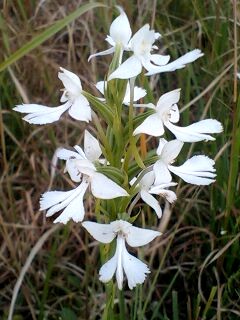
The sweet rein orchid (Habenaria halata) is a tuberous, perennial herb. It produces seven to eighteen white, sweet-smelling flowers with a three-lobed labellum.
Written 27 November 2026 from the sources listed below. Each statement was checked against the passage it cites; statements that could not be supported were removed.
Appearance
The sweet rein orchid is a tuberous, perennial herb with two or three upright, dark green leaves at its base. The basal leaves measure 40–70 mm long and 5–8 mm wide.[1][2][3]
The plant produces between seven and eighteen white, sweet-smelling flowers. Each flower measures 10–12 mm in length and width, and the flowering stem measures 300–500 mm in height.[4][5][6]
The dorsal sepal overlaps the base of the petals to form a hood over the column. It measures approximately 4 mm long and 3 mm wide, while the lateral sepals measure approximately 5 mm long and 3 mm wide and spread widely apart from each other.[7][8][9][10]
The petals measure approximately 5 mm long and 2.5 mm wide. The labellum is trident-shaped, with three lobes, and measures approximately 6 mm long and 9–11 mm wide.[11][12][13]
The labellum's side lobes are widely separated and have upturned tips. They measure approximately 5 mm long and 1 mm wide, while the middle lobe is shorter and wider than the side lobes.[14][15][16]
The nectary spur measures 8–9 mm in length and has a broad base.[17]
Reproduction and life cycle
The sweet rein orchid flowers from December to February.[18]
Classification of the Sweet Rein Orchid
| Kingdom | Plantae |
|---|---|
| Subkingdom | Pteridobiotina |
| Phylum | Tracheophyta |
| Class | Liliopsida |
| Order | Asparagales |
| Family | Orchidaceae (Orchid) |
| Genus | Habenaria (Bog Orchids) |
| Species | Habenaria halata D.L.Jones |
Where the Sweet Rein Orchid is found
Checklists and occurrence records place Habenaria halata in 1 country across Oceania. GBIF holds 6 georeferenced records of it.
Countries
Regions and cities with the most records
1 more country has a few records outside this range
These countries hold a few records of Habenaria halata but lie outside the range the checklists give for it. Such records are often zoo or garden specimens, museum material or vagrants, so the species is not counted as occurring there.
A number beside a place is its count of GBIF occurrence records. A place without a number comes from a checklist alone. Records show where a species has been observed or collected, which can include escapes and vagrants.
Common names
English
- Sweet Rein Orchid
Synonyms
One other scientific name has been used for this species and is now treated as a synonym of Habenaria halata.
- Pecteilis halata (D.L.Jones) D.L.Jones
Related species
-
 Water OrchidHabenaria repens
-
 Phantom OrchidHabenaria dentata
-
 Longhorn Bog OrchidHabenaria quinqueseta
-
 Toothpetal False ReinorchidHabenaria floribunda
-
 Plantain OrchidHabenaria plantaginea
-
 Red-Lipped HabenariaHabenaria rhodocheila
-
 Canary Three-finger OrchidHabenaria tridactylites
-
 Sickle OrchidHabenaria ochroleuca
Compare
Questions and answers
What is the scientific name of the Sweet Rein Orchid?
The scientific name of the Sweet Rein Orchid is Habenaria halata. Written with its author, the full name is Habenaria halata D.L.Jones.
Which family does the Sweet Rein Orchid belong to?
Habenaria halata belongs to the family Orchidaceae, in the order Asparagales and the class Liliopsida.
Where is the Sweet Rein Orchid found?
Checklists and occurrence records place Habenaria halata in 1 country: Australia.
Sources
Passages the profile rests on
- Habenaria halata is a tuberous, perennial herb. Source passage: “Habenaria halata is a tuberous, perennial herb” — English Wikipedia
- The plant has two or three upright, dark green leaves at its base. Source passage: “two or three upright, dark green leaves at its base” — English Wikipedia
- Its basal leaves measure 40–70 mm in length and 5–8 mm in width. Source passage: “the leaves 40–70 mm (2–3 in) long and 5–8 mm (0.2–0.3 in) wide.” — English Wikipedia
- The plant produces between seven and eighteen white, sweet-smelling flowers. Source passage: “Between seven and eighteen white, sweet-smelling flowers” — English Wikipedia
- Its flowers measure 10–12 mm in length and width. Source passage: “10–12 mm (0.4–0.5 in) long and wide” — English Wikipedia
- The flowering stem measures 300–500 mm in height. Source passage: “borne on a flowering stem 300–500 mm (10–20 in) tall.” — English Wikipedia
- The dorsal sepal overlaps the base of the petals to form a hood over the column. Source passage: “overlapping with the base of the petals to form a hood over the column.” — English Wikipedia
- The dorsal sepal measures approximately 4 mm long and 3 mm wide. Source passage: “The dorsal sepal is about 4 mm (0.16 in) long and 3 mm (0.1 in) wide” — English Wikipedia
- The lateral sepals measure approximately 5 mm long and 3 mm wide. Source passage: “The lateral sepals are about 5 mm (0.20 in) long, 3 mm (0.1 in) wide” — English Wikipedia
- The lateral sepals spread widely apart from each other. Source passage: “spread widely apart from each other.” — English Wikipedia
- The petals measure approximately 5 mm long and 2.5 mm wide. Source passage: “The petals are about 5 mm (0.2 in) long and 2.5 mm (0.1 in) wide.” — English Wikipedia
- The labellum is trident-shaped and has three lobes. Source passage: “The labellum is shaped like a trident, about 6 mm (0.2 in) long, 9–11 mm (0.35–0.43 in) wide with three lobes.” — English Wikipedia
- The labellum measures approximately 6 mm long and 9–11 mm wide. Source passage: “about 6 mm (0.2 in) long, 9–11 mm (0.35–0.43 in) wide” — English Wikipedia
- The labellum's side lobes are widely separated and have upturned tips. Source passage: “spread widely apart from each other with an upturned tip” — English Wikipedia
- The labellum's side lobes measure approximately 5 mm long and 1 mm wide. Source passage: “The side lobes are about 5 mm (0.2 in) long and 1 mm (0.04 in)” — English Wikipedia
- The middle lobe of the labellum is shorter and wider than the side lobes. Source passage: “the middle lobe is shorter but wider.” — English Wikipedia
- The nectary spur measures 8–9 mm in length and has a broad base. Source passage: “The nectary spur is 8–9 mm (0.3–0.4 in) long with a broad base.” — English Wikipedia
- The species flowers from December to February. Source passage: “Flowering occurs from December to February.” — English Wikipedia
Data
- Catalogue of Life, 2026-10-16 XR cc by
- Global Biodiversity Information Facility CC BY 4.0
- Wikidata CC0
- GeoNames CC BY 4.0
- Within the Catalogue of Life, this name comes from The World Checklist of Vascular Plants (WCVP) cc by
References
- Orchadian 13: 518 (2002) where the name was published
This species in other databases
Page built on 29 November 2026. See how the catalog is made and all sources and licences.
Cite this page
ScientificNames.org. (2026). Habenaria halata (Sweet Rein Orchid). Retrieved November 29, 2026, from https://scientificnames.org/species/habenaria-halata
“Habenaria halata (Sweet Rein Orchid).” ScientificNames.org, 2026, scientificnames.org/species/habenaria-halata. Accessed 29 Nov. 2026.
ScientificNames.org. “Habenaria halata (Sweet Rein Orchid).” Accessed November 29, 2026. https://scientificnames.org/species/habenaria-halata.
@misc{scientificnames_habenaria_halata_sweet_rein_orchid,
  author = {{ScientificNames.org}},
  title = {Habenaria halata (Sweet Rein Orchid)},
  year = {2026},
  url = {https://scientificnames.org/species/habenaria-halata},
  note = {Accessed 2026-11-29}
}