Species · Amphibians
Clay Robber Frog Haddadus binotatus
The scientific name of the Clay Robber Frog is Haddadus binotatus. It is a species of amphibian in the family Craugastoridae (robber frogs), order Anura. The name dates from 1824.
- Scientific name
- Haddadus binotatus (Spix, 1824)
- Common name
- Clay Robber Frog
- Genus
- Haddadus
- Family
- Craugastoridae (Robber Frogs)
- Order
- Anura
- Class
- Amphibia
- Red List category
- LC Least Concern
- Recorded in
- 1 country
- Name status
- accepted in the Catalogue of Life

Overview
The Clay Robber Frog is an amphibian in the family Craugastoridae. The species is endemic to Brazil's Atlantic Forest. Females are larger than males and reach a snout–vent length of 64 mm.
Written 27 November 2026 from the sources listed below. Each statement was checked against the passage it cites; statements that could not be supported were removed.
Habitat
The species inhabits primary and secondary forests as well as forest edges. It is commonly found in leaf litter on the forest floor.[1][2]
The species also occurs on leaves in low vegetation within forests.[3]
Appearance
Females are larger than males and reach a snout–vent length of 64 mm.[4][5]
Reproduction and life cycle
The species undergoes direct development.[6]
The larger size of females may be associated with their production of larger eggs.[4][7]
Behaviour
The species is described as very common and as the most abundant species in its community.[8][9]
Classification of the Clay Robber Frog
| Kingdom | Animalia |
|---|---|
| Phylum | Chordata |
| Subphylum | Vertebrata |
| Infraphylum | Gnathostomata |
| Parvphylum | Osteichthyes |
| Megaclass | Tetrapoda |
| Class | Amphibia (Amphibians) |
| Order | Anura (Frogs) |
| Superfamily | Brachycephaloidea |
| Family | Craugastoridae (Robber Frogs) |
| Genus | Haddadus (Robber Frogs) |
| Species | Haddadus binotatus (Spix, 1824) |
Where the Clay Robber Frog is found
Checklists and occurrence records place Haddadus binotatus in 1 country. GBIF holds 4,530 georeferenced records of it.
Countries
Regions and cities with the most records
- Rio de Janeiro, Brazil 1,022
- Espírito Santo, Brazil 685
- São Paulo, Brazil 672
- Rio de Janeiro, Brazil 327
- Santa Teresa, Brazil 327
- Estácio, Brazil 325
- Santa Teresa, Brazil 320
- Acari, Brazil 317
- Cordovil, Brazil 315
- Duque de Caxias, Brazil 308
- Freguesia, Brazil 305
- Botafogo, Brazil 300
- Catete, Brazil 300
- Ipanema, Brazil 299
- Leblon, Brazil 292
- Niterói, Brazil 292
- Rocinha, Brazil 292
- Vidigal, Brazil 292
- Barra da Tijuca, Brazil 284
- Minas Gerais, Brazil 276
- São Gonçalo, Brazil 266
- Santa Maria de Jetibá, Brazil 204
- Bahia, Brazil 184
- Macaé, Brazil 130
- Fundão, Brazil 129
- Arujá, Brazil 127
- Santa Catarina, Brazil 125
- Santa Isabel, Brazil 111
- Viana, Brazil 86
- Itaquaquecetuba, Brazil 81
- Cariacica, Brazil 78
- Nazaré Paulista, Brazil 78
- Vitória, Brazil 70
- São Caetano do Sul, Brazil 67
- São Paulo, Brazil 66
- Diadema, Brazil 65
A number beside a place is its count of GBIF occurrence records. A place without a number comes from a checklist alone. Records show where a species has been observed or collected, which can include escapes and vagrants.
Common names
English
- Clay Robber Frog
Names in 2 other languages
- Portuguese
- Rã-da-mata
- Russian
- Бразильская листовая лягушка
Synonyms
11 other scientific names have been used for this species and are now treated as synonyms of Haddadus binotatus.
- Eleutherodactylus abbreviatus (Spix, 1824)
- Eleutherodactylus binotatus (Spix, 1824)
- Eleutherodactylus cinotatus (Spix, 1824)
- Enydrobius abbreviatus (Spix, 1824)
- Hyla abbreviata Spix, 1824
- Hylodes abbreviatus (Spix, 1824)
- Hylodes binotatus (Spix, 1824)
- Hylodes rugulosus Peters, 1870
- Ololygon abbreviatus (Spix, 1824)
- Platymantes abbreviata (Spix, 1824)
- Rana binotata Spix, 1824
Related species
- Iguarasse Robber FrogHaddadus plicifer
-
 Mucugê Robber FrogHaddadus aramunha
-
 Barking FrogCraugastor augusti
- Craugastor myllomyllon
- Corquin Robber FrogCraugastor anciano
-
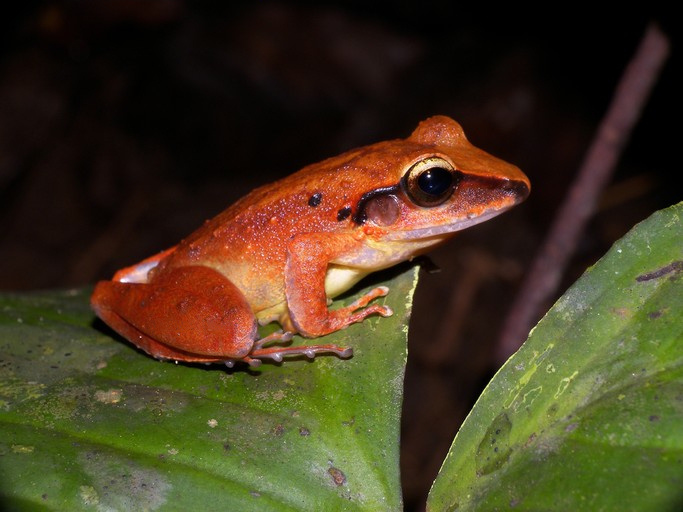 Fitzinger's Robber FrogCraugastor fitzingeri
-
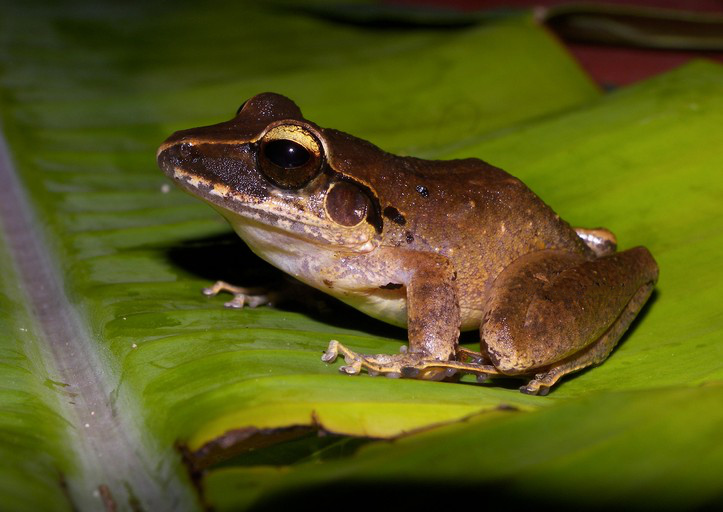 Robber FrogCraugastor raniformis
- McCranie's Robber FrogCraugastor chrysozetetes
Compare
Questions and answers
What is the scientific name of the Clay Robber Frog?
The scientific name of the Clay Robber Frog is Haddadus binotatus. Written with its author, the full name is Haddadus binotatus (Spix, 1824).
Which family does the Clay Robber Frog belong to?
Haddadus binotatus belongs to the family Craugastoridae, in the order Anura and the class Amphibia.
Where is the Clay Robber Frog found?
Checklists and occurrence records place Haddadus binotatus in 1 country: Brazil.
What is the conservation status of the Clay Robber Frog?
The IUCN Red List category recorded for Haddadus binotatus is Least Concern (LC).
Sources
Passages the profile rests on
- The species inhabits both primary and secondary forests as well as forest edges. Source passage: “It inhabits primary and secondary forest and forest edges.” — English Wikipedia
- The species is commonly found in leaf litter on the forest floor. Source passage: “It is usually found in the leaf-litter on the forest floor” — English Wikipedia
- The species also occurs on leaves in low vegetation within forests. Source passage: “or on leaves in low vegetation inside the forest.” — English Wikipedia
- Females are larger than males. Source passage: “The female of the species were larger than the males” — English Wikipedia
- Females reach a snout–vent length of 64 mm. Source passage: “Female frogs reach 64 mm (2.5 in) snout–vent length.” — English Wikipedia
- The species undergoes direct development. Source passage: “Haddadus binotatus is a direct-developing frog” — English Wikipedia
- The larger size of females may be associated with their production of larger eggs. Source passage: “which may result from the production of larger eggs.” — English Wikipedia
- The species is described as very common. Source passage: “Haddadus binotatus is a very common frog.” — English Wikipedia
- The species is described as the most abundant species in its community. Source passage: “and the most abundant species in the community.” — English Wikipedia
Data
- Catalogue of Life, 2026-10-16 XR cc by
- Global Biodiversity Information Facility CC BY 4.0
- Wikidata CC0
- GeoNames CC BY 4.0
- Wikimedia Commons per image; credit shown with each image
- Within the Catalogue of Life, this name comes from The Integrated Taxonomic Information System cc0
This species in other databases
Page built on 27 November 2026. See how the catalog is made and all sources and licences.
Cite this page
ScientificNames.org. (2026). Haddadus binotatus (Clay Robber Frog). Retrieved November 27, 2026, from https://scientificnames.org/species/haddadus-binotatus
“Haddadus binotatus (Clay Robber Frog).” ScientificNames.org, 2026, scientificnames.org/species/haddadus-binotatus. Accessed 27 Nov. 2026.
ScientificNames.org. “Haddadus binotatus (Clay Robber Frog).” Accessed November 27, 2026. https://scientificnames.org/species/haddadus-binotatus.
@misc{scientificnames_haddadus_binotatus_clay_robber_frog,
  author = {{ScientificNames.org}},
  title = {Haddadus binotatus (Clay Robber Frog)},
  year = {2026},
  url = {https://scientificnames.org/species/haddadus-binotatus},
  note = {Accessed 2026-11-27}
}