Species · Flowering plants
Halopegia azurea
Halopegia azurea has no English name on record in the checklists used here. It is a species of flowering plant in the family Marantaceae (arrowroots), order Zingiberales.
- Scientific name
- Halopegia azurea (K.Schum.) K.Schum.
- Genus
- Halopegia
- Family
- Marantaceae (Arrowroots)
- Order
- Zingiberales
- Class
- Liliopsida
- Recorded in
- 13 countries
- Name status
- accepted in the Catalogue of Life
Overview
Wikidata describes Halopegia azurea as “species of plant”.
Classification of Halopegia azurea
| Kingdom | Plantae |
|---|---|
| Subkingdom | Pteridobiotina |
| Phylum | Tracheophyta |
| Class | Liliopsida |
| Order | Zingiberales |
| Family | Marantaceae (Arrowroots) |
| Genus | Halopegia |
| Species | Halopegia azurea (K.Schum.) K.Schum. |
Where Halopegia azurea is found
Checklists and occurrence records place Halopegia azurea in 13 countries across Africa. GBIF holds 659 georeferenced records of it.
Countries
- Angola 5
- Cameroon 84
- Central African Republic 11
- Democratic Republic of the Congo 105
- Equatorial Guinea 26
- Gabon 302
- Ghana 20
- Guinea 14
- Ivory Coast 35
- Liberia 29
- Nigeria 11
- Republic of the Congo 11
- Sierra Leone 6
Regions and cities with the most records
- Ogooué-Ivindo, Gabon 60
- Estuaire, Gabon 52
- Woleu-Ntem, Gabon 50
- Ogooué-Lolo, Gabon 35
- Moyen-Ogooué, Gabon 27
- South, Cameroon 21
- South-West, Cameroon 20
- Tshopo, Democratic Republic of the Congo 16
- Nzérékoré Region, Guinea 14
- Oyam, Gabon 11
- Akanda, Gabon 9
- Azaguié, Ivory Coast 9
- Abidjan, Ivory Coast 8
- Abobo, Ivory Coast 8
- Anyama, Ivory Coast 8
- Centro Sur, Equatorial Guinea 8
- East, Cameroon 8
- Ituri, Democratic Republic of the Congo 8
- Makokou, Gabon 8
- Centre, Cameroon 7
- Eastern, Ghana 7
- Lagunes District, Ivory Coast 7
- Kisangani, Democratic Republic of the Congo 6
- Montagnes, Ivory Coast 6
- Ogooué-Maritime, Gabon 6
- Bas-Sassandra District, Ivory Coast 5
- Bolenge, Democratic Republic of the Congo 5
- Cuvette-Ouest, Republic of the Congo 5
- Gbarpolu County, Liberia 5
- Kribi, Cameroon 5
- Mbandaka, Democratic Republic of the Congo 5
- Volta, Ghana 5
- Équateur, Democratic Republic of the Congo 5
- Anyinam, Ghana 4
- Bas-Uele, Democratic Republic of the Congo 4
- Haut-Ogooué, Gabon 4
1 more country has a few records outside this range
These countries hold a few records of Halopegia azurea but lie outside the range the checklists give for it. Such records are often zoo or garden specimens, museum material or vagrants, so the species is not counted as occurring there.
A number beside a place is its count of GBIF occurrence records. A place without a number comes from a checklist alone. Records show where a species has been observed or collected, which can include escapes and vagrants.
Synonyms
4 other scientific names have been used for this species and are now treated as synonyms of Halopegia azurea.
- Clinogyne azurea (K.Schum.) K.Schum.
- Donax azurea K.Schum.
- Phrynium coriscense Baker
- Calathea vaginata A.Chev. ambiguous synonym
Related species
- Halopegia blumei
- Halopegia perrieri
-
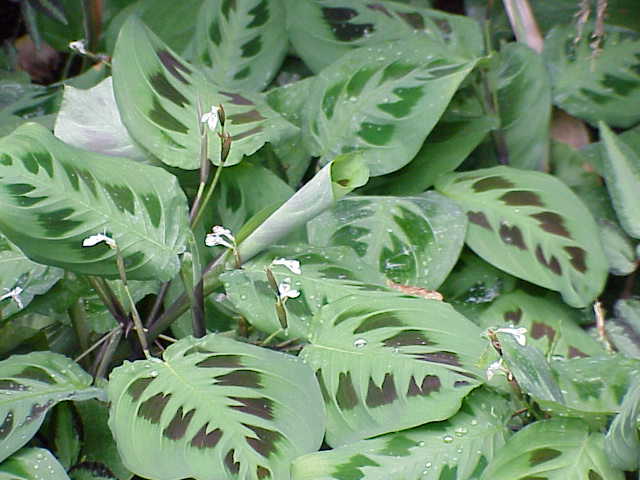 PrayerplantMaranta leuconeura
-
 BrainplantGoeppertia makoyana
-
 ArrowrootMaranta arundinacea
-
 PampanoCalathea lutea
-
 Rattlesnake-plantGoeppertia insignis
-
 Goeppertia rufibarba
Compare
Sources
Data
- Catalogue of Life, 2026-10-16 XR cc by
- Global Biodiversity Information Facility CC BY 4.0
- Wikidata CC0
- GeoNames CC BY 4.0
- Within the Catalogue of Life, this name comes from The World Checklist of Vascular Plants (WCVP) cc by
References
- H.G.A.Engler (ed.), Pflanzenr., IV, 48: 50 (1902) where the name was published
This species in other databases
Page built on 26 November 2026. See how the catalog is made and all sources and licences.
Cite this page
ScientificNames.org. (2026). Halopegia azurea. Retrieved November 26, 2026, from https://scientificnames.org/species/halopegia-azurea
“Halopegia azurea.” ScientificNames.org, 2026, scientificnames.org/species/halopegia-azurea. Accessed 26 Nov. 2026.
ScientificNames.org. “Halopegia azurea.” Accessed November 26, 2026. https://scientificnames.org/species/halopegia-azurea.
@misc{scientificnames_halopegia_azurea,
  author = {{ScientificNames.org}},
  title = {Halopegia azurea},
  year = {2026},
  url = {https://scientificnames.org/species/halopegia-azurea},
  note = {Accessed 2026-11-26}
}