Species · Flowering plants
Small Marsh Pitcher Heliamphora minor
The scientific name of the Small Marsh Pitcher is Heliamphora minor. It is a species of flowering plant in the family Sarraceniaceae (pitcher plant family), order Ericales.
- Scientific name
- Heliamphora minor Gleason
- Common name
- Small Marsh Pitcher
- Genus
- Heliamphora
- Family
- Sarraceniaceae (Pitcher Plant Family)
- Order
- Ericales
- Class
- Magnoliopsida
- Recorded in
- 1 country
- Name status
- accepted in the Catalogue of Life

Overview
The small marsh pitcher is endemic to Auyán-tepui in Venezuela. It has a nectar spoon that emerges from a narrow stalk, and two recognised varieties.
Written 26 November 2026 from the sources listed below. Each statement was checked against the passage it cites; statements that could not be supported were removed.
Appearance
The small marsh pitcher has a nectar spoon that emerges from a narrow stalk. Its nectar spoon is larger than that of H. pulchella.[1][2]
The variety H. minor var. pilosa has conspicuous hairs on the outside of its pitchers. The function of these external hairs is unknown.[3][4]
Habitat
The small marsh pitcher is endemic to Auyán-tepui in Venezuela.[5]
Behaviour
One hypothesis proposes that the external hairs discourage terrestrial arthropods from climbing the pitchers and limit access to nectar to flying insects. The hairs may also help prevent nectar theft by insects.[6][7]
Another proposed function is to assist insects in scaling otherwise smooth pitcher surfaces. The reflective surface of the hairs may also make the plant's foliage more visible to flying insects with light-sensitive vision.[8][9]
Uses
The small marsh pitcher is among the more widely available species of its genus for cultivation. It is typically cultivated under strong fluorescent lighting in a terrarium or in a greenhouse with partial sunlight.[10][11]
Cultivated plants require water without added minerals or chemicals and a substrate with low nutrient levels. Suitable substrates can include washed sand, orchid bark, sphagnum moss, peat moss, and perlite.[12][13][14]
The species can tolerate a wide range of temperatures, with a preferred cultivation temperature of approximately 70–90 °F. Nighttime temperatures should be approximately 10 degrees lower than daytime temperatures.[15][16][17]
Heliamphora plants require humidity levels above 70 percent. A greenhouse or terrarium can provide the required humidity.[18][19]
Similar species
The small marsh pitcher is closely related to H. ciliata and H. pulchella. It is one of the smallest species in its genus.[20][21]
Classification of the Small Marsh Pitcher
| Kingdom | Plantae |
|---|---|
| Subkingdom | Pteridobiotina |
| Phylum | Tracheophyta |
| Class | Magnoliopsida |
| Order | Ericales |
| Family | Sarraceniaceae (Pitcher Plant Family) |
| Genus | Heliamphora (Sun Pitchers) |
| Species | Heliamphora minor Gleason |
Where the Small Marsh Pitcher is found
Checklists and occurrence records place Heliamphora minor in 1 country across South America. GBIF holds 72 georeferenced records of it.
Countries
Regions and cities with the most records
1 more country has a few records outside this range
These countries hold a few records of Heliamphora minor but lie outside the range the checklists give for it. Such records are often zoo or garden specimens, museum material or vagrants, so the species is not counted as occurring there.
Range as the checklists state it
Venezuela (Bolívar)
A number beside a place is its count of GBIF occurrence records. A place without a number comes from a checklist alone. Records show where a species has been observed or collected, which can include escapes and vagrants.
Common names
English
- Small Marsh Pitcher
Names in 4 other languages
- Chinese
- 小太陽瓶子草
- Dutch
- Kleine zonnebeker
- Japanese
- キツネノツメガイソウ, ヒメキツネノメシガイソウ
- Slovak
- heliamfora drobná
Subspecies and varieties
Related species
-
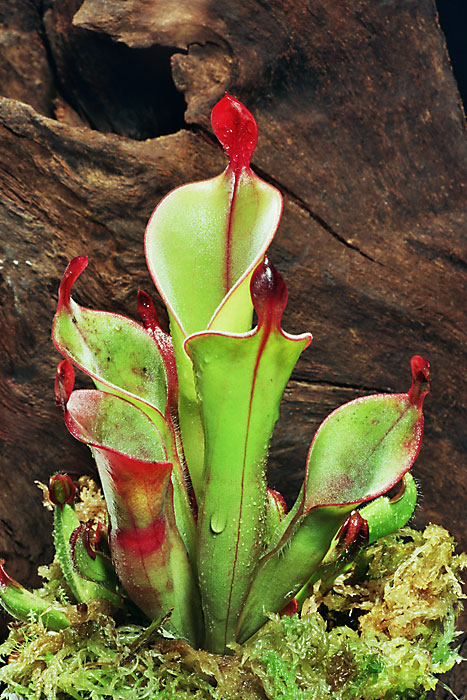 Chimantá Massif Marsh PitcherHeliamphora chimantensis
-
 Nodding Marsh PitcherHeliamphora nutans
-
 Giant Marsh PitcherHeliamphora tatei
-
 Chimantá-Aprada Marsh PitcherHeliamphora exappendiculata
-
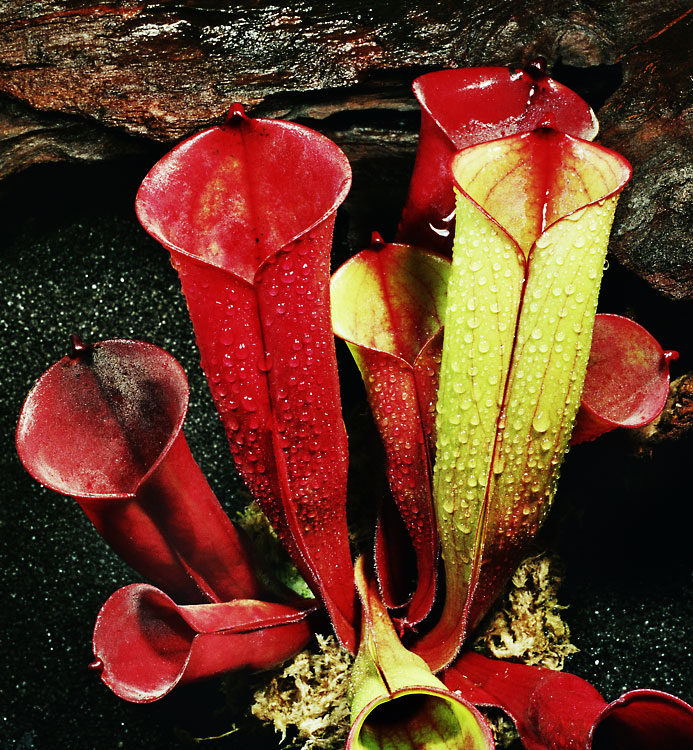 Aparaman Tepui-group Marsh PitcherHeliamphora folliculata
- Cerro Neblina Marsh PitcherHeliamphora hispida
- Huber's Marsh PitcherHeliamphora huberi
-
 Neblina Massif Marsh PitcherHeliamphora parva
Compare
Questions and answers
What is the scientific name of the Small Marsh Pitcher?
The scientific name of the Small Marsh Pitcher is Heliamphora minor. Written with its author, the full name is Heliamphora minor Gleason.
Which family does the Small Marsh Pitcher belong to?
Heliamphora minor belongs to the family Sarraceniaceae, in the order Ericales and the class Magnoliopsida.
Where is the Small Marsh Pitcher found?
Checklists and occurrence records place Heliamphora minor in 1 country: Venezuela.
What are the different types of pitcher plants?
Two varieties are recognised within the small marsh pitcher: H. minor var. minor and H. minor var. pilosa.[22]
Sources
Passages the profile rests on
- Heliamphora minor has a nectar spoon that emerges from a narrow stalk. Source passage: “the spoon of minor emerges on a narrow stalk” — English Wikipedia
- The nectar spoon of H. minor is larger than that of H. pulchella. Source passage: “ending in a larger nectar spoon than that of pulchella.” — English Wikipedia
- The variety H. minor var. pilosa has conspicuous hairs on the outside of its pitchers. Source passage: “H. minor var. pilosa, which is characterised by conspicuous hairs on the pitcher exterior.” — English Wikipedia
- The function of the external hairs on H. minor var. pilosa is unknown. Source passage: “The purpose of the exterior indumentum is unknown” — English Wikipedia
- The species is endemic to Auyán-tepui in Venezuela. Source passage: “endemic to Auyán-tepui in Venezuela.” — English Wikipedia
- One hypothesis proposes that the external hairs discourage terrestrial arthropods from climbing the pitchers and limit access to nectar to flying insects. Source passage: “it may discourage terrestrial arthropods from scaling the pitcher and restrict access to the nectar spoon to flying insects” — English Wikipedia
- The external hairs may help prevent nectar theft by insects. Source passage: “thus preventing the loss of nectar to insects that tend to steal nectar.” — English Wikipedia
- One proposed function of the external hairs is to assist insects in scaling otherwise smooth pitcher surfaces. Source passage: “but may assist in the scaling of otherwise glabrous exterior surfaces.” — English Wikipedia
- The reflective surface of the external hairs may make the plant's foliage more visible to flying insects with light-sensitive vision. Source passage: “the highly reflective surface of the indumenta may make foliage more visible to flying insects with light-sensitive vision.” — English Wikipedia
- Heliamphora minor is among the more widely available species of its genus for cultivation. Source passage: “Heliamphora minor is one of the more widely available species in the genus for cultivation.” — English Wikipedia
- Heliamphora minor is typically cultivated under strong fluorescent lighting in a terrarium or in a greenhouse with partial sunlight. Source passage: “Typically, H. minor is grown under strong fluorescent lights in a terrarium, or in a greenhouse with partial sunlight.” — English Wikipedia
- Cultivated Heliamphora minor requires water without added minerals or chemicals. Source passage: “H. minor requires water free from added minerals and chemicals.” — English Wikipedia
- The cultivation substrate for Heliamphora minor must have low nutrient levels. Source passage: “Soil for H. minor must be low in nutrients.” — English Wikipedia
- Suitable cultivation substrates can include washed sand, orchid bark, sphagnum moss, peat moss, and perlite. Source passage: “Combinations of washed sand, orchid bark, long fibered sphagnum moss (dried or living), peat moss, and perlite may be used.” — English Wikipedia
- Heliamphora minor can tolerate a wide range of temperatures. Source passage: “It can survive a wide range of temperatures” — English Wikipedia
- The preferred cultivation temperature for Heliamphora minor is approximately 70–90 °F. Source passage: “preferably around 70–90 °F” — English Wikipedia
- During cultivation, nighttime temperatures should be approximately 10 degrees lower than daytime temperatures. Source passage: “during the night the temperature must drop to around 10 degrees less than the day temperature.” — English Wikipedia
- Heliamphora plants require humidity levels above 70 percent. Source passage: “Heliamphora plants also require a high humidity level (70+%)” — English Wikipedia
- A greenhouse or terrarium can provide the humidity required for cultivating Heliamphora plants. Source passage: “which can be achieved in a greenhouse or terrarium.” — English Wikipedia
- Heliamphora minor is one of the smallest species in its genus. Source passage: “it is one of the smallest species in the genus.” — English Wikipedia
- Heliamphora minor is closely related to H. ciliata and H. pulchella. Source passage: “It is closely related to H. ciliata and H. pulchella.” — English Wikipedia
- Two varieties are recognised within Heliamphora minor: H. minor var. minor and H. minor var. pilosa. Source passage: “Two varieties of H. minor are recognised: the autonym H. minor var. minor and H. minor var. pilosa” — English Wikipedia
Data
- Catalogue of Life, 2026-10-16 XR cc by
- Global Biodiversity Information Facility CC BY 4.0
- Wikidata CC0
- GeoNames CC BY 4.0
- Wikimedia Commons per image; credit shown with each image
- Within the Catalogue of Life, this name comes from Synonymic Checklists of the Vascular Plants of the World cc by
References
- Gleason. (1939). Brittonia 3: 164 (1939). where the name was published
This species in other databases
Page built on 27 November 2026. See how the catalog is made and all sources and licences.
Cite this page
ScientificNames.org. (2026). Heliamphora minor (Small Marsh Pitcher). Retrieved November 27, 2026, from https://scientificnames.org/species/heliamphora-minor
“Heliamphora minor (Small Marsh Pitcher).” ScientificNames.org, 2026, scientificnames.org/species/heliamphora-minor. Accessed 27 Nov. 2026.
ScientificNames.org. “Heliamphora minor (Small Marsh Pitcher).” Accessed November 27, 2026. https://scientificnames.org/species/heliamphora-minor.
@misc{scientificnames_heliamphora_minor_small_marsh_pitcher,
  author = {{ScientificNames.org}},
  title = {Heliamphora minor (Small Marsh Pitcher)},
  year = {2026},
  url = {https://scientificnames.org/species/heliamphora-minor},
  note = {Accessed 2026-11-27}
}