Species · Flowering plants
Maltese Everlasting Helichrysum melitense
The scientific name of the Maltese Everlasting is Helichrysum melitense. It is a species of flowering plant in the family Asteraceae (composite), order Asterales.
- Scientific name
- Helichrysum melitense (Pignatti) Brullo, Lanfr., Pavone & Ronsisv.
- Common name
- Maltese Everlasting
- Genus
- Helichrysum
- Family
- Asteraceae (Composite)
- Order
- Asterales
- Class
- Magnoliopsida
- Red List category
- CR Critically Endangered
- Recorded in
- 1 country
- Name status
- accepted in the Catalogue of Life

Overview
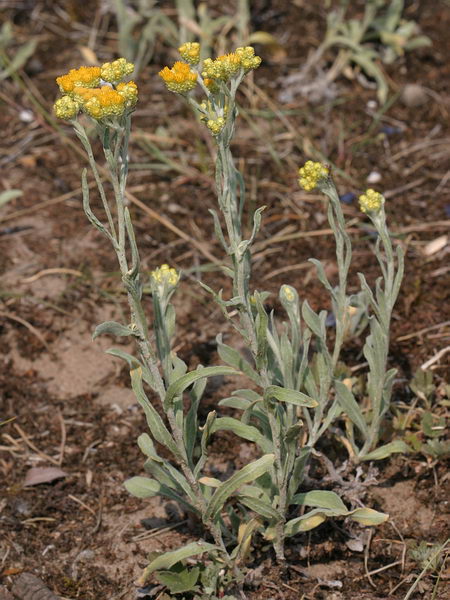
Maltese Everlasting is a low-growing shrub with small, erect, lanceolate leaves and a height of 30 to 70 cm. It grows in Mediterranean-type shrubby vegetation on coastal garigue and on vertical sheer cliffs, and is restricted to the island of Gozo. It has yellow tubular florets, curry-like smelling flowers and leaves that appear green when wet and silvery when dry.
Written 26 November 2026 from the sources listed below. Each statement was checked against the passage it cites; statements that could not be supported were removed.
Appearance
Maltese Everlasting is a low-growing shrub reaching a height of 30 to 70 cm. Its small, erect leaves are lanceolate.[1][2]
Its flower heads contain exclusively yellow tubular florets. The flowers have a curry-like smell.[3][4]
The leaves have numerous tiny silvery hairs on their surfaces. They appear green when wet and silvery when dry.[5][6]
Habitat
Maltese Everlasting grows in Mediterranean-type shrubby vegetation on coastal garigue and occurs on vertical sheer cliffs.[7][8]
It has been recorded at Dwejra in Gozo and occurs on cliffs in Gozo near Fungus Rock.[9][10]
The species is endemic to Malta and specifically restricted to the island of Gozo. New locations have recently been recorded on Gozo.[11][12]
Behaviour
The numerous tiny hairs on its leaves protect the plant against drying out from strong winds and summer drought.[5][13]
Conservation
Maltese Everlasting is declining in the wild. Habitat loss is identified as a threat to the species.[14][15]
Uses
Maltese Everlasting is easy to cultivate and is gaining popularity as an ornamental plant among local people.[16][17]
Its dried flowers can retain their original colours indoors for many years.[18]
Classification of the Maltese Everlasting
| Kingdom | Plantae |
|---|---|
| Subkingdom | Pteridobiotina |
| Phylum | Tracheophyta |
| Class | Magnoliopsida |
| Order | Asterales |
| Family | Asteraceae (Composite) |
| Subfamily | Asteroideae |
| Tribe | Gnaphalieae |
| Subtribe | Gnaphaliinae |
| Genus | Helichrysum (Cudweed) |
| Species | Helichrysum melitense (Pignatti) Brullo, Lanfr., Pavone & Ronsisv. |
Where the Maltese Everlasting is found
Checklists and occurrence records place Helichrysum melitense in 1 country across Europe. GBIF holds 67 georeferenced records of it.
Countries
Range as the checklists state it
Malta (Fungus Rock, Gozo Isl.)
A number beside a place is its count of GBIF occurrence records. A place without a number comes from a checklist alone. Records show where a species has been observed or collected, which can include escapes and vagrants.
Common names
English
- Maltese Everlasting
Names in 2 other languages
- Italian
- Perpetuini delle Scogliere Maltese
- Maltese
- Sempreviva Ta' Għawdex
Synonyms
4 other scientific names have been used for this species and are now treated as synonyms of Helichrysum melitense.
- Helichrysum panormitanum subsp. melitense (Pignatti) Iamonico & Pignatti
- Helichrysum panormitanum subsp. melitense Tineo ex Guss.
- Helichrysum rupestre var. melitense Pignatti
- Helichrysum rupestre var. melitense Guss. ex Nyman
Related species
-
 Italian StrawflowerHelichrysum italicum
-
 Licorice EverlastingHelichrysum petiolare
-
 Sandy EverlastingHelichrysum arenarium
-
 Common Shrubby EverlastingHelichrysum stoechas
-
 Red EverlastingHelichrysum sanguineum
-
 Eastern StrawflowerHelichrysum orientale
-
 Cape GoldHelichrysum splendidum
-
 Flask EverlastingHelichrysum retortum
Compare
Questions and answers
What is the scientific name of the Maltese Everlasting?
The scientific name of the Maltese Everlasting is Helichrysum melitense. Written with its author, the full name is Helichrysum melitense (Pignatti) Brullo, Lanfr., Pavone & Ronsisv..
Which family does the Maltese Everlasting belong to?
Helichrysum melitense belongs to the family Asteraceae, in the order Asterales and the class Magnoliopsida.
Where is the Maltese Everlasting found?
Checklists and occurrence records place Helichrysum melitense in 1 country: Malta.
What is the conservation status of the Maltese Everlasting?
The IUCN Red List category recorded for Helichrysum melitense is Critically Endangered (CR).
Where does helichrysum grow naturally?
Maltese Everlasting grows in Mediterranean-type shrubby vegetation on coastal garigue and on vertical sheer cliffs. It is restricted to Gozo, where it has been recorded at Dwejra and on cliffs near Fungus Rock.[7][8][9][10][11]
What are some examples of endemic plants in Malta?
Maltese Everlasting (Helichrysum melitense) is endemic to Malta and specifically restricted to the island of Gozo.[11]
Sources
Passages the profile rests on
- The Maltese everlasting is a low-growing shrub with small, erect, lanceolate leaves. Source passage: “This is a low shrub, ranging from 30 to 70 cm in height; has small lanceolate leaves that are erect;” — English Wikipedia
- The shrub reaches a height of 30 to 70 cm. Source passage: “This is a low shrub, ranging from 30 to 70 cm in height;” — English Wikipedia
- Its flower heads contain exclusively yellow tubular florets. Source passage: “the flower heads only contain yellow tubular florets.” — English Wikipedia
- Its flowers have a curry-like smell. Source passage: “The flowers smell like curry,” — English Wikipedia
- The leaves have numerous tiny silvery hairs on their surfaces. Source passage: “The leaves have many tiny silvery hairs on their surface,” — English Wikipedia
- Its leaves appear green when wet and silvery when dry. Source passage: “when wet they look green, but when dry they look silvery.” — English Wikipedia
- The species grows in Mediterranean-type shrubby vegetation on coastal garigue. Source passage: “Its natural habitats are Mediterranean-type shrubby vegetation on Coastal garigue” — English Wikipedia
- The species occurs on vertical sheer cliffs. Source passage: “and vertical sheer cliffs.” — English Wikipedia
- The species has been recorded at Dwejra in Gozo. Source passage: “It can be found in Dwejra,” — English Wikipedia
- The species occurs on cliffs in Gozo near Fungus Rock. Source passage: “and in cliffs in Gozo near Fungus Rock.” — English Wikipedia
- The species is endemic to Malta and is specifically restricted to the island of Gozo. Source passage: “is endemic to Malta, specifically to the island of Gozo.” — English Wikipedia
- New locations for the species have recently been recorded on Gozo. Source passage: “Recently, it was recorded in new locations on the island of Gozo.” — English Wikipedia
- The hairs on its leaves protect the plant against drying out from strong winds and summer drought. Source passage: “The hairs protect the plant for the heavy winds and summer drought from drying up.” — English Wikipedia
- The species is declining in the wild. Source passage: “This plant is on the decline in the wild,” — English Wikipedia
- Habitat loss is identified as a threat to the species. Source passage: “and it is threatened by habitat loss.” — English Wikipedia
- The species is easy to cultivate. Source passage: “It is very easy to cultivate,” — English Wikipedia
- The species is gaining popularity as an ornamental plant among local people. Source passage: “and it is gaining ornamental popularity amongst the locals.” — English Wikipedia
- Its dried flowers can retain their original colours indoors for many years. Source passage: “when flowers are kept dry indoors, they can last for many years with their original colours,” — English Wikipedia
Data
- Catalogue of Life, 2026-10-16 XR cc by
- Global Biodiversity Information Facility CC BY 4.0
- Wikidata CC0
- GeoNames CC BY 4.0
- Wikimedia Commons per image; credit shown with each image
- Within the Catalogue of Life, this name comes from Synonymic Checklists of the Vascular Plants of the World cc by
References
- Brullo, Lanfr., Pavone & Ronsisv. (1988). Giorn. Bot. Ital. 122, Supp. 1: 45 (1988). where the name was published
This species in other databases
- Catalogue of Life 3K6Y5
- Wikidata Q309689
- iNaturalist 193260
- World Flora Online wfo-0000088093
- GRIN 511304
Page built on 26 November 2026. See how the catalog is made and all sources and licences.
Cite this page
ScientificNames.org. (2026). Helichrysum melitense (Maltese Everlasting). Retrieved November 26, 2026, from https://scientificnames.org/species/helichrysum-melitense
“Helichrysum melitense (Maltese Everlasting).” ScientificNames.org, 2026, scientificnames.org/species/helichrysum-melitense. Accessed 26 Nov. 2026.
ScientificNames.org. “Helichrysum melitense (Maltese Everlasting).” Accessed November 26, 2026. https://scientificnames.org/species/helichrysum-melitense.
@misc{scientificnames_helichrysum_melitense_maltese_everlasting,
  author = {{ScientificNames.org}},
  title = {Helichrysum melitense (Maltese Everlasting)},
  year = {2026},
  url = {https://scientificnames.org/species/helichrysum-melitense},
  note = {Accessed 2026-11-26}
}