Species · Flowering plants
Cape Gold Everlasting Helichrysum splendidum
The scientific name of the Cape Gold Everlasting is Helichrysum splendidum. It is a species of flowering plant in the family Asteraceae (composite), order Asterales.
- Scientific name
- Helichrysum splendidum (Thunb.) Less.
- Common name
- Cape Gold Everlasting
- Genus
- Helichrysum
- Family
- Asteraceae (Composite)
- Order
- Asterales
- Class
- Magnoliopsida
- Recorded in
- 13 countries
- Name status
- accepted in the Catalogue of Life

Overview
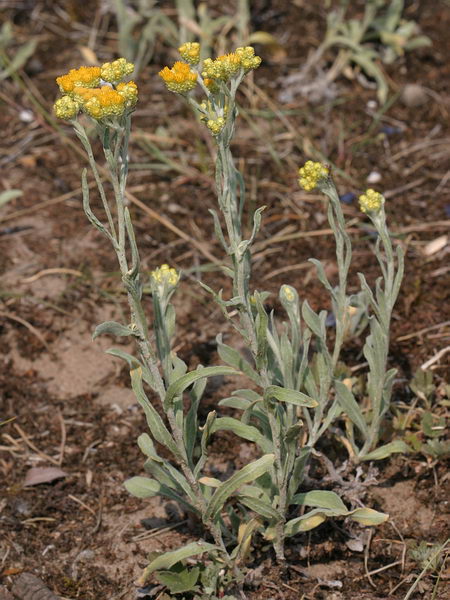
Cape Gold Everlasting (Helichrysum splendidum (Thunb.) Less.) is a hardy evergreen perennial flowering plant in the family Asteraceae, order Asterales and class Magnoliopsida. It grows in rocky places within fynbos, grassland and savanna biomes and occurs along the eastern escarpment mountains from the Southern Cape to Ethiopia. It is distinguished by blue-grey woolly leaves and yellow flower heads with bright canary-yellow, occasionally orange, involucral bracts.
Written 27 November 2026 from the sources listed below. Each statement was checked against the passage it cites; statements that could not be supported were removed.
Appearance
The leaves are blue-grey, with a softly woolly underside. They are linear, linear-oblong or linear-lanceolate, and their margins are commonly revolute.[1][2][3]
The upper leaf surface is prominently parallel-veined and grooved. The leaves measure 10–30 mm long and 1–2 mm wide, with occasional dimensions reaching 40 mm long and 6 mm wide.[4][5]
The branches are closely leafy and thinly covered with grey woolly hairs. Older branches become increasingly hairless and rough with leaf scars.[6][7]
The flower heads are hemispherical, with bright canary-yellow involucral bracts that are occasionally orange. The flowers are yellow.[8][9][10]
The flower heads measure 4–5 mm in length and 5–8 mm across the radiating bracts. The achenes measure approximately 0.75 mm long.[11][12]
Habitat
The species grows in rocky places within fynbos, grassland and savanna biomes.[13]
Reproduction and life cycle
The species produces heterogamous flower heads containing between 47 and 105 flowers.[14]
It produces achenes bearing duplex hairs and numerous scabrid pappus bristles whose bases are joined by spreading cilia. The pappus bristles are as long as the corolla.[15][16][17]
Uses
The leaves are pleasantly aromatic. An essential oil can be derived from them for use in aromatherapy.[18][19]
The essential oil contains β-pinene, β-phellandrene, δ-cadinene, germacrene D and 1,8-cineole as its main components.[20]
Classification of the Cape Gold Everlasting
| Kingdom | Plantae |
|---|---|
| Subkingdom | Pteridobiotina |
| Phylum | Tracheophyta |
| Class | Magnoliopsida |
| Order | Asterales |
| Family | Asteraceae (Composite) |
| Subfamily | Asteroideae |
| Tribe | Gnaphalieae |
| Subtribe | Gnaphaliinae |
| Genus | Helichrysum (Cudweed) |
| Species | Helichrysum splendidum (Thunb.) Less. |
Where the Cape Gold Everlasting is found
Checklists and occurrence records place Helichrysum splendidum in 13 countries across Africa and Asia. GBIF holds 1,321 georeferenced records of it.
Countries
- Angola 5
- Eswatini 22
- Ethiopia 387
- Kenya 8
- Lesotho 46
- Malawi 27
- South Africa 539
- South Sudan
- Tanzania 226
- Uganda 3
- Yemen
- Zambia 3
- Zimbabwe 55
Regions and cities with the most records
- Oromiya, Ethiopia 201
- Eastern Cape, South Africa 132
- Mpumalanga, South Africa 130
- KwaZulu-Natal, South Africa 67
- Limpopo, South Africa 41
- Kilimanjaro, Tanzania 32
- Felana, Ethiopia 28
- Harar, Ethiopia 28
- Sabie, South Africa 28
- ‘Alemaya, Ethiopia 28
- Arusha, Tanzania 20
- Goba, Ethiopia 19
- Western Cape, South Africa 18
- Addis Ababa, Ethiopia 17
- Hhohho Region, Eswatini 17
- Lydenburg, South Africa 17
- Mbabane, Eswatini 16
- Maseru District, Lesotho 14
- Barberton, South Africa 13
- Usa River, Tanzania 12
- Arusha, Tanzania 11
- Free State, South Africa 11
- Leribe, Lesotho 11
- Manicaland, Zimbabwe 11
- Amhara, Ethiopia 9
- Dodola, Ethiopia 8
- Tzaneen, South Africa 8
- Addis Ababa, Ethiopia 7
- Burayu, Ethiopia 7
- Lobamba, Eswatini 7
- Njombe, Tanzania 7
- Āfar, Ethiopia 7
- Berea, Lesotho 5
- Butha-Buthe, Lesotho 5
- Khowa, South Africa 5
- Somerset East, South Africa 5
1 more country has a few records outside this range
These countries hold a few records of Helichrysum splendidum but lie outside the range the checklists give for it. Such records are often zoo or garden specimens, museum material or vagrants, so the species is not counted as occurring there.
Range as the checklists state it
South Sudan; Ethiopia; Tanzania; Angola; Zambia; Malawi; Zimbabwe; South Africa (Limpopo, Gauteng, Mpulamanga, Free State, KwaZulu-Natal, W-Cape Prov., E-Cape Prov.); Lesotho; Eswatini [Swaziland]; Yemen (W-Yemen)
A number beside a place is its count of GBIF occurrence records. A place without a number comes from a checklist alone. Records show where a species has been observed or collected, which can include escapes and vagrants.
Common names
English
- Cape Gold Everlasting
- Cape Gold
Names in 3 other languages
- Finnish
- kultaolkikukka
- French
- immortelle
- German
- Südafrikanische Strohblume
Synonyms
11 other scientific names have been used for this species and are now treated as synonyms of Helichrysum splendidum.
- Gnaphalium abyssinicum (Sch.Bip. ex Hochst.) Sch.Bip.
- Gnaphalium splendidum Thunb.
- Gnaphalium xanthinum (DC.) Sch.Bip.
- Helichrysum abyssinicum Sch.Bip. ex Hochst.
- Helichrysum acrobates Bullock
- Helichrysum hendersonae S.Moore
- Helichrysum hendersoniae S.Moore
- Helichrysum splendidum var. splendidum
- Helichrysum xanthinum DC.
- Gnaphalium strictum Lam. ambiguous synonym
- Helichrysum strictum (Lam.) Druce ambiguous synonym
Related species
-
 Italian StrawflowerHelichrysum italicum
-
 Licorice EverlastingHelichrysum petiolare
-
 Sandy EverlastingHelichrysum arenarium
-
 Common Shrubby EverlastingHelichrysum stoechas
-
 Red EverlastingHelichrysum sanguineum
-
 Eastern StrawflowerHelichrysum orientale
-
 Maltese EverlastingHelichrysum melitense
-
 Flask EverlastingHelichrysum retortum
Compare
Questions and answers
What is the scientific name of the Cape Gold Everlasting?
The scientific name of the Cape Gold Everlasting is Helichrysum splendidum. Written with its author, the full name is Helichrysum splendidum (Thunb.) Less..
Which family does the Cape Gold Everlasting belong to?
Helichrysum splendidum belongs to the family Asteraceae, in the order Asterales and the class Magnoliopsida.
Where is the Cape Gold Everlasting found?
Checklists and occurrence records place Helichrysum splendidum in 13 countries, including South Africa, Ethiopia, Tanzania, Zimbabwe, Lesotho and Malawi.
What other names does the Cape Gold Everlasting have?
Helichrysum splendidum is also known in English as Cape Gold.
Where does Helichrysum grow naturally?
Helichrysum splendidum grows in rocky places within fynbos, grassland and savanna biomes. It occurs along the eastern escarpment mountains from the Southern Cape to Ethiopia, with recorded distribution in South Africa, Eswatini, Lesotho, Tanzania, Ethiopia, South Sudan, Malawi, Zimbabwe, Zambia and Yemen.[13][21][22]
Do helichrysums come back every year?
Cape Gold Everlasting is a hardy evergreen perennial.[23]
Sources
Passages the profile rests on
- The plant has blue-grey leaves with a softly woolly underside. Source passage: “Leaves have a blue-grey colour and are softly woolly on the under surface” — English Wikipedia
- Its leaves are linear, linear-oblong or linear-lanceolate in shape. Source passage: “Leaves 10–30 (–40) x 1–2 (–6) mm, linear, linear-oblong or linear-lanceolate” — English Wikipedia
- The leaf margins are commonly revolute. Source passage: “margins commonly revolute” — English Wikipedia
- The upper leaf surface is prominently parallel-veined and grooved. Source passage: “The upper surface is markedly parallel-veined and grooved” — English Wikipedia
- Its leaves measure 10–30 mm long and 1–2 mm wide, with occasional dimensions reaching 40 mm long and 6 mm wide. Source passage: “Leaves 10–30 (–40) x 1–2 (–6) mm” — English Wikipedia
- The branches are thinly covered with grey woolly hairs and are closely leafy. Source passage: “branches thinly grey-woolly, closely leafy” — English Wikipedia
- The older branches become increasingly hairless and rough with leaf scars. Source passage: “older parts glabrescent, rough with leaf scars.” — English Wikipedia
- The flower heads are hemispherical. Source passage: “Heads heterogamous, hemispherical” — English Wikipedia
- The flower heads have bright canary-yellow involucral bracts, which are occasionally orange. Source passage: “tips minutely radiating, bright canary-yellow, rarely orange, glossy.” — English Wikipedia
- The flowers are yellow. Source passage: “Flowers 47–105, 8–14 female, 39–84 homogamous, yellow.” — English Wikipedia
- Its flower heads measure 4–5 mm in length and 5–8 mm across the radiating bracts. Source passage: “Heads heterogamous, hemispherical, 4–5 mm long, 5–8 mm across the radiating bracts” — English Wikipedia
- Its achenes measure approximately 0.75 mm long. Source passage: “Achenes 0.75 mm long, with duplex hairs.” — English Wikipedia
- The species grows in rocky places within fynbos, grassland and savanna biomes. Source passage: “favouring rocky places in fynbos, grassland and savanna biomes.” — English Wikipedia
- The species produces heterogamous flower heads containing between 47 and 105 flowers. Source passage: “Flowers 47–105, 8–14 female, 39–84 homogamous” — English Wikipedia
- The plant produces numerous pappus bristles that are as long as the corolla. Source passage: “Pappus bristles many, equaling corolla, scabrid” — English Wikipedia
- The species produces achenes bearing duplex hairs. Source passage: “Achenes 0.75 mm long, with duplex hairs.” — English Wikipedia
- The species has numerous scabrid pappus bristles whose bases are joined by spreading cilia. Source passage: “Pappus bristles many, equaling corolla, scabrid, bases cohering by patent cilia.” — English Wikipedia
- The species has pleasantly aromatic leaves. Source passage: “This species has pleasantly aromatic leaves” — English Wikipedia
- An essential oil can be derived from its leaves for use in aromatherapy. Source passage: “leaves from which an essential oil used in aromatherapy can be derived.” — English Wikipedia
- The essential oil contains β-pinene, β-phellandrene, δ-cadinene, germacrene D and 1,8-cineole as its main components. Source passage: “The oil's main components are β-pinene, β-phellandrene, δ-cadinene, germacrene D, and 1,8-cineole.” — English Wikipedia
- The species occurs along the eastern escarpment mountains from the Southern Cape to Ethiopia. Source passage: “it occurs from the Southern Cape to Ethiopia along the eastern escarpment mountains” — English Wikipedia
- Its recorded distribution includes South Africa, Eswatini, Lesotho, Tanzania, Ethiopia, South Sudan, Malawi, Zimbabwe, Zambia and Yemen. Source passage: “The species is found in South Africa, Eswatini, Lesotho, Tanzania, Ethiopia, South Sudan, Malawi, Zimbabwe, Zambia and Yemen.” — English Wikipedia
- The species is a hardy evergreen perennial. Source passage: “A hardy evergreen perennial” — English Wikipedia
Data
- Catalogue of Life, 2026-10-16 XR cc by
- Global Biodiversity Information Facility CC BY 4.0
- Wikidata CC0
- GeoNames CC BY 4.0
- Wikimedia Commons per image; credit shown with each image
- Within the Catalogue of Life, this name comes from Synonymic Checklists of the Vascular Plants of the World cc by
References
- Less. Syn. Gen. Compos. 286 (1832). where the name was published
This species in other databases
- Catalogue of Life 6LHK8
- Wikidata Q5410445
- iNaturalist 343053
- World Flora Online wfo-0000090717
- GRIN 458045
Page built on 27 November 2026. See how the catalog is made and all sources and licences.
Cite this page
ScientificNames.org. (2026). Helichrysum splendidum (Cape Gold Everlasting). Retrieved November 27, 2026, from https://scientificnames.org/species/helichrysum-splendidum
“Helichrysum splendidum (Cape Gold Everlasting).” ScientificNames.org, 2026, scientificnames.org/species/helichrysum-splendidum. Accessed 27 Nov. 2026.
ScientificNames.org. “Helichrysum splendidum (Cape Gold Everlasting).” Accessed November 27, 2026. https://scientificnames.org/species/helichrysum-splendidum.
@misc{scientificnames_helichrysum_splendidum_cape_gold_everlasting,
  author = {{ScientificNames.org}},
  title = {Helichrysum splendidum (Cape Gold Everlasting)},
  year = {2026},
  url = {https://scientificnames.org/species/helichrysum-splendidum},
  note = {Accessed 2026-11-27}
}