Species · Birds
Plain-capped Starthroat Heliomaster constantii
The scientific name of the Plain-capped Starthroat is Heliomaster constantii. It is a species of bird in the family Trochilidae (hummingbird), order Apodiformes. The name dates from 1843.
- Scientific name
- Heliomaster constantii (Delattre, 1843)
- Common name
- Plain-capped Starthroat
- Genus
- Heliomaster
- Family
- Trochilidae (Hummingbird)
- Order
- Apodiformes
- Class
- Aves
- Red List category
- LC Least Concern
- Environment
- terrestrial
- Recorded in
- 9 countries
- Name status
- accepted in the Catalogue of Life

Overview
Heliomaster constantii occurs geographically from Mexico to Costa Rica. It has a long, almost straight, black bill, a white streak behind the eye, and essentially identical plumage in males and females.
Written 26 November 2026 from the sources listed below. Each statement was checked against the passage it cites; statements that could not be supported were removed.
Appearance
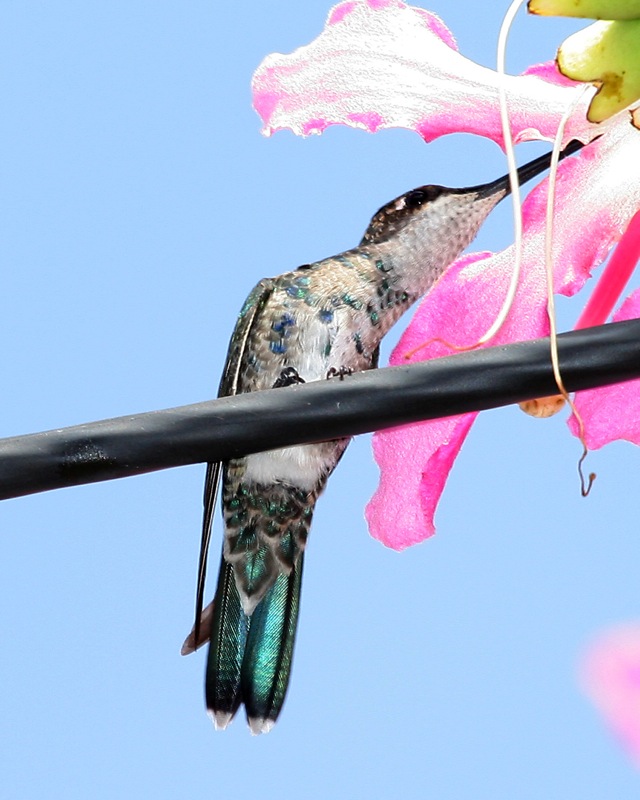
Both sexes have a long, almost straight, black bill and a white streak behind the eye. Males and females have essentially identical plumage.[1][2]
The nominate subspecies has metallic bronze-green upperparts, a wide white rump streak, and a crown that is less metallic than the rest of its upperparts. Its mostly dusky face has a wide white moustache-like marking.[3][4][5]
The nominate subspecies has a sooty to blackish chin and a gorget ranging from bright metallic red to purplish red. Its underparts are brownish-gray with a white belly, and its undertail coverts are pale gray with wide white tips.[6][7][8]
The nominate subspecies has a large tuft of white feathers on its flanks. Its central tail feathers are bronze-green with dusky ends, while the remaining tail feathers have blackish ends and white inner-margin edges.[9][10]
Immature birds have a dark sooty-brown throat with grayish-white feather margins.[11]
The H. c. pinicola subspecies has paler underparts and a smaller gorget than the nominate subspecies. The H. c. leocadiae subspecies has underparts darker than those of H. c. pinicola but paler than those of the nominate subspecies, and a pinker gorget than the nominate subspecies.[12][13][14]
Habitat
The Plain-capped Starthroat inhabits arid and semiarid landscapes. It occurs in the interiors and edges of mature forests, gallery forests, and secondary forests.[15][16][17]
It also inhabits open areas containing scattered trees.[18]
Diet
The Plain-capped Starthroat feeds on nectar from a wide variety of flowering plants and supplements its nectar diet with small insects. It feeds at flowers and spends much of its time flycatching for insects.[19][20][21]
It captures insects by hawking from exposed perches and gleaning vegetation.[22]
Behaviour
The Plain-capped Starthroat usually forages by trap-lining, visiting a circuit of flowers. Males sometimes defend patches of flowers.[23][24]
It forages at heights ranging from the understory to the forest canopy.[25]
The species is resident throughout the year in most of its geographic range. In Sonora, it appears mainly during the breeding season, although some winter records exist.[26][27]
Nearly all records of the species in Arizona occur between May and October.[28]
Reproduction and life cycle
The Plain-capped Starthroat breeds in western Mexico between January and June and in Costa Rica between October and January.[29][30]
It constructs a shallow cup nest from plant down, with lichen covering the exterior. The nest is typically placed near the tip of a high tree branch.[31][32]
Conservation
The Plain-capped Starthroat is classified as Least Concern by the IUCN. Its estimated population is 50,000 to 500,000 mature individuals, and its population is believed to be decreasing.[33][34][35]
No immediate threats to the species have been identified. Human activity is considered likely to have little short-term effect on the species.[36][37]
The species ranges from uncommon to common in different parts of its geographic range.[38]
Classification of the Plain-capped Starthroat
| Kingdom | Animalia |
|---|---|
| Phylum | Chordata |
| Subphylum | Vertebrata |
| Infraphylum | Gnathostomata |
| Parvphylum | Osteichthyes |
| Megaclass | Tetrapoda |
| Class | Aves (Bird) |
| Order | Apodiformes (Swifts) |
| Family | Trochilidae (Hummingbird) |
| Subfamily | Trochilinae |
| Genus | Heliomaster (Starthroat) |
| Species | Heliomaster constantii (Delattre, 1843) |
Where the Plain-capped Starthroat is found
Checklists and occurrence records place Heliomaster constantii in 9 countries across North America. GBIF holds 22,939 georeferenced records of it.
Countries
- Belize 3
- Costa Rica 8,152
- El Salvador 801
- Guatemala 376
- Honduras 451
- Mexico 10,187
- Nicaragua 683
- Panama 33
- United States 2,253
Regions and cities with the most records
- Jalisco, Mexico 2,854
- Guanacaste Province, Costa Rica 2,625
- Alajuela, Costa Rica 2,461
- Arizona, United States 2,251
- San Rafael, Costa Rica 2,101
- Heredia, Costa Rica 1,930
- San Felipe, Costa Rica 1,868
- San Pablo, Costa Rica 1,844
- San José, Costa Rica 1,832
- Alajuela Province, Costa Rica 1,816
- San José, Costa Rica 1,798
- San Juan, Costa Rica 1,742
- Guadalupe, Costa Rica 1,568
- San Rafael Abajo, Costa Rica 1,564
- Aserrí, Costa Rica 1,502
- San Juan de Dios, Costa Rica 1,500
- San Rafael Arriba, Costa Rica 1,475
- San Pedro, Costa Rica 1,466
- San Vicente, Costa Rica 1,464
- San Vicente de Moravia, Costa Rica 1,462
- Chiapas, Mexico 1,411
- Curridabat, Costa Rica 1,396
- San Miguel, Costa Rica 1,396
- Oaxaca, Mexico 1,344
- Purral, Costa Rica 1,267
- Puntarenas Province, Costa Rica 1,254
- Patarrá, Costa Rica 1,226
- Tuxtla, Mexico 1,066
- Puerto Vallarta, Mexico 1,049
- Chiapa de Corzo, Mexico 960
- Nayarit, Mexico 848
- San Diego, Costa Rica 804
- Sinaloa, Mexico 796
- Green Valley, United States 785
- Sonora, Mexico 779
- Berriozábal, Mexico 771
Range as the checklists state it
Middle America
North America
A number beside a place is its count of GBIF occurrence records. A place without a number comes from a checklist alone. Records show where a species has been observed or collected, which can include escapes and vagrants.
Common names
English
- Plain-capped Starthroat
Names in 24 other languages
- Catalan
- colibrí de Constant
- Chinese
- 淡頂星喉蜂鳥, 纯顶星喉蜂鸟
- Croatian
- prugastolici kolibrić
- Czech
- kolibřík achátový
- Danish
- Gråbuget Stjernestrube
- Dutch
- Vonkkeelkolibrie
- Esperanto
- brunĉapa stelkolibro
- Finnish
- tummasäiläkolibri
- French
- Colibri de Constant, Gemme de Constant
- German
- Funkenkehlchen, Funkenkehlkolibri
- Italian
- Gola stellata di Constant, Golastella caposcuro
- Japanese
- ムジボウシノドフサハチドリ
- Latvian
- pelēkgalvas zvaigznīte
- Lithuanian
- paprastasis angelas
- Norwegian
- bronsestjernestrupe
- Polish
- aksamitek białowąsy
- Portuguese
- bico-reto-de-coroa-escura, colibri-de-constant
- Russian
- Искрогорлый ангел
- Slovak
- medovec bielofúzy
- Spanish
- Colibrí Picudo Occidental, Colibrí ochotero, Colibrí picudo, Colibrí pochotero
- Swedish
- brunhättad stjärnkolibri
- Turkish
- Boz Alınlı Yıldızlıgerdan
- Ukrainian
- колібрі-ангел біловусий, колібрі-янгол біловусий
- Welsh
- sïedn gyddfseren plaen
Synonyms
2 other scientific names have been used for this species and are now treated as synonyms of Heliomaster constantii.
- Ornismya constanii Delattre, 1843
- Ornismya constantii Delattre, PA, 1843
Subspecies and varieties
- Heliomaster constantii constantii subspecies
- Heliomaster constantii leocadiae subspecies
- Heliomaster constantii pinicola subspecies
Related species
-
 Long-billed StarthroatHeliomaster longirostris
-
 Stripe-breasted StarthroatHeliomaster squamosus
-
 Blue-tufted StarthroatHeliomaster furcifer
-
 Bee HummingbirdMellisuga helenae
-
 Anna's HummingbirdCalypte anna
-
 Ruby-throated HummingbirdArchilochus colubris
-
 Rufous HummingbirdSelasphorus rufus
-
 White-booted Racket-tailOcreatus underwoodii
Compare
Questions and answers
What is the scientific name of the Plain-capped Starthroat?
The scientific name of the Plain-capped Starthroat is Heliomaster constantii. Written with its author, the full name is Heliomaster constantii (Delattre, 1843).
Which family does the Plain-capped Starthroat belong to?
Heliomaster constantii belongs to the family Trochilidae, in the order Apodiformes and the class Aves.
Where is the Plain-capped Starthroat found?
Checklists and occurrence records place Heliomaster constantii in 9 countries, including Mexico, Costa Rica, United States, El Salvador, Nicaragua and Honduras.
What is the conservation status of the Plain-capped Starthroat?
The IUCN Red List category recorded for Heliomaster constantii is Least Concern (LC).
What is the geographic range of the Plain-capped Starthroat?
The species occurs from Mexico to Costa Rica. The H. c. pinicola subspecies occurs in Mexico from Sonora south to Jalisco, the H. c. leocadiae subspecies occurs in southwestern Mexico and western Guatemala, and the nominate H. c. constantii subspecies occurs from El Salvador through Honduras and Nicaragua into northwestern Costa Rica.[39][40][41][42]
Sources
Passages the profile rests on
- Both sexes have a long, almost straight, black bill and a white streak behind the eye. Source passage: “Both sexes of all subspecies have a long, almost straight, black bill and a white streak behind the eye.” — English Wikipedia
- Males and females have essentially identical plumage. Source passage: “The sexes have essentially the same plumage.” — English Wikipedia
- The nominate subspecies has metallic bronze-green upperparts and a wide white rump streak. Source passage: “The nominate subspecies has metallic bronze green upperparts with a wide white streak on the rump;” — English Wikipedia
- The nominate subspecies has a crown that is less metallic than the rest of its upperparts. Source passage: “the crown is less metallic than the rest.” — English Wikipedia
- The nominate subspecies has a mostly dusky face with a wide white moustache-like marking. Source passage: “Much of the face is dusky, with a wide white "moustache".” — English Wikipedia
- The nominate subspecies has a sooty to blackish chin and a gorget ranging from bright metallic red to purplish red. Source passage: “The chin is sooty to blackish and the gorget ranges from several shades of bright metallic red to purplish red.” — English Wikipedia
- The nominate subspecies has brownish-gray underparts and a white belly. Source passage: “The underparts are browish gray with a white belly.” — English Wikipedia
- The nominate subspecies has pale-gray undertail coverts with wide white tips. Source passage: “The undertail coverts are pale gray with wide white tips.” — English Wikipedia
- The nominate subspecies has a large tuft of white feathers on its flanks. Source passage: “The flanks have a large tuft of white feathers.” — English Wikipedia
- The nominate subspecies has bronze-green central tail feathers with dusky ends, while the remaining tail feathers have blackish ends and white inner-margin edges. Source passage: “The central pair of tail feathers are bronze green with dusky ends and the rest bronze green with much blackish at the ends and white edges on their inner margins.” — English Wikipedia
- Immature birds have a dark sooty-brown throat with grayish-white feather margins. Source passage: “Immatures have a dark sooty brown throat with grayish white margins on the feathers.” — English Wikipedia
- The H. c. pinicola subspecies has paler underparts and a smaller gorget than the nominate subspecies. Source passage: “Subspecies H. c. pinicola is similar to the nominate but has paler underparts and a smaller gorget.” — English Wikipedia
- The H. c. leocadiae subspecies has underparts darker than those of H. c. pinicola but paler than those of the nominate subspecies. Source passage: “H. c. leocadiae's underparts are paler than the nominate's but darker than pinicola's” — English Wikipedia
- The H. c. leocadiae subspecies has a pinker gorget than the nominate subspecies. Source passage: “and its gorget is more pink than red.” — English Wikipedia
- The species inhabits arid and semiarid landscapes. Source passage: “The species inhabits a variety of arid to semiarid landscapes” — English Wikipedia
- The species occurs in the interiors and edges of mature forests. Source passage: “including the interior and edges of mature forest” — English Wikipedia
- The species occurs in gallery forests and secondary forests. Source passage: “gallery forest, secondary forest” — English Wikipedia
- The species also inhabits open areas containing scattered trees. Source passage: “and open areas with scattered trees.” — English Wikipedia
- The species feeds on nectar from a wide variety of flowering plants. Source passage: “The plain-capped starthroat feeds on nectar from a wide variety of flowering plants.” — English Wikipedia
- The species supplements its nectar diet with small insects. Source passage: “In addition to nectar, it also feeds on small insects” — English Wikipedia
- The species feeds at flowers and spends much of its time flycatching for insects. Source passage: “feeding at flowers, spends much of its time flycatching for insects, which it” — ebird.org
- The species captures insects by hawking from exposed perches and gleaning vegetation. Source passage: “captured by hawking from an exposed perch and by gleaning from vegetation.” — English Wikipedia
- The species usually forages by trap-lining, visiting a circuit of flowers. Source passage: “It usually forages by trap-lining (visiting a circuit of flowers)” — English Wikipedia
- Males sometimes defend patches of flowers. Source passage: “but males sometimes defend flower patches.” — English Wikipedia
- The species forages at heights ranging from the understory to the forest canopy. Source passage: “It forages at all heights from the understory to the forest canopy.” — English Wikipedia
- The species is resident throughout the year in most of its geographic range. Source passage: “The plain-capped starthroat is a year-round resident in most of its range.” — English Wikipedia
- In Sonora, the species appears mainly during the breeding season, although some winter records exist. Source passage: “In Sonora it appears to be mostly a breeding-season inhabitant but there are a few winter records as well.” — English Wikipedia
- Nearly all records of the species in Arizona occur between May and October. Source passage: “In Arizona almost all of the records are between May and October.” — English Wikipedia
- The species breeds in western Mexico between January and June. Source passage: “In western Mexico it breeds between January and June” — English Wikipedia
- The species breeds in Costa Rica between October and January. Source passage: “and in Costa Rica between October and January” — English Wikipedia
- The species constructs a shallow cup nest from plant down with lichen covering the exterior. Source passage: “It makes a shallow cup nest of plant down with lichen on the outside” — English Wikipedia
- The species typically places its nest near the tip of a high tree branch. Source passage: “and typically places it near the tip of a branch high in a tree.” — English Wikipedia
- The species is classified as Least Concern by the IUCN. Source passage: “The IUCN has assessed the plain-capped starthroat as being of Least Concern.” — English Wikipedia
- The species has an estimated population of 50,000 to 500,000 mature individuals. Source passage: “its population is estimated to be between 50,000 and 500,000 mature individuals.” — English Wikipedia
- The species' population is believed to be decreasing. Source passage: “The population is, however, believed to be decreasing.” — English Wikipedia
- No immediate threats to the species have been identified. Source passage: “No immediate threats have been identified.” — English Wikipedia
- Human activity is considered likely to have little short-term effect on the species. Source passage: “Human activity probably has little short term effect on [the] Plain-capped Starthroat” — English Wikipedia
- The species ranges from uncommon to common in different parts of its geographic range. Source passage: “It ranges from uncommon to common in various parts of its range.” — English Wikipedia
- The species occurs geographically from Mexico to Costa Rica. Source passage: “It is found from Mexico to Costa Rica.” — English Wikipedia
- The H. c. pinicola subspecies occurs in Mexico from Sonora south to Jalisco. Source passage: “it is found in Mexico from Sonora south to Jalisco.” — English Wikipedia
- The H. c. leocadiae subspecies occurs in southwestern Mexico and western Guatemala. Source passage: “H. c. leocadiae is found in southwestern Mexico and western Guatemala.” — English Wikipedia
- The nominate H. c. constantii subspecies occurs from El Salvador through Honduras and Nicaragua into northwestern Costa Rica. Source passage: “The nominate H. c. constantii is found from El Salvador through Honduras and Nicaragua into northwestern Costa Rica.” — English Wikipedia
- The H. c. pinicola subspecies occasionally reaches Arizona, where it was first recorded in 1969. Source passage: “H. c. pinicola also strays to Arizona, where it was first recorded in 1969” — English Wikipedia
- The H. c. pinicola subspecies was being recorded in Arizona almost annually by 2022. Source passage: “and by 2022 was being seen almost annually.” — English Wikipedia
- The species measures 11–13 cm in length. Source passage: “The plain-capped starthroat is 11 to 13 cm (4.3 to 5.1 in) long.” — English Wikipedia
- Male individuals weigh approximately 7.4 g. Source passage: “Males weigh about 7.4 g (0.26 oz)” — English Wikipedia
- Female individuals weigh approximately 7.2 g. Source passage: “females about 7.2 g (0.25 oz).” — English Wikipedia
Data
- Catalogue of Life, 2026-10-16 XR cc by
- Global Biodiversity Information Facility CC BY 4.0
- Wikidata CC0
- GeoNames CC BY 4.0
- Wikimedia Commons per image; credit shown with each image
- Within the Catalogue of Life, this name comes from The Integrated Taxonomic Information System cc0
References
- Echo Monde Savant, ser. 2, 7, col. 1069. 1843 where the name was published
- Banks, R. C., R. W. McDiarmid, and A. L. Gardner. (1987). Checklist of Vertebrates of the United States, the U.S. Territories, and Canada. Resource Publication, No. 166.
- Gill, Frank, & and Minturn Wright. (2006). Birds of the World: Recommended English Names.
- Howell, Steve N. G., Ian Lewington, and Will Russell. (2014). Rare Birds of North America.
This species in other databases
Page built on 27 November 2026. See how the catalog is made and all sources and licences.
Cite this page
ScientificNames.org. (2026). Heliomaster constantii (Plain-capped Starthroat). Retrieved November 27, 2026, from https://scientificnames.org/species/heliomaster-constantii
“Heliomaster constantii (Plain-capped Starthroat).” ScientificNames.org, 2026, scientificnames.org/species/heliomaster-constantii. Accessed 27 Nov. 2026.
ScientificNames.org. “Heliomaster constantii (Plain-capped Starthroat).” Accessed November 27, 2026. https://scientificnames.org/species/heliomaster-constantii.
@misc{scientificnames_heliomaster_constantii_plain_capped_starthroat,
  author = {{ScientificNames.org}},
  title = {Heliomaster constantii (Plain-capped Starthroat)},
  year = {2026},
  url = {https://scientificnames.org/species/heliomaster-constantii},
  note = {Accessed 2026-11-27}
}