Species · Birds
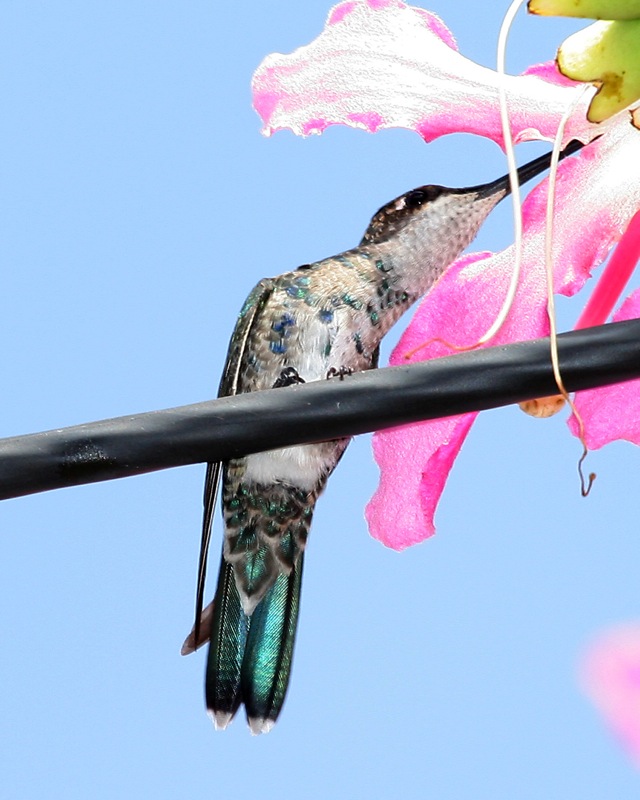
Stripe-breasted Starthroat Heliomaster squamosus
The scientific name of the Stripe-breasted Starthroat is Heliomaster squamosus. It is a species of bird in the family Trochilidae (hummingbird), order Apodiformes. The name dates from 1823.
- Scientific name
- Heliomaster squamosus (Temminck, 1823)
- Common name
- Stripe-breasted Starthroat
- Genus
- Heliomaster
- Family
- Trochilidae (Hummingbird)
- Order
- Apodiformes
- Class
- Aves
- Red List category
- LC Least Concern
- Recorded in
- 3 countries
- Name status
- accepted in the Catalogue of Life

Overview
The Stripe-breasted Starthroat is a large hummingbird. It inhabits forests and savannahs from sea level to 800 metres.
Written 26 November 2026 from the sources listed below. Each statement was checked against the passage it cites; statements that could not be supported were removed.
Appearance
Both sexes have a long, slightly curved black bill, a white streak behind the eye, and a white moustache. Both have forked tails, although the female's tail is less deeply indented than the male's.[1][2]
Breeding males have bronzy green upperparts and an iridescent green crown. Their throat has a glittering violet patch with outward-flaring sides, while their greenish-black underparts have a central white stripe.[3][4][5]
Females have upperparts similar to those of males and blackish-green throat feathers edged with white. Their chest and belly are grayish, with a central white stripe and greenish flanks.[6][7][8]
The female's green tail has a steel-blue band near the ends of its outer feathers and white tips. Males have a green body divided by a white stripe on the belly.[9][10]
Habitat
The species inhabits forests and savannahs, occurring in forest and semiopen habitats, including savannas. It occupies elevations from sea level to 800 metres.[11][12][13]
The species is endemic to Brazil, with a distribution extending from Pernambuco south to São Paulo state. It has been recorded as a vagrant in Iguazú National Park, Argentina.[14][15][16]
Diet
The species feeds on nectar from a wide variety of flowering plants. It also eats small insects captured while hawking.[17][18]
Behaviour
The species is essentially sedentary but occasionally wanders to higher elevations. It typically forages between 3 and 8 metres above the ground.[19][20]
The species is territorial and more strongly defends flower patches against members of its own species than against other hummingbirds.[21]
Its presumed song is a subdued, buzzy, scratchy warble. It also produces a liquid-sounding call.[22][23]
Reproduction and life cycle
The usual breeding season extends from February through April. Incubation has also been recorded in November.[24][25]
The species constructs a small cup-shaped nest, usually placed on a horizontal tree branch between 6 and 8 metres above the ground. Some nests have been observed higher than this, and at least one nest has been recorded on a utility wire.[26][27][28][29]
The female incubates a clutch of two eggs. Young birds fledge between 21 and 24 days after hatching.[30][31]
Conservation
The species has been classified as Least Concern since 2004. Its population size is unknown, but the population is believed to be stable.[32][33][34]
The species is considered locally common and occurs in at least one Brazilian national park. Its extremely large geographic range does not meet the range-size threshold for Vulnerable status.[35][36][37]
Classification of the Stripe-breasted Starthroat
| Kingdom | Animalia |
|---|---|
| Phylum | Chordata |
| Subphylum | Vertebrata |
| Infraphylum | Gnathostomata |
| Parvphylum | Osteichthyes |
| Megaclass | Tetrapoda |
| Class | Aves (Bird) |
| Order | Apodiformes (Swifts) |
| Family | Trochilidae (Hummingbird) |
| Subfamily | Trochilinae |
| Genus | Heliomaster (Starthroat) |
| Species | Heliomaster squamosus (Temminck, 1823) |
Where the Stripe-breasted Starthroat is found
Checklists and occurrence records place Heliomaster squamosus in 3 countries across South America. GBIF holds 5,608 georeferenced records of it.
Countries
Regions and cities with the most records
- São Paulo, Brazil 2,001
- Minas Gerais, Brazil 1,781
- Bahia, Brazil 735
- Pinhalzinho, Brazil 527
- Socorro, Brazil 473
- Amparo, Brazil 410
- Serra Negra, Brazil 399
- Goiás, Brazil 361
- Rio Claro, Brazil 223
- Santa Gertrudes, Brazil 213
- Cordeirópolis, Brazil 194
- Araras, Brazil 190
- Canudos, Brazil 113
- Rio Grande do Norte, Brazil 106
- Pernambuco, Brazil 104
- Arinos, Brazil 98
- Montes Claros, Brazil 98
- Iracemápolis, Brazil 95
- Paraíba, Brazil 91
- Botucatu, Brazil 83
- Belo Horizonte, Brazil 81
- Rio de Janeiro, Brazil 79
- Souzas, Brazil 79
- Itanhandu, Brazil 73
- Uberlândia, Brazil 69
- Campinas, Brazil 66
- Itatiba, Brazil 66
- Araraquara, Brazil 65
- Contagem, Brazil 65
- Mário Campos, Brazil 65
- Valinhos, Brazil 64
- Vinhedo, Brazil 62
- Cabreúva, Brazil 59
- Ibirité, Brazil 55
- Brumadinho, Brazil 54
- Ceará, Brazil 54
Range as the checklists state it
South America
A number beside a place is its count of GBIF occurrence records. A place without a number comes from a checklist alone. Records show where a species has been observed or collected, which can include escapes and vagrants.
Common names
English
- Stripe-breasted Starthroat
Names in 24 other languages
- Catalan
- colibrí escatós
- Chinese
- 紋胸星喉蜂鳥, 纹胸星喉蜂鸟
- Croatian
- ljubičastobradi kolibrić
- Czech
- kolibřík fialovolímcový
- Danish
- Grøn Stjernestrube
- Dutch
- Gestreepte Sterkeelkolibrie
- Esperanto
- stribrusta stelkolibro
- Finnish
- brasiliansäiläkolibri
- French
- Colibri médiastin, Gemme médiastin
- German
- Temminck-Kolibri, Violettkehlkolibri
- Hungarian
- pikkelyes bíborbegy
- Italian
- Golastella pettostriato
- Japanese
- シロスジハチドリ
- Lithuanian
- dryžakrūtis angelas
- Norwegian
- båndstjernestrupe
- Polish
- aksamitek łuskowany
- Portuguese
- bico-reto-de-banda-branca, colibri-de-peito-riscado
- Russian
- Аметистовогорлый ангел, Полосатогрудый ангел
- Slovak
- medovec bielopásy
- Spanish
- Colibrí escamoso, Picaflor Garganta Escamada, Picaflor escamado
- Swedish
- grön stjärnkolibri
- Turkish
- Ak Şeritli Yıldızlıgerdan
- Ukrainian
- колібрі-ангел фіолетововусий, колібрі-янгол фіолетововусий
- Welsh
- sïedn gyddfseren bronrhesen
Synonyms
2 other scientific names have been used for this species and are now treated as synonyms of Heliomaster squamosus.
- Trochilus mesoleucus Temminck, CJ, 1824
- Trochilus squamosus Temminck, 1823
Related species
-
 Long-billed StarthroatHeliomaster longirostris
-
 Plain-capped StarthroatHeliomaster constantii
-
 Blue-tufted StarthroatHeliomaster furcifer
-
 Bee HummingbirdMellisuga helenae
-
 Anna's HummingbirdCalypte anna
-
 Ruby-throated HummingbirdArchilochus colubris
-
 Rufous HummingbirdSelasphorus rufus
-
 White-booted Racket-tailOcreatus underwoodii
Compare
Questions and answers
What is the scientific name of the Stripe-breasted Starthroat?
The scientific name of the Stripe-breasted Starthroat is Heliomaster squamosus. Written with its author, the full name is Heliomaster squamosus (Temminck, 1823).
Which family does the Stripe-breasted Starthroat belong to?
Heliomaster squamosus belongs to the family Trochilidae, in the order Apodiformes and the class Aves.
Where is the Stripe-breasted Starthroat found?
Checklists and occurrence records place Heliomaster squamosus in 3 countries: Brazil, Argentina and Colombia.
What is the conservation status of the Stripe-breasted Starthroat?
The IUCN Red List category recorded for Heliomaster squamosus is Least Concern (LC).
Sources
Passages the profile rests on
- Both sexes have a long, slightly curved black bill, a white streak behind the eye, and a white moustache. Source passage: “Both sexes have a long, slightly decurved, black bill, a white streak behind the eye, and a white "moustache".” — English Wikipedia
- Both sexes have forked tails, although the female's tail is less deeply indented than the male's. Source passage: “Both have a forked tail but the female's is less deeply indented than the male's.” — English Wikipedia
- Breeding males have bronzy green upperparts and an iridescent green crown. Source passage: “Males in breeding plumage have bronzy green upperparts with an iridescent green crown.” — English Wikipedia
- Breeding males have a glittering violet throat patch with outward-flaring sides. Source passage: “Their gorget is glittering violet and the sides of it flare out.” — English Wikipedia
- Breeding males have greenish-black underparts with a central white stripe. Source passage: “Their underparts are greenish-black with a white stripe down the middle.” — English Wikipedia
- Females have upperparts similar to those of males. Source passage: “Females' upperparts are like the male's.” — English Wikipedia
- The female has blackish-green throat feathers edged with white. Source passage: “The throat feathers are blackish green with white edges.” — English Wikipedia
- The female has grayish chest and belly plumage with a central white stripe and greenish flanks. Source passage: “The chest and belly are grayish with a white stripe down the middle and the flanks are greenish.” — English Wikipedia
- The female's green tail has a steel-blue band near the ends of its outer feathers and white tips. Source passage: “The tail is green and the outer feathers have a steel blue band near the end and white tips.” — English Wikipedia
- Males have a green body divided by a white stripe on the belly. Source passage: “Males have a green body bisected by a white stripe on the belly.” — ebird.org
- The species inhabits forests and savannahs. Source passage: “It inhabits forest and savannah at elevations from sea level to 800 m (2,600 ft).” — English Wikipedia
- The species occurs in forest and semiopen habitats, including savannas. Source passage: “A large hummingbird found in forest and semiopen habitats such as savannas.” — ebird.org
- The species occupies elevations from sea level to 800 metres. Source passage: “at elevations from sea level to 800 m (2,600 ft).” — English Wikipedia
- The species is endemic to Brazil. Source passage: “It is endemic to Brazil.” — English Wikipedia
- Its Brazilian distribution extends from Pernambuco south to São Paulo state. Source passage: “The stripe-breasted starthroat is found in eastern Brazil from Pernambuco south to São Paulo state.” — English Wikipedia
- The species has been recorded as a vagrant in Iguazú National Park, Argentina. Source passage: “It has also been recorded as a vagrant in Argentina's Iguazú National Park.” — English Wikipedia
- The species feeds on nectar from a wide variety of flowering plants. Source passage: “The stripe-breasted starthroat feeds on nectar from a wide variety of flowering plants.” — English Wikipedia
- The species also eats small insects captured while hawking. Source passage: “In addition to nectar, it also feeds on small insects captured by hawking.” — English Wikipedia
- The species is essentially sedentary but occasionally wanders to higher elevations. Source passage: “The stripe-breasted starthroat is essentially sedentary but may occasionally wander to higher elevations than usual.” — English Wikipedia
- The species typically forages between 3 and 8 metres above the ground. Source passage: “It typically forages between 3 and 8 m (10 and 30 ft) above the ground.” — English Wikipedia
- The species is territorial and more strongly defends flower patches against members of its own species than against other hummingbirds. Source passage: “It is territorial, but defends flower patches from others of its species more than from other hummingbirds.” — English Wikipedia
- Its presumed song is a subdued, buzzy, scratchy warble. Source passage: “a subdued, buzzy scratchy warble 'bzzzrrrr..bzzzrrr..chi-chi-chi-chi..bzrrr'.” — English Wikipedia
- The species also produces a liquid-sounding call. Source passage: “It also makes "a liquid 'tsik'" call.” — English Wikipedia
- The usual breeding season extends from February through April. Source passage: “The stripe-breasted starthroat's breeding season is usually February to April” — English Wikipedia
- Incubation has also been recorded in November. Source passage: “but it has been recorded incubating in November.” — English Wikipedia
- The species constructs a small cup-shaped nest. Source passage: “It makes a small cup nest” — English Wikipedia
- Nests are usually placed on horizontal tree branches between 6 and 8 metres above the ground. Source passage: “usually sites it on a horizontal tree branch 6 to 8 m (20 to 30 ft) above the ground.” — English Wikipedia
- Some nests have been observed higher than the usual nesting height. Source passage: “Some nests have been seen higher” — English Wikipedia
- At least one nest has been recorded on a utility wire. Source passage: “at least one has been seen on a utility wire.” — English Wikipedia
- The female incubates a clutch of two eggs. Source passage: “The female incubates the clutch of two eggs” — English Wikipedia
- Young birds fledge between 21 and 24 days after hatching. Source passage: “fledging occurs 21 to 24 days after hatch.” — English Wikipedia
- The species has been classified as Least Concern since 2004. Source passage: “but since 2004 has rated it as being of Least Concern.” — English Wikipedia
- The species' population size is unknown. Source passage: “Though its population size is unknown” — English Wikipedia
- The species' population is believed to be stable. Source passage: “it is believed to be stable.” — English Wikipedia
- The species is considered locally common. Source passage: “It is considered to be locally common” — English Wikipedia
- The species occurs in at least one Brazilian national park. Source passage: “and occurs in at least one Brazilian national park.” — English Wikipedia
- The species has an extremely large geographic range that does not meet the range-size threshold for Vulnerable status. Source passage: “This species has an extremely large range, and hence does not approach the thresholds for Vulnerable under the range size criterion” — datazone.birdlife.org
Data
- Catalogue of Life, 2026-10-16 XR cc by
- Global Biodiversity Information Facility CC BY 4.0
- Wikidata CC0
- GeoNames CC BY 4.0
- Wikimedia Commons per image; credit shown with each image
- Within the Catalogue of Life, this name comes from The Integrated Taxonomic Information System cc0
References
- Gill, Frank, & and Minturn Wright. (2006). Birds of the World: Recommended English Names.
This species in other databases
Page built on 27 November 2026. See how the catalog is made and all sources and licences.
Cite this page
ScientificNames.org. (2026). Heliomaster squamosus (Stripe-breasted Starthroat). Retrieved November 27, 2026, from https://scientificnames.org/species/heliomaster-squamosus
“Heliomaster squamosus (Stripe-breasted Starthroat).” ScientificNames.org, 2026, scientificnames.org/species/heliomaster-squamosus. Accessed 27 Nov. 2026.
ScientificNames.org. “Heliomaster squamosus (Stripe-breasted Starthroat).” Accessed November 27, 2026. https://scientificnames.org/species/heliomaster-squamosus.
@misc{scientificnames_heliomaster_squamosus_stripe_breasted_starthroat,
  author = {{ScientificNames.org}},
  title = {Heliomaster squamosus (Stripe-breasted Starthroat)},
  year = {2026},
  url = {https://scientificnames.org/species/heliomaster-squamosus},
  note = {Accessed 2026-11-27}
}