Species · Reptiles
Arakan Forest Turtle Heosemys depressa
The scientific name of the Arakan Forest Turtle is Heosemys depressa. It is a species of reptile in the family Geoemydidae (geoemydid turtles), order Testudines. The name dates from 1875.
- Scientific name
- Heosemys depressa (Anderson, 1875)
- Common name
- Arakan Forest Turtle
- Genus
- Heosemys
- Family
- Geoemydidae (Geoemydid Turtles)
- Order
- Testudines
- Class
- Reptilia
- Red List category
- CR Critically Endangered
- Recorded in
- 2 countries
- Name status
- accepted in the Catalogue of Life
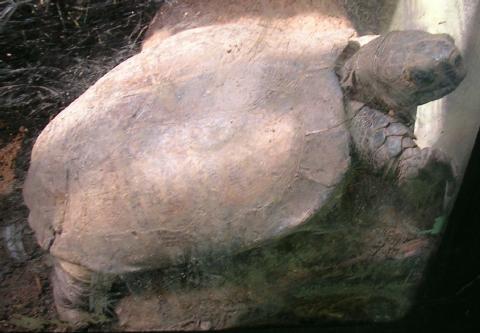
Overview
The species is native to the Arakan Hills in western Myanmar and the bordering Chittagong Hill Tracts in Bangladesh. The Arakan Forest Turtle is semiterrestrial.
Written 26 November 2026 from the sources listed below. Each statement was checked against the passage it cites; statements that could not be supported were removed.
Appearance
The species has a carapace length of 22 cm and weighs approximately 1.3 kg. It has 18 plastral annuli.[1][2][3]
Habitat
The Arakan Forest Turtle can survive in both aquatic and terrestrial habitats. Adult individuals prefer terrestrial habitats.[4][5]
Diet
The Arakan Forest Turtle is an omnivore that consumes both animal and plant matter. Its diet includes insects, worms, fish and fruit that falls to the forest floor.[6][7][8]
Behaviour
The species is active at night and increases its activity during the early wet season. It remains dormant for most of the time and hides among leaves and debris.[9][10][11][12]
The species is relatively reserved during most of its daily activity. It displays aggressive behaviour when feeding.[13][14]
Reproduction and life cycle
Eggs have been found in June and July inside female specimens examined by local hunters.[15]
Zoo Atlanta was the only institution reported to have successfully bred the species in captivity as of 2009.[16]
Conservation
The Arakan Forest Turtle is classified as critically endangered. Local people occasionally hunt and eat the species.[17][18]
Animal pet dealers in China trade individuals caught in western Myanmar. Nine individuals imported into the Czech Republic were sampled for research in 2003.[19][20]
Only a small number of individuals were recorded in captivity as of 2009.[21]
Classification of the Arakan Forest Turtle
| Kingdom | Animalia |
|---|---|
| Phylum | Chordata |
| Subphylum | Vertebrata |
| Infraphylum | Gnathostomata |
| Parvphylum | Osteichthyes |
| Megaclass | Tetrapoda |
| Class | Reptilia (Reptile) |
| Order | Testudines (Turtle) |
| Suborder | Cryptodira |
| Superfamily | Testudinoidea |
| Family | Geoemydidae (Geoemydid Turtles) |
| Genus | Heosemys (Forest Turtles) |
| Species | Heosemys depressa (Anderson, 1875) |
Where the Arakan Forest Turtle is found
Checklists and occurrence records place Heosemys depressa in 2 countries across Asia. GBIF holds 14 georeferenced records of it.
Countries
Regions and cities with the most records
Range as the checklists state it
Myanmar (= Burma) (hills in Arakan), Bangladesh
A number beside a place is its count of GBIF occurrence records. A place without a number comes from a checklist alone. Records show where a species has been observed or collected, which can include escapes and vagrants.
Common names
English
- Arakan Forest Turtle
Names in 5 other languages
- Chinese
- 扁東方龜
- Czech
- želva zploštělá
- German
- Arakanerdschildkröte, Flache Erdschildkröte
- Hungarian
- lapos partiteknős
- Japanese
- ヒラタヤマガメ
Synonyms
3 other scientific names have been used for this species and are now treated as synonyms of Heosemys depressa.
- Geoemyda arakana Theobald, 1876
- Geoemyda depressa Anderson, 1875
- Geomyda arakana Theobald, 1876
Related species
-
 Spiny TurtleHeosemys spinosa
-
 Giant Asian Pond TurtleHeosemys grandis
-
 Yellow-headed Temple TurtleHeosemys annandalii
-
 Chinese Pond TurtleMauremys reevesii
-
 Black-breasted Leaf TurtleGeoemyda spengleri
-
 Amboina Box TurtleCuora amboinensis
-
 Philippine Forest TurtleSiebenrockiella leytensis
-
 Painted TerrapinBatagur borneoensis
Compare
Questions and answers
What is the scientific name of the Arakan Forest Turtle?
The scientific name of the Arakan Forest Turtle is Heosemys depressa. Written with its author, the full name is Heosemys depressa (Anderson, 1875).
Which family does the Arakan Forest Turtle belong to?
Heosemys depressa belongs to the family Geoemydidae, in the order Testudines and the class Reptilia.
Where is the Arakan Forest Turtle found?
Checklists and occurrence records place Heosemys depressa in 2 countries: Myanmar and Bangladesh.
What is the conservation status of the Arakan Forest Turtle?
The IUCN Red List category recorded for Heosemys depressa is Critically Endangered (CR).
What do turtles eat in their natural habitat?
The Arakan Forest Turtle is an omnivore. It eats insects, worms, fish and fruit that falls to the forest floor.[6][7][8]
Is a turtle a carnivore or omnivore?
The Arakan Forest Turtle is an omnivore that consumes both animal and plant matter.[6]
Sources
Passages the profile rests on
- The species has a carapace length of 22 cm. Source passage: “a carapace length of 22 cm (8.7 in)” — English Wikipedia
- The species weighs approximately 1.3 kg. Source passage: “weighs 1.3 kg (2.9 lb).” — English Wikipedia
- The species has 18 plastral annuli. Source passage: “has 18 plastral annuli” — English Wikipedia
- The species can survive in both aquatic and terrestrial habitats. Source passage: “it can survive in aquatic as well as terrestrial habitats” — English Wikipedia
- Adult individuals prefer terrestrial habitats. Source passage: “adults prefer living in terrestrial habitats.” — English Wikipedia
- The species is an omnivore that consumes both animal and plant matter. Source passage: “It is an omnivore, feeding on both animals and plants.” — English Wikipedia
- The species eats insects, worms and fish. Source passage: “it comes to eating insects, worms, and fish.” — English Wikipedia
- The species consumes fruit that falls to the forest floor. Source passage: “It also consumes fruit that falls to the forest floor.” — English Wikipedia
- The species is active at night. Source passage: “The Arakan forest turtle is active at night” — English Wikipedia
- The species increases its activity during the early wet season. Source passage: “increases its activity during the early wet season.” — English Wikipedia
- The species remains dormant for most of the time. Source passage: “It remains dormant the majority of the time” — English Wikipedia
- The species hides among leaves and debris. Source passage: “hides in leaves and debris.” — English Wikipedia
- The species is relatively reserved during most of its daily activity. Source passage: “it is considered a relatively reserved animal for the majority of its daily activity” — English Wikipedia
- The species displays aggressive behaviour when feeding. Source passage: “it is aggressive when it comes to eating insects, worms, and fish.” — English Wikipedia
- Eggs of the species have been found in June and July inside female specimens examined by local hunters. Source passage: “Local hunters found eggs in June and July when skinning female specimens” — English Wikipedia
- Zoo Atlanta was the only institution reported to have successfully bred the species in captivity as of 2009. Source passage: “only the Zoo Atlanta has successfully bred the turtles in captivity.” — English Wikipedia
- The species is classified as critically endangered. Source passage: “is a critically endangered turtle species” — English Wikipedia
- Local people occasionally hunt and eat the species. Source passage: “locals do occasionally hunt and eat them.” — English Wikipedia
- Animal pet dealers in China trade individuals caught in western Myanmar. Source passage: “Arakan forest turtles are being traded by animal pet dealers in China, who catch them in western Myanmar.” — English Wikipedia
- Nine individuals imported into the Czech Republic were sampled for research in 2003. Source passage: “In 2003, researchers took samples for research from nine Arakan forest turtles that had been imported to the Czech Republic” — English Wikipedia
- Only a small number of individuals were recorded in captivity as of 2009. Source passage: “As of 2009, a small number of turtles were present in captivity” — English Wikipedia
Data
- Catalogue of Life, 2026-10-16 XR cc by
- Global Biodiversity Information Facility CC BY 4.0
- Wikidata CC0
- GeoNames CC BY 4.0
- Wikimedia Commons per image; credit shown with each image
- Within the Catalogue of Life, this name comes from The Reptile Database cc by
References
- Anderson, J. (1875) Description of some new Asiatic mammals and Chelonia. Annals and Magazine of Natural History, (4) 16, 282 - 285. https: // doi. org / 10.1080 / 00222937508681848 where the name was published
- Anderson, J. (1875). Description of some new Asiatic mammals and Chelonia. Ann. Mag. Nat. Hist. (4) 16: 282-285.
- Smith, Malcolm A. (1931). The Fauna of British India Including Ceylon and Burma. Reptilia and Amphibia Volume I.—Loricata, Testudines. Taylor and Francis, London, 185 Pp.
- Iverson, J. B. (1986). A Checklist with Distribution Maps of the Turtles of the World. Paust Printing, Richmond, Indiana. Viii + 282 Pp.
- Ernst,C.H. and Barbour,R.W. (1989). Turtles of the World. Smithsonian Institution Press, Washington D.C. - London.
- Iverson, John B.;McCord, William P. (1997). Redescription of the Arakan Forest Turtle Geoemyda depressa Anderson 1875 (Testudines: Bataguridae). Chelonian Conserv. Biol. 2 (3): 384-389.
- Platt, S. G., S. A. Min, W. K. Ko and T. R. Rainwater. (2003). A record of the Arakan forest turtle Heosemys depressa (Anderson, 1875) from the southern Arakan Yoma Hills, Myanmar. Hamadryad 27 (2):273-276.
- Schilde, M. (2004). Asiatische Sumpfschildkröten - Die Familie Geoemydidae in Südostasien, China und Japan. Natur Und Tier Verlag (Münster), 192 Pp.
- Meier, E. (2004). Das Internationale Zentrum für Schildkrötenschutz (IZS) füllt sich mit Leben. Elaphe 12 (2): 60-64.
- Joyce, Walter G. and Christopher J. Bell. (2004). A review of the comparative morphology of extant testudinoid turtles (Reptilia: Testudines). Asiatic Herpetological Research 10: 53-109.
- Kunz, K. (2009). Flache Erdschildkröte wiederentdeckt. Reptilia (Münster) 14 (79): 8.
- Platt, Steven G., Win ko Ko, Kalyar Platt, Khin Myo Myo, Me Me Soe and Thomas R. Rainwater. (2012). Species inventory and conservation status of chelonians in Natma Taung National Park, Myanmar. Hamadryad 36 (1): 1-11.
- TTWG [Peter Paul van Dijk, John B. Iverson, Anders G.J. Rhodin, H. Bradley Shaffer, and Roger Bour]. (2014). Turtles of the World, 7th Edition: Annotated Checklist of Taxonomy, Synonymy, Distribution with Maps, and Conservation Status. 000.v7. Chelonian Research Monographs (ISSN 1088-7105) No. 5, Doi:10.3854/Crm.5.000.Checklist.V7.2014.
- Platt, Steven G.; Kalyar Platt, Lay Lay Khaing, Thin Thin Yu, Me Me Soe, San San Nwe, Thet Zaw Naing, and Thomas R. Rainwater. (2014). Heosemys depressa in the Southern Chin Hills of Myanmar: A Significant Range Extension and Traditional Ecological Knowledge. Chelonian Conservation and Biology Dec 2014, Vol. 13, No. 2: 252-256.
- Purkayastha, J., DAS, I., & Sengupta, S. (2015). Freshwater Turtles & Tortoises of South Asia. Bhabani Books, 138 Pp.
- Wyrich, Luke, Robert HIll and Brad Lock. (2015). Captive husbandry of the Arakan Forest turtle (Heosemys depressa) and its implications for conservation. Herpetological Review 46 (1): 49-54.
- Rahman, Shahriar Caesar; Sheikh M.A. Rashid, Rupa Datta, Passing Mro, and Chirag J. Roy. (2015). Status, Exploitation, and Conservation of Freshwater Turtles and Tortoises in Chittagong Hill Tracts, Bangladesh. Chelonian Conservation and Biology Dec 2015, Vol. 14, No. 2: 130-135.
- Das, Indraneil, & Abhijit Das. (2017). A Naturalist’s Guide to the Reptiles of India, Bangladesh, Bhutan, Nepal, Pakistan and Sri Lanka. John Beaufoy Publishing Ltd., Oxford, 176 Pp.
- TTWG; Rhodin, A.G.J., Iverson, J.B., Bour, R., Fritz, U., Georges, A., Shaffer, H.B., and van Dijk, P.P. (2021). Turtles of the World: Annotated Checklist and Atlas of Taxonomy, Synonymy, Distribution, and Conservation Status (9th Ed.). In: Rhodin, A.G.J., Iverson, J.B., van Dijk, P.P., Stanford, C.B., Goode, E.V., Buhlmann, K.A., and Mittermeier, R.A. (Eds.). Conservation Biology of Freshwater Turtles and Tortoises: A Compilation Project of the IUCN/SSC Tortoise and Freshwater Turtle Specialist Group. Chelonian Research Monographs 8:1–472. Doi:10.3854/Crm.8.Checklist.Atlas.V9.2021.
- PLATT, STEVEN G.; HTUN THU, NATHAN A. HAISLIP & THOMAS R. RAINWATER. (2022). HEOSEMYS DEPRESSA (Arakan Forest Turtle). NESTING BEHAVIOR and REPRODUCTION. Herpetological Review 53 (3): 488–490.
- Lindken T.; Anderson, C. V., Ariano-Sánchez, D., Barki, G., Biggs, C., Bowles, P., Chaitanya, R., Cronin, D. T., Jähnig, S. C., Jeschke, J. M., Kennerley, R. J., Lacher, T. E. Jr., Luedtke, J. A., Liu, C., Long, B., Mallon, D., Martin, G. M., Meiri, S., Pasachnik, S. A. ... Evans, T. (2024). What factors influence the rediscovery of lost tetrapod species? Global Change Biology, 30: 1-18.
- TTWG [TURTLE TAXONOMY WORKING GROUP: RHODIN, A.G.J., IVERSON, J.B., FRITZ, U., GALLEGO-GARCÍA, N., GEORGES, A., SHAFFER, H.B., AND VAN DuK, P.P.]. (2025). Turtles of the World: Annotated Checklist and Atlas of Taxonomy, Synonymy, Distribution, and Conservation Status (10th Ed.). In: Rhodin, A.G.J., Iverson, J.B., van Dijk, P.P., Stanford, C.B., Goode, E.V., Buhlmann, K.A., and Mittermeier, R.A. (Eds.). Conservation Biology of Freshwater Turtles and Tortoises: A Compilation Project of the IUCN SSC Tortoise and Freshwater Turtle Specialist Group. Chelonian Research Monographs 10:1-575.
This species in other databases
Page built on 29 November 2026. See how the catalog is made and all sources and licences.
Cite this page
ScientificNames.org. (2026). Heosemys depressa (Arakan Forest Turtle). Retrieved November 29, 2026, from https://scientificnames.org/species/heosemys-depressa
“Heosemys depressa (Arakan Forest Turtle).” ScientificNames.org, 2026, scientificnames.org/species/heosemys-depressa. Accessed 29 Nov. 2026.
ScientificNames.org. “Heosemys depressa (Arakan Forest Turtle).” Accessed November 29, 2026. https://scientificnames.org/species/heosemys-depressa.
@misc{scientificnames_heosemys_depressa_arakan_forest_turtle,
  author = {{ScientificNames.org}},
  title = {Heosemys depressa (Arakan Forest Turtle)},
  year = {2026},
  url = {https://scientificnames.org/species/heosemys-depressa},
  note = {Accessed 2026-11-29}
}