Species · Reptiles
Spiny Turtle Heosemys spinosa
The scientific name of the Spiny Turtle is Heosemys spinosa. It is a species of reptile in the family Geoemydidae (geoemydid turtles), order Testudines. The name dates from 1831.
- Scientific name
- Heosemys spinosa (Gray, 1831)
- Common name
- Spiny Turtle
- Genus
- Heosemys
- Family
- Geoemydidae (Geoemydid Turtles)
- Order
- Testudines
- Class
- Reptilia
- Red List category
- EN Endangered
- Environment
- freshwater
- Recorded in
- 6 countries
- Name status
- accepted in the Catalogue of Life

Overview
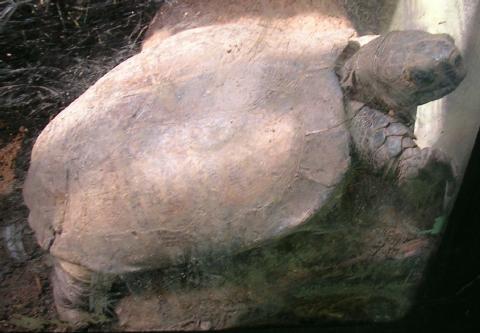
The Spiny Turtle (Heosemys spinosa) is a reptile in the family Geoemydidae, order Testudines, and class Reptilia. The species inhabits lowland and hill rainforests, generally near streams in hilly and mountainous areas, at elevations between 170 and 1,000 m above sea level. The Spiny Turtle has a brown shell, red spots on its head, and a spiky-edged carapace with a spiny keel.
Written 26 November 2026 from the sources listed below. Each statement was checked against the passage it cites; statements that could not be supported were removed.
Appearance
The Spiny Turtle has a brown shell and a head marked with red spots. Its carapace has spiky edges, marginal scutes, and a spiny keel.[1][2]
Juveniles have black-striped and yellow shell undersides that fade as they mature. The serrations along the carapace margin become smaller with age and remain only along the rear margin.[3][4]
Adult carapace length typically ranges from 175 to 220 mm. Adult body mass ranges from 1.5 to 2.0 kg.[5][6]
Habitat
The species inhabits lowland and hill rainforests, generally near small streams in hilly areas. It also occurs along brooks in forested areas, particularly in mountainous locations.[7][8]
The species has been recorded at elevations between 170 and 1,000 m above sea level.[9]
The species is recorded in Brunei, Indonesia, Malaysia, Myanmar, the Philippines, Singapore, and Thailand.[10]
Diet
The Spiny Turtle consumes carrion, insects, fruits, and plants. Fruit from the yin-ngan tree is an especially important food source.[11][12]
Captive juveniles consume fruit salads several times per week, particularly salads containing tomatoes.[13]
Behaviour
The species buries itself in leaf litter during the day for camouflage and emerges at night to forage.[14]
Reproduction and life cycle
Mating occurs in December and February and appears to be triggered by rainfall. Females can produce up to three clutches annually.[15][16]
Females lay one or two eggs per nest in the wild. A hinge develops in the female's plastron before egg laying to facilitate delivery.[17][18]
Eggs are generally partially covered with substrate after laying. They have been found in protected locations beneath cork bark or thick foliage.[19][20]
Captive breeding attempts have often failed because the eggshells are thick and can burst when the substrate is excessively damp.[21]
The first successful captive copulation occurred in 1991 at Zoo Atlanta. A spiny turtle hatched at Chester Zoo in the United Kingdom in 2013.[22][23]
A documented captive incubation lasted 106 days. During the first 35 days, the egg was kept at 28–30°C, and during the final 71 days, the temperature was reduced to 26–28°C.[24][25][26]
Conservation
The species was classified as vulnerable by the IUCN in 1996. In 2000, it was classified as endangered following a halving of its supply in the Chinese food market.[27][28]
Forest destruction for oil palm plantations is identified as a major threat, particularly in southern Myanmar. Participation in the international pet trade has also contributed to the species' decline.[29][30]
Use in traditional Chinese medicine has contributed to the species' decline. The species is protected under the Philippines Wildlife Act.[31][32]
Similar species
The Spiny Turtle belongs to the genus Heosemys, which contains four species. Relationships among the four species in the genus remain undetermined.[33][34]
The species is also known as the cog-wheel turtle.[35]
A proposed mainland form occurs in Malaysia, Thailand, and southern Myanmar. A proposed insular form occurs in Indonesia and the Philippines, and possibly also in Brunei and Singapore.[36][37]
Classification of the Spiny Turtle
| Kingdom | Animalia |
|---|---|
| Phylum | Chordata |
| Subphylum | Vertebrata |
| Infraphylum | Gnathostomata |
| Parvphylum | Osteichthyes |
| Megaclass | Tetrapoda |
| Class | Reptilia (Reptile) |
| Order | Testudines (Turtle) |
| Suborder | Cryptodira |
| Superfamily | Testudinoidea |
| Family | Geoemydidae (Geoemydid Turtles) |
| Genus | Heosemys (Forest Turtles) |
| Species | Heosemys spinosa (Gray, 1831) |
Where the Spiny Turtle is found
Checklists and occurrence records place Heosemys spinosa in 6 countries across Asia. GBIF holds 463 georeferenced records of it.
Countries
Regions and cities with the most records
- Novena, Singapore 57
- Queenstown Estate, Singapore 55
- Singapore, Singapore 55
- Bukit Timah, Singapore 54
- Anak Bukit, Singapore 53
- Ang Mo Kio New Town, Singapore 49
- Yio Chu Kang, Singapore 49
- MacPherson, Singapore 48
- Eunos, Singapore 47
- Jurong East, Singapore 46
- Marine Parade, Singapore 46
- Sengkang New Town, Singapore 46
- Jurong Town, Singapore 44
- Choa Chu Kang New Town, Singapore 43
- Jurong West, Singapore 43
- Keat Hong Village, Singapore 43
- Teck Whye, Singapore 43
- Bedok New Town, Singapore 42
- Bukit Panjang New Town, Singapore 42
- Ulu Bedok, Singapore 42
- Boon Lay, Singapore 40
- Matilda Estate, Singapore 40
- Yishun New Town, Singapore 39
- Kampong Pasir Ris, Singapore 38
- Yew Tee, Singapore 38
- Sabah, Malaysia 37
- Punggol, Singapore 36
- Kampong Loyang, Singapore 34
- Sungai Simpang, Singapore 34
- Marsiling, Singapore 32
- Woodlands, Singapore 31
- Alam Damai, Malaysia 30
- Bandar Tun Hussein Onn, Malaysia 30
- Desa Petaling, Malaysia 30
- Kuchai Lama, Malaysia 30
- Sri Petaling, Malaysia 30
1 more country has a few records outside this range
These countries hold a few records of Heosemys spinosa but lie outside the range the checklists give for it. Such records are often zoo or garden specimens, museum material or vagrants, so the species is not counted as occurring there.
Range as the checklists state it
Myanmar (= Burma) (Tenasserim), Philippines,
A number beside a place is its count of GBIF occurrence records. A place without a number comes from a checklist alone. Records show where a species has been observed or collected, which can include escapes and vagrants.
Common names
English
- Spiny Turtle
- Spiny Terrapin
- Sunburst Turtle
Names in 10 other languages
- Chinese
- 太陽龜
- Czech
- želva ostnitá
- Danish
- Pigskildpadde
- French
- Héosémyde épineuse
- German
- Stachel-Erdschildkröte, Stachelrand-Schildkröte, Stachelrandschildkröte
- Hungarian
- tüskés partiteknős
- Indonesian
- Kura-kura Duri, Kura-kura Matahari
- Japanese
- トゲヤマガメ
- Russian
- Колючая черепаха
- Thai
- เต่าจักร
Synonyms
3 other scientific names have been used for this species and are now treated as synonyms of Heosemys spinosa.
- Emys spinosa Gray, 1831
- Emys spinosae Bell
- Geoemyda spinosa (Gray, 1831)
Related species
-
 Giant Asian Pond TurtleHeosemys grandis
-
 Arakan Forest TurtleHeosemys depressa
-
 Yellow-headed Temple TurtleHeosemys annandalii
-
 Chinese Pond TurtleMauremys reevesii
-
 Black-breasted Leaf TurtleGeoemyda spengleri
-
 Amboina Box TurtleCuora amboinensis
-
 Philippine Forest TurtleSiebenrockiella leytensis
-
 Painted TerrapinBatagur borneoensis
Compare
Questions and answers
What is the scientific name of the Spiny Turtle?
The scientific name of the Spiny Turtle is Heosemys spinosa. Written with its author, the full name is Heosemys spinosa (Gray, 1831).
Which family does the Spiny Turtle belong to?
Heosemys spinosa belongs to the family Geoemydidae, in the order Testudines and the class Reptilia.
Where is the Spiny Turtle found?
Checklists and occurrence records place Heosemys spinosa in 6 countries: Malaysia, Indonesia, Singapore, Thailand, Myanmar and Philippines.
What is the conservation status of the Spiny Turtle?
The IUCN Red List category recorded for Heosemys spinosa is Endangered (EN).
What other names does the Spiny Turtle have?
Heosemys spinosa is also known in English as Spiny Terrapin and Sunburst Turtle.
What is the scientific classification of turtles?
The Spiny Turtle (Heosemys spinosa) belongs to class Reptilia, order Testudines, and family Geoemydidae.[33]
Sources
Passages the profile rests on
- The spiny turtle has a brown shell and a head marked with red spots. Source passage: “The spiny turtle is a medium-sized turtle with a brown shell and red-spotted head.” — English Wikipedia
- The species has a spiky-edged carapace, marginal scutes, and a spiny keel. Source passage: “it derives its name from its spiky-edged carapace, marginal scutes, and spiny keel.” — English Wikipedia
- Juveniles have black-striped and yellow shell undersides that fade as they mature. Source passage: “As juvenile spiny turtles become adults, the black striped and yellow underside of their shell fades in color.” — English Wikipedia
- The serrations along the carapace margin become smaller with age and remain only along its rear margin. Source passage: “the juveniles' serrations, or jagged edges, at the carapace margin decrease in size and become restricted to the carapace's rear margin.” — English Wikipedia
- Adult carapace length typically ranges from 175 to 220 mm. Source passage: “Adult spiny turtles' carapace length usually falls between 175 mm to 220 mm” — English Wikipedia
- Adult body mass ranges from 1.5 to 2.0 kg. Source passage: “their mass ranges from 1.5 kg to 2.0 kg.” — English Wikipedia
- The species inhabits lowland and hill rainforests, generally near small streams in hilly areas. Source passage: “It inhabits lowland and hill rainforest, usually dwelling in the vicinity of small streams in hill areas” — English Wikipedia
- The species occurs along brooks in forested areas, particularly in mountainous locations. Source passage: “It lives along brooks in forested areas, usually in mountains” — English Wikipedia
- The species has been recorded at elevations between 170 and 1,000 m above sea level. Source passage: “usually in mountains with altitudes of 170 m to 1,000 m above sea level.” — English Wikipedia
- The species is recorded in Brunei, Indonesia, Malaysia, Myanmar, the Philippines, Singapore, and Thailand. Source passage: “The spiny turtle is known from Brunei, Indonesia, Malaysia, Myanmar, the Philippines, Singapore, and Thailand.” — English Wikipedia
- The species consumes carrion, insects, fruits, and plants. Source passage: “the spiny turtle also eats carrion and insects alongside fruits and plants.” — English Wikipedia
- Fruit from the yin-ngan tree is an especially important food source. Source passage: “Fruit from the yin-ngan tree is especially important for the turtle” — English Wikipedia
- Captive juveniles consume fruit salads several times per week, particularly salads containing tomatoes. Source passage: “captive juvenile spiny turtles consume fruit salads multiple times a week, particularly those containing tomatoes.” — English Wikipedia
- The species buries itself in leaf litter during the day for camouflage and emerges at night to forage. Source passage: “The spiny turtle buries itself in leaf litter to camouflage during the day and only emerges at night, foraging for food.” — English Wikipedia
- Mating occurs in December and February and appears to be triggered by rainfall. Source passage: “Mating occurs in December and February, and appears to be triggered by rain.” — English Wikipedia
- Females can produce up to three clutches annually. Source passage: “produces up to three clutches annually.” — English Wikipedia
- Females lay one or two eggs per nest in the wild. Source passage: “the female lays one or two eggs in a nest” — English Wikipedia
- A hinge develops in the female's plastron before egg laying to facilitate delivery. Source passage: “To ease the delivery of the egg, a hinge forms in the female turtle's plastron before it is laid.” — English Wikipedia
- Eggs are generally partially covered with substrate after laying. Source passage: “The egg is usually covered with a partial layer of substrate” — English Wikipedia
- Eggs have been found in protected locations beneath cork bark or thick foliage. Source passage: “researchers have found eggs laid in a so-called "protected spot" underneath cork bark or thick foliage.” — English Wikipedia
- Captive breeding attempts have often failed because the eggshells are thick and can burst when the substrate is excessively damp. Source passage: “Many attempts at reproduction in captivity have proved unsuccessful due to the eggs' shells being thick and prone to bursting if the substrate is too damp.” — English Wikipedia
- The first successful captive copulation occurred in 1991 at Zoo Atlanta. Source passage: “The first successful copulation in captivity occurred in 1991 at Zoo Atlanta” — English Wikipedia
- A spiny turtle hatched at Chester Zoo in the United Kingdom in 2013. Source passage: “A spiny turtle hatching at the Chester Zoo in the UK in 2013” — English Wikipedia
- A documented captive incubation lasted 106 days. Source passage: “where incubation lasted for 106 days” — English Wikipedia
- During the first 35 days of the documented incubation, the egg was kept at 28–30°C. Source passage: “For the first 35 days, the egg was incubated at a temperature of 28-30°C” — English Wikipedia
- During the final 71 days of the documented incubation, the temperature was reduced to 26–28°C. Source passage: “for the last 71 days, the temperature was decreased to 26-28°C.” — English Wikipedia
- The species was classified as vulnerable by the IUCN in 1996. Source passage: “Labeled as "vulnerable" by the IUCN in 1996” — English Wikipedia
- The species was classified as endangered in 2000 following a halving of its supply in the Chinese food market. Source passage: “the spiny turtle became endangered in 2000 when the supply of the species declined by a half in the Chinese food market.” — English Wikipedia
- Forest destruction for oil palm plantations is identified as a major threat, particularly in southern Myanmar. Source passage: “the main threat to the spiny turtle has been the destruction of natural forests to create oil palm plantations, common in southern Myanmar.” — English Wikipedia
- Participation in the international pet trade has contributed to the species' decline. Source passage: “The spiny turtle's participation in the international pet trade” — English Wikipedia
- Use in traditional Chinese medicine has contributed to the species' decline. Source passage: “its use in traditional Chinese medicine has also led to its decline.” — English Wikipedia
- The species is protected under the Philippines Wildlife Act. Source passage: “the turtle is protected by the Philippines Wildlife Act and other initiatives.” — English Wikipedia
- The species belongs to the genus Heosemys, which contains four species. Source passage: “The classification of Heosemys incorporates four species: Heosemys annandalii, Heosemys depressa, Heosemys grandis, and Heosemys spinosa;” — English Wikipedia
- Relationships among the four species in the genus Heosemys remain undetermined. Source passage: “however, relationships between the four are undetermined.” — English Wikipedia
- The species is also known as the cog-wheel turtle. Source passage: “Also known as the "cog-wheel turtle,"” — English Wikipedia
- A proposed mainland form occurs in Malaysia, Thailand, and southern Myanmar. Source passage: “a "mainland form" dwelling in Malaysia, Thailand, and southern Myanmar” — English Wikipedia
- A proposed insular form occurs in Indonesia and the Philippines, and possibly also in Brunei and Singapore. Source passage: “an "insular form" found in Indonesia and the Philippines, possibly in Brunei and Singapore as well.” — English Wikipedia
Data
- Catalogue of Life, 2026-10-16 XR cc by
- Global Biodiversity Information Facility CC BY 4.0
- Wikidata CC0
- GeoNames CC BY 4.0
- Wikimedia Commons per image; credit shown with each image
- Within the Catalogue of Life, this name comes from The Reptile Database cc by
References
- Gray, J. E. (1831). A synopsis of the species of Class Reptilia. In: Griffith, E & E. Pidgeon: The animal kingdom arranged in conformity with its organisation by the Baron Cuvier with additional descriptions of all the species hither named, and of many before noticed [Vol. 9]. Whittaker, Treacher and Co., London: 481 + 110 Pp. [1830].
- Gray. J. E. (1834). Illustrations of Indian Zoology, chiefly selected from the collection of Major - General Hardwicke. Vol. 2. London (1833-1834): 263 Pp., 95 Plates.
- Duméril, A.M.C., and G. Bibron. (1835). Erpétologie Générale ou Histoire Naturelle Complète des Reptiles, Vol. 2. Librairie Encyclopédique de Roret, Paris, Iv + 680 P.
- Bell, T. (1836). A monograph of the Testudinata. London, 1836-1842 (Sometimes given as 1832-1836, Not Date given, Unnumbered Pages).
- Sowerby, & James de Carle and Edward Lear. (1872). Tortoises, terrapins, and turtles: drawn from life. London, Paris, and Frankfort :H. Sotheran, J. Baer & Co.
- Gray, J. E. (1873). Additional notes on the form of the bones in the sternum of very young tortoises, and their development. Ann. Mag. Nat. Hist. (4) 12: 319-323.
- Stejneger, L. (1902). Some generic names of turtles. Proc. Biol. Soc, Washington 15: 235-238.
- de Rooij, & de, N. (1915). The Reptiles of the Indo-Australian Archipelago. I. Lacertilia, Chelonia, Emydosauria. Leiden (E. J. Brill), Xiv + 384 Pp.
- Mertens, R. (1971). Die Stachelschildkröte (Heosemys spinosa) und ihre Verwandten. Salamandra 7 (2): 49-54.
- Bong Heang, & Kiew. (1987). An annotated checklist of the herpetofauna of Ulu Endau, Johore, Malaysia. Malayan Nature Journal 41 (2-3): 413-423.
- Ernst,C.H. and Barbour,R.W. (1989). Turtles of the World. Smithsonian Institution Press, Washington D.C. - London.
- Herman, Dennis W. (1993). Reproduction and management of the southeast Asian spiny turtle (Heosemys spinosa) in captivity. Herpetological Natural History 1 (1): 97-100.
- Becker, H. (1994). Bemerkungen zur Aufzucht und Haltung der Stachel-Erdschildkröte Heosemys spinosa (Gray,1831). . Herpetofauna 16 (91): 06-10.
- Das, & Indraneil. (1996). First record of Heosemys spinosa from the Philippines, with biogeographic notes. Chelonian Conserv. Biol. 2 (1): 80-82.
- Teo, R. C. H., & Rajathurai, S. (1997). Mammals, reptiles and amphibians in the Nature Reserves of Singapore - diversity, abundance and distribution. Proc. Nature Reserves Survey Seminar. Gardens’ Bulletin Singapore 49: 353-425.
- Fritz, U. (1997). Zum Vorkommen von Heosemys spinosa (GRAY 1831) auf den Philippinen (Reptilia: Testudines: Bataguridae). Faun. Abh. Mus. Tierk. Dresden 21 (7): 131-134.
- Manthey, U., & Grossmann, W. (1997). Amphibien & Reptilien Südostasiens. Natur Und Tier Verlag (Münster), 512 Pp. (ISBN 3-931587-12-6).
- Cox, Merel J.; Van Dijk, Peter Paul; Jarujin Nabhitabhata & Thirakhupt,Kumthorn. (1998). A Photographic Guide to Snakes and Other Reptiles of Peninsular Malaysia, Singapore and Thailand. Ralph Curtis Publishing, 144 Pp.
- Gaulke, M., & Fritz, U. (1998). Distribution patterns of batagurid turtles in the Philippines (Testudines: Bataguridae: Cuora, Cyclemys, Heosemys). Herpetozoa 11 (1/2): 3-12.
- Pauwels,O.S.G. et al. (2000). Herpetological investigations in Phang-Nga Province, southern Peninsular Thailand, with a list of reptile species and notes on their biology. Dumerilia 4 (2): 123-154.
- Grossmann, W., & Tillack, F. (2001). Bemerkungen zur Herpetofauna des Khao Lak, Phang Nga, thailändische Halbinsel. Teil II: Reptilia: Serpentes; Testudines; Diskussion. Sauria 23 (1): 25-40.
- Malkmus, R.; Manthey, U.; Vogel, G. Hoffmann, P. & Kosuch, J. (2002). Amphibians and reptiles of Mount Kinabalu (North Borneo). A.R.G. Ganther Verlag, Rugell, 404 Pp.
- Schilde, M. (2004). Asiatische Sumpfschildkröten - Die Familie Geoemydidae in Südostasien, China und Japan. Natur Und Tier Verlag (Münster), 192 Pp.
- Joyce, Walter G. and Christopher J. Bell. (2004). A review of the comparative morphology of extant testudinoid turtles (Reptilia: Testudines). Asiatic Herpetological Research 10: 53-109.
- Praschag, Peter; Christian Schmidt, Guido Fritzsch, Anke Müller, Richard Gemel and Uwe Fritz. (2006). Geoemyda silvatica, an enigmatic turtle of the Geoemydidae (Reptilia: Testudines), represents a distinct genus. Organisms Diversity and Evolution 6 (2): 151-162 [Erratum in 6 (3): 254].
This species in other databases
- Catalogue of Life 3KVXC
- Wikidata Q2532001
- iNaturalist 40005
- WoRMS urn:lsid:marinespecies.org:taxname:1527892
- ITIS 551925
Page built on 26 November 2026. See how the catalog is made and all sources and licences.
Cite this page
ScientificNames.org. (2026). Heosemys spinosa (Spiny Turtle). Retrieved November 26, 2026, from https://scientificnames.org/species/heosemys-spinosa
“Heosemys spinosa (Spiny Turtle).” ScientificNames.org, 2026, scientificnames.org/species/heosemys-spinosa. Accessed 26 Nov. 2026.
ScientificNames.org. “Heosemys spinosa (Spiny Turtle).” Accessed November 26, 2026. https://scientificnames.org/species/heosemys-spinosa.
@misc{scientificnames_heosemys_spinosa_spiny_turtle,
  author = {{ScientificNames.org}},
  title = {Heosemys spinosa (Spiny Turtle)},
  year = {2026},
  url = {https://scientificnames.org/species/heosemys-spinosa},
  note = {Accessed 2026-11-26}
}