Species · Insects
Heptaulacus testudinarius
Heptaulacus testudinarius has no English name on record in the checklists used here. It is a species of insect in the family Scarabaeidae (dung beetles), order Coleoptera. The name dates from 1775.
- Scientific name
- Heptaulacus testudinarius (Fabricius, 1775)
- Genus
- Heptaulacus
- Family
- Scarabaeidae (Dung Beetles)
- Order
- Coleoptera
- Class
- Insecta
- Recorded in
- 27 countries
- Name status
- accepted in the Catalogue of Life

Overview
Heptaulacus testudinarius is recorded in Armenia, Austria, Belarus, Belgium, Croatia, the Czech Republic, Denmark, Estonia, France, Germany, Great Britain, Hungary, Italy, Kazakhstan, Latvia, Lithuania, the Netherlands, Poland, Portugal, Russia, Slovakia, Slovenia, Spain, Sweden, Switzerland, Ukraine and Uzbekistan. It has an elongate, convex, moderately shiny, blackish body with yellowish pubescence and ferruginous elytra densely marked with blackish spots.
Written 27 November 2026 from the sources listed below. Each statement was checked against the passage it cites; statements that could not be supported were removed.
Appearance
Adults measure approximately 3–4.5 mm in length. The body is elongate, convex, moderately shiny and blackish, with yellowish pubescence.[1][2]
The elytra are ferruginous and densely marked with blackish spots.[3]
Habitat
Specimens have been collected in horse dung and found among rotting plants.[4][5]
Classification of Heptaulacus testudinarius
| Kingdom | Animalia |
|---|---|
| Phylum | Arthropoda |
| Subphylum | Hexapoda |
| Class | Insecta (Insect) |
| Order | Coleoptera (Beetle) |
| Suborder | Polyphaga |
| Series | Staphyliniformia |
| Superfamily | Scarabaeoidea |
| Family | Scarabaeidae (Dung Beetles) |
| Subfamily | Aphodiinae |
| Tribe | Aphodiini |
| Subtribe | Aphodiina |
| Genus | Heptaulacus |
| Species | Heptaulacus testudinarius (Fabricius, 1775) |
Where Heptaulacus testudinarius is found
Checklists and occurrence records place Heptaulacus testudinarius in 27 countries across Asia and Europe. GBIF holds 507 georeferenced records of it.
Countries
- Armenia
- Austria 13
- Belarus 1
- Belgium
- Croatia
- Czechia
- Denmark
- Estonia 3
- France 185
- Germany 5
- Hungary 2
- Italy 3
- Kazakhstan
- Latvia 1
- Lithuania
- Poland 15
- Portugal 10
- Russia
- Slovakia
- Slovenia
- Spain 214
- Sweden 1
- Switzerland 23
- The Netherlands 7
- Ukraine 2
- United Kingdom 22
- Uzbekistan
Regions and cities with the most records
- Madrid, Spain 32
- Auvergne-Rhône-Alpes, France 23
- England, United Kingdom 22
- Collado-Villalba, Spain 21
- Pays de la Loire, France 18
- Torrelodones, Spain 18
- Île-de-France, France 17
- Bourgogne-Franche-Comté, France 16
- Ticino, Switzerland 15
- Elbeuf, France 13
- Galapagar, Spain 13
- Le Grand-Quevilly, France 13
- Le Petit-Quevilly, France 13
- Provence-Alpes-Côte d'Azur, France 13
- Romsey, United Kingdom 13
- Rouen, France 13
- Saint-Étienne-du-Rouvray, France 13
- Sotteville-lès-Rouen, France 13
- Colmenar Viejo, Spain 11
- Mont-Saint-Aignan, France 11
- Occitanie, France 11
- Tres Cantos, Spain 11
- Blanquefort, France 10
- Bordeaux, France 10
- Bègles, France 10
- Cenon, France 10
- Cestas, France 10
- El Escorial, Spain 10
- Eysines, France 10
- Floirac, France 10
- Gradignan, France 10
- Hauts-de-France, France 10
- Le Bouscat, France 10
- Lormont, France 10
- Mérignac, France 10
- Pessac, France 10
Range as the checklists state it
Palaearctic(Armenia, Austria, Belarus, Belgium, Croatia, Czech Republic, Denmark, Estonia, France, Germany, Great Britain, Hungary, Italy, Kazakhstan, Latvia, Lithuania, Netherlands, Poland, Portugal, Russia, Slovakia, Slovenia, Spain, Sweden, Switzerland, Ukraine, Uzbekistan)
A number beside a place is its count of GBIF occurrence records. A place without a number comes from a checklist alone. Records show where a species has been observed or collected, which can include escapes and vagrants.
Common names
Names in 2 other languages
- German
- Englische Schildkrötenkäfer
- Swedish
- Sköldpaddsdyngbagge
Synonyms
One other scientific name has been used for this species and is now treated as a synonym of Heptaulacus testudinarius.
- Scarabaeus testudinarius Fabricius, 1775
Related species
- Heptaulacus pirazzolii
- Heptaulacus syrticola
- Heptaulacus koshantschikoffi
- Heptaulacus algarbiensis
- Heptaulacus brancoi
- Heptaulacus gadetinus
- Heptaulacus rasettii
-
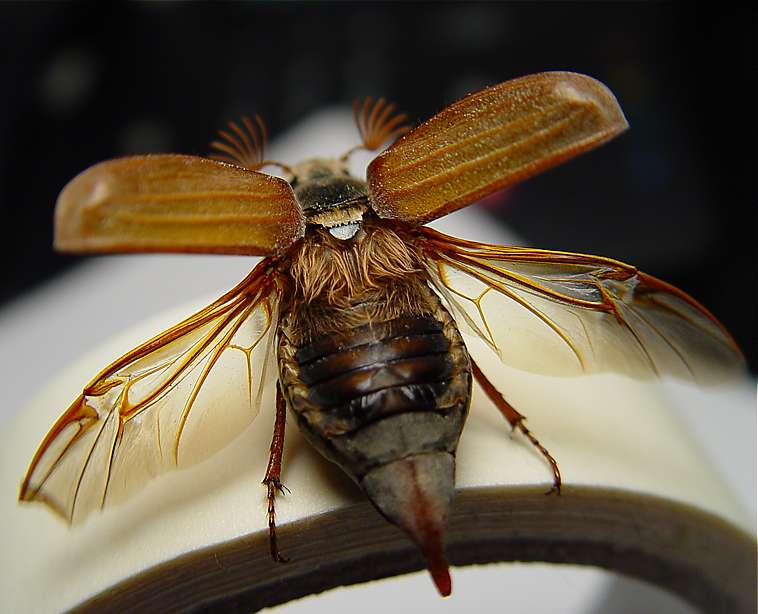 CockchaferMelolontha melolontha
Compare
Sources
Passages the profile rests on
- Adults measure approximately 3–4.5 mm in length. Source passage: “Adults reach a length of about 3–4.5 mm (0.12–0.18 in).” — English Wikipedia
- The adult beetle has an elongate, convex, moderately shiny, blackish body covered with yellowish pubescence. Source passage: “They have an elongate, convex, moderately shiny, yellowish pubescent, blackish body.” — English Wikipedia
- The elytra are ferruginous and densely marked with blackish spots. Source passage: “The elytra are ferrugineous and densely blackish spotted.” — English Wikipedia
- Specimens have been collected in horse dung. Source passage: “Specimens have been collected in horse dung” — English Wikipedia
- Specimens have also been found among rotting plants. Source passage: “but have also been found among rotting plants.” — English Wikipedia
Data
- Catalogue of Life, 2026-10-16 XR cc by
- Global Biodiversity Information Facility CC BY 4.0
- Wikidata CC0
- GeoNames CC BY 4.0
- Wikimedia Commons per image; credit shown with each image
- Within the Catalogue of Life, this name comes from World Scarabaeidae Database cc by
References
- Mulsant, E. (1842). Histoire naturelle des Coléoptères de France. Lamellicornes. Paris, Lyon :1-623. https://archive.org/download/histoirenaturel00mulsb/histoirenaturel00mulsb.pdf Link where the name was published
This species in other databases
Page built on 27 November 2026. See how the catalog is made and all sources and licences.
Cite this page
ScientificNames.org. (2026). Heptaulacus testudinarius. Retrieved November 27, 2026, from https://scientificnames.org/species/heptaulacus-testudinarius
“Heptaulacus testudinarius.” ScientificNames.org, 2026, scientificnames.org/species/heptaulacus-testudinarius. Accessed 27 Nov. 2026.
ScientificNames.org. “Heptaulacus testudinarius.” Accessed November 27, 2026. https://scientificnames.org/species/heptaulacus-testudinarius.
@misc{scientificnames_heptaulacus_testudinarius,
  author = {{ScientificNames.org}},
  title = {Heptaulacus testudinarius},
  year = {2026},
  url = {https://scientificnames.org/species/heptaulacus-testudinarius},
  note = {Accessed 2026-11-27}
}