Species · Fishes
Kelp Greenling Hexagrammos decagrammus
The scientific name of the Kelp Greenling is Hexagrammos decagrammus. It is a species of fish in the family Hexagrammidae (greenlings), order Perciformes. The name dates from 1810.
- Scientific name
- Hexagrammos decagrammus (Pallas, 1810)
- Common name
- Kelp Greenling
- Genus
- Hexagrammos
- Family
- Hexagrammidae (Greenlings)
- Order
- Perciformes
- Class
- Teleostei
- Red List category
- LC Least Concern
- Environment
- marine
- Recorded in
- 2 countries
- Name status
- accepted in the Catalogue of Life

Overview
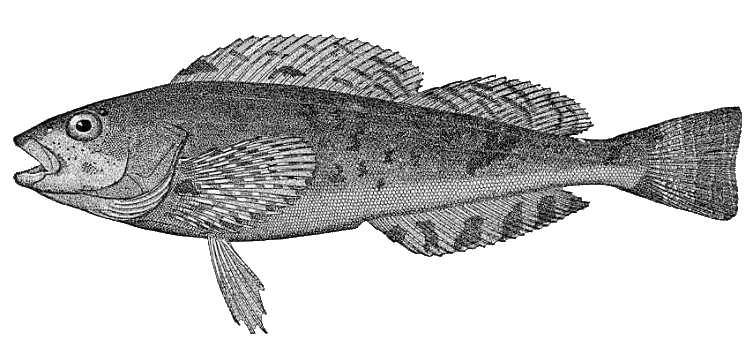
Hexagrammos decagrammus has five lateral lines on each flank and fleshy cirrhi above the eye and halfway between the eye and the origin of the dorsal fin.
Written 26 November 2026 from the sources listed below. Each statement was checked against the passage it cites; statements that could not be supported were removed.
Habitat
Kelp Greenling inhabits rocky nearshore areas, kelp beds, and sandy bottoms. It is classified as a demersal fish.[1][2]
Appearance
The first dorsal fin has 21 or 22 spines, while the second dorsal fin has 24 soft rays. The anal fin contains one spine and either 23 or 24 soft rays.[3][4]
Males are gray to brownish olive and have irregular blue spots across the anterior half to two-thirds of their bodies. The blue spots are surrounded by rings of small rusty spots.[5][6]
Females are gray to brownish and have rust-colored or golden spots across their bodies. Their fins are yellowish orange.[7][8]
Both sexes have a yellowish interior to the oral cavity. The species frequently has an eye-like spot near the rear of the second dorsal fin.[9][10]
The maximum published total length is 61 cm, and the maximum published weight is 2.1 kg.[11][12]
Diet
Kelp Greenling feeds on crustaceans, polychaete worms, brittle stars, mollusks, and small fishes.[13]
Behaviour
Young kelp greenlings are prey for large predators, including steelhead and salmon.[14]
Reproduction and life cycle
Males sometimes attempt to inseminate eggs in nests belonging to other males.[15]
Uses
Kelp Greenling is recreationally and commercially exploited. It is frequently caught using hook-and-line fishing from shore or from a skiff, and divers also catch it by spearing.[16][17][18]
The species responds to a wide variety of natural and artificial baits.[19]
Classification of the Kelp Greenling
| Kingdom | Animalia |
|---|---|
| Phylum | Chordata |
| Subphylum | Vertebrata |
| Infraphylum | Gnathostomata |
| Parvphylum | Osteichthyes |
| Gigaclass | Actinopterygii |
| Superclass | Actinopteri |
| Class | Teleostei (Teleost) |
| Order | Perciformes |
| Suborder | Cottoidei |
| Family | Hexagrammidae (Greenlings) |
| Subfamily | Hexagramminae |
| Genus | Hexagrammos (Greenlings) |
| Species | Hexagrammos decagrammus (Pallas, 1810) |
Where the Kelp Greenling is found
Checklists and occurrence records place Hexagrammos decagrammus in 2 countries. GBIF holds 97,970 georeferenced records of it.
Countries
Regions and cities with the most records
- Monterey, United States 20,540
- Pacific Grove, United States 20,539
- Seaside, United States 20,539
- Marina, United States 13,046
- California, United States 4,700
- Santa Cruz, United States 2,489
- Live Oak, United States 2,482
- Isla Vista, United States 2,280
- Goleta, United States 2,276
- Santa Barbara, United States 1,706
- British Columbia, Canada 1,619
- Lompoc, United States 1,378
- San Luis Obispo, United States 1,244
- Agoura Hills, United States 630
- Thousand Oaks, United States 630
- West Vancouver, Canada 487
- North Vancouver, Canada 401
- North Cowichan, Canada 391
- Agoura, United States 376
- Vancouver, Canada 296
- Orcutt, United States 249
- Pacifica, United States 235
- San Bruno, United States 234
- Millbrae, United States 233
- Burlingame, United States 232
- San Mateo, United States 232
- Colwood, Canada 202
- Langford, Canada 202
- McKinleyville, United States 171
- South San Francisco, United States 168
- Esquimalt, Canada 155
- Victoria, Canada 147
- Saanich, Canada 146
- Oak Bay, Canada 145
- Alaska, United States 143
- Central Saanich, Canada 138
A number beside a place is its count of GBIF occurrence records. A place without a number comes from a checklist alone. Records show where a species has been observed or collected, which can include escapes and vagrants.
Common names
English
- Kelp Greenling
Names in 7 other languages
- Czech
- hřebeník chaluhový
- Danish
- Tanggrønling
- French
- Hexagramme de roche, sourcil de varech
- German
- Kelpgrünling, Tanggrünling
- Portuguese
- Lorcha-do-kelp
- Russian
- Американский терпуг, Терпуг американский (десятилинейный)
- Spanish
- Molva de Kelp
Synonyms
7 other scientific names have been used for this species and are now treated as synonyms of Hexagrammos decagrammus.
- Chiropsis decagrammus (Pallas, 1810)
- Chirus constellatus Girard, 1854
- Chirus denarius Richardson, 1844
- Chirus guttatus Girard, 1854
- Chirus maculoseriatus Lockington, 1880
- Grystes lineatus Ayres, 1854
- Labrax decagrammus Pallas, 1810
Related species
-
 Rock GreenlingHexagrammos lagocephalus
-
 Whitespotted GreenlingHexagrammos stelleri
-
 Fat GreenlingHexagrammos otakii
-
 Spotty-Bellied GreenlingHexagrammos agrammus
-
 Masked GreenlingHexagrammos octogrammus
-
 LingcodOphiodon elongatus
-
 Okhotsk Atka MackerelPleurogrammus azonus
-
 Atka MackerelPleurogrammus monopterygius
Compare
Questions and answers
What is the scientific name of the Kelp Greenling?
The scientific name of the Kelp Greenling is Hexagrammos decagrammus. Written with its author, the full name is Hexagrammos decagrammus (Pallas, 1810).
Which family does the Kelp Greenling belong to?
Hexagrammos decagrammus belongs to the family Hexagrammidae, in the order Perciformes and the class Teleostei.
Where is the Kelp Greenling found?
Checklists and occurrence records place Hexagrammos decagrammus in 2 countries: United States and Canada.
What is the conservation status of the Kelp Greenling?
The IUCN Red List category recorded for Hexagrammos decagrammus is Least Concern (LC).
Do people eat kelp greenling?
The species is recreationally and commercially exploited.[16]
Sources
Passages the profile rests on
- The species inhabits rocky nearshore areas, kelp beds, and sandy bottoms. Source passage: “This species occurs in rocky nearshore areas of the northern is common on kelp beds and on sand bottoms.” — English Wikipedia
- The species is classified as a demersal fish. Source passage: “is a recreationally and commercially exploited demersal fish” — digitalcommons.csumb.edu
- The first dorsal fin has 21 or 22 spines, while the second dorsal fin has 24 soft rays. Source passage: “21 or 22 spines in their first dorsal fin and 24 soft rays in their second dorsal fin” — English Wikipedia
- The anal fin contains one spine and either 23 or 24 soft rays. Source passage: “the anal fin contains a single spine and 23 or 24 soft rays.” — English Wikipedia
- Males are gray to brownish olive and have irregular blue spots across the anterior half to two-thirds of their bodies. Source passage: “The males are gray to brownish olive in color, dotted with irregular blue spots over the anterior half to two-thirds of their body.” — English Wikipedia
- Male blue spots are surrounded by rings of small rusty spots. Source passage: “Each of these spots has a ring of small rusty spots around it.” — English Wikipedia
- Females are gray to brownish and have rust-colored or golden spots across their bodies. Source passage: “The females are also gray to brownish in color but they are marked all over with rust colored or golden spots.” — English Wikipedia
- The fins of females are yellowish orange. Source passage: “They have yellowish orange fins.” — English Wikipedia
- Both sexes have a yellowish interior to the oral cavity. Source passage: “In both males and females the inside of the oral cavity is yellowish” — English Wikipedia
- The species frequently has an eye-like spot near the rear of the second dorsal fin. Source passage: “there is frequently an eye-like spot, an ocellus. at the rear of the second dorsal fin.” — English Wikipedia
- The maximum published total length of the species is 61 cm. Source passage: “maximum published total length of 61 cm (24 in)” — English Wikipedia
- The maximum published weight of the species is 2.1 kg. Source passage: “maximum published weight of 2.1 kg (4.6 lb).” — English Wikipedia
- The species feeds on crustaceans, polychaete worms, brittle stars, mollusks, and small fishes. Source passage: “Kelp greenlings feed on crustaceans, polychaete worms, brittle stars, mollusks, and small fishes.” — English Wikipedia
- Young kelp greenlings are prey for large predators, including steelhead and salmon. Source passage: “The young are food for large predators such as steelhead and salmon.” — English Wikipedia
- Males sometimes attempt to inseminate eggs in nests belonging to other males. Source passage: “males attempt to inseminate eggs in the nests of other males.” — English Wikipedia
- The species is recreationally and commercially exploited. Source passage: “is a recreationally and commercially exploited demersal fish” — digitalcommons.csumb.edu
- The species is frequently caught using hook-and-line fishing from shore or from a skiff. Source passage: “This species is frequently caught by hook and line, fishing from shore or skiff” — English Wikipedia
- Divers also catch the species by spearing. Source passage: “as well as speared by divers.” — English Wikipedia
- The species responds to a wide variety of natural and artificial baits. Source passage: “respond to a wide variety of natural and artificial baits.” — English Wikipedia
Data
- Catalogue of Life, 2026-10-16 XR cc by
- Global Biodiversity Information Facility CC BY 4.0
- Wikidata CC0
- GeoNames CC BY 4.0
- Wikimedia Commons per image; credit shown with each image
- Within the Catalogue of Life, this name comes from World Register of Marine Species cc by
This species in other databases
- Catalogue of Life 3LGGD
- Wikidata Q2378626
- iNaturalist 68596
- WoRMS urn:lsid:marinespecies.org:taxname:240732
- ITIS 167110
Page built on 28 November 2026. See how the catalog is made and all sources and licences.
Cite this page
ScientificNames.org. (2026). Hexagrammos decagrammus (Kelp Greenling). Retrieved November 28, 2026, from https://scientificnames.org/species/hexagrammos-decagrammus
“Hexagrammos decagrammus (Kelp Greenling).” ScientificNames.org, 2026, scientificnames.org/species/hexagrammos-decagrammus. Accessed 28 Nov. 2026.
ScientificNames.org. “Hexagrammos decagrammus (Kelp Greenling).” Accessed November 28, 2026. https://scientificnames.org/species/hexagrammos-decagrammus.
@misc{scientificnames_hexagrammos_decagrammus_kelp_greenling,
  author = {{ScientificNames.org}},
  title = {Hexagrammos decagrammus (Kelp Greenling)},
  year = {2026},
  url = {https://scientificnames.org/species/hexagrammos-decagrammus},
  note = {Accessed 2026-11-28}
}