Species · Fishes
Rock Greenling Hexagrammos lagocephalus
The scientific name of the Rock Greenling is Hexagrammos lagocephalus. It is a species of fish in the family Hexagrammidae (greenlings), order Perciformes. The name dates from 1810.
- Scientific name
- Hexagrammos lagocephalus (Pallas, 1810)
- Common name
- Rock Greenling
- Genus
- Hexagrammos
- Family
- Hexagrammidae (Greenlings)
- Order
- Perciformes
- Class
- Teleostei
- Red List category
- LC Least Concern
- Environment
- marine
- Recorded in
- 2 countries
- Name status
- accepted in the Catalogue of Life

Overview
Hexagrammos lagocephalus occurs from the Bering Sea and Alaska southward to Point Conception, California, inhabiting shallow, rocky nearshore habitats, tidepools, and sandy areas. It typically has a greenish-to-brown body with darker mottling, five lateral lines, and a large cirrus above its eye.
Written 26 November 2026 from the sources listed below. Each statement was checked against the passage it cites; statements that could not be supported were removed.
Appearance
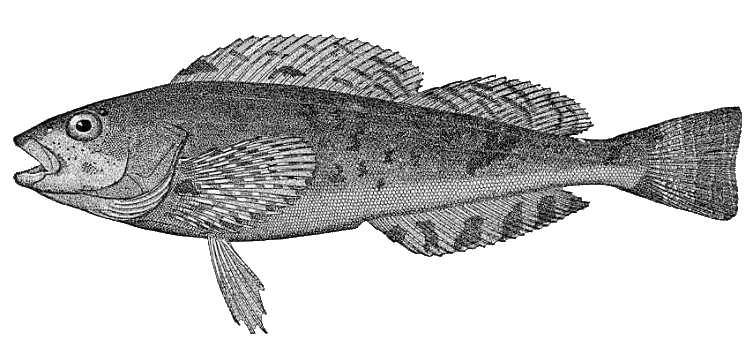
The Rock Greenling typically has a greenish-to-brown body with darker mottling and five lateral lines. Its fins have dark bars or blotches, and it has a large cirrus above its eye.[1][2][3][4]
Males commonly have red blotches on their sides. Adults commonly have blue mouths, whereas juveniles have bright red eyes.[5][6]
The flesh is blue before cooking and becomes white after cooking.[7]
The Rock Greenling can reach 61 cm in length and 830 g in weight.[8][9]
Habitat
The Rock Greenling inhabits shallow, rocky nearshore habitats, particularly along exposed coasts. It also occurs in tidepools and sandy areas.[10][11][12]
It prefers living among rocks in areas with heavy surge.[13]
Diet
The Rock Greenling feeds on invertebrates, including crabs and isopods. It also consumes fish eggs and algae.[14][15]
Juvenile Rock Greenlings feed on zooplankton.[16]
Behaviour
The Rock Greenling is usually solitary. It is sometimes cryptic and often elusive to divers and spear fishermen.[17][18]
Conservation
FishBase reports a moderate-to-high vulnerability score of 54 out of 100 for the Rock Greenling.[19]
Uses
The Rock Greenling is a popular gamefish, although it is not commonly targeted by commercial fisheries. Sport fishers commonly catch it off exposed rocky shores.[20][21]
Classification of the Rock Greenling
| Kingdom | Animalia |
|---|---|
| Phylum | Chordata |
| Subphylum | Vertebrata |
| Infraphylum | Gnathostomata |
| Parvphylum | Osteichthyes |
| Gigaclass | Actinopterygii |
| Superclass | Actinopteri |
| Class | Teleostei (Teleost) |
| Order | Perciformes |
| Suborder | Cottoidei |
| Family | Hexagrammidae (Greenlings) |
| Subfamily | Hexagramminae |
| Genus | Hexagrammos (Greenlings) |
| Species | Hexagrammos lagocephalus (Pallas, 1810) |
Where the Rock Greenling is found
Checklists and occurrence records place Hexagrammos lagocephalus in 2 countries. GBIF holds 73,467 georeferenced records of it.
Countries
Regions and cities with the most records
- Monterey, United States 16,821
- Pacific Grove, United States 16,821
- Seaside, United States 16,821
- Marina, United States 10,447
- California, United States 3,578
- Goleta, United States 2,245
- Isla Vista, United States 2,245
- Santa Barbara, United States 1,694
- Live Oak, United States 1,682
- Santa Cruz, United States 1,682
- Lompoc, United States 1,281
- San Luis Obispo, United States 1,180
- Agoura Hills, United States 627
- Thousand Oaks, United States 627
- Agoura, United States 375
- Orcutt, United States 183
- Alaska, United States 93
- Santa Maria, United States 77
- British Columbia, Canada 36
- Oregon, United States 33
- San Bruno, United States 28
- South San Francisco, United States 28
- Millbrae, United States 27
- Pacifica, United States 27
- Burlingame, United States 26
- San Mateo, United States 26
- Belmont, United States 18
- McKinleyville, United States 17
- Coos Bay, United States 13
- Eureka, United States 13
- Arcata, United States 12
- Bayside, United States 11
- Colwood, Canada 11
- Langford, Canada 11
- Sooke, Canada 8
- Bayview-Hunters Point, United States 7
2 more countries have a few records outside this range
These countries hold a few records of Hexagrammos lagocephalus but lie outside the range the checklists give for it. Such records are often zoo or garden specimens, museum material or vagrants, so the species is not counted as occurring there.
A number beside a place is its count of GBIF occurrence records. A place without a number comes from a checklist alone. Records show where a species has been observed or collected, which can include escapes and vagrants.
Common names
English
- Rock Greenling
Names in 5 other languages
- Czech
- hřebeník útesový
- French
- sourcil de roche
- Japanese
- ウサギアイナメ
- Portuguese
- Lorcha-da-Califórnia
- Russian
- Зайцеголовый (курильский) терпуг, Красный терпуг
Synonyms
7 other scientific names have been used for this species and are now treated as synonyms of Hexagrammos lagocephalus.
- Chirus balias Cope, 1873
- Chirus pictus Girard, 1854
- Hexagrammos superciliosus (Pallas, 1810)
- Hexagrammus scaber Bean, 1881
- Labrax lagocephalus Pallas, 1810
- Labrax superciliosus Pallas, 1810
- Lebius superciliosus (Pallas, 1810)
Related species
-
 Kelp GreenlingHexagrammos decagrammus
-
 Whitespotted GreenlingHexagrammos stelleri
-
 Fat GreenlingHexagrammos otakii
-
 Spotty-Bellied GreenlingHexagrammos agrammus
-
 Masked GreenlingHexagrammos octogrammus
-
 LingcodOphiodon elongatus
-
 Okhotsk Atka MackerelPleurogrammus azonus
-
 Atka MackerelPleurogrammus monopterygius
Compare
Questions and answers
What is the scientific name of the Rock Greenling?
The scientific name of the Rock Greenling is Hexagrammos lagocephalus. Written with its author, the full name is Hexagrammos lagocephalus (Pallas, 1810).
Which family does the Rock Greenling belong to?
Hexagrammos lagocephalus belongs to the family Hexagrammidae, in the order Perciformes and the class Teleostei.
Where is the Rock Greenling found?
Checklists and occurrence records place Hexagrammos lagocephalus in 2 countries: United States and Canada.
What is the conservation status of the Rock Greenling?
The IUCN Red List category recorded for Hexagrammos lagocephalus is Least Concern (LC).
Sources
Passages the profile rests on
- The rock greenling typically has a greenish-to-brown body with darker mottling. Source passage: “The body of the rock greenling varies in color but is usually greenish to brown with darker mottling.” — wdfw.wa.gov
- The species has five lateral lines running along its body. Source passage: “Five lateral lines run along the body.” — wdfw.wa.gov
- Its fins have dark bars or blotches. Source passage: “The fins have dark bars or blotches.” — wdfw.wa.gov
- The rock greenling has a large cirrus above its eye. Source passage: “This species has a large cirrus above the eye.” — wdfw.wa.gov
- Males commonly have red blotches on their sides. Source passage: “Most males tend to have red blotches on the sides.” — wdfw.wa.gov
- Adult rock greenlings commonly have blue mouths, whereas juveniles have bright red eyes. Source passage: “Most adult have blue mouths, while the young have bright red eyes.” — English Wikipedia
- The flesh of the rock greenling is blue before cooking and becomes white after cooking. Source passage: “The flesh is also blue in color, but turns into white after cooked.” — English Wikipedia
- The rock greenling can reach 61 cm in length. Source passage: “Rock greenling can grow up to 61 cm (24 in) in length, and 830 g (1.83 lbs) in weight.” — wdfw.wa.gov
- The rock greenling can reach a weight of 830 g. Source passage: “Rock greenling can grow up to 61 cm (24 in) in length, and 830 g (1.83 lbs) in weight.” — wdfw.wa.gov
- The rock greenling inhabits rocky shorelines. Source passage: “Its habitat of choice is rocky shoreline.” — English Wikipedia
- The species can also occur in tidepools and sandy areas. Source passage: “Sometimes, though, they can be found in tidepools and sandy areas.” — English Wikipedia
- The rock greenling occurs in shallow, rocky nearshore habitats, particularly along exposed coasts. Source passage: “They can be found in shallow rocky nearshore areas, especially on exposed coasts.” — wdfw.wa.gov
- Rock greenlings prefer living among rocks in areas with heavy surge. Source passage: “as they prefer living among the rock in the heavy surge.” — English Wikipedia
- The rock greenling feeds on invertebrates including crabs and isopods. Source passage: “eating everything from invertebrates such as crabs and isopods to fish eggs and algae.” — English Wikipedia
- The rock greenling consumes fish eggs and algae. Source passage: “eating everything from invertebrates such as crabs and isopods to fish eggs and algae.” — English Wikipedia
- Juvenile rock greenlings feed on zooplankton. Source passage: “When young, the fish eat zooplankton.” — English Wikipedia
- The rock greenling is usually solitary. Source passage: “The species is usually solitary, but not aggressive” — English Wikipedia
- The species is sometimes cryptic and often elusive to divers and spear fishermen. Source passage: “It is sometimes cryptic, however, and often elusive to divers and spear fishermen” — English Wikipedia
- FishBase reports a moderate-to-high vulnerability score of 54 out of 100 for the rock greenling. Source passage: “Moderate to high vulnerability (54 of 100).” — fishbase.se
- The rock greenling is a popular gamefish despite not being commonly targeted by commercial fisheries. Source passage: “Though not commonly commercially fished like the related lingcod, they are a popular gamefish.” — English Wikipedia
- Sport fishers commonly catch rock greenlings off exposed rocky shores. Source passage: “They are commonly caught by sport fishers off exposed rocky shores.” — English Wikipedia
Data
- Catalogue of Life, 2026-10-16 XR cc by
- Global Biodiversity Information Facility CC BY 4.0
- Wikidata CC0
- GeoNames CC BY 4.0
- Wikimedia Commons per image; credit shown with each image
- Within the Catalogue of Life, this name comes from World Register of Marine Species cc by
This species in other databases
- Catalogue of Life 6LTFR
- Wikidata Q2443920
- iNaturalist 68594
- WoRMS urn:lsid:marinespecies.org:taxname:240735
- ITIS 167111
Page built on 29 November 2026. See how the catalog is made and all sources and licences.
Cite this page
ScientificNames.org. (2026). Hexagrammos lagocephalus (Rock Greenling). Retrieved November 29, 2026, from https://scientificnames.org/species/hexagrammos-lagocephalus
“Hexagrammos lagocephalus (Rock Greenling).” ScientificNames.org, 2026, scientificnames.org/species/hexagrammos-lagocephalus. Accessed 29 Nov. 2026.
ScientificNames.org. “Hexagrammos lagocephalus (Rock Greenling).” Accessed November 29, 2026. https://scientificnames.org/species/hexagrammos-lagocephalus.
@misc{scientificnames_hexagrammos_lagocephalus_rock_greenling,
  author = {{ScientificNames.org}},
  title = {Hexagrammos lagocephalus (Rock Greenling)},
  year = {2026},
  url = {https://scientificnames.org/species/hexagrammos-lagocephalus},
  note = {Accessed 2026-11-29}
}