Species · Birds
Black-necked Stilt Himantopus mexicanus
The scientific name of the Black-necked Stilt is Himantopus mexicanus. It is a species of bird in the family Recurvirostridae (stilts), order Charadriiformes. The name dates from 1776.
- Scientific name
- Himantopus mexicanus (P. L. S. Müller, 1776)
- Common name
- Black-necked Stilt
- Genus
- Himantopus
- Family
- Recurvirostridae (Stilts)
- Order
- Charadriiformes
- Class
- Aves
- Environment
- freshwater, marine, terrestrial
- Recorded in
- 56 countries
- Name status
- accepted in the Catalogue of Life

Overview
The Black-necked Stilt (Himantopus mexicanus) is a bird in the family Recurvirostridae, order Charadriiformes, and class Aves. It occurs from the western United States through Central America and the Caribbean to parts of South America, with an isolated population in Hawaii. It is distinguished by long pink legs, a slender black bill, black wings and back, and white underparts.
Written 26 November 2026 from the sources listed below. Each statement was checked against the passage it cites; statements that could not be supported were removed.
Appearance
Adults have long pink legs, a slender black bill, black wings and backs, and white underparts. Adult males develop a greenish gloss on their backs and wings, particularly during the breeding season, while females have brown-tinged backs and wings.[1][2][3]
Adults measure 35–39 cm in length and weigh approximately 150–180 g. Their wingspan is approximately 71–75 cm, and the species reaches a height of approximately 33–43 cm.[4][5][6][7]
Habitat
The Black-necked Stilt inhabits estuaries, lakes, salt ponds, emergent wetlands, marshes, mudflats, flooded fields, ponds, and drainage ditches. It prefers shallow saline wetlands, including soda and alkaline wetlands.[8][9][10]
The species also uses artificially created lakes and drainage basins in the Phoenix metropolitan area.[11]
Diet
The Black-necked Stilt feeds on crustaceans, other arthropods, mollusks, small fish, tadpoles, worms, shrimp, insects, and occasionally plant or floating seeds. Inland populations primarily consume aquatic insects and their larvae, while coastal populations primarily consume aquatic invertebrates.[12][13][14][15]
Behaviour
The species obtains food by probing and gleaning in mudflats, lakeshores, and very shallow coastal waters. It wades in shallow water to capture food and rarely swims despite having partially webbed feet.[16][17][18]
The species has moderate tolerance for human disturbance. It generally nests in colonies containing dozens of pairs, although colonies can occasionally contain hundreds of pairs.[19][20]
Parents remove eggshells from the nest after chicks hatch, possibly reducing the nest's visibility. Adult males may mob intruders and attempt to drive people away from nesting areas.[21][22]
Reproduction and life cycle
In North America, reproduction occurs from late April through August, with peak activity in June. Tropical populations usually breed after the rainy season.[23][24]
Nests are established on mudflats, dried lake margins, and levees with friable soil, generally within one kilometre of feeding locations. The species typically lays clutches of three to five eggs.[25][26][27]
Females lay three or four tan eggs with irregular dark brown or black spots. Both parents incubate the eggs for approximately 22–26 days.[28][29]
Newly hatched young can swim within two hours of hatching and generally fledge at approximately one month of age. Individuals begin breeding at approximately one to two years of age, and the species reaches sexual maturity at approximately one year.[30][31][32][33]
Conservation
The Black-necked Stilt is classified as Least Concern by the IUCN. North American populations declined somewhat during the twentieth century, mainly because of habitat conversion and pollution.[34][35]
The Hawaiian population numbers fewer than 2,000 individuals. The species is listed as a Special Concern species in Wisconsin.[36][37]
Classification of the Black-necked Stilt
| Kingdom | Animalia |
|---|---|
| Phylum | Chordata |
| Subphylum | Vertebrata |
| Infraphylum | Gnathostomata |
| Parvphylum | Osteichthyes |
| Megaclass | Tetrapoda |
| Class | Aves (Bird) |
| Order | Charadriiformes (Auks) |
| Family | Recurvirostridae (Stilts) |
| Genus | Himantopus (Stilt) |
| Species | Himantopus mexicanus (P. L. S. Müller, 1776) |
Where the Black-necked Stilt is found
Checklists and occurrence records place Himantopus mexicanus in 56 countries across North America, Oceania and South America. GBIF holds 1,607,049 georeferenced records of it.
Countries
- Anguilla 1,585
- Antigua and Barbuda 1,081
- Argentina 54,320
- Aruba 5,222
- Australia 7
- Bahamas 3,311
- Barbados 64
- Belgium 1,015
- Belize 8,945
- Bermuda 512
- Bolivia 2,711
- Bonaire, Saint Eustatius and Saba 5,827
- Brazil 27,293
- British Virgin Islands 377
- Canada 31,809
- Cayman Islands 6,409
- Chile 31,577
- Colombia 15,957
- Costa Rica 23,397
- Cuba 8,438
- Curacao 5,016
- Dominican Republic 2,666
- Ecuador 13,516
- El Salvador 2,504
- Falkland Islands 4
- French Guiana 221
- Grenada 6
- Guadeloupe 2,011
- Guatemala 2,967
- Guyana 46
- Haiti 617
- Honduras 4,462
- Jamaica 2,274
- Martinique 7
- Mexico 76,114
- Montserrat 18
- Nicaragua 4,027
- Panama 7,526
- Paraguay 2,671
- Peru 14,558
- Puerto Rico 18,369
- Saint Barthelemy 101
- Saint Kitts and Nevis 465
- Saint Lucia 10
- Saint Martin 1,678
- Saint Pierre and Miquelon 21
- Saint Vincent and the Grenadines 3
- Sint Maarten 331
- Suriname 169
- Trinidad and Tobago 1,381
- Turks and Caicos Islands 976
- U.S. Virgin Islands 3,400
- United States 1,194,318
- United States Minor Outlying Islands 3
- Uruguay 8,693
- Venezuela 6,043
Regions and cities with the most records
- California, United States 400,981
- Texas, United States 253,692
- Florida, United States 97,836
- Arizona, United States 82,298
- Newark, United States 67,969
- East Palo Alto, United States 67,904
- Menlo Park, United States 63,061
- Palo Alto, United States 61,901
- Union City, United States 61,632
- Fremont, United States 59,230
- Los Altos, United States 55,807
- San Carlos, United States 54,981
- Belmont, United States 54,159
- Redwood City, United States 53,459
- Mountain View, United States 53,138
- Sunnyvale, United States 46,910
- Milpitas, United States 44,635
- Westminster, United States 44,498
- Garden Grove, United States 42,933
- Foster City, United States 42,116
- Santa Clara, United States 41,975
- Cupertino, United States 41,891
- Santa Ana, United States 41,327
- Hawaii, United States 41,193
- Fountain Valley, United States 40,530
- Huntington Beach, United States 38,192
- Costa Mesa, United States 37,004
- Newport Beach, United States 36,851
- Utah, United States 35,291
- San Lorenzo, United States 34,841
- Chandler, United States 34,384
- Orange, United States 34,297
- Gilbert, United States 33,962
- Tustin, United States 33,177
- Alamo, United States 32,848
- Donna, United States 32,522
4 more countries have a few records outside this range
These countries hold a few records of Himantopus mexicanus but lie outside the range the checklists give for it. Such records are often zoo or garden specimens, museum material or vagrants, so the species is not counted as occurring there.
Range as the checklists state it
Middle America
North America
South America
Caribbean
A number beside a place is its count of GBIF occurrence records. A place without a number comes from a checklist alone. Records show where a species has been observed or collected, which can include escapes and vagrants.
Common names
English
- Black-necked Stilt
- Ae'o
- American Stilt
- Black-winged Stilt
- Hawaiian Stilt
- Long-legged Avocet
- Mexican Stilt
Names in 39 other languages
- Arabic
- كرسوع أسود الرقبة, كرسوع مكسيكي
- Breton
- Skaseg gouzoug du
- Bulgarian
- Кокилобегач
- Chinese
- 黑頸長腳鷸, 黑頸高蹺鴴, 黑颈长脚鹬
- Croatian
- crnokapa vlastelica
- Czech
- Pisila karibská, pisila americká, pisila černokrká
- Danish
- Sortnakket Stylteløber
- Dutch
- Amerikaanse steltkluut, Steltkluut
- Esperanto
- Nigrakola himantopo, nigrakola himantopodo
- Estonian
- mustpea-karkjalg
- Finnish
- amerikanpitkäjalka
- French
- echasse d'Amérique, Échasse d'Amérique, Échasse d’Amérique
- German
- Amerikanischer Stelzenläufer, Schwarznacken-Stelzenläufer
- Greek
- Μεξικάνικος Καλαμοκανάς
- Hungarian
- mexikói gólyatöcs
- Irish
- Cosardach pibdbubh
- Italian
- Cavaliere collonero, Cavaliere nordamericano
- Japanese
- クロエリセイタカシギ
- Latvian
- melnkakla garstilbis
- Lithuanian
- Amerikinis kūjokas, amerikinis kojūkas
- Norwegian
- svartkronestylteløper
- Papiamento
- Caweta di Patu, Kaweta di Patu, Kaweta di awa, Macamba, Makamba, Redadó, Snepi Hudiu, Snepi di Sabana
- Persian
- چوبپای گردنسیاه
- Polish
- Szczudlak bialobrewy, szczudłak białobrewy
- Portuguese
- Perna-de-pau, pernilongo-americano, pernilongo-de-costas-negras
- Russian
- Американский ходулочник
- Serbian
- Crnovrata vlastelica
- Slovak
- šišila čiernokrká
- Spanish
- Candelero americano, Cigüeñuela Cuellinegro, Cigüeñuela americana, Cigüeñuela cuellinegra, Cigüeñuela de Cuello Negro, Monjita Americana, Perrito, Tero real
- Swedish
- amerikansk styltlöpare
- Turkish
- Maskeli Uzunbacak
- Ukrainian
- кулик-довгоніг американський
- Vietnamese
- Cà kheo cổ đen
- Welsh
- hirgoes gyddfddu
- fry
- Steltklút
- gcf
- Gibier la mort
- grn
- Tetéu jagua
- hat
- Pèt-pèt
- nav
- Jáádtsʼósí łizhinígíí
Synonyms
2 other scientific names have been used for this species and are now treated as synonyms of Himantopus mexicanus.
- Himantopus mexicanus americanus
- Himentopus mexicanus mexicanus Müller, PLS, 1776
Subspecies and varieties
- Himantopus mexicanus knudseni (Hawaiian Stilt) subspecies
- Himantopus mexicanus mexicanus (Northern Black-necked Stilt) subspecies
Related species
-
 Black-winged StiltHimantopus himantopus
-
 Pied StiltHimantopus leucocephalus
-
 Black StiltHimantopus novaezelandiae
-
 White-backed StiltHimantopus melanurus
-
 Pied AvocetRecurvirostra avosetta
-
 American AvocetRecurvirostra americana
-
 Red-necked AvocetRecurvirostra novaehollandiae
-
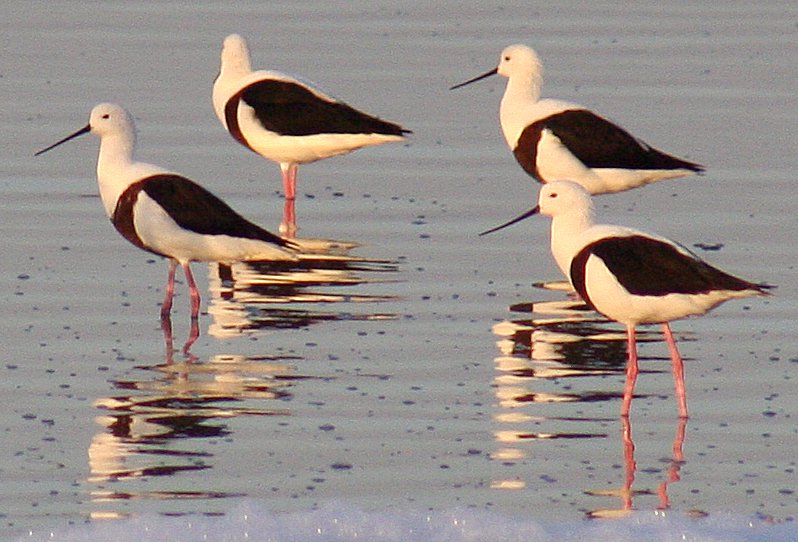 Banded StiltCladorhynchus leucocephalus
Compare
Questions and answers
What is the scientific name of the Black-necked Stilt?
The scientific name of the Black-necked Stilt is Himantopus mexicanus. Written with its author, the full name is Himantopus mexicanus (P. L. S. Müller, 1776).
Which family does the Black-necked Stilt belong to?
Himantopus mexicanus belongs to the family Recurvirostridae, in the order Charadriiformes and the class Aves.
Where is the Black-necked Stilt found?
Checklists and occurrence records place Himantopus mexicanus in 56 countries, including United States, Mexico, Argentina, Canada, Chile and Brazil.
What other names does the Black-necked Stilt have?
Himantopus mexicanus is also known in English as Ae'o, American Stilt, Black-winged Stilt, Hawaiian Stilt, Long-legged Avocet and Mexican Stilt.
Are black-necked stilts rare?
The species is classified as Least Concern by the IUCN. However, its Hawaiian population numbers fewer than 2,000 individuals, and it is listed as a Special Concern species in Wisconsin.[34][36][37]
What is a fun fact about the black-necked stilt?
Newly hatched young can swim within two hours of hatching.[30]
What is the average lifespan of a black-necked stilt?
The species has an approximate lifespan of 20 years.[38]
Where do black-necked stilts live?
They occur from the western United States through Central America and the Caribbean to parts of South America. They also occur in Hawaii, with an isolated population there.[39][40]
What do black-necked stilts eat?
They eat crustaceans, other arthropods, mollusks, small fish, tadpoles, worms, shrimp, and insects, as well as occasional plant or floating seeds.[12][15]
How long does it take for black-necked stilt eggs to hatch?
Both parents incubate the eggs for approximately 22–26 days.[28]
Sources
Passages the profile rests on
- Adults have long pink legs, a slender black bill, black wings and backs, and white underparts. Source passage: “They have long pink legs and a long thin black bill. They are white below and have black wings and backs.” — English Wikipedia
- Adult males develop a greenish gloss on their backs and wings, particularly during the breeding season. Source passage: “Males have a greenish gloss to the back and wings, particularly in the breeding season.” — English Wikipedia
- Adult females have brown-tinged backs and wings rather than the greenish gloss found in males. Source passage: “This is less pronounced or absent in females, which have a brown tinge to these areas instead.” — English Wikipedia
- Adults measure 35–39 cm in length. Source passage: “Length: 13.8–15.3 in (35–39 cm)” — English Wikipedia
- Adults weigh approximately 150–180 g. Source passage: “Weight: 5.3–6.2 oz (150–180 g)” — English Wikipedia
- Adults have a wingspan of approximately 71–75 cm. Source passage: “Wingspan: 28.1–29.7 in (71–75 cm)” — English Wikipedia
- The species reaches a height of approximately 33–43 cm. Source passage: “The black-necked stilt reaches a height of 13 to17 inches (33 to 43 cm)” — tpwd.texas.gov
- The species inhabits estuaries, lakes, salt ponds, and emergent wetlands. Source passage: “The black-necked stilt is found in estuarine, lacustrine, salt pond and emergent wetland habitats” — English Wikipedia
- The species prefers shallow saline wetlands, including soda and alkaline wetlands. Source passage: “They are known to prefer shallow, saline wetlands, including those which are soda or alkaline.” — English Wikipedia
- The species inhabits marshes, mudflats, flooded fields, ponds, and drainage ditches. Source passage: “Black-necked stilts prefer marshes, mudflats, flooded fields, ponds and drainage ditches where food is abundant.” — tpwd.texas.gov
- The species uses artificially created lakes and drainage basins in the Phoenix metropolitan area. Source passage: “In Arizona, black-necked stilts may be seen along artificially created lakes and drainage basins in the Phoenix metropolitan area” — English Wikipedia
- The species feeds on crustaceans, other arthropods, mollusks, small fish, tadpoles, and occasionally plant seeds. Source passage: “it seeks out a range of aquatic invertebrates – mainly crustaceans (such as shrimp) and other arthropods (such as worms and flies), and mollusks – and small fish, tadpoles and very rarely plant seeds.” — English Wikipedia
- Inland populations primarily consume aquatic insects and their larvae. Source passage: “inland birds usually feed mainly on aquatic insects and their larvae” — English Wikipedia
- Coastal populations primarily consume aquatic invertebrates. Source passage: “while coastal populations mostly eat other aquatic invertebrates.” — English Wikipedia
- The species consumes worms, mollusks, shrimp, insects, small fish, and occasionally floating seeds. Source passage: “Worms, mollusks, shrimp, insects, small fish, and sometimes floating seeds make up the black-necked stilt's diet.” — tpwd.texas.gov
- The species obtains food by probing and gleaning in mudflats, lakeshores, and very shallow coastal waters. Source passage: “The black-necked stilt forages by probing and gleaning primarily in mudflats and lakeshores, but also in very shallow waters near shores” — English Wikipedia
- The species wades in shallow water to capture food. Source passage: “The black-necked stilt wades in shallow water to catch food.” — tpwd.texas.gov
- The species rarely swims despite having partially webbed feet. Source passage: “Black-necked stilts have partially webbed feet, which allow them to swim - but they rarely do.” — tpwd.texas.gov
- The species has moderate tolerance for human disturbance. Source passage: “This bird is considered to have a moderate tolerance for human disturbance.” — English Wikipedia
- The species generally nests in colonies containing dozens of pairs, although colonies can occasionally contain hundreds of pairs. Source passage: “colonies usually number dozens, rarely hundreds, of pairs.” — English Wikipedia
- Parents remove eggshells from the nest after chicks hatch, possibly reducing the nest's visibility. Source passage: “After the chicks hatch, the parents will remove all eggshells from the nest, probably to better camouflage the nest.” — tpwd.texas.gov
- Adult males may mob intruders and attempt to drive people away from nesting areas. Source passage: “males will often mob intruders and will even try to chase people away.” — tpwd.texas.gov
- In North America, reproduction occurs from late April through August, with peak activity in June. Source passage: “Reproduction occurs from late April through August in North America, with peak activity in June” — English Wikipedia
- Tropical populations usually breed after the rainy season. Source passage: “while tropical populations usually breed after the rainy season.” — English Wikipedia
- The species typically lays clutches of three to five eggs. Source passage: “The clutch size generally is 3–5 eggs with an average of four.” — English Wikipedia
- Nests are established on mudflats, dried lake margins, and levees with friable soil. Source passage: “This stilt chooses mudflats, desiccated lacustrine verges, and levees for nest locations, as long as the soil is friable.” — English Wikipedia
- Nests are generally situated within one kilometre of feeding locations. Source passage: “The nests are typically sited within 1 km (0.62 mi) of a feeding location” — English Wikipedia
- Both parents incubate the eggs for approximately 22–26 days. Source passage: “For 22–26 days both sexes take turns incubating the eggs.” — English Wikipedia
- Females lay three or four tan eggs with irregular dark brown or black spots. Source passage: “Females lay three or four tan-colored eggs with dark brown or black irregular spots.” — tpwd.texas.gov
- Newly hatched young can swim within two hours of hatching. Source passage: “The young are so precocial that they are seen swimming within two hours after hatching” — English Wikipedia
- Young generally fledge at approximately one month of age. Source passage: “They fledge after about one month” — English Wikipedia
- Individuals begin breeding at approximately one to two years of age. Source passage: “Birds begin to breed at 1–2 years of age.” — English Wikipedia
- The species reaches sexual maturity at approximately one year. Source passage: “It reaches sexual maturity at one year.” — tpwd.texas.gov
- The species is classified as Least Concern by the IUCN. Source passage: “This stilt is therefore classified as a Species of Least Concern by the IUCN.” — English Wikipedia
- North American populations declined somewhat during the twentieth century, mainly because of habitat conversion and pollution. Source passage: “Particularly the North American populations of the black-necked stilt have somewhat declined in the 20th century, mainly due to conversion of habitat for human use and pollution” — English Wikipedia
- The Hawaiian population numbers fewer than 2,000 individuals. Source passage: “is very rare however and numbers less than 2,000 individuals.” — English Wikipedia
- The species is listed as a Special Concern species in Wisconsin. Source passage: “Black-necked Stilt (Himantopus mexicanus), a Special Concern species” — apps.dnr.wi.gov
- The species has an approximate lifespan of 20 years. Source passage: “Their lifespan is approximately 20 years.” — tpwd.texas.gov
- The species occurs from the western United States through Central America and the Caribbean to parts of South America. Source passage: “It is found from the coastal areas of California through much of the interior western United States and along the Gulf of Mexico as far east as Florida, then south through Central America and the Caribbean to Brazil, Peru and the Galápagos Islands” — English Wikipedia
- An isolated population of the species occurs in Hawaii. Source passage: “with an isolated population, the Hawaiian stilt, in Hawaii.” — English Wikipedia
Data
- Catalogue of Life, 2026-10-16 XR cc by
- Global Biodiversity Information Facility CC BY 4.0
- Wikidata CC0
- GeoNames CC BY 4.0
- Wikimedia Commons per image; credit shown with each image
- Within the Catalogue of Life, this name comes from The Integrated Taxonomic Information System cc0
References
- Natursyst., Suppl.: 117. 1776 where the name was published
- Banks, R. C., R. W. McDiarmid, and A. L. Gardner. (1987). Checklist of Vertebrates of the United States, the U.S. Territories, and Canada. Resource Publication, No. 166.
- Gill, Frank, & and Minturn Wright. (2006). Birds of the World: Recommended English Names.
This species in other databases
- Catalogue of Life 6LWTY
- Wikidata Q280358
- iNaturalist 4836
- WoRMS urn:lsid:marinespecies.org:taxname:159131
- Avibase bknsti
Page built on 27 November 2026. See how the catalog is made and all sources and licences.
Cite this page
ScientificNames.org. (2026). Himantopus mexicanus (Black-necked Stilt). Retrieved November 27, 2026, from https://scientificnames.org/species/himantopus-mexicanus
“Himantopus mexicanus (Black-necked Stilt).” ScientificNames.org, 2026, scientificnames.org/species/himantopus-mexicanus. Accessed 27 Nov. 2026.
ScientificNames.org. “Himantopus mexicanus (Black-necked Stilt).” Accessed November 27, 2026. https://scientificnames.org/species/himantopus-mexicanus.
@misc{scientificnames_himantopus_mexicanus_black_necked_stilt,
  author = {{ScientificNames.org}},
  title = {Himantopus mexicanus (Black-necked Stilt)},
  year = {2026},
  url = {https://scientificnames.org/species/himantopus-mexicanus},
  note = {Accessed 2026-11-27}
}