Species · Birds
Pied Avocet Recurvirostra avosetta
The scientific name of the Pied Avocet is Recurvirostra avosetta. It is a species of bird in the family Recurvirostridae (stilts), order Charadriiformes. The name dates from 1758.
- Scientific name
- Recurvirostra avosetta Linnaeus, 1758
- Common name
- Pied Avocet
- Genus
- Recurvirostra
- Family
- Recurvirostridae (Stilts)
- Order
- Charadriiformes
- Class
- Aves
- Red List category
- LC Least Concern
- Environment
- marine, terrestrial
- Recorded in
- 122 countries
- Name status
- accepted in the Catalogue of Life

Overview
Recurvirostra avosetta occurs across western Europe, central Asia, the Indian subcontinent, and Africa. It is distinguished by black-and-white plumage, long bluish-gray legs, and a slender bill that curves upward.
Written 26 November 2026 from the sources listed below. Each statement was checked against the passage it cites; statements that could not be supported were removed.
Appearance
Males generally have larger bodies and longer, less curved bills than females. Male irises are red or reddish-brown, while female irises are hazel-brown.[1][2][3]
Chicks have pale grey-brown down with black speckles and patterns, four rows of black back spots, and a yellowish-tinged white underbelly. Juveniles have dingy grey wing coverts and reddish-brown vermiculated back and scapular feathers.[4][5]
Adults measure 42–46 cm in length, with a wingspan of 67 to 77 cm that can occasionally reach 80 cm. Adult males have bills measuring 8.2–9.1 cm, while female bills measure 7.2–8.5 cm.[6][7][8]
Adult body weight ranges from 267 to 382 g, averaging 325 g. The species does not undergo seasonal plumage variation.[9][10]
Habitat
The Pied Avocet frequents coastal habitats, including brackish and saline bays, sandbanks, estuaries, lagoons, deltas, and intertidal mudflats during winter. Brackish and saline coastal lagoons and estuaries are key habitats for the species.[11][12]
During breeding, it uses wetlands with sparse vegetation and shallow water containing mud, sand, or clay islets. It also occurs in shallow lakes, ponds, salt marshes, and floodplains.[13][14]
In Anatolia, the species breeds at elevations of up to 1,000 m.[15]
The species occurs across western Europe, central Asia, the Indian subcontinent, and Africa. Its Asian distribution extends from Turkey and Anatolia to northern Mongolia, northern China, and Kazakhstan.[16][17]
In Africa, it occurs from the Mediterranean coast of North Africa and the Red Sea to the Atlantic coast of Senegal and northern Guinea.[18]
Northern European and eastern Asian populations are migratory. Western European populations winter in West Africa and Mediterranean countries, particularly Spain and Portugal, while Mediterranean, some African, and Gulf populations are sedentary.[19][20][21]
Diet
The Pied Avocet primarily consumes small benthic invertebrates, including annelids, crustaceans, worms, and bivalve molluscs. It also eats small insects, including midges and beetles measuring 4–15 mm.[22][23]
Chironomid larvae are an important food source during breeding and wintering in salt marshes. The species occasionally consumes small fish, seeds, and small roots.[24][25]
Its average daily food intake is approximately 150 g per individual.[26]
Behaviour
The Pied Avocet forages in shallow brackish water or on mudflats by sweeping its bill laterally through the water. It also probes sediment surfaces and makes lateral pecks to locate prey.[27][28]
Adults typically feed in water depths of 4–10 cm. Some populations align their daily feeding rhythms with tides and feed at night in salt marshes.[29][30]
The species is philopatric, with some ringed individuals returning to their original Atlantic breeding sites.[31]
Pied Avocets are highly territorial when protecting chicks and defend feeding and rearing areas against other birds. Adults use broken-wing displays and swooping attacks to distract intruders threatening their chicks.[32][33]
Reproduction and life cycle
The species breeds in dense colonies of 10–70 pairs, occasionally reaching 200 pairs in multiple groups, or as isolated pairs. Pied Avocets are monogamous, with pairs forming shortly after arrival at breeding sites.[34][35]
The nest is a shallow scrape averaging 12–12.55 cm in diameter and 3–4 cm in depth. Nests are generally placed near water on islets or dikes, in sand, short vegetation, or debris, but not in mud.[36][37]
Egg-laying occurs from early April to early July, with a peak between mid-April and mid-May. Typical clutches contain three to five eggs.[38][39]
Both parents incubate the eggs, with incubation averaging 23 days. Chicks leave the nest after the final egg hatches.[40][41]
Chicks become independent and fledge 35–42 days after hatching. The species generally reaches sexual maturity at two to three years of age.[42][43]
Conservation
The Pied Avocet is classified as Least Concern on the IUCN Red List. The species was most recently assessed in 2012.[44][45]
Threats to the species include habitat destruction, climate change, and pollution.[46]
Classification of the Pied Avocet
| Kingdom | Animalia |
|---|---|
| Phylum | Chordata |
| Subphylum | Vertebrata |
| Infraphylum | Gnathostomata |
| Parvphylum | Osteichthyes |
| Megaclass | Tetrapoda |
| Class | Aves (Bird) |
| Order | Charadriiformes (Auks) |
| Family | Recurvirostridae (Stilts) |
| Genus | Recurvirostra (Avocet) |
| Species | Recurvirostra avosetta Linnaeus, 1758 |
Where the Pied Avocet is found
Checklists and occurrence records place Recurvirostra avosetta in 122 countries across Africa and Asia. GBIF holds 1,285,414 georeferenced records of it.
Countries
- Afghanistan 4
- Aland Islands 6
- Albania 358
- Algeria 216
- Angola 91
- Armenia 216
- Austria 5,124
- Azerbaijan 465
- Bahrain 14
- Bangladesh 315
- Belarus 50
- Belgium 39,271
- Bhutan 51
- Bosnia and Herzegovina 11
- Botswana 463
- Bulgaria 3,345
- Cabo Verde 14
- Cameroon 6
- China 12,908
- Croatia 233
- Cyprus 225
- Czechia 1,373
- Democratic Republic of the Congo 4
- Denmark 130,783
- Djibouti 13
- Egypt 219
- Eritrea 5
- Estonia 3,210
- Eswatini 16
- Ethiopia 504
- Faroe Islands 3
- Finland 251
- France 96,725
- Gabon 4
- Gambia 381
- Georgia 244
- Germany 11,564
- Ghana 32
- Gibraltar 3
- Greece 6,843
- Guernsey 4
- Guinea 13
- Guinea-Bissau 7
- Hong Kong 8,349
- Hungary 3,589
- Iceland 18
- India 16,274
- Iran 918
- Iraq 27
- Ireland 142
- Isle of Man 32
- Israel 7,171
- Italy 8,622
- Japan 459
- Jordan 57
- Kazakhstan 895
- Kenya 3,725
- Kosovo 6
- Kuwait 586
- Kyrgyzstan 50
- Latvia 25
- Lebanon 5
- Lesotho 9
- Libya 5
- Lithuania 49
- Luxembourg 3
- Macao 161
- Malawi 26
- Malaysia 36
- Malta 71
- Mauritania 43
- Moldova 225
- Mongolia 1,816
- Montenegro 99
- Morocco 1,783
- Mozambique 337
- Myanmar 22
- Namibia 4,551
- Nepal 63
- Nigeria 10
- North Macedonia 13
- Norway 1,688
- Oman 275
- Pakistan 101
- Palestinian Territory 8
- Philippines 350
- Poland 950
- Portugal 27,592
- Qatar 113
- Romania 2,053
- Russia 2,245
- Saudi Arabia 289
- Senegal 824
- Serbia 767
- Slovakia 151
- Slovenia 1,359
- South Africa 42,877
- South Korea 209
- South Sudan 4
- Spain 82,690
- Sri Lanka 66
- Sudan 29
- Sweden 175,586
- Switzerland 252
- Syria 14
- Taiwan 44,000
- Tajikistan 12
- Tanzania 2,573
- Thailand 1,119
- The Netherlands 367,060
- Tunisia 353
- Turkey 4,346
- Uganda 197
- Ukraine 3,154
- United Arab Emirates 2,603
- United Kingdom 142,945
- Uzbekistan 63
- Vietnam 19
- Western Sahara 81
- Yemen 22
- Zambia 189
- Zimbabwe 327
Regions and cities with the most records
- England, United Kingdom 135,392
- Den Helder, The Netherlands 51,041
- Skåne, Sweden 41,720
- Bergschenhoek, The Netherlands 38,975
- Berkel en Rodenrijs, The Netherlands 37,126
- Rotterdam, The Netherlands 34,990
- Ridderkerk, The Netherlands 34,856
- Waddinxveen, The Netherlands 34,536
- Julianadorp, The Netherlands 34,329
- Boskoop, The Netherlands 33,620
- Pijnacker, The Netherlands 33,601
- Nootdorp, The Netherlands 33,370
- Zeeland, The Netherlands 32,019
- Capelle aan den IJssel, The Netherlands 31,872
- Voorburg, The Netherlands 31,753
- Kalmar, Sweden 31,749
- Halland, Sweden 31,474
- Delft, The Netherlands 31,449
- Krimpen aan den IJssel, The Netherlands 31,351
- Ypenburg, The Netherlands 31,054
- Vlaardingen, The Netherlands 30,717
- Schiedam, The Netherlands 30,372
- Vlissingen, The Netherlands 29,772
- South Denmark, Denmark 29,214
- Barendrecht, The Netherlands 29,131
- Benthuizen, The Netherlands 29,117
- The Hague, The Netherlands 28,672
- Scheveningen, The Netherlands 28,421
- Alblasserdam, The Netherlands 28,412
- Hendrik-Ido-Ambacht, The Netherlands 28,351
- Zoetermeer, The Netherlands 27,747
- Amsterdam, The Netherlands 27,730
- Voorschoten, The Netherlands 27,675
- Amstelveen, The Netherlands 27,525
- Rijswijk, The Netherlands 27,422
- Dordrecht, The Netherlands 27,400
2 more countries have a few records outside this range
These countries hold a few records of Recurvirostra avosetta but lie outside the range the checklists give for it. Such records are often zoo or garden specimens, museum material or vagrants, so the species is not counted as occurring there.
Range as the checklists state it
Europe & Northern Asia (excluding China)
Southern Asia
Africa
A number beside a place is its count of GBIF occurrence records. A place without a number comes from a checklist alone. Records show where a species has been observed or collected, which can include escapes and vagrants.
Common names
English
- Pied Avocet
- Eurasian Avocet
- PIAV
- Avocet
Names in 74 other languages
- Afrikaans
- Bontelsie
- Albanian
- korana, sqepbiza, sqepshpata këmbëkaltër
- Arabic
- النكات, نكات أبقع, نكات ابقع, نكات العالم القديم
- Armenian
- Բզակտուց
- Azerbaijani
- Bizdimdik
- Basque
- Abozeta
- Belarusian
- Шыладзюб, Шыладзюбка
- Bengali
- উল্টোঠুঁটি
- Breton
- Avosetenn vistr
- Bulgarian
- Саблеклюн
- Catalan
- Bec d'alena, bec d'alena comú
- Chinese
- 反嘴長腳鷸, 反嘴高腳鷸, 反嘴鴴, 反嘴鴴〔斑反嘴長腳鷸〕, 反嘴鷸, 反嘴鹬
- Croatian
- modronoga sabljarka
- Czech
- tenkozobec opačný
- Danish
- klyde
- Dutch
- kluut
- Esperanto
- Blanknigra avoceto, ordinara avoceto
- Estonian
- naaskelnokk
- Faroese
- Nevfatti
- Finnish
- avosetti
- French
- Avocette à nuque noire, Avocette à tête noire, Avocette élégante
- Georgian
- სადგისნისკარტა
- German
- Säbelschnäbler
- Greek
- Αβοκέτα, Ευρωπαϊκή Αβοκέτα
- Hebrew
- סייפן, סייפן עקוד, סיפן, סיפן עקוד
- Hungarian
- gulipán
- Icelandic
- Bjúgnefja
- Irish
- Abhóiséad breac
- Italian
- avocetta
- Japanese
- ソリハシセイタカシギ
- Kazakh
- Бізтұмсық
- Korean
- 뒷부리장다리물떼새
- Latvian
- avozeta
- Lithuanian
- avocetė, paprastoji avocetė
- Luxembourgish
- Säwelschniewel
- Macedonian
- сабјарка
- Malagasy
- Bilavava
- Malayalam
- ആവോസെറ്റ്
- Maltese
- Xifa
- Marathi
- उचाट्या
- Mongolian
- Ээтэн / ᠠᠯᠠᠭ ᠡᠭᠡᠲᠡᠨ
- Northern Sami
- Avoseahtta, bonjusáiti
- Norwegian
- Avosett
- Persian
- آووست
- Polish
- szablodziób, szablodziób (zwyczajny)
- Portuguese
- alfaiate, alfaiate-comum
- Romanian
- Ciocîntors, ciocântorsul
- Russian
- шилоклювка
- Scottish Gaelic
- Gob cearr, Gob ceàrr, abhóiséad, ceàrra-ghob, ceàrra-ghuib, gob-ceàrr, guib-cheàrr
- Serbian
- sabljarka / Сабљарка, Сабљарка
- Slovak
- šabliarka modronohá
- Slovenian
- sabljarka
- Spanish
- Avoceta, Avoceta común
- Swahili
- Msese domojuu
- Swedish
- skärfläcka
- Tamil
- Pavazha kaal ullan, கோணமூக்கு உள்ளான்
- Thai
- นกปากงอน
- Turkish
- Bayağı Kılıçgaga, kilicgaga, kılıç gaga
- Ukrainian
- Чоботар, Шилодзьобка, чоботар синьоногий
- Vietnamese
- Cà kheo mỏ cong
- Welsh
- Cambig
- bak
- Беҙ суҡыш
- bar
- Saawéschnowler
- cor
- Gelvyn menowes
- frr
- Sütjer
- fry
- Klút
- glv
- Gob kiare
- kbd
- Псыкъуакъо
- pcd
- Clépe
- pnb
- پائڈ ایوسٹ
- roh
- Gambun grond
- srd
- Filippa
- tyv
- Шивегей-думчук куш
- yid
- אָל־שנאָבלער אַװאָצעטאַ
Synonyms
5 other scientific names have been used for this species and are now treated as synonyms of Recurvirostra avosetta.
- Avocetta europaea Dumont, CHF, 1816
- Avosetta atricapilla S.D.W., 1836
- Recurvirostra avocetta Smith, A, 1838
- Recurvirostra fissipes Brehm, CL, 1855
- Recurvirostra helebi Brehm, AE, 1854
Related species
-
 American AvocetRecurvirostra americana
-
 Red-necked AvocetRecurvirostra novaehollandiae
-
 Andean AvocetRecurvirostra andina
-
 Black-winged StiltHimantopus himantopus
-
 Black-necked StiltHimantopus mexicanus
-
 Pied StiltHimantopus leucocephalus
-
 Black StiltHimantopus novaezelandiae
-
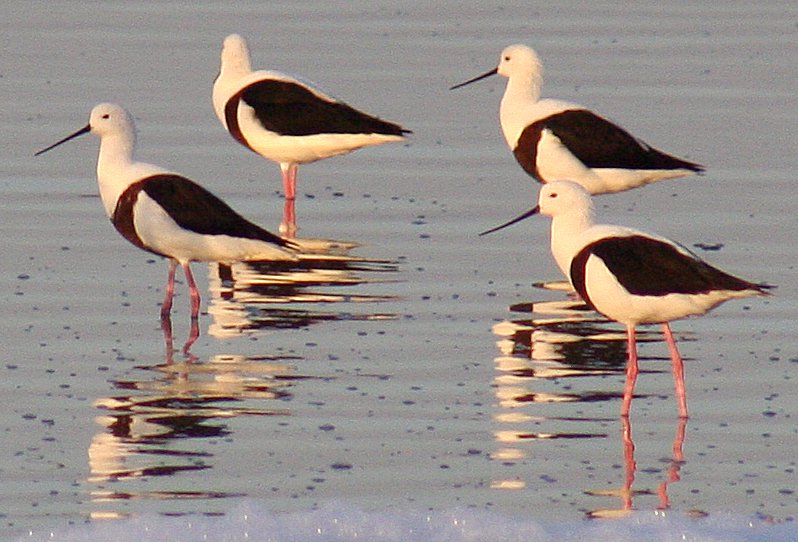 Banded StiltCladorhynchus leucocephalus
Compare
Questions and answers
What is the scientific name of the Pied Avocet?
The scientific name of the Pied Avocet is Recurvirostra avosetta. Written with its author, the full name is Recurvirostra avosetta Linnaeus, 1758.
Which family does the Pied Avocet belong to?
Recurvirostra avosetta belongs to the family Recurvirostridae, in the order Charadriiformes and the class Aves.
Where is the Pied Avocet found?
Checklists and occurrence records place Recurvirostra avosetta in 122 countries, including The Netherlands, Sweden, United Kingdom, Denmark, France and Spain.
What is the conservation status of the Pied Avocet?
The IUCN Red List category recorded for Recurvirostra avosetta is Least Concern (LC).
What other names does the Pied Avocet have?
Recurvirostra avosetta is also known in English as Eurasian Avocet, PIAV and Avocet.
Where are avocets found?
The Pied Avocet occurs across western Europe, central Asia, the Indian subcontinent, and Africa. Its distribution includes Turkey, Anatolia, northern Mongolia, northern China, Kazakhstan, and parts of Africa extending from the Mediterranean coast of North Africa and the Red Sea to Senegal and northern Guinea.[16][17][18]
Sources
Passages the profile rests on
- The male has a longer and less curved bill than the female. Source passage: “The male's bill is longer and less curved, while the female's is shorter and more distinctly curved.” — English Wikipedia
- Male Pied Avocets generally have larger bodies than females. Source passage: “Males are generally larger than females” — English Wikipedia
- Male irises are red or reddish-brown, whereas female irises are hazel-brown. Source passage: “Males are generally larger than females, with a red or reddish-brown iris, while females have a hazel-brown iris.” — English Wikipedia
- Chicks have pale grey-brown down with black speckles and patterns, four rows of black back spots, and a yellowish-tinged white underbelly. Source passage: “Chicks are covered in pale grey-brown down, finely speckled with black, with black patterns on the head, four rows of black spots on the back, and a white underbelly tinged yellowish at the neck and belly.” — English Wikipedia
- Juveniles have dingy grey wing coverts and reddish-brown vermiculated back and scapular feathers. Source passage: “Juveniles have dingy grey wing coverts, with back and scapular feathers vermiculated with reddish-brown.” — English Wikipedia
- Adults measure 42–46 cm in length. Source passage: “The pied avocet measures between 42 and 46 cm (17 and 18 in) in length” — English Wikipedia
- The wingspan ranges from 67 to 77 cm and can occasionally reach 80 cm. Source passage: “with a wingspan of 67 to 77 cm (26 to 30 in), occasionally up to 80 cm (31 in).” — English Wikipedia
- Adult males have bills measuring 8.2–9.1 cm, while female bills measure 7.2–8.5 cm. Source passage: “The bill measures 8.2 to 9.1 cm (3.2 to 3.6 in) in males and is slightly shorter in females, ranging from 7.2 to 8.5 cm (2.8 to 3.3 in).” — English Wikipedia
- Adult body weight ranges from 267 to 382 g, averaging 325 g. Source passage: “The weight ranges from 267 to 382 g (9.4 to 13.5 oz), with an average of 325 g (11.5 oz).” — English Wikipedia
- The species does not undergo seasonal plumage variation. Source passage: “The species shows no seasonal plumage variation.” — English Wikipedia
- The species frequents coastal habitats, including brackish and saline bays, sandbanks, estuaries, lagoons, deltas, and intertidal mudflats during winter. Source passage: “In winter, it gathers in groups on soft substrates like brackish or saline bays, sandbanks, estuaries, lagoons, deltas, or intertidal mudflats, used for resting and feeding.” — English Wikipedia
- Brackish and saline coastal lagoons and estuaries are identified as key habitats for the species. Source passage: “The EUNIS lists brackish and saline coastal lagoons and estuaries as key habitats.” — English Wikipedia
- During breeding, it uses wetlands with sparse vegetation and shallow water containing mud, sand, or clay islets. Source passage: “On the Atlantic coast, it inhabits wetlands, natural or artificial, with sparse vegetation and shallow water pockets with mud, sand, or clay islets, or dikes with samphire.” — English Wikipedia
- The species also occurs in shallow lakes, ponds, salt marshes, and floodplains. Source passage: “It also occurs in shallow lakes, ponds, salt marshes, or various floodplains” — English Wikipedia
- It breeds at elevations of up to 1,000 m in Anatolia. Source passage: “It breeds up to 1,000 m (3,300 ft) in altitude in Anatolia.” — English Wikipedia
- The species occurs across western Europe, central Asia, the Indian subcontinent, and Africa. Source passage: “The species has a wide distribution, spanning western Europe, central Asia, the Indian subcontinent, and Africa.” — English Wikipedia
- Its Asian distribution extends from Turkey and Anatolia to northern Mongolia, northern China, and Kazakhstan. Source passage: “In Asia, it ranges from Turkey (Anatolia) to northern Mongolia, northern China, southern Russian Far East, Kazakhstan, and Middle Eastern countries (Iran, Iraq, Jordan).” — English Wikipedia
- In Africa, the species occurs from the Mediterranean coast of North Africa and the Red Sea to the Atlantic coast of Senegal and northern Guinea. Source passage: “In Africa, it occurs along the Mediterranean coast of North Africa, the Red Sea, and Atlantic coast to Senegal and northern Guinea” — English Wikipedia
- Northern European and eastern Asian populations are migratory. Source passage: “Northern European (Netherlands to Scandinavia) and eastern Asian populations are migratory.” — English Wikipedia
- Western European populations winter in West Africa and Mediterranean countries, particularly Spain and Portugal. Source passage: “Western European birds winter in West Africa (Senegal, Gambia, Niger) and Mediterranean countries, especially Spain and Portugal (one-third of migratory European birds).” — English Wikipedia
- Mediterranean, some African, and Gulf populations are sedentary. Source passage: “Mediterranean, some African, and Gulf populations are sedentary.” — English Wikipedia
- The Pied Avocet primarily consumes small benthic invertebrates, including annelids, crustaceans, worms, and bivalve molluscs. Source passage: “The pied avocet primarily feeds on small benthic invertebrates, such as annelids, small crustaceans like Corophium, oligochaete and polychaete worms (e.g., Hediste diversicolor or Polydora species), and bivalve molluscs.” — English Wikipedia
- It also eats small insects, including midges and beetles measuring 4–15 mm. Source passage: “It also consumes small insects (midges, beetles) measuring 4 to 15 mm (0.16 to 0.59 in).” — English Wikipedia
- Chironomid larvae are an important food source during breeding and wintering in salt marshes. Source passage: “Chironomid larvae are a key food source during breeding and wintering in salt marshes.” — English Wikipedia
- The species occasionally consumes small fish, seeds, and small roots. Source passage: “It occasionally eats small fish, seeds, and small roots.” — English Wikipedia
- Its average daily food intake is approximately 150 g per individual. Source passage: “Daily food intake averages 150 g (5.3 oz) per individual.” — English Wikipedia
- The species forages in shallow brackish water or on mudflats by sweeping its bill laterally through the water. Source passage: “Like all avocets, it forages in shallow brackish water or on mud flats, often scything its bill from side to side in water” — English Wikipedia
- It uses its bill to probe sediment surfaces and make lateral pecks to locate prey. Source passage: “It uses its bill to probe the sediment surface, making lateral pecks to find prey, or catches them by sight.” — English Wikipedia
- Adults typically feed in water depths of 4–10 cm. Source passage: “Adults feed in water depths of 4 to 10 cm (1.6 to 3.9 in).” — English Wikipedia
- Some populations align their daily feeding rhythms with tides and feed at night in salt marshes. Source passage: “Locally, it may align its circadian rhythm with tides, feeding at night in salt marshes, such as in the Guérande Peninsula.” — English Wikipedia
- The species is philopatric, with some ringed individuals returning to their original Atlantic breeding sites. Source passage: “The pied avocet is philopatric. This has been demonstrated through ringing studies in Atlantic sites like the Gulf of Morbihan, Guérande Marshes, and Müllembourg Marshes on Noirmoutier Island, where some ringed birds returned to nest.” — English Wikipedia
- Pied Avocets are highly territorial when protecting chicks and defend feeding and rearing areas against other birds. Source passage: “The species is highly territorial during chick-rearing, defending feeding and rearing areas against other birds.” — English Wikipedia
- Adults use broken-wing displays and swooping attacks to distract intruders threatening their chicks. Source passage: “Adults use distraction displays, such as feigning a broken wing or swooping at intruders.” — English Wikipedia
- The species breeds in dense colonies of 10–70 pairs, occasionally reaching 200 pairs in multiple groups, or as isolated pairs. Source passage: “It nests in dense colonies of 10–70 pairs, sometimes up to 200 in multiple groups, or as isolated pairs.” — English Wikipedia
- Pied Avocets are monogamous, with pairs forming shortly after arrival at breeding sites. Source passage: “It is monogamous, with pairs forming soon after arriving at breeding sites.” — English Wikipedia
- The nest is a shallow scrape averaging 12–12.55 cm in diameter and 3–4 cm in depth. Source passage: “The nest is a shallow scrape, averaging 12 to 12.55 cm (4.72 to 4.94 in) in diameter, ranging from 6 to 22 cm (2.4 to 8.7 in), and 3 to 4 centimetres (1.2 to 1.6 in) deep.” — English Wikipedia
- Nests are generally placed near water on islets or dikes, in sand, short vegetation, or debris, but not in mud. Source passage: “It is placed near water, up to 15 cm (5.9 in) above the shore, preferably on islets or dikes, in sand, short vegetation, or debris, but never in mud.” — English Wikipedia
- Egg-laying occurs from early April to early July, with a peak between mid-April and mid-May. Source passage: “Egg-laying occurs from early April to early July, peaking from mid-April to mid-May.” — English Wikipedia
- Typical clutches contain three to five eggs. Source passage: “Clutches range from 69 to 92 days, typically with three to five eggs, occasionally more due to intraspecific parasitism.” — English Wikipedia
- Both parents incubate the eggs, with incubation averaging 23 days. Source passage: “Incubation lasts 19–34 days, averaging 23 days. Both parents incubate” — English Wikipedia
- Chicks leave the nest after the final egg hatches. Source passage: “Chicks are nidifugous, leaving the nest after the last egg hatches.” — English Wikipedia
- Chicks become independent and fledge 35–42 days after hatching. Source passage: “Chicks fledge and become independent 35–42 days after hatching.” — English Wikipedia
- The species generally reaches sexual maturity at two to three years of age. Source passage: “Generally, maturity is reached at 2–3 years.” — English Wikipedia
- The Pied Avocet is classified as Least Concern on the IUCN Red List. Source passage: “Recurvirostra avosetta is listed as Least Concern.” — iucnredlist.org
- The species was most recently assessed in 2012. Source passage: “Pied Avocet Recurvirostra avosetta has most recently been assessed of Threatened Species in 2012.” — iucnredlist.org
- Threats to the species include habitat destruction, climate change, and pollution. Source passage: “it nonetheless faces threats from anthropogenic factors such as habitat destruction, climate change, and pollution.” — English Wikipedia
Data
- Catalogue of Life, 2026-10-16 XR cc by
- Global Biodiversity Information Facility CC BY 4.0
- Wikidata CC0
- GeoNames CC BY 4.0
- Wikimedia Commons per image; credit shown with each image
- Within the Catalogue of Life, this name comes from The Integrated Taxonomic Information System cc0
References
- Linnaeus, C. (1758). Systema Naturae per regna tria naturae, secundum classes, ordines, genera, species, cum characteribus, differentiis, synonymis, locis. Tomus I. Editio decima, reformata. Laurentii Salvii. Holmiae [Stockholm]. [iii] + 824 pp. where the name was published
- Peters, & James Lee. (1934). Check-List of Birds of the World, Vol. 2.
- Gill, Frank, & and Minturn Wright. (2006). Birds of the World: Recommended English Names.
- Dickinson, E. C., and J. V. Remsen Jr., eds. (2013). The Howard and Moore Complete Checklist of the Birds of the World, 4th Edition, Vol. 1 Non-Passerines.
This species in other databases
- Catalogue of Life 4RP59
- Wikidata Q26147
- iNaturalist 4883
- WoRMS urn:lsid:marinespecies.org:taxname:212721
- Avibase pieavo1
Page built on 28 November 2026. See how the catalog is made and all sources and licences.
Cite this page
ScientificNames.org. (2026). Recurvirostra avosetta (Pied Avocet). Retrieved November 28, 2026, from https://scientificnames.org/species/recurvirostra-avosetta
“Recurvirostra avosetta (Pied Avocet).” ScientificNames.org, 2026, scientificnames.org/species/recurvirostra-avosetta. Accessed 28 Nov. 2026.
ScientificNames.org. “Recurvirostra avosetta (Pied Avocet).” Accessed November 28, 2026. https://scientificnames.org/species/recurvirostra-avosetta.
@misc{scientificnames_recurvirostra_avosetta_pied_avocet,
  author = {{ScientificNames.org}},
  title = {Recurvirostra avosetta (Pied Avocet)},
  year = {2026},
  url = {https://scientificnames.org/species/recurvirostra-avosetta},
  note = {Accessed 2026-11-28}
}