Species · Flowering plants
Common Waxflower Hoya australis
The scientific name of the Common Waxflower is Hoya australis. It is a species of flowering plant in the family Apocynaceae (dogbane family), order Gentianales.
- Scientific name
- Hoya australis R.Br. ex J.Traill
- Common name
- Common Waxflower
- Genus
- Hoya
- Family
- Apocynaceae (Dogbane Family)
- Order
- Gentianales
- Class
- Magnoliopsida
- Recorded in
- 15 countries
- Name status
- accepted in the Catalogue of Life

Overview
Common waxflower (Hoya australis) is a succulent climbing vine or subshrub. The species is recorded in Western Australia, the Northern Territory, Queensland and New South Wales. It has fleshy, cream-coloured flowers with a strong sweet fragrance.
Written 26 November 2026 from the sources listed below. Each statement was checked against the passage it cites; statements that could not be supported were removed.
Appearance
Common waxflower is a succulent climbing vine or subshrub that typically reaches a height of 4–10 m. Its stems are woody, and its leaves are thick, fleshy or leathery.[1][2][3]
Its leaves may be elliptic, oblong, egg-shaped or nearly round, reaching 150 mm in length and 120 mm in width. Leaves growing in sunny positions are more yellowish green, while those growing in shade are dark green.[4][5][6]
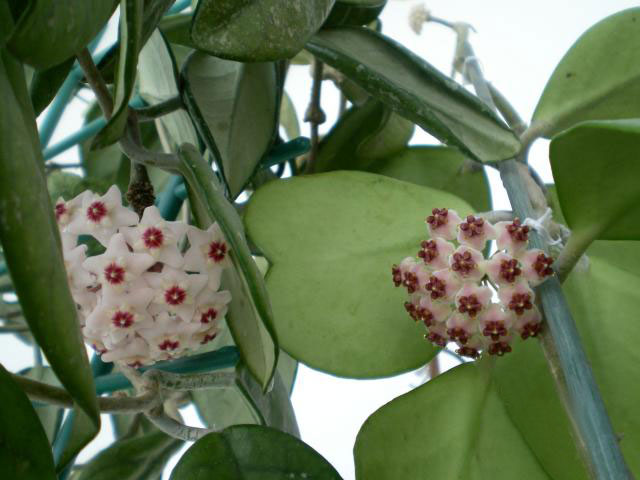
Its flowers grow in clusters called racemes measuring 10–25 mm in diameter. They are fleshy and bell-shaped to wheel-shaped, with cream colouring and red beneath the corona.[7][8][9]
The flowers have a strong sweet fragrance and produce abundant nectar. Its fruit is a spindle-shaped follicle measuring 90–130 mm in length.[10][11][12]
Habitat
The species is recorded in Western Australia, the Northern Territory, Queensland and New South Wales. It is described as native to a geographical range extending from Borneo to New Guinea and Australia.[13][14]
Subspecies australis occurs in eastern Australia between the Torres Strait in northern Queensland and Dorrigo in New South Wales. Subspecies rupicola grows on sandstone outcrops and cliffs in the Kimberley region and the Top End.[15][16]
Subspecies sanae grows in foreshore vine thickets on Cape York Peninsula and some offshore islands. Subspecies tenuipes occurs on southern Cape York Peninsula, south to Innisfail, and also in New Guinea, the Solomon Islands and Melanesia.[17][18]
Subspecies oramicola is restricted to Melville and Bathurst Islands north of Darwin.[19]
Diet
The plant serves as a food source for caterpillars of the no-brand crow butterfly and the common Australian crow butterfly.[20][21]
Behaviour
The species attracts butterflies when grown in gardens.[22]
Reproduction and life cycle
The flowering period varies according to subspecies. The flowers are pollinated by the southern grass-dart butterfly.[23][24]
Uses
Common waxflower is cultivated as a garden and houseplant in Australia. It is commonly grown in containers and trained to climb trellises on verandahs, fences and in glasshouses.[25][26]
The species can be grown indoors if it receives direct sunlight.[27]
Classification of the Common Waxflower
| Kingdom | Plantae |
|---|---|
| Subkingdom | Pteridobiotina |
| Phylum | Tracheophyta |
| Class | Magnoliopsida |
| Order | Gentianales |
| Family | Apocynaceae (Dogbane Family) |
| Subfamily | Asclepiadoideae |
| Tribe | Marsdenieae |
| Genus | Hoya (Waxflowers) |
| Species | Hoya australis R.Br. ex J.Traill |
Where the Common Waxflower is found
Checklists and occurrence records place Hoya australis in 15 countries across North America and Oceania. GBIF holds 2,786 georeferenced records of it.
Countries where it is native or its origin is not stated
- American Samoa 29
- Australia 2,100
- Cook Islands 5
- Fiji 99
- French Polynesia 9
- Papua New Guinea 174
- Samoa 134
- Solomon Islands 10
- Tonga 67
- Vanuatu 73
- Wallis and Futuna 6
Countries where it has been introduced
Regions and cities with the most records
- Queensland, Australia 1,369
- New South Wales, Australia 296
- Northern Territory, Australia 255
- Morobe Province, Papua New Guinea 53
- Brisbane, Australia 51
- Cairns, Australia 38
- Gladstone, Australia 38
- Hawaii, United States 34
- Gold Coast, Australia 32
- Western Australia, Australia 30
- Caloundra, Australia 27
- Sunshine Coast, Australia 26
- Bulolo, Papua New Guinea 25
- Central Province, Papua New Guinea 23
- Logan City, Australia 18
- Toowoomba, Australia 18
- Rockhampton, Australia 16
- Madang Province, Papua New Guinea 15
- Gympie, Australia 14
- Sanma, Vanuatu 12
- Tafea, Vanuatu 12
- Capalaba, Australia 11
- Hervey Bay, Australia 10
- West New Britain Province, Papua New Guinea 10
- Gaga'ifomauga, Samoa 9
- Lae, Papua New Guinea 9
- Tuamasaga, Samoa 9
- Australian Capital Territory, Australia 8
- Bougainville, Papua New Guinea 8
- Canberra, Australia 8
- Malampa, Vanuatu 8
- Oro Province, Papua New Guinea 8
- Port-Vila, Vanuatu 8
- Shefa, Vanuatu 8
- Townsville, Australia 8
- Tuggeranong, Australia 8
4 more countries have a few records outside this range
These countries hold a few records of Hoya australis but lie outside the range the checklists give for it. Such records are often zoo or garden specimens, museum material or vagrants, so the species is not counted as occurring there.
A number beside a place is its count of GBIF occurrence records. A place without a number comes from a checklist alone. Records show where a species has been observed or collected, which can include escapes and vagrants.
Common names
English
- Common Waxflower
- Samoan Waxplant
- Wax Vine
- Hoya
- Native Hoya
Names in 7 other languages
- Chinese
- 澳洲鲁比球兰
- Finnish
- australianposliinikukka
- German
- australische Porzellanblume
- Lithuanian
- Australinė vaškuolė
- Polish
- hoja zwyczajna
- Thai
- โฮย่าออสเตรลิส
- Tongan
- laumatolu
Subspecies and varieties
- Hoya australis subsp. australis (Wax Vine) subspecies
- Hoya australis subsp. melanesica subspecies
- Hoya australis subsp. nathalieae subspecies
- Hoya australis subsp. oramicola subspecies
- Hoya australis subsp. rupicola subspecies
- Hoya australis subsp. sana subspecies
- Hoya australis subsp. tenuipes subspecies
Related species
-
 Wax PlantHoya carnosa
-
 Heart HoyaHoya kerrii
-
 Miniature Wax PlantHoya bella
-
 Hoya pubicalyx
-
 Hoya linearis
-
 Hoya imbricata
-
 Hoya multiflora
-
 Red HoyaHoya macgillivrayi
Compare
Questions and answers
What is the scientific name of the Common Waxflower?
The scientific name of the Common Waxflower is Hoya australis. Written with its author, the full name is Hoya australis R.Br. ex J.Traill.
Which family does the Common Waxflower belong to?
Hoya australis belongs to the family Apocynaceae, in the order Gentianales and the class Magnoliopsida.
Where is the Common Waxflower found?
Checklists and occurrence records place Hoya australis in 15 countries, including Australia, Papua New Guinea, Samoa, Fiji, Vanuatu and Tonga.
What other names does the Common Waxflower have?
Hoya australis is also known in English as Samoan Waxplant, Wax Vine, Hoya and Native Hoya.
What is the scientific name for waxflower?
The scientific name of common waxflower is Hoya australis R.Br. ex J.Traill.[1]
Sources
Passages the profile rests on
- Hoya australis is a succulent climbing vine or subshrub. Source passage: “Hoya australis is a succulent climbing vine to subshrub” — English Wikipedia
- The plant typically reaches a height of 4–10 m. Source passage: “typically reaches a height of 4–10 m (13–33 ft).” — English Wikipedia
- Hoya australis has thick, fleshy leaves and woody stems, consistent with the general description of hoya plants. Source passage: “Hoyas are trailing vines that have woody stems and thick, fleshy leaves” — gardeningsolutions.ifas.ufl.edu
- Its leaves are fleshy or leathery and may be elliptic, oblong, egg-shaped or nearly round. Source passage: “fleshy or leathery, elliptic, oblong, egg-shaped or more or less round leaves” — English Wikipedia
- Its leaves can reach 150 mm in length and 120 mm in width. Source passage: “leaves up to 150 mm (5.9 in) long and 120 mm (4.7 in) wide.” — English Wikipedia
- Leaves growing in sunny positions are more yellowish green, whereas those growing in shade are dark green. Source passage: “Leaves growing in sunnier positions are a more yellowish green while those in shadier situations are dark green in colour.” — English Wikipedia
- Its flowers are arranged in clusters called racemes. Source passage: “The flowers are arranged in racemes” — English Wikipedia
- Its flower racemes measure 10–25 mm in diameter. Source passage: “racemes 10–25 mm (0.39–0.98 in) in diameter” — English Wikipedia
- Its flowers are fleshy and bell-shaped to wheel-shaped, with cream colouring and red beneath the corona. Source passage: “The flowers are fleshy, bell-shaped to wheel-shaped, cream-coloured with red under the corona” — English Wikipedia
- Its flowers have a strong sweet fragrance. Source passage: “The flowers have a strong sweet scent” — English Wikipedia
- Its flowers produce abundant nectar. Source passage: “produce abundant nectar.” — English Wikipedia
- Its fruit is a spindle-shaped follicle measuring 90–130 mm in length. Source passage: “the fruit is a spindle-shaped follicle 90–130 mm (3.5–5.1 in) long.” — English Wikipedia
- The species is recorded in Western Australia, the Northern Territory, Queensland and New South Wales. Source passage: “is found in Western Australia, the Northern Territory, Queensland and New South Wales.” — English Wikipedia
- The species is described as native to a geographical range extending from Borneo to New Guinea and Australia. Source passage: “It is native to a wide area from Borneo to New Guinea and Australia.” — plants.ces.ncsu.edu
- Subspecies australis occurs in eastern Australia between the Torres Strait in northern Queensland and Dorrigo in New South Wales. Source passage: “Subspecies australis occurs in eastern Australia from the Torres Strait in northern Queensland to Dorrigo in New South Wales.” — English Wikipedia
- Subspecies rupicola grows on sandstone outcrops and cliffs in the Kimberley region and the Top End. Source passage: “subsp. rupicola occurs in the Kimberley region of Western Australia and the Top End of the Northern Territory on sandstone outcrops and cliffs.” — English Wikipedia
- Subspecies sanae grows in foreshore vine thickets on Cape York Peninsula and some offshore islands. Source passage: “subsp. sanae grows in foreshore vine thickets on Cape York Peninsula and some offshore islands” — English Wikipedia
- Subspecies tenuipes occurs on southern Cape York Peninsula, south to Innisfail, and also in New Guinea, the Solomon Islands and Melanesia. Source passage: “subsp. tenuipes is found on the southern Cape York Peninsula, as far south as Innisfail, and in New Guinea, the Solomon Islands and Melanesia.” — English Wikipedia
- Subspecies oramicola is restricted to Melville and Bathurst Islands north of Darwin. Source passage: “Subspecies oramicola is restricted to Melville and Bathurst Islands north of Darwin” — English Wikipedia
- The plant serves as a food source for caterpillars of the no-brand crow butterfly. Source passage: “It serves as a food plant for the caterpillars of the Queensland butterfly the no-brand crow (Euploea alcathoe)” — English Wikipedia
- The plant serves as a food source for caterpillars of the common Australian crow butterfly. Source passage: “and the common Australian crow (E. core).” — English Wikipedia
- The species attracts butterflies when grown in gardens. Source passage: “It is a butterfly-attracting plant in the garden.” — English Wikipedia
- The flowering period of Hoya australis varies according to its subspecies. Source passage: “Flowering time depends on subspecies” — English Wikipedia
- The flowers are pollinated by the southern grass-dart butterfly. Source passage: “Flowers are pollinated by the southern grass-dart (Ocybadistes walkeri).” — English Wikipedia
- Hoya australis is cultivated as a garden and houseplant in Australia. Source passage: “Hoya australis is a popular garden and houseplant in Australia” — English Wikipedia
- The plant is commonly grown in containers and trained to climb trellises on verandahs, fences and in glasshouses. Source passage: “It is often grown in containers and trained to grow on trellises on verandahs, fences and in glasshouses.” — English Wikipedia
- The species can be grown indoors if it receives direct sunlight. Source passage: “It can be grown indoors provided it receives direct sunlight.” — English Wikipedia
Data
- Catalogue of Life, 2026-10-16 XR cc by
- Global Biodiversity Information Facility CC BY 4.0
- Wikidata CC0
- GeoNames CC BY 4.0
- Wikimedia Commons per image; credit shown with each image
- Within the Catalogue of Life, this name comes from Synonymic Checklists of the Vascular Plants of the World cc by
References
- R.Br. ex J.Traill. where the name was published
This species in other databases
- Catalogue of Life 3MRK3
- Wikidata Q311190
- iNaturalist 348419
- World Flora Online wfo-0000725141
- GRIN 19392
Page built on 27 November 2026. See how the catalog is made and all sources and licences.
Cite this page
ScientificNames.org. (2026). Hoya australis (Common Waxflower). Retrieved November 27, 2026, from https://scientificnames.org/species/hoya-australis
“Hoya australis (Common Waxflower).” ScientificNames.org, 2026, scientificnames.org/species/hoya-australis. Accessed 27 Nov. 2026.
ScientificNames.org. “Hoya australis (Common Waxflower).” Accessed November 27, 2026. https://scientificnames.org/species/hoya-australis.
@misc{scientificnames_hoya_australis_common_waxflower,
  author = {{ScientificNames.org}},
  title = {Hoya australis (Common Waxflower)},
  year = {2026},
  url = {https://scientificnames.org/species/hoya-australis},
  note = {Accessed 2026-11-27}
}