Species · Flowering plants
Wax Plant Hoya carnosa
The scientific name of the Wax Plant is Hoya carnosa. It is a species of flowering plant in the family Apocynaceae (dogbane family), order Gentianales.
- Scientific name
- Hoya carnosa (L.fil.) R.Br.
- Common name
- Wax Plant
- Genus
- Hoya
- Family
- Apocynaceae (Dogbane Family)
- Order
- Gentianales
- Class
- Magnoliopsida
- Recorded in
- 21 countries
- Name status
- accepted in the Catalogue of Life

Overview
The species is native to southern China, including Hainan, and Japan, including the Ryukyu Islands.
Written 26 November 2026 from the sources listed below. Each statement was checked against the passage it cites; statements that could not be supported were removed.
Appearance
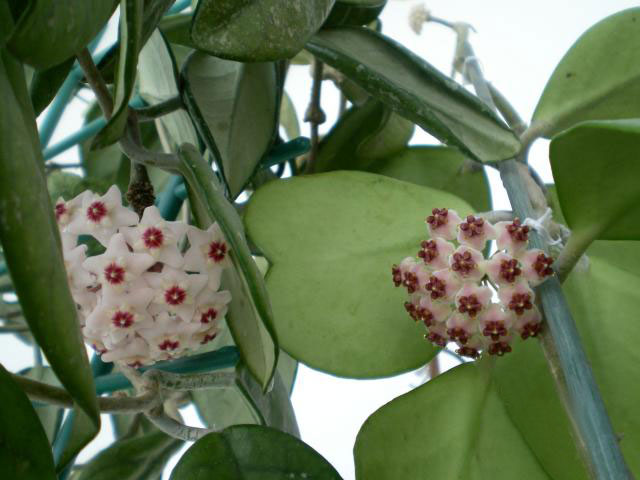
The wax plant produces smooth, pale-gray, hairless shoots that twine and climb. Its perennial leaves are oval, elongated oval or heart-shaped, fleshy, slightly succulent and glossy with a waxy surface.[1][2]
The leaves measure 3–5 centimetres wide and 3.5–13 centimetres long. Their petioles measure approximately 1–1.5 centimetres long.[3][4]
The flowers grow in clusters forming umbels. The spindle-shaped fruits measure 6–10 centimetres long and 0.5–1.5 centimetres wide.[5][6]
Habitat
The wax plant is native to southern China, including Hainan, and Japan, including the Ryukyu Islands.[7][8]
It can be grown indoors throughout the year or during cooler months in the UK. During summer, it can be moved outdoors to a warm, sheltered location.[9][10]
In a large conservatory, the plant can be trained to grow along horizontal wires attached to a wall.[11]
Uses
The wax plant is cultivated as a houseplant for its attractive waxy foliage and sweetly scented flowers. It can be grown in pots and hanging baskets.[12][13]
The species has been cultivated for more than 200 years and has produced numerous cultivated varieties differing in foliage form or flower colour.[14][15]
The wax plant received the Royal Horticultural Society's Award of Garden Merit in UK cultivation. A 2009 University of Georgia study identified it as an effective remover of indoor pollutants.[16][17]
Behaviour
The flowers are heavily scented and may release excess nectar that drips from them. Their scent is nocturnal and has pheromonal characteristics.[18][19]
The plant can grow quite large when left unpruned. Light pruning in late winter or early spring can maintain it at a manageable size.[20][21]
Changes in light levels may cause the plant to drop its flower buds. Retaining the flower stalks after flowering can allow another flush of flowers to develop.[22][23]
Reproduction and life cycle
Flowering occurs from spring through late summer. Each umbel can contain 10–50 star-shaped flowers, which mature gradually over two to three weeks on the same peduncle.[24][25]
The wax plant can be propagated through air layering or stem cuttings. Layering and cuttings can be carried out in spring or early summer.[26][27]
Classification of the Wax Plant
| Kingdom | Plantae |
|---|---|
| Subkingdom | Pteridobiotina |
| Phylum | Tracheophyta |
| Class | Magnoliopsida |
| Order | Gentianales |
| Family | Apocynaceae (Dogbane Family) |
| Subfamily | Asclepiadoideae |
| Tribe | Marsdenieae |
| Genus | Hoya (Waxflowers) |
| Species | Hoya carnosa (L.fil.) R.Br. |
Where the Wax Plant is found
Checklists and occurrence records place Hoya carnosa in 21 countries across Africa, Asia, North America, Oceania and South America. GBIF holds 2,209 georeferenced records of it.
Countries where it is native or its origin is not stated
Countries where it has been introduced
- Bangladesh 1
- Colombia 20
- Fiji 7
- Honduras 3
- Mexico 4
- Myanmar 3
- Panama 4
- Philippines 8
- South Korea 1
- Trinidad and Tobago
- Venezuela
- Zimbabwe 1
Regions and cities with the most records
- Taiwan, Taiwan 535
- Xizhi, Taiwan 401
- Neihu, Taiwan 379
- Taipei, Taiwan 369
- Banqiao, Taiwan 365
- New Taipei City, Taiwan 323
- Shulin, Taiwan 261
- Okinawa, Japan 255
- Taipei, Taiwan 241
- Keelung, Taiwan 238
- Sanxia, Taiwan 196
- Danshui, Taiwan 195
- Sanzhi, Taiwan 190
- Keng Hau, Hong Kong 163
- San Tin, Hong Kong 163
- Tai Wai, Hong Kong 163
- Pok Hong, Hong Kong 161
- Sha Tin, Hong Kong 161
- Sha Tin Wai, Hong Kong 161
- Sun Tin Wai, Hong Kong 160
- City One, Hong Kong 159
- Mei Foo, Hong Kong 159
- Mei Foo Sun Chuen, Hong Kong 159
- Shui Chuen O, Hong Kong 159
- Wong Tai Sin, Hong Kong 159
- Siu Lek Yuen, Hong Kong 158
- Chuk Yuen, Hong Kong 157
- Chuk Yuen North Estate, Hong Kong 157
- Fo Tan, Hong Kong 157
- So Uk, Hong Kong 157
- So Uk Estate, Hong Kong 157
- Tai Po, Hong Kong 157
- Tsz Ching Estate, Hong Kong 157
- Tsz Wan Shan, Hong Kong 157
- Wang Tau Hom, Hong Kong 157
- Wang Tau Hom Estate, Hong Kong 157
14 more countries have a few records outside this range
These countries hold a few records of Hoya carnosa but lie outside the range the checklists give for it. Such records are often zoo or garden specimens, museum material or vagrants, so the species is not counted as occurring there.
Range as the checklists state it
Zimbabwe [I]; China (Fujian, Guangdong, Guangxi, Hainan, Yunnan); South Korea [I]; Japan (S-Kyushu); Ryukyu Isl.; Taiwan; ?Bhutan; Bangladesh [I]; Myanmar [I]; Laos; peninsular Malaysia; Philippines [I]; Solomon Isl. [I]; Fiji [I]; Mexico [I]; Honduras [I]; Panama [I]; Trinidad & Tobago [I]; Colombia [I]; Venezuela [I]
A number beside a place is its count of GBIF occurrence records. A place without a number comes from a checklist alone. Records show where a species has been observed or collected, which can include escapes and vagrants.
Common names
English
- Wax Plant
- Common Wax-plant
- Honeyplant
- Waxflower
Names in 18 other languages
- Chinese
- qiu lan, 毬蘭, 球兰, 球蘭
- Czech
- hoja masitá
- Danish
- almindelig voksblomst
- Dutch
- Grote wasbloem
- Finnish
- isoposliinikukka
- German
- Porzellanblume
- Hebrew
- בת-שבע מטפסת
- Italian
- Fiore di cera
- Japanese
- サクララン
- Lithuanian
- Storalapė vaškuolė
- Polish
- Hoja różowa
- Portuguese
- Flor-de-cera
- Russian
- Восковой плющ, Хойя мясистая
- Slovak
- hoja mäsitá
- Spanish
- Canastilla asiática, Flor de cera asiática, Flor de nácar
- Swedish
- porslinsblomma
- Thai
- นมพิจิตร, โฮย่าเกลียวสวาท
- Turkish
- Mum Çiçeği
Synonyms
21 other scientific names have been used for this species and are now treated as synonyms of Hoya carnosa.
- Hoya carnosa f. variegata (Siebold ex C.Morren) H.Hara
- Hoya carnosa var. carnosa
- Hoya carnosa var. gushanica W.Xu
- Hoya carnosa var. japonica Siebold ex Maxim.
- Hoya carnosa var. variegata (Siebold ex C.Morren) L.H.Bailey
- Hoya chinensis (Lour.) Traill
- Hoya compacta C.M.Burton
- Hoya intermedia A.C.Sm.
- Hoya motoskei Teijsm. & Binn.
- Hoya rotundifolia Siebold
- Hoya skinneriana Kloppenb.
- Hoya variegata Siebold ex C.Morren
- Schollia carnosa Schrank ex Steud.
- Schollia chinensis (Lour.) J.Jacq.
- Schollia crassifolia J.Jacq.
- Stapelia chinensis Lour.
- Asclepias carnosa L.fil. ambiguous synonym
- Cynanchum carnosum (L.fil.) Decne. ambiguous synonym
- Hoya crassifolia (J.Jacq.) Haw. ambiguous synonym
- Hoya laurifolia Miq. ambiguous synonym
- Hoya picta Siebold ex C.Morren ambiguous synonym
Related species
-
 Heart HoyaHoya kerrii
-
 Common WaxflowerHoya australis
-
 Miniature Wax PlantHoya bella
-
 Hoya pubicalyx
-
 Hoya linearis
-
 Hoya imbricata
-
 Hoya multiflora
-
 Red HoyaHoya macgillivrayi
Compare
Questions and answers
What is the scientific name of the Wax Plant?
The scientific name of the Wax Plant is Hoya carnosa. Written with its author, the full name is Hoya carnosa (L.fil.) R.Br..
Which family does the Wax Plant belong to?
Hoya carnosa belongs to the family Apocynaceae, in the order Gentianales and the class Magnoliopsida.
Where is the Wax Plant found?
Checklists and occurrence records place Hoya carnosa in 21 countries, including Taiwan, Japan, Hong Kong, China, India and Vietnam.
What other names does the Wax Plant have?
Hoya carnosa is also known in English as Common Wax-plant, Honeyplant and Waxflower.
Do wax flowers come back every year?
New flowers develop annually on the same specialised perennial peduncles. Flowering occurs from spring through late summer.[24][28][29]
What is wax flower used for?
The wax plant is cultivated as a houseplant for its waxy foliage and sweetly scented flowers. It can be grown in pots and hanging baskets. It was also identified in a 2009 University of Georgia study as an effective remover of indoor pollutants.[12][13][17]
Where do hoyas grow naturally?
The wax plant is native to southern China, including Hainan, and Japan, including the Ryukyu Islands.[7][8]
How do I care for a Hoya carnosa wax plant?
The plant can be grown indoors throughout the year or during cooler months in the UK. During summer, it can be moved outdoors to a warm, sheltered location. It can be trained to climb using a wire loop or tripod of canes, or allowed to trail from a hanging container. Light pruning in late winter or early spring can maintain a manageable size.[9][10][30][21]
Sources
Passages the profile rests on
- The plant produces smooth, pale-gray, hairless shoots that twine and climb. Source passage: “Hoya carnosa makes faintly succulent shoots with smooth, pale gray, and bare surfaces that twine and climb.” — English Wikipedia
- Its perennial leaves are oval to elongated oval or heart-shaped, fleshy, slightly succulent, and glossy with a waxy surface. Source passage: “The perennial leaves are wide oval to longitudinal oval or heart-shaped. They are slightly succulent, fleshy with a waxy glossy surface” — English Wikipedia
- Its leaves measure 3–5 centimetres wide and 3.5–13 centimetres long. Source passage: “3–5 centimetres (1.2–2.0 in) wide and 3.5–13 centimetres (1.4–5.1 in) long” — English Wikipedia
- Its leaf petioles measure approximately 1–1.5 centimetres long. Source passage: “with a petiole of about 1–1.5 centimetres (0.39–0.59 in).” — English Wikipedia
- Its spindle-shaped fruits measure 6–10 centimetres long and 0.5–1.5 centimetres wide. Source passage: “The spindle-shaped fruits measure 6 to 10 × 0.5 to 1.5 cm.” — English Wikipedia
- The flowers are arranged in clusters forming umbels. Source passage: “The inflorescence is made up of numerous flowers, hanging or more upright, which are grouped in an umbel.” — English Wikipedia
- The species is native to southern China, including Hainan. Source passage: “Hoya carnosa is native to southern China (including Hainan)” — English Wikipedia
- The species is native to Japan, including the Ryukyu Islands. Source passage: “Japan (including the Ryukyu Islands).” — English Wikipedia
- The species can be grown indoors throughout the year or during cooler months in the UK. Source passage: “They are tender, so must be grown indoors in the UK, either all year round or throughout the cooler months.” — rhs.org.uk
- The species can be moved outdoors during summer to a warm, sheltered location. Source passage: “Hoyas can be moved outdoors in summer to a warm, sheltered spot” — rhs.org.uk
- The species can be trained to grow along horizontal wires attached to a wall in a large conservatory. Source passage: “Hoya carnosa AGM is a particularly vigorous climber and if you have space in a large conservatory, you could train it along horizontal wires attached to a wall.” — rhs.org.uk
- The species is cultivated as a houseplant for its attractive waxy foliage and sweetly scented flowers. Source passage: “It is a common house plant grown for its attractive waxy foliage, and sweetly scented flowers.” — English Wikipedia
- The species can be grown in pots and hanging baskets. Source passage: “It is grown well in pots and hanging baskets.” — English Wikipedia
- The species has been cultivated for more than 200 years. Source passage: “Hoya carnosa has been in cultivation for more than 200 years” — English Wikipedia
- The species has produced numerous cultivated varieties differing in foliage form or flower colour. Source passage: “has given rise to many cultivars that vary in foliage form or flower color.” — English Wikipedia
- The species received the Royal Horticultural Society's Award of Garden Merit in UK cultivation. Source passage: “In cultivation in the UK it has gained the Royal Horticultural Society's Award of Garden Merit.” — English Wikipedia
- The species was identified in a 2009 University of Georgia study as an effective remover of indoor pollutants. Source passage: “Studies at the University of Georgia, published in 2009, have shown H. carnosa to be an excellent remover of pollutants in the indoor environment.” — English Wikipedia
- The flowers are heavily scented and may release excess nectar that drips from them. Source passage: “They are heavily scented and may produce excess nectar that drips from the flowers.” — English Wikipedia
- The flowers have a nocturnal scent with pheromonal characteristics. Source passage: “The scent is nocturnal with a pheromonal tendency.” — English Wikipedia
- The species can grow quite large when left unpruned. Source passage: “If left unpruned, it can get quite large” — rhs.org.uk
- The species can be maintained at a manageable size through light pruning in late winter or early spring. Source passage: “Light pruning in late winter/early spring will help to keep these vigorous plants to a manageable size.” — rhs.org.uk
- The species may drop its flower buds when light levels change. Source passage: “But never move plants once flower buds have formed, as they may drop the buds if light levels change.” — rhs.org.uk
- The species can produce another flush of flowers if its flower stalks are retained after flowering. Source passage: “After flowering, you may get a second flush if you leave the flower stalks in place.” — rhs.org.uk
- Flowering occurs from spring through late summer. Source passage: “The plant flowers from spring to late summer” — English Wikipedia
- Each umbel can contain 10–50 star-shaped flowers that mature gradually over two to three weeks on the same peduncle. Source passage: “it can produce umbels of 10 to 50 small star-shaped flowers that mature gradually (2 to 3 weeks) on the same peduncle.” — English Wikipedia
- The species can be propagated through air layering or stem cuttings. Source passage: “It can be propagated by air layering or by stem cuttings.” — English Wikipedia
- The species can be propagated by layering and cuttings in spring or early summer. Source passage: “You can make new hoyas for free by layering and taking in spring or early summer.” — rhs.org.uk
- Its flowers develop from specialised perennial peduncles that emerge from leaf and stem axils. Source passage: “These appear from the axils of the leaves and stem” — English Wikipedia
- New flowers develop annually on the same specialised perennial peduncles. Source passage: “New flowers are produced on these same spurs every year, so they should not be removed.” — English Wikipedia
- The species can be trained to climb using a wire loop or tripod of canes, or allowed to trail from a hanging container. Source passage: “Hoyas are climbers or trailers – so provide support such as a wire loop or tripod of canes if you want them to climb” — rhs.org.uk
Data
- Catalogue of Life, 2026-10-16 XR cc by
- Global Biodiversity Information Facility CC BY 4.0
- Wikidata CC0
- GeoNames CC BY 4.0
- Wikimedia Commons per image; credit shown with each image
- iNaturalist per image; credit shown with each image
- Within the Catalogue of Life, this name comes from Synonymic Checklists of the Vascular Plants of the World cc by
References
- R.Br. Prodr. Fl. Nov. Holland. 460 (1810). where the name was published
This species in other databases
- Catalogue of Life 3MRLT
- Wikidata Q134347
- iNaturalist 129523
- World Flora Online wfo-0000725176
- GRIN 103205
Page built on 27 November 2026. See how the catalog is made and all sources and licences.
Cite this page
ScientificNames.org. (2026). Hoya carnosa (Wax Plant). Retrieved November 27, 2026, from https://scientificnames.org/species/hoya-carnosa
“Hoya carnosa (Wax Plant).” ScientificNames.org, 2026, scientificnames.org/species/hoya-carnosa. Accessed 27 Nov. 2026.
ScientificNames.org. “Hoya carnosa (Wax Plant).” Accessed November 27, 2026. https://scientificnames.org/species/hoya-carnosa.
@misc{scientificnames_hoya_carnosa_wax_plant,
  author = {{ScientificNames.org}},
  title = {Hoya carnosa (Wax Plant)},
  year = {2026},
  url = {https://scientificnames.org/species/hoya-carnosa},
  note = {Accessed 2026-11-27}
}