Species · Insects
Hydaticus Fabricii Hydaticus (Prodaticus) fabricii
The scientific name of the Hydaticus Fabricii is Hydaticus (Prodaticus) fabricii. It is a species of insect in the family Dytiscidae (diving beetles), order Coleoptera. The name dates from 1825.
- Scientific name
- Hydaticus (Prodaticus) fabricii (W. S. MacLeay, 1825)
- Common name
- Hydaticus Fabricii
- Genus
- Hydaticus
- Family
- Dytiscidae (Diving Beetles)
- Order
- Coleoptera
- Class
- Insecta
- Recorded in
- 9 countries
- Name status
- accepted in the Catalogue of Life
Overview
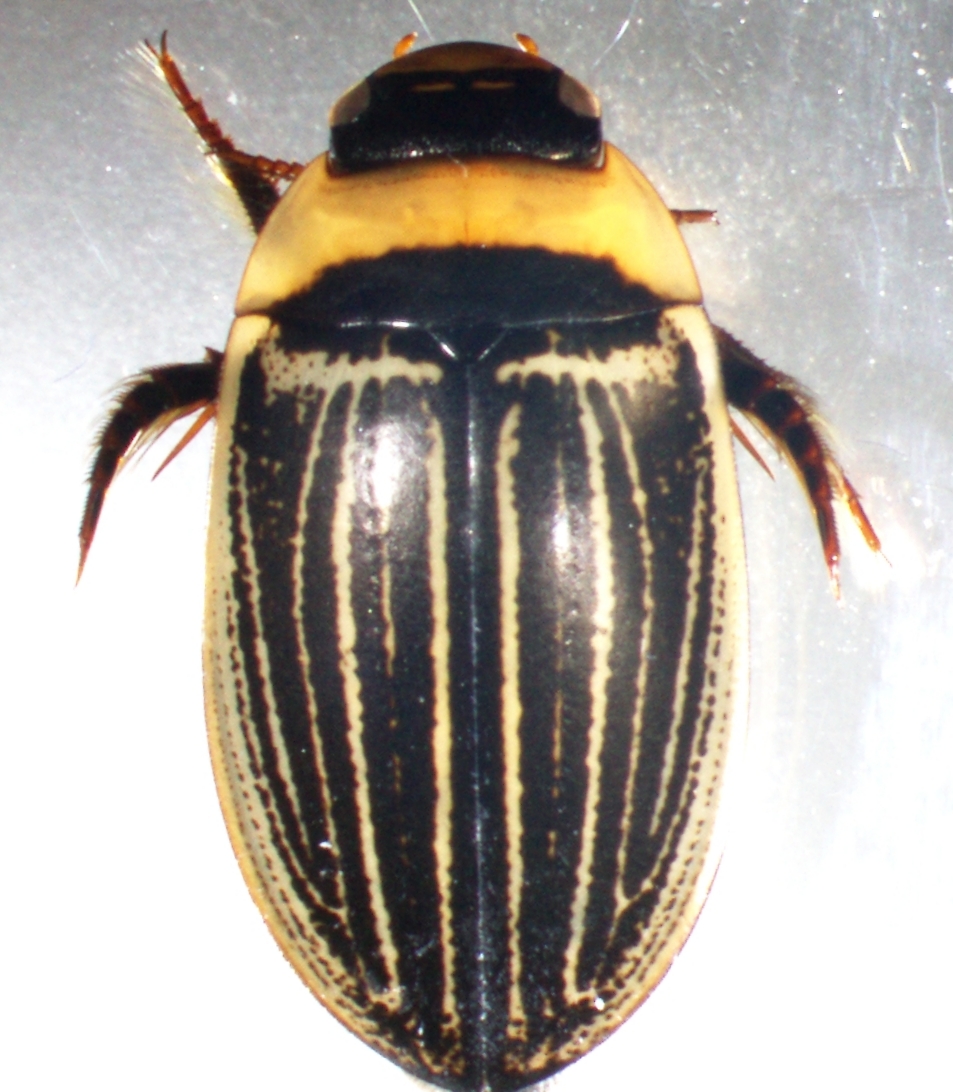
Hydaticus fabricii has been recorded in India, Afghanistan, Myanmar, Nepal, Pakistan, Sri Lanka, China, Indonesia, Iran, Japan, the Philippines, Taiwan, Thailand, Vietnam and Australia. Hydaticus fabricii has an oval-shaped body, distinctly darkened pronotal margins and characteristic bristles on the tarsi.
Written 27 November 2026 from the sources listed below. Each statement was checked against the passage it cites; statements that could not be supported were removed.
Appearance
Hydaticus fabricii has an oval-shaped body with a length of approximately 9.0–10.7 mm. The front and rear margins of the pronotum are distinctly darkened.[1][2][3]
The upper surface of the hind tarsal phalanx has relatively long bristles along its rear margin. Males have a row of bristles along the rear margin of the adhesive disc on their fore tarsi, and these bristles exceed half the length of the limb.[4][5][6]
The male aedeagus is relatively straight and has a long bristle plate at the tip of the penis.[7]
The loeffleri subspecies is substantially smaller than the nominate subspecies. Its penis tip is slightly curved.[8][9]
The confusus subspecies has a relatively slender penis. Its bristle plate at the penis tip is considerably shorter than that of the nominate subspecies.[10][11]
Similar species
Several forms historically grouped under Hydaticus fabricii are difficult to distinguish by external characteristics but can be distinguished by male genitalia.[12]
Classification of the Hydaticus Fabricii
| Kingdom | Animalia |
|---|---|
| Phylum | Arthropoda |
| Subphylum | Hexapoda |
| Class | Insecta (Insect) |
| Order | Coleoptera (Beetle) |
| Suborder | Adephaga |
| Family | Dytiscidae (Diving Beetles) |
| Subfamily | Dytiscinae |
| Tribe | Hydaticini |
| Genus | Hydaticus |
| Subgenus | Prodaticus |
| Species | Hydaticus (Prodaticus) fabricii (W. S. MacLeay, 1825) |
Where the Hydaticus Fabricii is found
Checklists and occurrence records place Hydaticus (Prodaticus) fabricii in 9 countries across Africa and Asia. GBIF holds 108 georeferenced records of it.
Countries
Regions and cities with the most records
- Bali, Indonesia 18
- Klungkung, Indonesia 14
- Ubud, Indonesia 10
- Batubulan, Indonesia 9
- Amlapura, Indonesia 7
- Amlapura city, Indonesia 7
- Bedugul, Indonesia 7
- Dalung, Indonesia 7
- Denpasar, Indonesia 7
- Tabanan, Indonesia 7
- Kuta, Indonesia 4
- Benoa, Indonesia 3
- Tuban, Indonesia 3
- Xaisomboun, Laos 3
1 more country has a few records outside this range
These countries hold a few records of Hydaticus (Prodaticus) fabricii but lie outside the range the checklists give for it. Such records are often zoo or garden specimens, museum material or vagrants, so the species is not counted as occurring there.
Range as the checklists state it
Southern Asia
Africa
A number beside a place is its count of GBIF occurrence records. A place without a number comes from a checklist alone. Records show where a species has been observed or collected, which can include escapes and vagrants.
Common names
English
- Hydaticus Fabricii
Subspecies and varieties
- Hydaticus fabricii confusus subspecies
- Hydaticus fabricii fabricii subspecies
- Hydaticus fabricii loeffleri subspecies
Related species
-
 Hydaticus PacificusHydaticus (Prodaticus) pacificus
-
 Hydaticus (Hydaticus) aruspex
-
 Hydaticus (Prodaticus) luczonicus
- Hydaticus VittatusHydaticus (Prodaticus) vittatus
-
 Hydaticus RicinusHydaticus (Prodaticus) ricinus
- Hydaticus (Hydaticus) piceus
-
 Hydaticus (Hydaticus) seminiger
- Hydaticus (Prodaticus) incertus
Compare
Questions and answers
What is the scientific name of the Hydaticus Fabricii?
The scientific name of the Hydaticus Fabricii is Hydaticus (Prodaticus) fabricii. Written with its author, the full name is Hydaticus (Prodaticus) fabricii (W. S. MacLeay, 1825).
Which family does the Hydaticus Fabricii belong to?
Hydaticus (Prodaticus) fabricii belongs to the family Dytiscidae, in the order Coleoptera and the class Insecta.
Where is the Hydaticus Fabricii found?
Checklists and occurrence records place Hydaticus (Prodaticus) fabricii in 9 countries, including Indonesia, Nepal, Sri Lanka, Philippines, Malaysia and Laos.
How many subspecies of Hydaticus fabricii are recognized?
Three subspecies are recognized: H. fabricii confusus, H. fabricii fabricii and H. fabricii loeffleri.[13][14]
How large is Hydaticus fabricii?
Its body length is approximately 9.0–10.7 mm.[2]
Sources
Passages the profile rests on
- Hydaticus fabricii has an oval-shaped body. Source passage: “This oval shaped beetle has a body size of about 9.0 to 10.7 mm.” — English Wikipedia
- The body length of Hydaticus fabricii is approximately 9.0–10.7 mm. Source passage: “This oval shaped beetle has a body size of about 9.0 to 10.7 mm.” — English Wikipedia
- The front and rear margins of the pronotum are distinctly darkened. Source passage: “Front and rear edges of the pronotum are clearly darkened.” — English Wikipedia
- The upper surface of the hind tarsal phalanx has relatively long bristles along its rear margin. Source passage: “The bristles on the rear edge of the hind tarsal phalanx are quite long on the upper side.” — English Wikipedia
- Males have a row of bristles along the rear margin of the adhesive disc on their fore tarsi. Source passage: “There is a bristle border on the rear edge of the adhesive disc in the fore tarsi of male.” — English Wikipedia
- The bristles on the male fore-tarsal adhesive disc exceed half the length of the limb. Source passage: “These bristles are longer than half the length of the limb.” — English Wikipedia
- The male aedeagus is relatively straight and has a long bristle plate at the tip of the penis. Source passage: “In male, aedeagus is fairly straight and has a tip long bristle plate in penis.” — English Wikipedia
- The loeffleri subspecies is substantially smaller than the nominate subspecies. Source passage: “The subspecies loeffleri is much smaller than nominate subspecies.” — English Wikipedia
- The penis tip of the loeffleri subspecies is slightly curved. Source passage: “The penis tip is slightly curved.” — English Wikipedia
- The confusus subspecies has a relatively slender penis. Source passage: “The subspecies confusus, has a slimmer penis” — English Wikipedia
- The bristle plate at the penis tip of the confusus subspecies is considerably shorter than that of the nominate subspecies. Source passage: “the bristle plate is at the tip of the penis much shorter than ssp. fabricii.” — English Wikipedia
- Several forms historically grouped under Hydaticus fabricii are difficult to distinguish by external characteristics but can be distinguished by male genitalia. Source passage: “Most authors have grouped at least eight forms: six species and two subspecies under the name H. fabricii, which can hardly be separated according to external characteristics, but can be clearly differentiated according to the male genitalia.” — English Wikipedia
- Three subspecies are recognized within Hydaticus fabricii. Source passage: “Three subspecies are identified.” — English Wikipedia
- The three recognized subspecies are H. fabricii confusus, H. fabricii fabricii and H. fabricii loeffleri. Source passage: “Hydaticus fabricii confusus Boheman, 1858 Hydaticus fabricii fabricii (W.S.MacLeay, 1825) Hydaticus fabricii loeffleri Wewalka, 1979” — English Wikipedia
Data
- Catalogue of Life, 2026-10-16 XR cc by
- Global Biodiversity Information Facility CC BY 4.0
- Wikidata CC0
- GeoNames CC BY 4.0
- Within the Catalogue of Life, this name comes from The Integrated Taxonomic Information System cc0
References
- Nilsson, Anders N. (2001). World Catalogue of Insects, Volume 3: Dytiscidae (Coleoptera).
This species in other databases
Page built on 29 November 2026. See how the catalog is made and all sources and licences.
Cite this page
ScientificNames.org. (2026). Hydaticus (Prodaticus) fabricii (Hydaticus Fabricii). Retrieved November 29, 2026, from https://scientificnames.org/species/hydaticus-prodaticus-fabricii
“Hydaticus (Prodaticus) fabricii (Hydaticus Fabricii).” ScientificNames.org, 2026, scientificnames.org/species/hydaticus-prodaticus-fabricii. Accessed 29 Nov. 2026.
ScientificNames.org. “Hydaticus (Prodaticus) fabricii (Hydaticus Fabricii).” Accessed November 29, 2026. https://scientificnames.org/species/hydaticus-prodaticus-fabricii.
@misc{scientificnames_hydaticus_prodaticus_fabricii_hydaticus_fabricii,
  author = {{ScientificNames.org}},
  title = {Hydaticus (Prodaticus) fabricii (Hydaticus Fabricii)},
  year = {2026},
  url = {https://scientificnames.org/species/hydaticus-prodaticus-fabricii},
  note = {Accessed 2026-11-29}
}