Species · Insects
Hydaticus Vittatus Hydaticus (Prodaticus) vittatus
The scientific name of the Hydaticus Vittatus is Hydaticus (Prodaticus) vittatus. It is a species of insect in the family Dytiscidae (diving beetles), order Coleoptera. The name dates from 1775.
- Scientific name
- Hydaticus (Prodaticus) vittatus (Fabricius, 1775)
- Common name
- Hydaticus Vittatus
- Genus
- Hydaticus
- Family
- Dytiscidae (Diving Beetles)
- Order
- Coleoptera
- Class
- Insecta
- Recorded in
- 10 countries
- Name status
- accepted in the Catalogue of Life
Overview
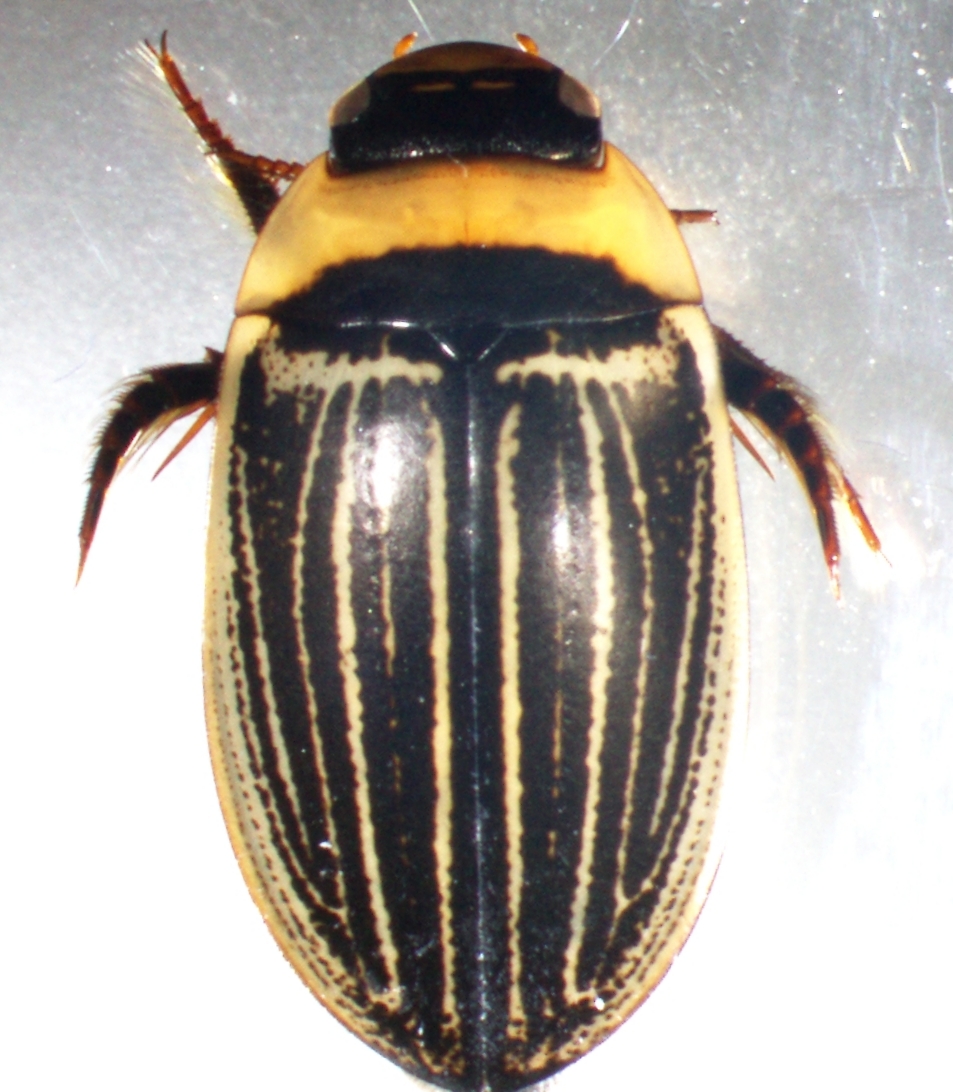
Adults inhabit rainwater pools and muddy buffalo wallows with grassy margins. The elytra bear two bright golden-yellow longitudinal stripes along their lateral sides in the basal half, and large black markings are present on both the elytra and pronotum.
Written 27 November 2026 from the sources listed below. Each statement was checked against the passage it cites; statements that could not be supported were removed.
Appearance
The body shape varies considerably across geographic regions. The head is blackish and may vary in yellow coloration toward the front, while the pronotum is black with narrow yellowish lateral stripes.[1][2][3][4]
The elytra bear two bright golden-yellow longitudinal stripes along their lateral sides in the basal half. Large black markings are present on both the elytra and pronotum.[5][6]
The typical body length ranges from 11.3 to 14.6 mm. In males, the aedeagus lacks a longitudinal ridge near the ventral margin in its apical third when viewed laterally.[7][8]
The posterior margins of the first four hind-tarsal segments have a coarse transverse fringe of flat, appressed, golden-yellow setae.[9]
Habitat
Adults inhabit rainwater pools. They also inhabit muddy buffalo wallows with grassy margins.[10][11]
Classification of the Hydaticus Vittatus
| Kingdom | Animalia |
|---|---|
| Phylum | Arthropoda |
| Subphylum | Hexapoda |
| Class | Insecta (Insect) |
| Order | Coleoptera (Beetle) |
| Suborder | Adephaga |
| Family | Dytiscidae (Diving Beetles) |
| Subfamily | Dytiscinae |
| Tribe | Hydaticini |
| Genus | Hydaticus |
| Subgenus | Prodaticus |
| Species | Hydaticus (Prodaticus) vittatus (Fabricius, 1775) |
Where the Hydaticus Vittatus is found
Checklists and occurrence records place Hydaticus (Prodaticus) vittatus in 10 countries across Asia. GBIF holds 189 georeferenced records of it.
Countries
- China 8
- Hong Kong 9
- India 13
- Indonesia 26
- Japan 83
- Malaysia 3
- Nepal 9
- Sri Lanka 6
- Taiwan 19
- Thailand 13
Regions and cities with the most records
- Taiwan, Taiwan 6
- Bao'an Centre, China 3
- Houhai, China 3
- Nantou, China 3
- San Tung Chung Hang, Hong Kong 3
- Shahe, China 3
- Shekou, China 3
- Shenzhenwan, China 3
- Tung Chung, Hong Kong 3
- Wushipai, China 3
1 more country has a few records outside this range
These countries hold a few records of Hydaticus (Prodaticus) vittatus but lie outside the range the checklists give for it. Such records are often zoo or garden specimens, museum material or vagrants, so the species is not counted as occurring there.
Range as the checklists state it
Southern Asia
A number beside a place is its count of GBIF occurrence records. A place without a number comes from a checklist alone. Records show where a species has been observed or collected, which can include escapes and vagrants.
Common names
English
- Hydaticus Vittatus
Names in 3 other languages
- Chinese
- 單斑龍蝨, 黃紋麗龍蝨
- Japanese
- オキナワスジゲンゴロウ
- Korean
- 노란줄물방개
Synonyms
2 other scientific names have been used for this species and are now treated as synonyms of Hydaticus (Prodaticus) vittatus.
- Hydaticus vittatus angustulus Régimbart, 1899
- Hydaticus vittatus vittatus (Fabricius, 1775)
Related species
-
 Hydaticus PacificusHydaticus (Prodaticus) pacificus
-
 Hydaticus (Hydaticus) aruspex
-
 Hydaticus (Prodaticus) luczonicus
-
 Hydaticus RicinusHydaticus (Prodaticus) ricinus
- Hydaticus (Hydaticus) piceus
- Hydaticus FabriciiHydaticus (Prodaticus) fabricii
-
 Hydaticus (Hydaticus) seminiger
- Hydaticus (Prodaticus) incertus
Compare
Questions and answers
What is the scientific name of the Hydaticus Vittatus?
The scientific name of the Hydaticus Vittatus is Hydaticus (Prodaticus) vittatus. Written with its author, the full name is Hydaticus (Prodaticus) vittatus (Fabricius, 1775).
Which family does the Hydaticus Vittatus belong to?
Hydaticus (Prodaticus) vittatus belongs to the family Dytiscidae, in the order Coleoptera and the class Insecta.
Where is the Hydaticus Vittatus found?
Checklists and occurrence records place Hydaticus (Prodaticus) vittatus in 10 countries, including Japan, Indonesia, Taiwan, India, Thailand and Hong Kong.
How large is Hydaticus vittatus?
The typical body length ranges from 11.3 to 14.6 mm.[8]
Sources
Passages the profile rests on
- The beetle has a highly variable body shape across geographic regions. Source passage: “The beetle has a highly variable body shape characterized by geographic variations” — English Wikipedia
- The head is blackish and may vary in yellow coloration toward the front. Source passage: “The head is blackish, becoming variably yellow anteriorly.” — English Wikipedia
- The pronotum is black with yellowish coloration along its sides. Source passage: “The pronotum is also black, but yellowish laterally.” — English Wikipedia
- The yellow lateral stripes on the pronotum are narrow. Source passage: “The yellow stripes on the lateral sides of the pronotum are narrow.” — English Wikipedia
- The elytra bear two bright golden-yellow longitudinal stripes along their lateral sides in the basal half. Source passage: “The elytra have two bright golden yellow longitudinal lateral stripes in the basal half.” — English Wikipedia
- Large black markings are present on both the elytra and pronotum. Source passage: “Large black markings occur on the elytra and pronotum.” — English Wikipedia
- In males, the aedeagus lacks a longitudinal ridge near the ventral margin in its apical third when viewed laterally. Source passage: “In males, the aedeagus in lateral view lacks a longitudinal ridge near the ventral margin in the apical third.” — English Wikipedia
- The typical body length ranges from 11.3 to 14.6 mm. Source passage: “with a typical body length ranging from 11.3 to 14.6 mm.” — English Wikipedia
- The posterior margins of the first four hind-tarsal segments have a coarse transverse fringe of flat, appressed, golden-yellow setae. Source passage: “The posterior margins of the first four segments of hind tarsi are transversely lined with a coarse fringe of flat, adpressed, golden-yellow setae.” — English Wikipedia
- Adults inhabit rainwater pools. Source passage: “Adults are inhabited in rain water pools,” — English Wikipedia
- Adults inhabit muddy buffalo wallows with grassy margins. Source passage: “muddy buffalo wallows with grassy margins,” — English Wikipedia
- Two subspecies are identified for this species. Source passage: “Two subspecies identified.” — English Wikipedia
- One identified subspecies is Hydaticus vittatus angustulus Régimbart, 1899. Source passage: “Hydaticus vittatus angustulus Régimbart, 1899” — English Wikipedia
- One identified subspecies is Hydaticus vittatus vittatus (Fabricius, 1775). Source passage: “Hydaticus vittatus vittatus (Fabricius, 1775)” — English Wikipedia
Data
- Catalogue of Life, 2026-10-16 XR cc by
- Global Biodiversity Information Facility CC BY 4.0
- Wikidata CC0
- GeoNames CC BY 4.0
- Within the Catalogue of Life, this name comes from The Integrated Taxonomic Information System cc0
References
- Nilsson, Anders N. (2001). World Catalogue of Insects, Volume 3: Dytiscidae (Coleoptera).
This species in other databases
Page built on 28 November 2026. See how the catalog is made and all sources and licences.
Cite this page
ScientificNames.org. (2026). Hydaticus (Prodaticus) vittatus (Hydaticus Vittatus). Retrieved November 28, 2026, from https://scientificnames.org/species/hydaticus-prodaticus-vittatus
“Hydaticus (Prodaticus) vittatus (Hydaticus Vittatus).” ScientificNames.org, 2026, scientificnames.org/species/hydaticus-prodaticus-vittatus. Accessed 28 Nov. 2026.
ScientificNames.org. “Hydaticus (Prodaticus) vittatus (Hydaticus Vittatus).” Accessed November 28, 2026. https://scientificnames.org/species/hydaticus-prodaticus-vittatus.
@misc{scientificnames_hydaticus_prodaticus_vittatus_hydaticus_vittatus,
  author = {{ScientificNames.org}},
  title = {Hydaticus (Prodaticus) vittatus (Hydaticus Vittatus)},
  year = {2026},
  url = {https://scientificnames.org/species/hydaticus-prodaticus-vittatus},
  note = {Accessed 2026-11-28}
}